
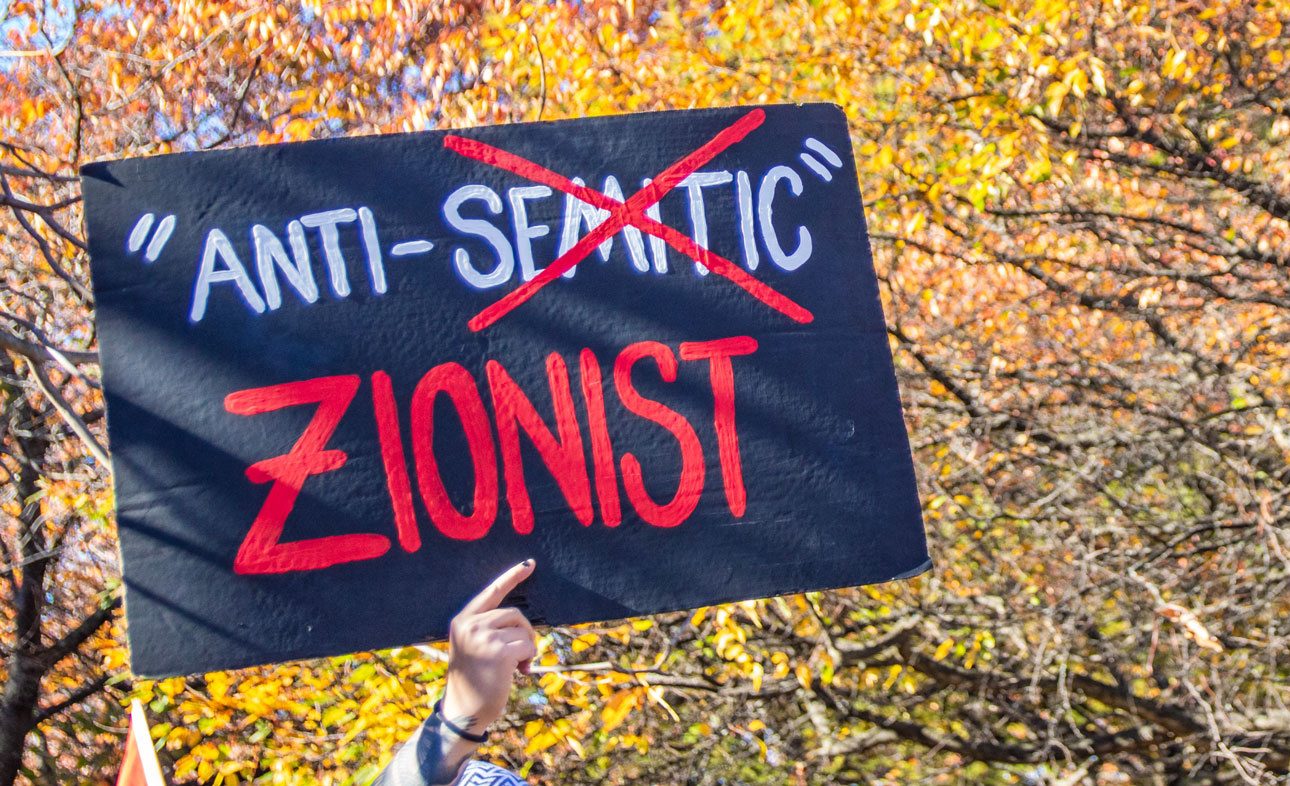
Recent years have seen an upsurge in the United States of antisemitism, Islamophobia, and anti-Arab, particularly anti-Palestinian bigotry. The cause is multifaceted.
White nationalism and xenophobia are major components of the MAGA movement and promoted by the current occupant of the White House. Pres. Donald Trump has brought antisemites and Islamophobes into his administration and pursued bigoted policies.
Antisemitism and Islamophobia have also been exacerbated by the horrors taking place in Israel-Palestine. The atrocities committed against civilians on October 7, 2023, by Hamas led many to wrongly vent their anger at Muslims, Arabs, or Palestinians more generally. And the ensuing murderous Israeli assault on Gaza, killing more than 70,000 people, mostly civilians, done in the name of a country calling itself the Jewish state, with many on all sides equating Judaism and Zionism, led many to wrongly vent their anger at Jews as Jews. With many American Jews and Palestinians having relatives in the region, it is not surprising that tensions are high.
Complicating matters further, partisans often find it advantageous to weaponize charges of bigotry against their opponents to promote their favored cause. In many jurisdictions in the United States, among them New Jersey, Israel advocates have sought to use legislation to restrict the bounds of permissible debate by declaring various statements about Israel to be antisemitic.
The growing spread of bigotry is a serious problem, one calling for serious journalistic analysis. But given the deep passions involved, it is crucial that this analysis be careful, sober, balanced, and well-sourced. Understandably, the time constraints on reporting breaking events sometimes make it difficult to maintain these standards, but for an in-depth background investigation, these standards are essential.
On December 22, 2025, the Star Ledger and NJ.com ran an article of over 4,000 words on antisemitism in New Jersey titled “N.J. Jews are living in fear. How unthinkable hate became the ‘new normal.’” The authors, Jeff Roberts and Matthew Enuco, explained that the article was part of a six-month investigation—so this was no rush job. The next day, a 1,200-word article by Jeff Roberts appeared headlined “Jewish students feel unwelcome—and under attack—at N.J. colleges. The FBI is paying attention.” And then on March 17, 2026, Matthew Enuco wrote a 2000-word piece on the town of Teaneck entitled “Paradise Lost? A N.J. town was once ‘the Emerald City.’ Now it’s an epicenter for hate.”
The Star Ledger was the largest circulation newspaper in New Jersey until it ceased print publication in 2024. Today, its online presence, NJ.com, has 1.5 million Facebook followers and is “New Jersey’s largest newsroom and website, affiliated with 12 local newspapers.” The Ledger and NJ.com are published by NJ Advance Media (hereafter NJAM).
The three articles in the NJAM antisemitism series illustrate how journalistic standards can be violated in pursuit of a one-sided agenda. The articles do not attempt balance in their sources. Many inflammatory statements are poorly sourced, or not sourced at all. Needed context is frequently missing.
Although the fourth estate is supposed to serve as the public square where citizens can debate the issues of the day, the Star Ledger does not accept letters to the editor. Op-eds responding to the series have been turned down (information from Rich Siegal and Paula Rogovin), and indeed the only op-ed published in response to the series was by one of the most partisan voices cited in the series who, unsurprisingly, gave the series high praise.
The main thesis of the series is stated in the first article:
… a climate of fear has engulfed the Garden State, casting a pall over Jewish communities. The surge of hate that began in the years before the COVID-19 pandemic exploded during the war in Gaza in a tidal wave of intimidation, harassment and threats.
It has been fanned by far-left leaders, Gen-Z influencers and social media, often under the guise of criticism of Israel, its foreign policy and the plight of Palestinian civilians, NJ Advance Media has found in a six-month investigation.
There are four different ways in which the series distorts reality. First, incidents that are not aimed at Jews or Zionists or Israelis at all are falsely portrayed as antisemitic. Second, antisemitic acts that are carried out by people having no connection to the left are presented as if they in fact have such connections. Third, actions that are aimed at Israel’s crimes are said without evidence to be really aimed at Jews. And fourth, the series relies on highly partisan or unidentified sources to substantiate its most inflammatory charges. The aim in this article will be to show the journalistic malpractice in the series, not to offer a complete counter-narrative.
1. Exaggerating antisemitism
The NJAM series reports “The fear is real in Teaneck’s Jewish community. In March 2024, a security guard was assaulted at a Jewish high school.” The link provided is to an article in the Daily Voice. But that article says the following: The suspect, Nakieme Murphy,
entered Hiechal HaTorah High School on Sterling Place just after midnight Sunday, March 24, said Teaneck Police Chief Andrew McGurr.
Murphy refused to leave and was being escorted to an exit when he punched the officer, the chief said.
Security staff and event attendees subdued Murphy and held him for police. They charged Murphy with simple assault and criminal trespassing and released him on a summons pending a court hearing.
***
McGurr said police interviewed several people involved and haven’t been able to substantiate social media posts that Murphy made anti-Semitic remarks during the incident.
Now of course, later evidence may show that the suspect did make antisemitic remarks, but NJAM gives no source for any such claim. And both NorthJersey.com (not to be confused with NJ.com) and StopAntisemitism state the following: “Teaneck police also said they are aware of social media posts that allege the trespasser was making antisemitic remarks during the incident. The remarks have not been reported by the complainants or substantiated by the investigation, officials said.” (On the other hand, the ADL stated “An individual illegally entered a Jewish school during Purim, attacked a security guard and made antisemitic remarks,” but gives no source.)
Another incident cited by NJAM is that “Last fall, a rabbi from Keter Torah was attacked in nearby Bergenfield.” But NJAM didn’t report that after the suspect was arrested, the police held a news conference. “After reviewing surveillance footage and investigating, they concluded the attack was not a hate crime.”
An NJAM article that was not part of the series continued the pattern. Headlined “Jews feel less safe, survey finds. Why AI is partly to blame,” and published on Feb. 10, 2026, the piece by Ted Sherman (a contributor to the antisemitism series and who links to it) mostly summarizes a survey on antisemitism by the American Jewish Committee. But it begins this way:
The violent attacks, some deadly, play out across the country.
A rock thrown through the window of a bus carrying Jewish school kids from Teaneck, fracturing the skull of an eight-year-old girl.
The article thus clearly implies that this was a serious antisemitic bias incident, the lead example in a story about the lack of Jewish safety. But NJAM’s own account of the bus incident the month before (to which Sherman’s article links) quoted Mark J. Schwartz, the mayor of Teaneck, saying, “There’s no indication it’s a bias crime. At the same time, it was a slow-moving bus off a ramp with visibly Jewish kids inside.” The mayor went on: “We don’t want to rush to make accusations of antisemitism or racism. But because of the times we’re in and the fact that was a Yeshiva bus with visibly Jewish kids, we’re treading carefully.” And NJAM’s follow-up story on January 10 reports that the perpetrator has been caught: an unhoused man who had been involved in previous rock-throwing incidents. Another report quoted the police as saying that there were no markings on the school bus indicating that it was carrying Jewish children. Accounts of the detention hearing make no mention of antisemitic intent and suggest that the suspect had severe mental issues, with the prosecutor stating that the suspect told them the bus “was the devil or his enemy.”
Antisemitism, of course, is frighteningly real. But for the NJAM series to spread unsubstantiated or false incidents of it does not add to Jewish safety.
2. Attributing right-wing actions to the left
The first article of the NJAM series says that the horrific antisemitic killings in Jersey City in 2019 were carried out by an individual who “followed the far-left teachings of anti-Jewish influencers, including the hate group the Black Israelites.” But there is nothing about the killers or the Black Hebrew Israelites (their actual name) linking them to “far-left” teachings. Some of their sects are antisemitic and homophobic. Neither the Anti-Defamation League (ADL), nor the Southern Poverty Law Center, nor the George Washington University Program on Extremism have claimed that the attackers were on the left.
The series mentions several other terrible acts of antisemitism: an attempted firebombing of a Bloomfield synagogue, and a “one-man antisemitic crime spree in which an Ocean County resident stabbed an Orthodox man in the chest, carjacked and assaulted a driver, and then ran down two pedestrians in Lakewood and Jackson, later telling police that Jews were ‘the real devils.’” The series does not attribute these incidents to the left—but fails to clarify that there has been no evidence presented suggesting anything to do with the left.
The series states:
Ron Carr, 35, was arrested in 2023 after vandalizing 14 homes “with Nazi symbolism” and burning down a Manchester Township home and damaging three others because he believed ‘the Jews are ruining everything.’” The Manchester man pleaded guilty last year to arson, bias intimidation and other charges and was sentenced to 13½ years in state prison.
Experts refer to this as “the horseshoe effect,” when opposing extremes—in this case, the far-left and far-right—share the same views. It exponentially intensifies political volatility.
But no one on the left “shares” Carr’s apparently pro-Nazi views. When there is antisemitism on the left it comes from wrongly attributing to Jews responsibility for Israel’s crimes, and Carr’s use of Nazi symbolism is used in admiration of that ideology, not as a means of illustrating the repugnance of Israeli policies.
3. Conflating criticisms of Israel with antisemitism
A picture that appears in two of the three NJAM articles in the series well illustrates the problem with conflating criticisms of Israel with antisemitism. The picture shows Teaneck councilwoman Hillary Goldberg. One caption reads: “Teaneck councilwoman Hillary Goldberg has been an active voice against antisemitism. Here she is with half of an Israeli flag that she saved after it was torn and stepped on during an anti-Israel protest in Teaneck in March of 2024.” But a damaged Israeli flag has nothing at all to do with antisemitism. Desecrating the flag is a political statement denouncing the policies of the Israeli government. Yes, many synagogues display Israeli flags. But this was a case where a non-Jewish individual “carrying an Israeli flag walked through a crowd of pro-Palestinian protesters” (despite police efforts to separate protesters and counter-protesters) and had it thrown to the ground. Even the ADL, whose very expansive definition of antisemitism is discussed below, does not include burning or desecrating the Israeli flag as an antisemitic incident. If a demonstrator protesting Russia’s war on Ukraine burned a Russian flag, no one (but a Putin apologist) would consider the act to be anti-Slavic or displaying bigotry against the Orthodox Church. In the United States, the Supreme Court permits one to burn the U.S. flag—doing so does not make one a bigot against the American people. That the NJAM series uses the torn Israeli flag picture to illustrate “an active voice against antisemitism” exemplifies the confusion of antisemitism with criticism of Israel throughout the series.
The series draws heavily on data from the ADL. Once regarded as an important civil rights organization, the ADL has over the years weakened its commitment to civil rights in its effort to defend Israel and its opposition to affirmative action. It has become a highly problematic source of information about antisemitism because it takes the view that, in the words of its CEO Jonathan Greenblatt, “anti-Zionism is antisemitism.” Since October 7, 2023, it has begun to include in its annual Audit of antisemitism “certain expressions of opposition to Zionism.” This means that its data on the incidence of antisemitism is wholly unreliable. Unsurprisingly, their count of antisemitic incidents and particularly those from the left will show a sharp increase, given that it has changed its definition of antisemitism. There has been dissension within the ADL, and some employees have left in protest. In June 2024, Wikipedia reached a consensus that the ADL was “generally unreliable” on the topic of the Israel-Palestine conflict, including “the intersection of antisemitism and the [Israeli–Palestinian] conflict, such as labeling pro-Palestinian activists as antisemitic.”
Note that the problem with the NJAM series is not that it fails to adopt the anti-Zionist position of many critics of Israel, but that it doesn’t inform its readers that the ADL, on whose statistics on antisemitism it relies, has changed its definition of what counts as antisemitism. Nor does NJAM note more generally that the definition of Zionism is contested, as is the status of anti-Zionism. NJAM offers just one view on the relation between anti-Zionism and antisemitism, citing David Zimmermann, senior research fellow at George Washington University’s Program on Extremism, as saying that “Anti-Zionism is just the latest excuse to be antisemitic.” (Zimmerman is the only expert cited in the first article in the series. The GWU Program on Extremism is a rather partisan outfit, directed by Lorenzo Vidino, who was identified by a report in The New Yorker as being connected to various anti-Muslim think tanks, leading several professors to withdraw their affiliation.)
There is a long history of Jewish anti-Zionism, opposition to a Jewish state in Palestine, both before and after the establishment of the state of Israel. And today there are many people—Jews and non-Jews—who reject Zionism. (A recent poll of U.S. Jews shows 37 percent identifying as Zionist; 7 percent as Anti-Zionist; 8 percent as Non-Zionist; 30 percent as None of these; and 18 percent as Not sure / Don’t know.) There are also many Jews who while considering themselves Zionist nevertheless do not consider it antisemitic to oppose Zionism. Moreover, many leading Jewish and non-Jewish scholars have endorsed the Jerusalem Statement on Antisemitism, which holds that “criticizing or opposing Zionism” is not in itself antisemitic, and others have promulgated the Nexus Document, which states that “as a general rule, criticism of Zionism and Israel…should not, as such, be deemed antisemitic.” (See also.)
To determine whether something is antisemitic, the ADL uses the definition of the International Holocaust Remembrance Alliance (IHRA), which provides a set of examples to declare various criticisms of Israel to be antisemitic. Israel supporters have gotten the IHRA enacted into law in many U.S. states and they have been working to push this definition through the NJ State legislature. The NJ.com series should have made clear to its readers that that definition—upon which the ADL relies—is contentious, challenged by the American Civil Liberties Union and other leading civil rights and civil liberties organizations as well as by Jewish organizations such as J Street, the Progressive Israel Network, Bend the Arc, Jewish Voice for Peace, and T’ruah. The claim by Jason Shames, CEO of the Jewish Federation of Northern New Jersey, that the “only people who are opposed to this bill are the ones perpetrating most of the violence and hate speech” is simply false.
One reason for the ADL’s high count of antisemitic incidents is that it has chosen to designate a frequent chant of the pro-Palestine movement—“From the river to the sea, Palestine shall be free”—as antisemitic. Before repeating ADL statistics, a serious journalist would at least let readers know that the characterization of the slogan—which renders antisemitic many demonstrations on behalf of Palestinians—is highly contentious. To many Palestinians—and Jews and others who have protested Israel’s treatment of Palestinians—the slogan, which long predates the existence of Hamas, is “an aspirational call for freedom, human rights and peaceful coexistence, not death, destruction or hate” (Palestinian congresswoman Rashida Tlaib). To these protesters, calling for Palestinian freedom no more implies the expulsion, let alone the extermination, of Jews than the slogan of the U.S. Civil Rights movement—“Freedom Now”—implied the removal of white Americans. It is true that the Palestinian chant does not specify the position of Jews in a free Palestine, but it does not explicitly deny self-determination to anyone, unlike the original 1977 platform of Likud, the political party now led by Israeli prime minister Benjamin Netanyahu, which stated “between the Sea and the Jordan there will only be Israeli sovereignty.” Netanyahu continues to hold this view today.
Consider the slogan “We stand with Israel.” To many Palestinians, at a time when the Israeli state has been engaging in what leading human rights organizations characterize as genocide against the people of Gaza, to “stand with Israel” is to endorse the slaughter of civilians. Many Palestinians find this slogan highly offensive and threatening. Yet no one has suggested legislation declaring this slogan to be anti-Palestinian or Islamophobic.
The slogan “From the river to the sea” has been the subject of much debate and analysis. Among those who reject the claim that the slogan is antisemitic are writers in Jewish publications and respected Jewish commentators. It is inappropriate for journalists to rely on the ADL to identify antisemitism without acknowledging that its assessment of the slogan is highly contested.
The same holds for another Palestinian slogan: “Globalize the Intifada.” The ADL claims this is “generally understood” as a call for “indiscriminate violence against Israel, and potentially against Jews … worldwide.” And many pro-Israel Jews agree. But “intifada” is the Arabic word for “shaking off” oppressors, “uprising,” “rebellion,” or “civilian resistance,” without any implication of Jew-hatred or murder. (Indeed, the Holocaust Museum used the term in its Arabic translation of the Warsaw Ghetto Uprising.) The most prominent use of the term in modern times is to refer to two Palestinian uprisings against Israeli oppression: the First and the Second Intifadas. The first, which began in 1987, was largely nonviolent (“the hallmark of the Intifada, particularly during its euphoric first years, was nonviolent protest.” Wendy Pearlman, Violence, Nonviolence, and the Palestinian National Movement, Cambridge Univ. Press, 2011, p. 102), while the second was an armed uprising. So “intifada” has no necessary connection to violence.
Needless to say, the fact that a slogan is not antisemitic does not mean that its use is strategically wise in terms of winning over supporters. But it is incumbent on journalists when citing antisemitism statistics to clarify what the numbers include.
4. Reliance on highly partisan or unidentified sources to substantiate the most inflammatory charges
a) The Teaneck Council resolution, Oct. 17, 2023
One of the articles in the NJAM series says the following:
Just days after the Oct. 7, 2023 attack [actually, Oct. 17], antisemitic protestors swarmed the Teaneck municipal building accusing the town of being an arm of the Israeli government. Why? It denounced Hamas—a terrorist organization according to the U.S. government—and its assault that left about 1,200 dead and initiated the war in Gaza. Demonstrators shouted, “Gas them, you filthy Jews” and “Go run you dirty Jew bitch, we will get you!” as residents left a town council meeting.
In this paragraph, the protesters as a whole are characterized as “antisemitic,” their motives are described (opposing the denunciation of Hamas), and words they purportedly shouted are reported.
There is a hyperlink provided under the words “denounced Hamas” and “Gas them, you filthy Jews” to a report from CBS New York. But that report never uses the words “gas,” “filthy,” “Jew,” “dirty,” or “bitch.” Nor do these words appear in the accompanying video. One cannot rule out that some demonstrators may have yelled such things, but NJAM provided zero evidence.
There are some other reports of the Oct. 17 demonstration. Similar words are quoted in an ADL report, but that report gives only a single source: the same CBS New York report. So the ADL provides no additional substantiation for the allegation. (This ADL source is cited in the third of the NJAM series.)
Jewish Link covered the same demonstration. This is not a neutral source. One of the Council members who voted in favor of the controversial resolution, Mark Schwartz, is co-publisher of the newspaper (as the article acknowledges). Nevertheless, its lengthy news story never reports the use of the words “gas,” “filthy,” or “bitch.” Indeed, no protester is quoted using the word “Jew” at all.
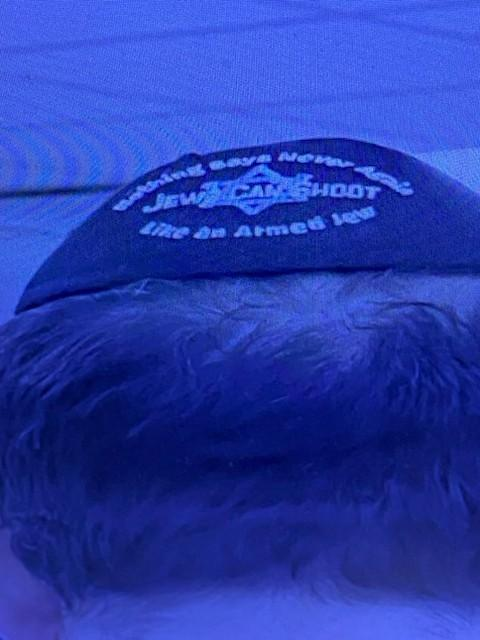
One former Teaneck council member, Keith Kaplan, a highly partisan source (he wore a “Jews Can Shoot” skullcap to a Board of Education meeting on October 18, 2023) is quoted as saying “They were screaming, ‘Drop Qassam rockets on Tel Aviv’ in Arabic, and ‘From the river to the sea, Palestine will be free.’” Assuming Kaplan correctly identified the Arabic, the first quote might be condemnable (civilians should never be targeted) but not antisemitic. The second quote has been discussed above.
Kaplan is quoted in the Jewish Link article saying that he “stood outside, … I stood in between the two groups. I wanted to record what they were doing.” But despite the presence of this partisan source recording “what they were doing,” the only video clips accompanying the article offer no evidence of anyone using the words “gas,” “filthy,” or “bitch.”
Hillary Goldberg, in a subsequent op-ed published by NJAM, praised the antisemitism series for having “cited evidence” that these vile comments were expressed, but in fact no substantiation was offered.
Again, one cannot rule out that some individuals may have uttered such words, but this is very different from confirmation that they were said, let alone that these represented the position or views of the demonstrators as a whole.
Turning to the motives of the demonstrators, NJAM portrays them as simply fans of Hamas. NJAM spoke to councilwoman Hillary Goldberg, the author of the resolution that was passed by the Council, but it omitted much crucial context.
First, the resolution did far more than just condemn Hamas. It stated
that the Township of Teaneck stands united with Israel… stands in solidarity with the people of Israel and extend our condolences for the all [sic] lives lost in these attacks; and… supports Israel’s right to defend herself against terrorism.
This was more than a week after Israel had announced on October 9 a total blockade of the Gaza Strip: “We are putting a complete siege on Gaza … No electricity, no food, no water, no gas—it’s all closed.” (Defense Minister of Israel, Yoav Gallant) “We are fighting human animals and we are acting accordingly.” (Gallant) That same day the spokesperson for the Israeli Minister of Energy declared that the water supply to the Gaza Strip would be cut, effective immediately. So the resolution called for standing united with Israel at the very time that Israel was stating its intention to treat Palestinians like animals, and in fact killing large numbers of Palestinian civilians and enacting a siege of a civilian population—war crimes under international law.
The second piece of missing context was that there was another resolution proposed that same evening—a unity resolution—that the Council rejected. That draft resolution stated that “the actions of the terrorist organization Hamas, do not represent the
Palestinian people or the entire Muslim community” but also expressed concern for the suffering of Palestinians (“the death of at least 2,670 people” and wounding of “at least 9,600 people in Gaza where more than half the population are women and children”).
NJAM states in a picture caption that the October 17 demonstrators were “protesting the town council’s pledge of support for the victims and hostages.” But the unity resolution explicitly “calls for the safe return of all innocent hostages currently in captivity.” Being opposed to one-sidedly standing with Israel as it begins its genocide is not the same as protesting support for victims and hostages.
These critical omissions and mischaracterizations might have been avoided if NJAM had spoken to people from the other side—the Muslims, Palestinians, and, yes, Jews, who didn’t believe that standing with Israel was appropriate for the town council. Many spoke critically of the stand with Israel resolution at the Oct. 17 meeting, but none of them were interviewed by NJAM. Seven of eleven members of the town’s Community Relations Board resigned after the unity resolution was defeated. They were not interviewed. Other newspaper coverage of the meeting appropriately quoted supporters of the stand-with-Israel resolution, but quoted as well the resolution’s opponents, comments from the chair of the Community Relations Board, and had no reports of antisemitic chants.
Goldberg told NJAM that she had received various hateful messages.
“We wish that you would burn in the ovens like the Nazis.”
“Stop murdering children in Gaza.”
NJAM then states:
Goldberg is not an Israeli soldier or politician. It makes no difference, the Teaneck public official says.
She’s still a Jew.
The first of the messages she says she had received is clearly repulsive and antisemitic. The second would be antisemitic if it blamed someone for the actions of the Israeli government just because they were Jewish. But if someone introduced and voted for a resolution declaring solidarity with the Israeli government at the very time it was carrying out its murderous response to the October 7, 2023 massacre, while the UN was reporting that “as of 16 October … 47 entire families have been killed, amounting to about 500 people,” then berating them for ‘murdering children in Gaza’ would be intemperate, exaggerated, but not antisemitic.
Perhaps Goldberg became the subject of much controversy not because she was a Jew but because she authored a resolution expressing solidarity with a government carrying out humanitarian crimes. Perhaps many (including Jews) were critical of her for claiming that those who chanted “From the river to the sea” were expressing genocidal views. Perhaps many (including Jews) were highly critical of her for urging the banning of a high school student walkout in November 2023 in support of Palestine and then standing across the street filming the highschoolers. (The walkout was not discussed in the NJAM series; the Bergen County Jewish Action Committee and the Rabbinical Council of Bergen County had demanded that what they called “this libelous and hateful protest,” “this grotesque and overt antisemitism,” be prohibited.” Rep. Josh Gottheimer, D-NJ, CD 5, a source for the NJAM series, urged the federal Dept. of Education to investigate discrimination at the high school.) But NJAM never interviewed a single Goldberg critic. The journalists were apparently happy to accuse her critics of being antisemites without talking to a single one of them.
Any hateful antisemitic emails that were sent to Hillary Goldberg and other Israel supporters are, of course, condemnable. As anonymous communications we don’t know how many people sent these or the senders’ political orientation. NJAM notes that:
Certainly, white supremacists have also leveraged tensions to fan antisemitism, according to the New Jersey Office of Homeland Security and Preparedness. In May, for instance, a neo-Nazi Telegram channel encouraged followers to use pro-Palestinian protests as a cover to carry out “extreme activities” against Jews, according to the agency.
Death threats and other hateful emails have also been sent to pro-Palestine individuals, including to the student participants in the pro-Palestine high school walkout. A responsible journalistic account of online hate in Teaneck or elsewhere in New Jersey would have made clear, with diverse interviews, that the phenomenon does not only target Jews.
b) The Teaneck Zaka protest, end of March 2024
Another example used by NJAM to make it seem as if pro-Palestine demonstrators wanted to dishonor the Oct. 7 victims and the hostages is a March 31, 2024, protest described this way in the series article on Teaneck: “a heated protest broke out at a ceremony honoring Oct. 7 victims hosted by ZAKA—a search-and-rescue agency providing humanitarian assistance after disasters in Israel.”
But when one checks NJAM’s hyperlinked source one finds an article from NorthJersey.com (again, not to be confused with NJ.com) that provides some evidence regarding the motivation of the demonstrators that NJAM did not see fit to mention. A participant from the pro-Palestinian side—Sarah Elm from Passaic County—was quoted saying “The hostages need to be freed, but we are calling for an end to the murder of Palestinian people. Thirty-three thousand Palestinians have died at the hands of Israel. The genocide needs to end.” NJAM did not follow up with Ms. Elm, nor did they quote any of the demonstrators.
But why protest a humanitarian rescue organization? What NJAM doesn’t explain is that ZAKA’s status as a humanitarian organization is highly contested. As stated in a social media post from some of the organizers behind the demonstration: “While they’re being hailed as heroes, ZAKA’s false claims and fabricated evidence have fueled genocide in Gaza. Let’s ensure truth prevails and justice is served.”
And sure enough, the allegation that ZAKA officials promoted false atrocity stories had been confirmed at the time of the demonstration. This doesn’t mean that there were no Hamas atrocities on October 7—there certainly were many. But some of ZAKA’s most grisly stories, stories of babies burned in ovens and beheaded, were simply false, yet spread by the Israeli government to build public support for its terrible crimes against the people of Gaza (see here, here, here, and here; and later, here and here). In an interview with the Israeli news site Ynet, Nitzan Chen, the director of the Israeli government press office, said, “It’s hard for me to see the Israeli public relations activities with the foreign correspondents without the amazing, significant and effective activity of the ZAKA people.” (Google translate; see also for another translation). For another Journalists distributed the false stories and, for a while, even President Biden repeated them.
The issue, of course, is not whether or not ZAKA should have been protested, but whether NJAM should have let its readers know that there might have been reasons to protest “a search-and-rescue agency providing humanitarian assistance,” reasons other than antisemitism.
c) Fort Lee, November 2023
On November 5, 2023, a “Rally for Israel” was organized by Young Israel of Fort Lee and several other synagogues. Not surprisingly, a rally supporting Israel when in just that month its military had killed more than 8,000 Gazans—a toll greater than the total number of Israeli Jews, civilian and military, killed by Palestinians over 75 years—provoked a counter-demonstration.
NJAM states: “The protestors yelled slogans such as ‘Go back to Auschwitz, bitch!’ and called for the removal of ‘Zionists,’ according to a local report.” The words ‘Go back to Auschwitz, bitch!’ are hyperlinked, but the source provided is a story in Jewish Link that never uses the words “Auschwitz,” “bitch,” or “Zionist.”
There is, however, uncited YouTube video of the event that shows (at 3:10) angry protesters yelling and one can make out a single protester shouting (not as part of a chant or a group) appalling antisemitic slogans. This is despicable. We don’t know who this person is or what his political orientation is. And it is certainly legitimate to criticize the demonstration’s organizers for not better marshalling the event. But the vile language is not coming from the organizers or the crowd as a whole. In the meantime, inside the synagogue, Harry Wild, president of the Young Israel of Fort Lee, declared from the podium, “We must remain strong and steadfast during this war. We must fight antisemitism with all means necessary” (at 19-31). Israel supporters frequently consider those last four words to be genocidal when uttered by pro-Palestinian demonstrators.
d) Teaneck, Real Estate Offering, March 10, 2024
On March 10, 2024, a synagogue in Teaneck, Keter Torah, made its space available for a real estate company to showcase property for sale in Israel and in the settlements in the occupied territories. NJAM acknowledges that the Israeli settlements have encroached on Palestinian neighborhoods and “resulted in forced evictions under questionable legal authority, according to the United Nations.” The formulation in the linked UN source is quite a bit stronger:
These evictions form part of a concerted campaign by the Israeli State and settler organizations, which target Palestinian neighborhoods to seize Palestinian homes and expand Jewish settlements. Such acts violate international law, which prohibits the confiscation of private property in occupied territory and the annexation of such territory, as highlighted by the Advisory Opinion of the International Court of Justice last July. (See also.)
In March 2024, the U.S. government also considered the Israeli settlements to be illegal.
NJAM tells us that Councilwoman Hillary Goldberg “said land was not sold at the event”—as if this rendered the showcase ethically acceptable. But if it’s wrong to sell stolen land, isn’t it also wrong to hold an event facilitating the sale of stolen land, even if the sale wasn’t consummated that day? And are people who think that is wrong automatically antisemitic?
Goldberg also told NJAM that the event was open to the public and that some non-Jews attended. But protesters said that when they called to attend, they were denied entry or asked to name their rabbi or synagogue. And it is hard to believe that Palestinians who have been expelled from their lands over the past 78 years would have been allowed to simply return home by buying property at a real estate sale.
Even when these real estate companies don’t feature West Bank land, their sales are problematic. As one of the realtors explained to the New York Times, “some of the properties … are reserved for Jews only, per Israeli law. ‘When there’s an area where only Jewish people can buy, Arabs don’t want to buy. When there’s an area where Arab people live, their villages, their towns, their cities, Jewish people don’t want to live.”
Another one of NJAM’s sources, Harry Wild, asks “In what world is it OK for (outsiders) to come into Jewish neighborhoods because of what’s happening 6,000 miles away and harassing people on the street here?” Certainly no one should be harassed on the street anywhere, but Israel-critics are no more barred from gathering because of what they see as local complicity with injustice 6,000 miles away than Israel-supporters are barred from gathering to cheer on 6,000-miles-away Israel. There were protesters from Teaneck and protesters who were “outsiders,” non-residents of Teaneck. But the latter had no less right to be in Teaneck than did non-Teaneck supporters of the real estate event, including many of the showcase attendees and Jason Shames and Harry Wild.
Yigal Gross, a spokesman for the Bergen County Jewish Action Committee, called the
demonstration a “cynical attempt to target a religious institution under false pretenses as part of a coordinated and malicious campaign to harass Teaneck’s Jewish community.” But there have been no protests in New Jersey against Jewish religious institutions for their Jewishness. Protests have only taken place when a religious institution has hosted a political event related to the Gaza war or turned over its space to a real estate company to host an event that was seen as contributing to the dispossession and oppression of Palestinians. One may disagree with the protesters, but their focus was Palestine, not Jew hatred. Unmentioned by NJAM, but reported in other press accounts, among those who were denouncing the real estate event were many Jews (see here, here, here, here, and here).
NJAM says that the real estate demonstration “turned violent.” But this characterization is rather hyperbolic. There were angry groups of protesters and counter-protesters who yelled abuse at each other. These were not polite discussions. Some of the language was bigoted. But here’s how other outlets referred to the violence. The Teaneck Daily Voice headline was “Only Two Arrests Made at Trouble-Free Israeli Real Estate Protest in Teaneck, Police Chief Says.” NorthJersey.com reported that “While the protest was largely non-violent, there were some skirmishes.” The New York Times stated that profanities and taunts were traded, and that “police had to break up a few potential fights, but overall they kept the two groups separated.” And the “demonstration ended peacefully, despite extremely high levels of anger.” The more serious of the two arrests involved a protester charged with spraying apparently washable red paint at some cars associated with the real estate event. She was also charged with bias intimidation for this action, despite the fact that there was no indication that she was motivated by antisemitism, especially as there were Jewish pro-Palestine protesters nearby (conversation with protester’s attorney, Joseph A. Fortunato, May 2026).
e) Antisemitism at universities
It is quite appropriate of course for a newspaper to report on a bias incident. But an expansive headline that reads “Jewish students feel unwelcome—and under attack—at N.J. colleges” warrants testimony from more than a single student. And when that lone student is also quoted in another of the NJAM antisemitism series articles and is the only college student to be quoted in any of the series articles, and the student has been a speaker at pro-Israel events, there’s a great deal riding on the testimony of that single individual.
The article quotes the U.S. Department of Education’s Office for Civil Rights (OCR) as stating in January 2025 that Rutgers was found to have “likely operated a hostile environment based on national origin/shared ancestry in university programs or activities.” But when one checks the link, it is to a news article that makes clear—as the NJAM series did not—that the OCR settlement dealt with a hostile environment for both Jews and Palestinians (see also).
There is no doubt that the events of October 7 and the ensuing Israeli attack on Gaza generated many instances of bigotry on all sides. But many of the allegations of antisemitism and reports of a hostile environment were in fact reflections of political disagreements over Israel-Palestine rather than instances of Jew-hatred.
For example, Rep. Josh Gottheimer charged antisemitism because Rutgers part-time faculty voted to call for divesting university funds from Israel. Gottheimer demanded that Rutgers ban particular speakers from a campus event (among them Marc Lamont Hill, who had urged a free Palestine “from the river to the sea”).
A list of over 50 antisemitic incidents at Rutgers compiled by “Jewish leaders on campus” was submitted to a committee of the U.S. Congress. Some of the listed incidents were reprehensible antisemitism (for example, someone yelling “fucking Jew”). But many were not.
After October 7, on various occasions, Jewish students put up posters of hostages that were subsequently torn down. Some were torn down by other students. Some were torn down by university staff who were instructed, as part of their job, to remove all posters (regardless of content) from bus stops.
***
Wednesday, Nov 29: a group of students received permission to have a press conference on the Livingston Campus. About 50 of them ended up walking to the Business School while classes were in session (around 12 pm-2 pm) and stayed there, chanting, for about 20-30 minutes. They left the space and protested outside. After about 30-45 minutes some came back in. This time they were quietly occupying the space. Classes were still going on. They set up a projector to show a documentary in an open lounge. Some individuals remained until the building closed at 10:30 pm.
***
Thursday Dec 7: Event called “Race, Liberation, and Palestine: A Conversation with Noura Erakat, Nick Estes, and Marc Lamont Hill” took place on the Cook/Douglass Campus.
***
A postdoc fellow reported flyers on the doors of the Nelson Biology Laboratories (Allison Road, Piscataway). The flyers listed “University Faculty & Staff killed in Gaza by Israel” and the non-Jewish postdoc felt that these flyers were biased and inappropriate propaganda pieces. She reported it as a bias incident to the university.
The Dept. of Education reported some allegations that, while raising concerns, did not seem to implicate antisemitism. For example,
The complaint alleged that in [redacted content] 2024, a New Brunswick … student wearing a sweatshirt with the Israeli flag at a University Progressive Club student group meeting was told that the club was a Zionist-free space. … During [the University’s] review of the allegation, University Progressive Club members stated that they asked a student not to attend its meetings not because he was wearing a shirt with an Israeli flag, but because the club’s members believed the student previously had attempted to disrupt Pro-Palestinian protests and had recorded its members protesting. The [redacted content] advised the group that they could not prohibit anyone from attending open organization meetings.
In another example, some Jewish students complained that they were prohibited from entering a pro-Palestine encampment to record individuals who were participating (p. 8).
There has been much coverage of the hostile environment for many Jewish students at universities. But NJAM—like many other outlets—has given little attention to the corresponding environment for pro-Palestinian Jews, or for Palestinian, Arab, or Muslim students. Consider two universities that have been the focus of much reporting in the past two years, Columbia and Harvard. Surveys of student opinion have been conducted at both institutions. Despite their methodological limitations they each provide some useful information.
At Columbia, while only 10 percent of students overall reported experiences of discrimination based on their religion, 53 percent of Jewish students and over 40 percent of Muslim students reported this experience (p. 7). Among Jews, 39 percent said they would be somewhat or very uncomfortable reporting discrimination; among Muslims it was higher at 54 percent (p. 8). Most Jews (87 percent) of Jews felt concerned about expressing their views as did 82 percent of Muslims (p. 9).
Most Jewish students (69%) felt in danger because of their expressed support for any side in the conflict, as did most Muslim (65%) students. But significantly, the Jewish figure of 69 percent includes 9 percent who felt in danger for supporting Palestine and 7 percent who expressed support for both (p. 16). Of the Jews who participated in any marches or protests on campus related to Israel-Palestine, about 70 percent supported Israel and 30 percent Palestine (p. 15). While 3 percent of all Columbia students participated in the tent encampment, 4 percent of Jews did so (p. 17).
Harvard was another focus of national attention. The Harvard Task Force on Antisemitism and Anti-Israel Bias conducted a survey of student opinion and found: “In virtually every category, Jewish students reported more negative experiences than their Christian or atheist/agnostic peers, though Muslim students reported even greater negative experiences than Jewish students” (p. 26; see also).
As the Harvard Crimson reported:
Fifty-six percent of Muslim and 26 percent of Jewish student respondents reported feeling physically unsafe on campus—a figure significantly higher than the 12 percent of Christian and 8 percent of atheist or agnostic students who felt similarly.
Meanwhile, 92 percent of Muslim and 61 percent of Jewish respondents, including faculty and staff as well as students, feared academic and professional repercussions for voicing their personal or political opinions—compared to 59 percent for all respondents.
The Task Force further found that “Some Jewish students who identify as anti-Zionist report the same sort of bullying and shunning that other Jewish students describe encountering from pro-Palestinian students” (p. 27). One Jewish student told the Task Force “The largest form of antisemitism I have experienced has been from other Jewish students who are interested in policing the bounds of Jewish identity one way or the other” (p. 133).
The NJAM series did not interview or cite or refer to a single university student who was Palestinian, Muslim, or a Jew with a critical view of Israel. NJAM tries to convey an image of the atmosphere on university campuses, but it gives a rather distorted view. Yes, there were swastikas drawn, eggs thrown, anonymous threatening posts. But the Rutgers Center for Islamic Life was vandalized, causing more than $19,000 in damage—unmentioned in the NJAM series. All these are part of the atmosphere.
One person NJAM might have interviewed but did not was a Jewish distinguished professor and former dean and provost at Rutgers, Todd Clear. In an op-ed, he wrote:
Every crowd engaged in protest, from the days of Civil Rights and Vietnam, contains some individuals whose actions discredit the ethics of the mass. We know this was true at Rutgers. We also know that the students at the encampment (many of whom were Jewish) made signs proclaiming, “No Antisemitism, No Islamophobia,” served bagel brunches, and held Shabbat services.
***
Nobody would say that a person who is opposed to Hamas as a political entity “hates” Palestinians. That is absurd and illogical. It is equally so to equate opposition to the state of Israel—or a political ideology undergirding it—with hating Jews. We can do better.
***
In the entire three-part series on antisemitism, NJ Advance Media hardly refers to the opinion of a single Muslim. Former NJ assemblywoman Sadaf Jaffer, a Muslim, is referenced, but indirectly and incorrectly. In discussing public testimony regarding the IHRA bill before the legislature, NJAM writes:
Opponents, including former Assemblywoman Sadaf Jaffer, disputed the definition because it accepts Israel as a Jewish state, the New Jersey Monitor reported.
But Jaffer’s objection was not that IHRA accepted Israel as a Jewish state, but that it required everyone to accept Israel as a Jewish state. As the NJ Monitor actually stated: “Sadaf Jaffer, a former assemblywoman, testified against the bill, saying it wrongly requires New Jerseyans to accept Israel as a Jewish state…. ‘How is that different from requiring all New Jerseyans to accept Iran as an Islamic Republic or the U.S. as a Christian nation? These kinds of ideological tests are absurd and dangerous,’ Jaffer said.”
But it’s not just Muslims, Arabs, and Palestinians whose views NJAM ignores. It also fails to interview a single Jew with a different point of view from that expressed by Rep. Gottheimer or Councilwoman Goldberg.
In these times of great political tension, with polarized views, careful reporting can serve a valuable public purpose. But one-sided reporting, that interviews only one side, that exaggerates antisemitism, that attributes right-wing antisemitism to the left, and that conflates criticisms of Israel with antisemitism, does not meet its journalistic responsibility. Nor does it help us address the real problem of antisemitism.
Thanks for valuable conversation and comments to Jon Moscow, Adam Weissman, and Emily Filardo. None of these people are responsible for my errors or interpretations.

Stephen R. Shalom (born September 8, 1948) is professor emeritus of political science at William Paterson University in NJ. Among other topics, he writes about U.S. foreign policy and political vision. He is on the editorial board of New Politics and a member of Jewish Voice for Peace and the Real Utopia network.
ZNetwork is funded solely through the generosity of its readers.
Donate

