
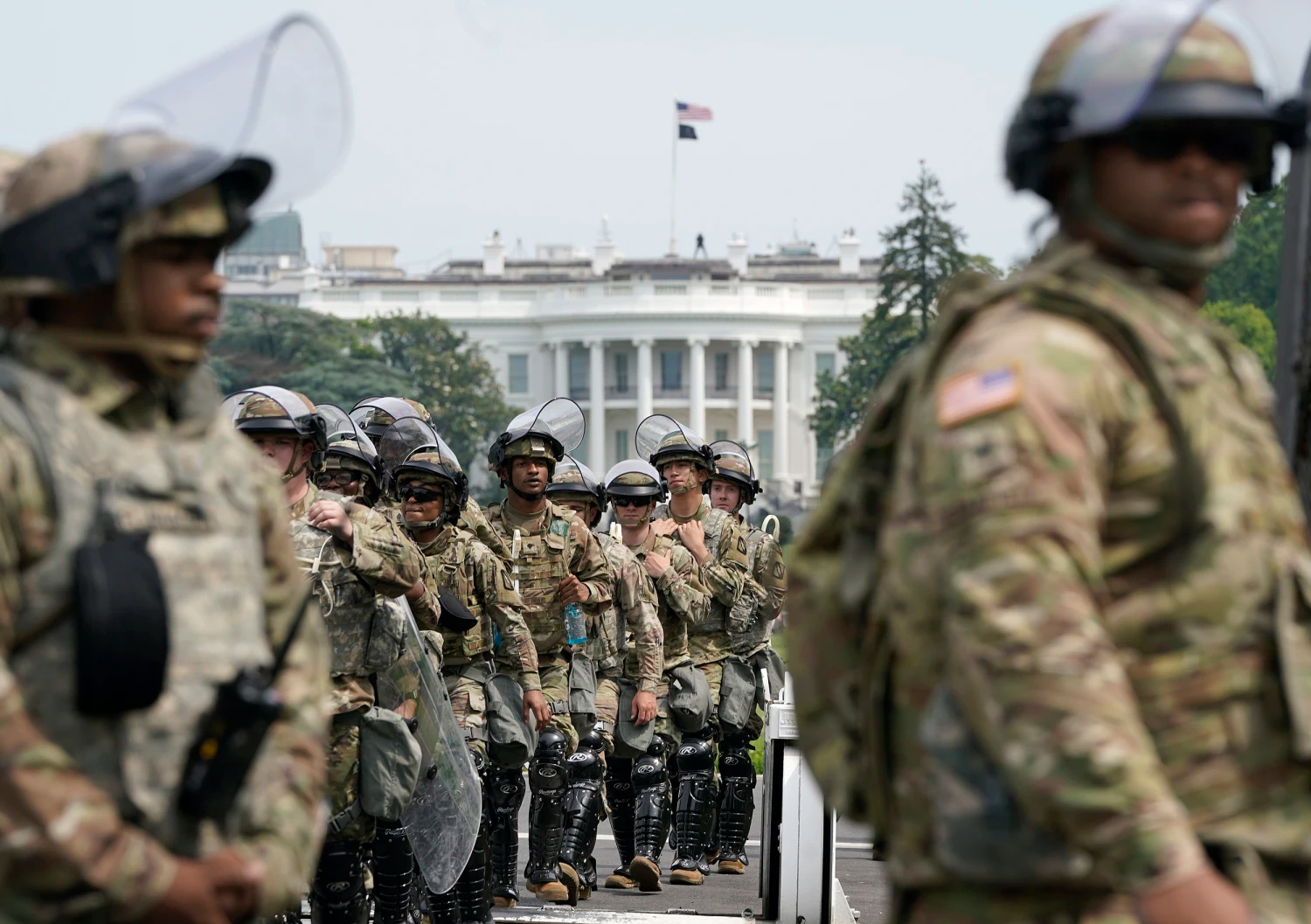
Donald Trump’s takeover of Washington, D.C., the building of Alligator Alcatraz, and ICE’s gestapo tactics have reignited discussion surrounding Aimé Césaire’s work, particularly his outlining of the “boomerang effect.” The violence and authoritarianism the US has imposed on much of the world seems to be creeping back towards the imperial core. For Césaire, this is the inevitable result of an imperialist capitalist system. As he wrote in Discourse on Colonialism, “At the end of capitalism, which is eager to outlive its day, there is Hitler.” Of course, Trump’s fascism is unique. As Robert Paxton has noted, unlike Trump, “Mussolini and Hitler had no desire to leave economic, social, or environmental matters to unchecked market forces.” This difference largely defines Trump’s fascist project. But just like twentieth century fascism, Trump’s agenda was first experimented with in the developing world.
As Césaire noted, the racialized assumptions of colonialism were extremely self-serving: “Before the arrival of the French in their country, the Vietnamese were people of an old culture, exquisite and refined. To recall this fact upsets the digestion of the Banque d’Indochine.” Similarly, after the US acquired the Philippines following the Spanish American War, William McKinley purportedly concluded through prayer, “There was nothing left for us to do but to take them all, and to educate the Filipinos and uplift them and Christianize them.” Of course, most Filipinos were practicing Catholicism already. Without specifying whether this also came to him in prayer, McKinley, in justifying the US war against Philippine revolutionaries, urged people to consider “the commercial opportunity, to which American statesmanship cannot be indifferent.”
While the US today acknowledges a civilian death toll for the Philippine American War of around 200,000, on the largest island of Luzon alone, US General James Franklin Bell, who led troops in the war, guessed possibly 600,000 people died. On the island of Samar, Colonel Jacob Smith, ordered his soldiers to kill anyone over the age of ten, saying, “I wish you to kill and burn. The more you kill and the more you burn, the better you will please me.” Paternalism and brutality would characterize US imperialism for decades on end. Racist imperial hubris could be heard when Woodrow Wilson’s secretary of state William Jennings Bryan said of Haitians, “Dear me…think of it, N****** speaking French,” as US marines killed 15,000 Haitians and Haitian economic policy was effectively handed over to the president of the US. One hundred years later, after one million Iraqis had been killed following a US intervention that paved the way for US oil companies to operate within the country, then retired US Army lieutenant general Michael Flynn told Fox News, “I’ve been at war with Islam, or a component of Islam, for the last decade.”
Beginning on September 11, 1973, US intervention took on a particular form. On that day, the Chilean Army, led by Augusto Pinochet, overthrew democratically elected Salvador Allende with US support. US Navy ships were in Chilean waters and US planes flew the skies monitoring events. Henry Kissinger said after the coup, “I think we should understand our policy—that however unpleasant they act, [this] government is better for us than Allende.” Officially 3,065 people were killed and another 40,000 tortured. On the fortieth anniversary of the coup, Amnesty International released a report that said of Leila Pérez, a torture victim, the first time she “felt the sear of a cattle prod it was at the hands of a Chilean soldier. She was a 16 year old high school student, used as a guinea pig to help Pinochet’s security services hone their skills in torture. They didn’t even bother to ask any questions.” Five days later, Pérez was released in clothes worn by people she had seen killed in them.
While US-based corporations like Anaconda Copper and ITT had millions to gain, Chile’s ultimate purpose would be as a testing ground for neoliberalism. Beginning in 1956, the State Department funded the expenses and tuition of Latin American students of economics to travel to Chicago to be personally educated by neoliberal economist Milton Friedman. Prior to the coup in Chile, a number of these so-called “Chicago Boys,” with CIA assistance, drafted a 300-page free-market economic plan, implemented by Pinochet after he took power. Many labor unions were banned, labor laws were suspended, and strikes were prohibited. Health-care spending was cut by 40%, public housing by 60%, and education by 73%. The number of state-owned enterprises fell from 596 in 1973 to just 48 seven years later. Friedman would call the result of the polices the “Miracle of Chile,” citing economic growth in the early years, despite horrific human-rights violations. But between 1969 and 1989, poverty increased from 28.5% to 42%, with extreme poverty increasing from 9% to 12%.
In 1979, the US felt the first effects of the free market boomerang. That year to curb inflation, Jimmy Carter’s chairman of the Federal Reserve, after declaring “the American standard of living must decline,” began a drastic increase on interest rates which ballooned to 20% by 1981. By the end of the twentieth century, workplace safety regulations were gutted, free trade agreements allowed manufacturing to leave the US, welfare was slashed, and taxes on the very rich were cut. Friedman played a direct role in this as an unofficial advisor to the Reagan administration. The result was that between 1978 and 1999, the top 0.1% of income earners’ share of the national income increased from 2% to 6% and the ratio of the median income of workers to the salaries of CEOs between 1970 and 2000 increased from 30 to 1 to 500 to 1.
This was paired with the state’s expanded capacity for violence, replete with a uniquely massive prison system teaming with individuals caught up in the government’s racist War on Drugs, racialized police violence, and militarized police forces. Neoliberalism’s most egregious policy of the twenty-first century took place in response to the financial crisis of 2008 when the government offered a $700 billion bailout to banks that were actively foreclosing on four million homes. This happened amidst the War on Terror, which included the development of a mass surveillance apparatus, warrantless wiretappings, watchlists, and assassinations of US citizens.
It was with Trump, however, that state violence in defense of a neoliberal agenda came to be openly embraced. Gavin McInnes, founder of the Proud Boys, has called himself a “libertarian” and has decried regulatory Democratic policies, saying “We can’t have the DNC deciding how big companies behave.” He has also stated, “I don’t want our culture diluted. We need to close the borders now and let everyone assimilate to a Western, white, English-speaking way of life.” During Trump’s first term, billionaires in the US got $1 trillion richer. Still, on January 6, 2021, members of the Proud Boys along with other far right militias, stormed the Capitol attempting to prevent the counting of electoral votes.
The crux of Césaire’s claim is that the ideas of fascism, its dehumanizing rhetoric and violent practices, are colonial in origin. For example, he writes that “it was already Hitler speaking” when colonizers voiced that it was “lawful to apply to non-European peoples ‘a kind of expropriation for public purposes’ for the benefit of nations that were stronger and better equipped”. The unique anti-democratic, repressive, and yet neoliberal agenda unfolding in the US today could also be detected in the words of neoliberal imperialists. Gary Becker, another Chicago University economist, in 1977 praised Chicago Boys who were his students, for their “willingness to work for a cruel dictator and start a different economic approach” noting that it was “one of the best things that happened to Chile.”
Since taking office, Trump has axed USAID, the Corporation for Public Broadcasting, and set in motion the phasing out of the Department of Education. At the same time, describing bright fluorescent lights kept on at night, limited opportunities to shower, and being crammed in a cage with 32 other people, one detainee told NBC News about being held in Alligator Alcatraz, “I feel like my life is in danger”, saying of his condition that he is living “in a state of torture.” Trump’s Big Beautiful Bill (BBB) will cut an estimated $1 trillion from Medicaid and the Children’s Health Insurance Program, while continuing the 2016 Trump tax cuts. But it will also increase the Immigration and Customs Enforcement budget to the point that they will now be the most funded federal law enforcement agency.
At one National Security Council meeting, prior to the 1973 coup, Kissinger famously quipped, “I don’t see why we need to stand by and watch a country go communist due to the irresponsibility of its own people.” A similar rationale went into Trump’s deployment of federal agents to Portland in 2020. Then acting secretary of homeland security Chad Wolf mostly cited graffiti perpetrated by “violent anarchists.” Today, six Republican-led states have sent National Guard troops to Washington, D.C., where hundreds of arrests have been made in a city experiencing a thirty year low for violent crime. The agenda this crackdown on democracy is defending is a neoliberal one, first experimented with in Chile. This is an agenda that has been openly embraced by supporters of Trump. As far back as 2017, Proud Boys have been seen wearing shirts that read, “Pinochet Did Nothing Wrong.” The boomerang has been thrown. We are now simply experiencing its return.
ZNetwork is funded solely through the generosity of its readers.
Donate