
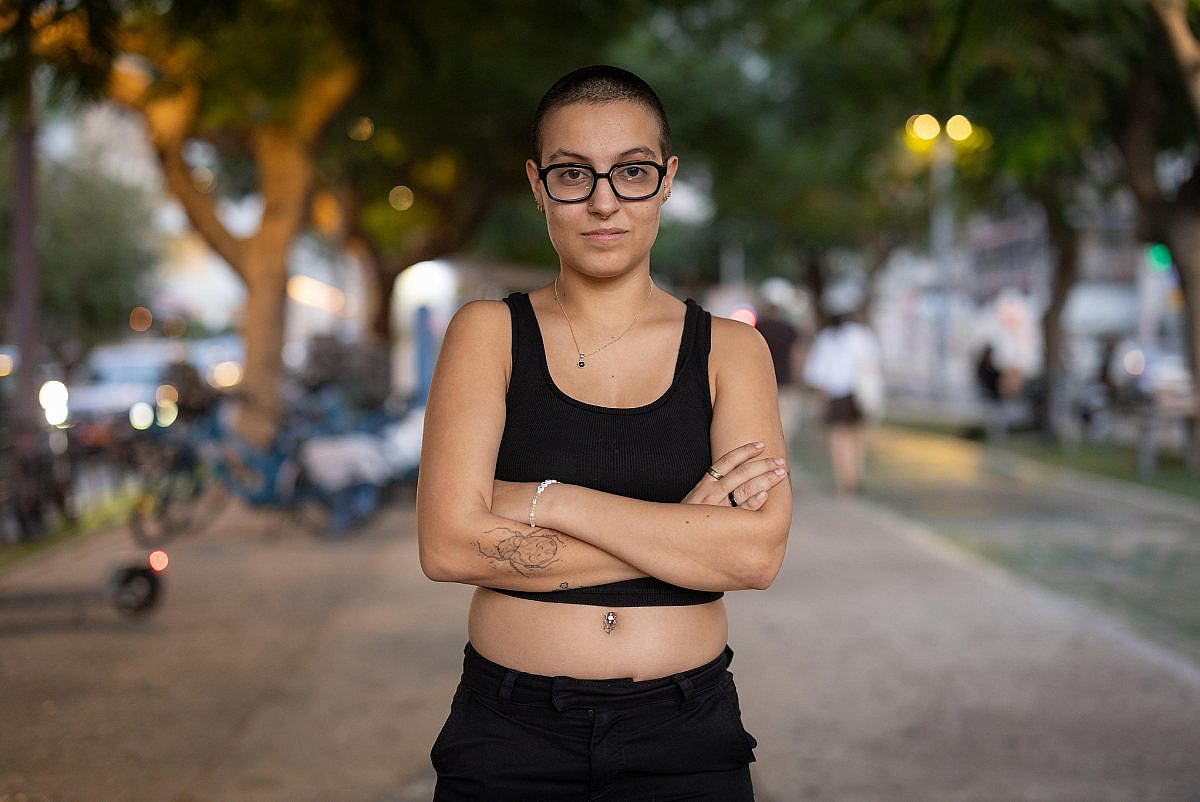
Daniel Schultz, 18, grew up believing Israel’s military was ‘the most moral’ in the world. Now she’s going to prison to avoid serving in it.
On Sunday, 18-year-old Daniel Schultz was sentenced to an initial 20 days in Israeli military prison for refusing to enlist in mandatory army service. In an unusual development, after declaring her refusal and receiving her sentence at the Tel Hashomer recruitment office near Tel Aviv, Schultz was sent home by the military authorities to wait for an appointment with the conscience committee.
“My refusal isn’t a heroic act,” she wrote in a statement published before her sentencing. “I’m not refusing because I believe my individual action will change reality, and I don’t think my choices as an Israeli deserve central attention in the conversation [around] Palestinian liberation. I’m refusing because it is the most human thing to do. In the face of babies starved to death, entire villages violently uprooted, and civilians sent to torture camps — there is no other choice.”
“In Gaza, the West Bank, and the ‘48 interior, the State of Israel and its citizens impose a nightmare regime on the Palestinian people, [and] the mainstream Israeli opinion is that every such step has a ‘security necessity,’” Schultz’s statement continues. “A country whose security requires an extermination of another people has no right to security.”
“A society capable of these deeds is ill,” she added. “Israeli society has no chance for rehabilitation so long as Zionism is its inseparable tenet.”
Two days earlier, dozens had gathered on Tel Aviv’s Rothschild Boulevard for a solidarity demonstration in support of Schultz, organized by the conscientious objector network Mesarvot. Passersby, including a soldier in uniform, physically attacked and cursed at the protestors.
Conscientious objection is exceptionally rare in Israel. Schultz joins around 20 Israeli teens who have been jailed for publicly refusing the draft since the start of the genocide two years ago. According to Mesarvot, the army has adopted an increasingly hard line against these young refuseniks — repeatedly sending them back to prison after the expiration of their sentence by treating their continued refusal as a “new” offense.
The first to be imprisoned after October 7, Tal Mitnick, served 185 days; another, Itamar Greenberg, was incarcerated for nearly 200 days — the longest sentence for a conscientious objector in more than a decade. Mesarvot said the army has also stopped exempting refusers after 120 days in prison, which was previously common practice.
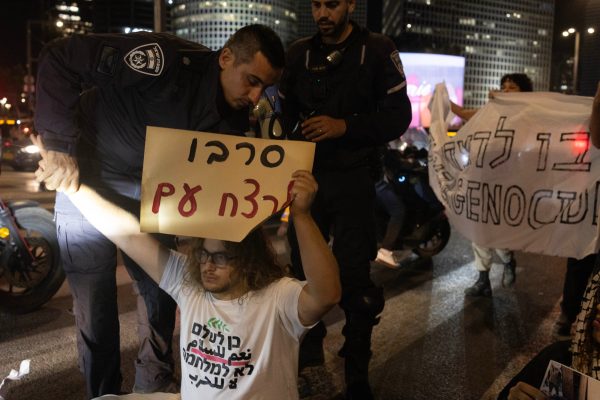
Yuval Peleg, another conscientious objector, is currently awaiting further sentencing after having already served 90 days in jail across three terms. Two soldiers who began their military service and then refused, Omer Yoran and a soldier who goes only by the initial R., were also sentenced last week to an initial 20 days in prison.
In an interview with +972 Magazine before reporting to the recruitment office, Schultz explained that she didn’t grow up with radical left-wing views. “I used to be quite centrist, holding liberal, humanist values,” she said. “The idea that the IDF is ‘the most moral army in the world’ was a significant part of my worldview.”
That outlook began to shift when, at the age of 16, she enrolled in an international boarding school at Givat Haviva in northern Israel, where Israeli, Palestinian, and international students studied together. “It was the first time I met and spoke with Palestinians,” she recalled. “Within the first six months there, I was suddenly exposed to the injustices: the reality in the West Bank, the apartheid Palestinians experience inside the Green Line, and the situation in Gaza [even] before the beginning of the genocide.”
When did you decide to refuse?
I decided I didn’t want to enlist around that time [while studying at Givat Haviva]. I had a Palestinian roommate, with whom I would talk late into the night during the first six months [of school]. I listened to her with my jaw open.
I heard about her uncle who participated in demonstrations in the West Bank that were dispersed [by the Israeli army] with live fire in May 2021. I heard how her parents, who are citizens [of Israel], shrink with fear every time they see a soldier. I heard how angry and hurt she was that some of her friends chose to enlist. It affected me deeply.
I would come home on weekends and ask my parents if they knew these things were happening. Their answers varied. They saw reality as more complex than I did. I see evil, and my first instinct is to resist it. There were many arguments, but they were always very empathetic. They understood where I was coming from and didn’t blame me for feeling what I feel toward the state or the army.
Initially, I thought I would get an exemption for pacifism or psychological reasons. But as time went on, I realized that the choice not to enlist is inherently political and carries a political statement with it. So I can’t do it quietly and pretend that the whole system is fine and that I’m the problem. My statement is that the system is the problem, and I choose not to enlist.
I have friends from school whose entire families were wiped out in one night in Gaza. That pain and shock are unbearable.
How did your family and friends react to your refusal?
People in my family don’t really agree with me. It’s hard for them with my public exposure [as a result of refusing the draft], but in the end they love me and support me. I don’t feel that they’re angry at me or think I shouldn’t be doing this, and that strengthens me.
Most of the people around me, most of my friends, are in the same radical leftist sphere. My partner just got out of prison [for refusing to enlist in August]; I feel enormous and unequivocal support.
Is your refusal a message to other young Israelis before they enlist?
I believe the clearest message I can send to [Israeli] society through my refusal is that enlisting is always a choice. Many people live with the perception that it’s something that just happens to us: you turn 18, you get a draft notice — a passive situation. But there’s always a choice.
I know people who don’t support what the army does but feel that [enlistment is] forced on them. My message is that this simply isn’t true. If you’re being asked to do something that goes against your moral compass, you always have the right to say no.
Are you also trying to send a message to Palestinians through your refusal?
I hope my refusal gives Palestinians some kind of hope. Still, we’re talking about a few dozen refusers out of a draft cohort of tens of thousands. It’s not enough. But if through my actions and words I can make Palestinians — especially my friends from school — feel seen, then I’ve done my part.
ZNetwork is funded solely through the generosity of its readers.
Donate

1 Comment
Amazing strength! Amazing courage!
Love this story of human caring for other human regardless of ethnicity or religion.