


With the encouragement of the state, universities from coast to coast are taking draconian steps to silence debate about US-backed violence in the Middle East.
The Columbia University community looked on in shock as cops in riot gear arrested at least 100 pro-Palestine protesters who had set up an encampment in the center of campus (New York Post, 4/18/24). The university’s president, Nemat Shafik, had just the day before testified before a Republican-dominated congressional committee ostensibly concerned with campus “antisemitism”—a label that has come to be misapplied to any criticism of Israel, though the critics so smeared are often themselves Jewish.
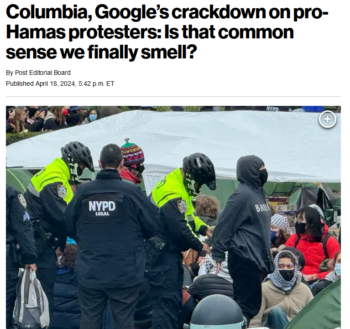
A sense of delight has filled the city’s opinion pages. The New York Post editorial board (4/18/24) hailed both the clampdown on protests and Congress’s push to ensure that such drastic action against free speech was taken: “We’re glad to see Shafik stand up…. Congress deserves some credit for putting educrats’ feet to the fire on this issue.” The paper added, “Academia has been handling anti-Israel demonstrations with kid gloves.” In other words, universities have been allowing too many people to think and speak critically about an important issue of the day.
In “At Columbia, the Grown-Ups in the Room Take a Stand,” New York Times columnist Pamela Paul (4/18/24) hailed the eviction, saying of the encampment that for the “passer-by, the fury and self-righteous sentiment on display was chilling,” and that for supporters of Israel, “it must be unimaginably painful.” In other words, conservative pundits have decided that campus safe spaces where speech is banned to protect the feelings of listeners are good, depending on the issue. Would Paul (no relation!) favor bans on pro-Taiwan or pro-Armenia demonstrations because they could offend Chinese and Turkish students?
And for Michael Oren, a prominent Israeli politico, Columbia students hadn’t suffered enough. He said of Columbia in a Wall Street Journal op-ed (4/19/24):
Missing was an admission of the university’s failure to enforce the measures it had enacted to protect its Jewish community. [Shafik] didn’t address how, under the banner of free speech, Columbia became inhospitable to Jews. She didn’t acknowledge how incendiary demonstrations such as the encampment were the product of the university’s inaction.
Shafik had assured her congressional interrogators that Columbia had already suspended 15 students for speaking out for Palestinian human rights, suspended two student groups—Jewish Voice for Peace and Students for Justice in Palestine (Jewish Telegraphic Agency, 11/10/23)—and had even terminated an instructor (New York Times, 4/17/24).
The hearing was bizarre, to say the least; a Georgia Republican asked the president if she wanted her campus to be “cursed by God” (New York Times, 4/18/24). (“Definitely not,” was her response.)
The former World Bank economist had clearly been shaken after seeing how congressional McCarthyism ousted two other female Ivy League presidents (FAIR.org, 12/12/23; Al Jazeera, 1/2/24).
‘Protected from having to hear’
“What happened at those hearings yesterday should be of grave concern to everybody, regardless of their feelings on Palestine, regardless of their politics,” Barnard College women’s studies professor Rebecca Jordan-Young told Democracy Now! (4/18/24). “What happened yesterday was a demonstration of the growing and intensifying attack on liberal education writ large.”
Her colleague, historian Nara Milanich, said in the same interview:
This is not about antisemitism so much as attacking areas of inquiry and teaching, whether it’s about voting rights or vaccine safety or climate change — right?—arenas of inquiry that are uncomfortable or inconvenient or controversial for certain groups. And so, this is essentially what we’re seeing, antisemitism being weaponized in a broad attack on the university.
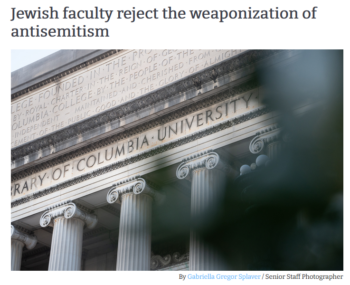
Jewish faculty at Columbia spoke out against the callous misuse of antisemitism to silence students, but those in power aren’t listening (Columbia Spectator, 4/10/24).
Shafik justified authorizing the mass arrests, which many said hadn’t been seen on campus since the anti-Vietnam War protests of 1968. “The individuals who established the encampment violated a long list of rules and policies,” she said (BBC, 4/18/24). “Through direct conversations and in writing, the university provided multiple notices of these violations.”
One policy suggested by the university’s “antisemitism task force,” according to a university trustee who also testified (New York Times, 4/18/24): “If you are going to chant, it should only be in a certain place, so that people who don’t want to hear it are protected from having to hear it.”
Cross-country rollback
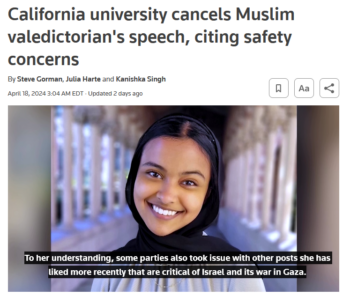
Meanwhile, the University of Southern California canceled the planned graduation speech by valedictorian Asna Tabassum—a Muslim woman who had spoken out for Palestine (Reuters, 4/18/24). The university cited unnamed “security risks”; The Hill (4/16/24) noted that “she had links to pro-Palestinian sites on her social media.” Andrew T. Guzman, the provost and senior vice president for academic affairs, said in a statement that cancelation was “consistent with the fundamental legal obligation—including the expectations of federal regulators—that universities act to protect students and keep our campus community safe” (USC Annenberg Media, 4/15/24).
This is happening as academic freedom is being rolled back across the country. Republicans in Indiana recently passed a law to allow a politically appointed board to deny or even revoke university professors’ tenure if the board feels their classes lack “intellectual diversity”—at the same time that it threatens them if they seem “likely” to “subject students to political or ideological views and opinions” deemed unrelated to their courses (Inside Higher Ed, 2/21/24).
Benjamin Balthaser, associate professor of English at Indiana University South Bend, told FAIR in regard to the congressional hearing:
There is no other definition of bigotry or racism that equates criticism of a state, even withering, hostile criticism, with an entire ethnic or religious group, especially a state engaging in ongoing, documented war crimes and crimes against humanity. Added to this absurdity is the fact that many of the accused are not only Jewish, but have strong ties to their Jewish communities. To make such an equation assumes a collective or group homogeneity which is itself a form of essentialism, even racism itself: People are not reducible to the crimes of their state, let alone a state thousands of miles away to which most Jews are not citizens.
Of course, witch hunts against leftists in US society are often motivated by antisemitism. Balthaser again:
The far right has long deployed antisemitism as a weapon of censorship and repression, associating Jewishness with Communism and subversion during the First and Second Red Scares. Not only did earlier forms of McCarthyism overwhelmingly target Jews (Jews were two-thirds of the “defendants” called before HUAC in 1952, despite being less than 2% of the US population), it did so while cynically pretending to protect Jews from Communism. Something very similar is occurring now: Mobilizing a racist trope of Jewish adherence to Israel, far-right politicians are using accusations of antisemitism to both silence criticism of Israel and, in doing so, promote their antisemitic ideas of Jewishness in the world.
Silencing for ‘free speech’

These universities are not simply clamping down on free speech because the administrators dislike this particular speech, or out of fear that pro-Palestine demonstrations or vocal faculty members could scare donors from writing big checks. This is a result of state actors—congressional Republicans, in particular—who are using their committee power and sycophants in the media to demand more firings, more suspensions, more censorship.
I have written for years (FAIR.org, 10/23/20, 11/17/21, 3/25/22), as have many others, that Republican complaints about “cancel culture” on campus suppressing free speech are exaggerated. One of the biggest hypocrisies is that so-called free-speech conservatives claim that campus activists are silencing conservatives, but have little to say about blatant censorship and political firings when it comes to Palestine.
This isn’t a mere moral inconsistency. This is the anti-woke agenda at work: When criticism of the right is deemed to be the major threat to free speech, it’s a short step to enlisting the state to “protect” free speech by silencing the critics—in this case, dissenters against US support for Israeli militarism.
But this isn’t just about Palestine; crackdowns against pro-Palestine protests are part of a broader war against discourse and thought. The right has already paved the way for assaults on educational freedom with bans aimed at Critical Race Theory adopted in 29 states.
If the state can now stifle and punish speech against the murder of civilians in Gaza, what’s next? With another congressional committee investigating so-called infiltration by China’s Communist Party, will Chinese political scholars be targeted next (Reuters, 2/28/24)? With state laws against environmental protests proliferating (Sierra, 9/17/23), will there be a new McCarthyism against climate scientists? (Author Will Potter raised the alarm about a “green scare” more than a decade ago—People’s World, 9/26/11; CounterSpin, 2/1/13.)
Universities and the press are supposed to be places where we can freely discuss the issues of the day, even if that means having to hear opinions that might be hard for some to digest. Without those arenas for free thought, our First Amendment rights mean very little. If anyone who claims to be a free speech absolutist isn’t citing a government-led war against free speech and assembly on campuses as their No. 1 concern in the United States right now, they’re a fraud.
ZNetwork is funded solely through the generosity of its readers.
Donate