
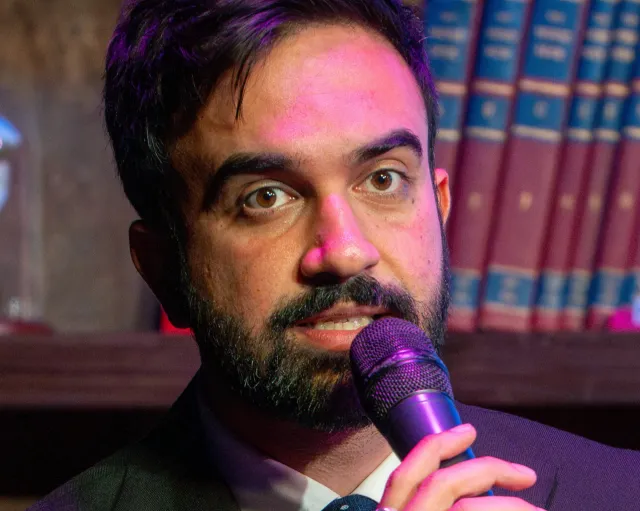
Progressives are desperate for a savior. Rarely does a week go by without another sighting of the elusive Great Blue Hope, the magical candidate destined to resurrect the Democratic Party.
New York Times columnist, Michelle Goldberg, published a story on October 1 entitled, “He’s Young, Talented and Openly Religious. Is He the Savior Democrats Have Been Waiting For?”
The young man in question is James Talarico, who is running in the Democratic senatorial primary in Texas. He apparently has a “plain spoken message, which combines Bernie Sanders’s anger at the oligarchy with a diagnosis of the spiritual sickness that almost everyone in the country feels.”
Ten days later, Michael Hirschorn, also in the Times, chimed in “With Mamdani, the Left Finally Has Its Trump” (The paper of record soon changed the headline to “Voting for Mamdani Taught Me Why Trump Won.”) Hirschorn sees this new savior, who is leading but has not yet won the race for New York City mayor, as a combination of Bernie Sanders and Mahatma Ghandi. He believes that Mamdani’s democratic socialism sells not only in deep blue New York City, but also in rural red America:
“Do I think that approach would work in Arkansas? I sure do, and in Cedar Rapids or Sioux County, Iowa.”
That’s not because of Mamdani’s programs, but because of his willingness to listen “even to those who voted for Trump.” These days, that will play everywhere, Hirschorn believes.
The desire for someone to lead the Democrats out of the wilderness is understandable. Democrats are still in shock by Trump winning, not once, but twice. Democratic voters know that they are losing and that their decrepit leadership is an unmitigated disaster. Rebuilding the party will be an arduous, time-consuming process, and difficult to get excited about. But a much more enlivening road to redemption would be the rise of a Trump-like charismatic leader with the chutzpah to become the Pied Piper of social media, leading the young to victory.
The obvious example of such a leader is Franklin Delano Roosevelt, a patrician with such compelling communication skills that he could repel fear and inspire hope throughout the Great Depression – the worst economic crisis in American history. FDR stood up for working people as if he’d come up through the coal mines himself, rather than as a member of the millionaire class. He made it clear that capitalism had to be tamed so that working people could survive, if not thrive. And he didn’t mince words.
At a campaign rally in New York City, in 1936, he described the first four years of his administration:
We had to struggle with the old enemies of peace—business and financial monopoly, speculation, reckless banking, class antagonism, sectionalism, war profiteering.
They had begun to consider the Government of the United States as a mere appendage to their own affairs. We know now that Government by organized money is just as dangerous as Government by organized mob.
Never before in all our history have these forces been so united against one candidate as they stand today. They are unanimous in their hate for me—and I welcome their hatred.
I should like to have it said of my first Administration that in it the forces of selfishness and of lust for power met their match. I should like to have it said of my second Administration that in it these forces met their master.
Couldn’t the Democratic Party be saved today if a new leader emerged who said much the same? It’s tempting to see Zohran Mamdani’s campaign in New York as a blueprint for future successes across the country, but I have my doubts. Not just about unproven Mamdani, but about what it takes to make real change.
Looking for salvation in one person misreads the context that made FDR so productive. Charismatic leaders from above require mass movements from below. FDR, indeed, was a gifted leader. Not only did he have unmatched oratorical skills, but he also had the guts to rattle the golden cage of plutocratic capitalism.
But he didn’t do any of his New Deal magic in a vacuum. There was, when he came to power, a mass movement already underway to organize new labor unions, which involved disrupting industrial production through strikes galore. The labor movement emerged under the leadership of the Congress of Industrial Organizations (CIO) and shook capitalism to its core. Workers sat down in factory after factory demanding immediate wage increases and the legalization of unions. In response, workers were harassed, beaten, and sometimes shot by company thugs. To the owners of capital lethal force was justified, because to them this was the Russian Revolution coming home.
Roosevelt also sensed the corresponding rise of radical political movements. There were millions of working people and their allies who were openly questioning whether capitalism needed to be replaced and whether socialism, communism, or something else should replace it.
Roosevelt was special, very special, but it was the movement from below that created the political space and support he needed to do very special things. They fed off each other.
The lesson, I think, is that if you want a charismatic leader to save the Democratic Party, you’d better help build a mass movement that will shake things up.
Like what Bernie tapped into after the financial crash. Sanders, who still brings crowds to their feet with attacks on the billionaire class, had been around forever before taking on Hillary Clinton in the 2016 primaries. He always wore his democratic socialist politics on his sleeve – pro-worker and anti-billionaire to the core. Nobody could miss it. So, how did an overt socialist almost grab the Democratic presidential nomination in 2016?
Sure, he is talented, but I think the key was 2008-09 financial crash and the rise of Occupy Wall Street, which put runaway inequality on the map. The Wall Street crash and the resulting bailouts made clear to all that, no matter what, the rich would be protected. Back then I dubbed it the “Billionaire Bailout Society.”
In 2011, two years after the crash and two years full of bailouts for the rich, two hundred or so people gathered in Zuccotti Park in Lower Manhattan to start Occupy Wall Street. They had absolutely no idea where their movement might go, but with the chant of “We are the 99 percent,” it soon mushroomed into more than 900 encampments around the world.
With little or no coordination, the movement faded, but “We are the 99%” endured. It was alive and well when Bernie Sanders took on the Democratic plutocratic establishment in 2016. It was also alive and well when Donald Trump took on the Republican plutocratic establishment that year as well.
In a real way both Trump and Sanders were riding the same populist wave. Trump played on the anti-elitism of the movement and grafted onto it attacks on immigrants. Bernie was pure anti-billionaire. A face-off between the two would have put to the test what kind of populism might best carry the working class. But the Democratic establishment made sure that Hillary, and not Bernie, won the nomination. That cleared the field for Trump to grab both sides of the populist mantle, unopposed.
It was child’s play during the campaign to paint Clinton as a pillar of the established economic order, as well as a tool of Wall Street. Goldman Sachs had paid her $675,000 for just three speeches in 2014-15, and the Clintons received more than $125 million in speaking fees between 2001 and 2016. Those $250,000-a-pop speeches were in the public record for all to see who she was working for. They were truly offensive to those struggling to make ends meet.
Maybe somewhere, sometime, there was a charismatic leader who didn’t ride to power on the wave of a popular uprising, but I think you’ll have trouble finding one. And that’s the problem with wishing for one now.
The quest for the next charismatic leader is like looking for love in all the wrong places.
ZNetwork is funded solely through the generosity of its readers.
Donate