
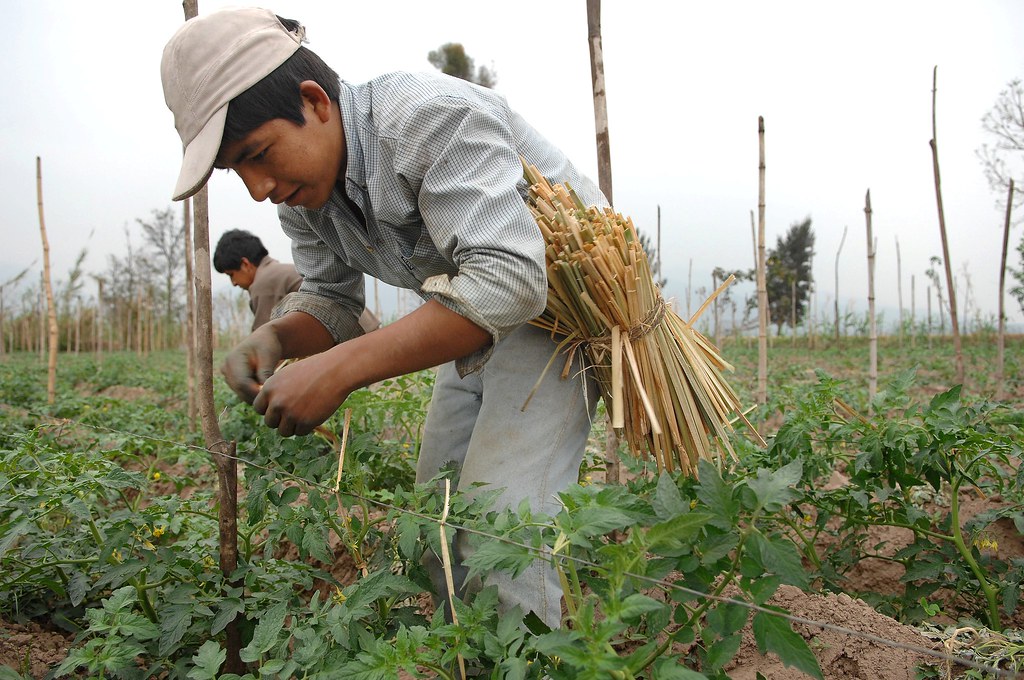
A significant piece of legislation most voters have likely never heard of will spend the summer sitting on the cutting room floor of Congress. When the legislation is ready for a vote, it will ensure people aren’t sentenced to hunger for lack of income, dictate international trade policies, and provide support to a farm system that—depending on who you ask—is either failing or flourishing.
Colloquially known as the Farm Bill, the legislation is responsible for the allocation of billions of dollars over its five-year term. The last Farm Bill, the Agricultural Improvement Act of 2018, had a price tag of more than $800 billion. On its surface, the legislation is a novel-length amalgam of technical programs ostensibly designed to assist farmers. Looking closer at the Farm Bill’s near-100-year history, it’s apparent the omnibus, multiyear law has strayed far from its initial model of labor-minded price floors and supply management and crept further into the corners of federal institutions where structural racism thrives.
Wrestling with how the Farm Bill started, what about it has changed, and its current operations also requires looking at the legislation with a new lens that appears to be gaining traction within the U.S. Department of Agriculture (USDA): The Farm Bill’s potential as a climate bill. Addressing the root causes and impacts of a rapidly changing climate system demands that we change how we grow, raise, and consume food. This is a daunting task at best and an improbable feat at worst. But however improbable, it’s desperately needed, given scientists’ predictions of what will happen to global economies, societies, and political structures if a fossil fuel-based economy continues in its current direction.
Yet the Farm Bill is a source of serious environmental consequences: a monoculture, industrial, and privately financed food system that traps most growers in a cycle of debt and prohibits new growers from entering the field. It’s also a piece of legislation that illustrates the stories of America’s colonial past and present: how land ownership results from and predicts institutional power and how land use begets climate outcomes.
“This Farm Bill is definitely shaping up to be one that is focused on racial justice, equity, [and] climate action,” said Sakeenah Shabazz, the policy director at Berkeley Food Institute. “I think this Farm Bill is for people who have been left out of that political process and policy process in years prior. There is still so much repair to be done [to] give resources to young farmers and BIPOC farmers who want to make a livelihood in our community.”
With the current Farm Bill set to expire Sept. 30, farmers, ranchers, advocates, and organizers hope to influence what’s included in its next iteration. In doing so, they could potentially shift the status quo of farming away from a white-led production-oriented industry toward one that serves people historically marginalized out of it.
The Farm Bill: anti-Blackness baked in from the outset
To understand what needs to change about the legislation, it’s important to understand how the Farm Bill became what it is today. The bill consists of 12 “titles,” or sections responsible for funding, guiding, and outlining programs related to food and farming that include things like commodities, conservation, nutrition, rural development, research, forestry, and energy, among others. Some programs help farmers recover lost income if a crop fails because of extreme weather, while others provide loans for beginning farmers and ranchers. Funding for the country’s low-income food support program, the Supplemental Nutrition Assistance Program (SNAP), consistently accounts for a majority of Farm Bill funding. By February 2023, the 2018 Nutrition Title, which funds SNAP, received 85% of farm bill funding. Some experts say that without SNAP, the U.S. would be a food-insecure country.
One major goal of the Farm Bill is to make sure that people are fed; the other is to keep farmers operational. That said, the bill’s 12 titles illustrate how food and farming touch every aspect of our economic, political, and social lives.
This is clear from the Farm Bill’s inception in 1933. During and shortly after World War I, the government encouraged farmers to produce as much as possible to send commodities like wheat and corn overseas. The overproduction enabled by mechanized farming replaced native grasses with row crops, and a combination of extreme environmental changes led to the Dust Bowl and exacerbated the Great Depression. A quarter of the U.S. population at the time worked in agriculture, which meant that the supply management, parity pricing, and export subsidies within the Agricultural Adjustment Act (AAA) of 1933 also functioned as an economic stimulus—for some.
From its inception, the Farm Bill was exclusionary, said Garrett Graddy-Lovelace, an associate professor of agriculture policy and agrarian politics at American University.
Overt discrimination from the USDA has caused irreparable harm to Black farmers, who, throughout the 20th century, lost their land at an astounding rate. During this time, Black farm ownership declined by 90%, from about 1 in 7 farms to just over 1 in 100 farms. Black farming in the U.S. arose out of the trans-Atlantic slave trade and then transitioned into sharecropping, both of which prevented land ownership and tenure. So in prioritizing land owners, the AAA also allowed white settlers to claim and farm dispossessed Native land.
“Planters of the Deep South got ahold of [the first Farm Bill] and said that tenant farmers and sharecroppers couldn’t be included. So it had racism [and] anti-Blackness from its outset,” Graddy-Lovelace said.
Other legislation enacted in the 1930s intended to support workers, like the Fair Labor Standards Act, National Labor Relations Act, and Social Security Act, didn’t apply to farmworkers. At the time, nearly two-thirds of the country’s Black population was employed as farmworkers.
From the 1930s through the 1970s, farming policies enabled the overproduction of commodity crops, and farmers became dependent on federal subsidies provided by the Farm Bill. A series of industry changes—the proliferation of fertilizers, increased use of mechanized labor, and reliance on government-backed private insurance to cover losses—left an indelible change in the farming landscape. To stay in business, farmers and ranchers faced pressure to join this largely unprofitable output-focused form of farming as support for small farms shrank.
This industrialization worked in tandem with discrimination within the USDA, and plenty of more recent examples illustrate how structural discrimination has continued within the agency. For example, the Reagan administration got rid of the USDA’s Office of Civil Rights in 1983. In 1999, Black Southern farmers sued the federal government in Pigford v. Glickman for decades of discrimination in farm loans, credit, and debt restructuring that, in many cases, led to farm foreclosure and loss of land. That same year, Native farmers and ranchers filed a lawsuit against the USDA for discrimination in lending practices that prioritized white ranchers.
Perhaps more unclear to Americans is how the industrialization of farming is also a climate story. Soil quality has degraded due to monocropping, pesticides, and pollution. Farmland expansion has led to the breakdown of native plant and animal species. Native grasslands, wetlands, and forests are no longer able to function as natural sponges for carbon dioxide because they’ve disappeared or deteriorated. Farmers and ranchers are included among those working and living on the front lines of climate change, as changes in weather, water scarcity, and insect population health all contribute to the productivity of an agricultural operation.
The interests of farmers of color and the needs of the environment have never before been explicitly outlined in the Farm Bill. Grassroots organizations are working to undercut the legislation’s own legacy by making sure they’re represented in this year’s version. Making room for BIPOC in the Farm Bill—and in agriculture more broadly—also has the potential to create space for environmental provisions.
Farmers and ranchers of color demonstrate climate solutions
This summer, advocacy groups are connecting the dots for lawmakers, shedding light on how the federal government incentivized environmentally degrading agriculture policies that became the norm. These policies greatly contributed to climate change, and now it’s time for BIPOC farmers and ranchers with the solutions to finally be given a seat at the table.
Given the Farm Bill’s history of land dispossession, it makes sense that land access is the top challenge the next generation of BIPOC farmers and ranchers are facing, according to the National Young Farmers Coalition. With the oldest generation of farmers and ranchers set to retire and sell or pass down their farmland, the coalition hopes that this next farm bill will include a dedicated program to transfer 1 million acres to young farmers and ranchers.
“The 1 million acres number is something that we think is both achievable and meaningful for this next generation,” said Holly Rippon-Butler, the land access program director with the National Young Farmers Coalition. “It’s something that could help over 52,000 young people gain access to land in the next 10 years.”
According to Rippon-Butler, non-farming buyers are gobbling up farmland, raising the price of land in general, and putting parcels out of reach of BIPOC farmers and agricultural workers who want their own operations.
The land access program director told Prism that 98% of the private agricultural land in the U.S. is owned by white landowners, and 45% of non-operator landowners have never actually farmed themselves. This leaves renting as the only viable option for BIPOC farmers, many of whom are young and well below the average farming age of 57. But renting comes with serious challenges, namely that many USDA programs and grants are only available to farmers and ranchers who own land.
Young BIPOC farmers and ranchers operate differently than those toeing the status quo. In a coalition survey of National Young Farmers Coalition members, 86% of farmers identified their practices as regenerative, sustainable, and aimed at addressing the cycles of climate change they experience, Rippon-Butler said. It’s not implementing climate-aware growing strategies that hampers their work, it’s that buying and keeping land is extremely difficult.
“We know that if we can get these farmers access to land, they can plant perennial crops and do cover cropping and all the practices that are related to being able to contribute to both climate change mitigation and resiliency,” Rippon-Butler said.
In response to the organization’s advocacy efforts, a bipartisan group of legislators introduced the ‘‘Increasing Land Access, Security, and Opportunities Act,” which would expand a USDA program implemented in 2022 with similar aims.
Farming that works with the soil rather than against it affects farmworkers as well. Like farmers and ranchers, those who plant and harvest crops, tend cattle, and work the land face climate impacts more frequently than most. Pesticide exposure has led to severe chronic illness and cancer among farm workers, which some have dubbed a public health crisis. When wildfires clouded California’s skies in 2017 and 2019, agricultural workers were told to report for work or face retaliation.
Forced to contend with environmental hazards and withstand climate disasters, farmworkers are hailed as essential and ignored in federal farm policy. The overwhelming majority of farmworkers in the U.S. are Latinx, and like the Black farm workers before them, continue to be excluded from basic federal workplace protections.
“All our lives, we know we’ve been invisible,” said Mily Treviño-Sauceda, co-founder of Alianza Nacional de Campesinas, a farmworker organizing and advocacy group founded by and on behalf of women farmworkers. “We’re used as a commodity, or [operators] use us as objects.”
That started to change in 2008, when during Farm Bill negotiations Alianza and other groups successfully pushed for a role within the USDA that would coordinate farmworker needs and demands. Nothing like it had ever been done at the federal level, said Treviño-Sauceda. Later, the pandemic demonstrated a continued disconnect between the lives and labor of farmworkers and what takes place at the policy level.
Heading into Farm Bill discussions, one of Alianza’s goals is to firm up the Farm Bill coordinator role. Without an advocate who understands and respects the personhood, labor, and skills of farmworkers, policy will continue to exclude their needs, the organization worries. The organization would like to see greater scrutiny of the H-2A Temporary Agricultural Program, access to grants, and recognition that farmworkers often have vast, specialized farming expertise. A more significant coordinator role within the USDA could also help direct research on the effects of chemical exposure.
Other advocacy groups are focused on closing the gap between who is eligible for environmental grants and how the funding is actually dispersed. In the case of Farm Bill conservation programs, farmers of color are not offered grants at a parity rate to white farmers. In other instances, groups are working to dispel the myth of efficacy of other USDA programs, including the factory farm manure management funding that protracts, rather than ameliorates, environmental degradation.
There have been developments that indicate a tide change. For example, a 2021 executive order signed by President Joe Biden resulted in the formation of a USDA equity commission. A 2023 interim report from the commission cited its main goals as wide-scale departmental change, reevaluating some programs, and offering support to farmworkers and their families. In late May, USDA officials, farmers, agricultural organizers, and scholars gathered in Kansas City, Missouri, to discuss how agroecology—an internationalist, regenerative, and movement-based form of raising food—could fit into U.S. farm politics.
Zooming out, other experts told Prism that the current political landscape will also play a role in how Farm Bill negotiations play out. On the one hand, the Biden administration has expanded services and programs to farmers and ranchers of color. The American Rescue Plan and Inflation Reduction Act offered some indication that the Democratic administration was prepared to support not only the food industry, but those who plant, pick, and grow the nation’s food.
Yet the Farm Bill is legislation that needs approval from several committees and positive votes in the Senate and House of Representatives, where Democrats have a slim majority and minority, respectively. Farming and ranching take place in Democratic and Republican states—food isn’t partisan. Everyone has to eat.
But food defines partisanship in most other ways, from meat-vegetable culture wars and labor to climate—and it is climate that will determine the ultimate shape of the Farm Bill. As Civil Eats noted, transforming the Farm Bill into an environmental bill won’t be an easy task because of the number of lawmakers opposed to the approach. With the Sept. 30 deadline just a few months away, this summer is a key time for lawmakers to integrate what advocates demand. It’s well known that the clock is ticking on climate action. The opportunity to implement mitigation strategies won’t come around for another five years.
ZNetwork is funded solely through the generosity of its readers.
Donate