
Across Europe, “far-right” parties are gaining power and steering the political climate. On the road to the European Union, parties once grounded in social-democratic and democratic ideals have lost their unifying role. Wars, militarism, and capitalist expansion around the world have deepened destruction and economic hardship, triggering migration and displacement. Right-wing parties, warning that “European prosperity is under threat,” have turned the arrival of migrants into a “threat” and a source of fear. Meanwhile, democratic parties call the deaths along migration routes “tragedies.” Refugees — or “migrants,” as they are often reduced to — now play a central role in shaping politics and governments across Europe.
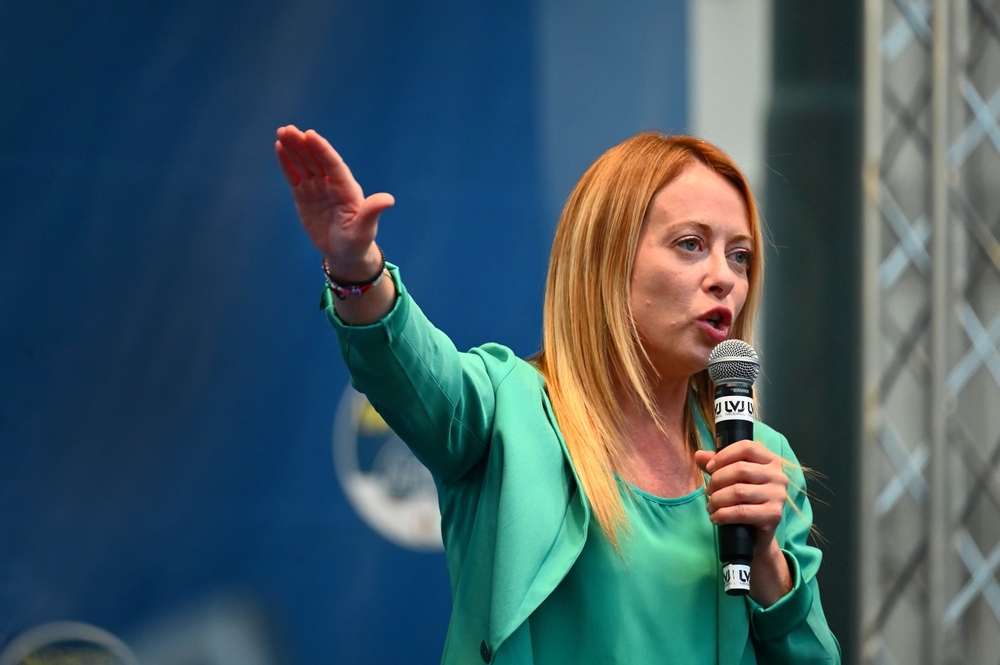
What’s called the “far right,” or neo-fascist movements, exploit fear through nationalist rhetoric, turning frightened citizens into loyal voter bases. The rise of these movements — even to power — is not surprising in Italy or across Europe. Italy, the continent’s fourth-largest economy and home to its third-largest population, is led by Prime Minister Giorgia Meloni, who openly sees no problem defending the ideas of Fascist leader Benito Mussolini. Her party, Brothers of Italy (Fratelli d’Italia, FdI), grew from just 4 percent of the vote in 2018 to 26 percent in the 2022 elections, giving her the premiership in a country of nearly 60 million people.
The decades-long political, financial, and economic instability in Italy has undeniably fueled the rise of far-right populism. In the 2000s, Italian politics swung between weak center-right and center-left governments. That volatility opened the door in 2009 for comedian Beppe Grillo’s populist Five Star Movement, which captured 32 percent of the vote. The inability of left-wing and democratic forces to present a united and credible front created the conditions that eventually lifted Meloni to power.
To understand the causes of the far right’s rise in Italy, its political course over the past three years, the shortcomings of the left and democratic parties, and the instrumental use of refugees in politics, we spoke with Laura Boldrini — former UNHCR Spokesperson for Southern Europe, President of the Italian Parliament (2013-2018), Democratic Party (PD) MP, and Chair of the Parliament’s Human Rights Committee.
Giorgia Meloni has been Italy’s prime minister for three years and is firmly in the saddle. In the mainstream media, she is often portrayed as a guarantor of stability. Isn’t this contradictory, given her political background, which is associated with fascism in Italian history?
Stability has value and is important if it brings something positive to people’s lives, otherwise it becomes stagnation, immobility. And that is the situation in Italy. Wages are among the lowest in Europe and are stagnant, industrial production is at a standstill, and minimum pensions have been increased by only €1.50. In this sense, I do not see any added value in stability. Furthermore, stability is an advantage if foreign policy choices do not cover the country in shame, as was the case with Meloni’s stance on the genocide in Gaza so as not to upset her ally Netanyahu. A stance that was one of complicity. Similarly, stability is not a value if it is synonymous with subordination to someone else’s politics solely because of ideological affiliation. I am referring above all to Donald Trump. Meloni’s choices on many issues, including the purchase of liquid gas from the US, which costs much more than Algerian gas, the increase in arms spending to 5% of GDP, and the lack of opposition to the tariffs imposed by the White House, are all against the interests of Italy and Italians.
It is true that Meloni has a background rooted in fascism. Her mentor, Giorgio Almirante, was a member of the fascist regime, took part in the Republic of Salò, and was a leading writer for the magazine La difesa della razza (The Defense of the Race). This has always prevented Giorgia Meloni from declaring herself an anti-fascist, despite having sworn on our Constitution, which is the product of the Resistance that opposed that regime and liberated Italy. But this does not contradict the guarantee of stability: illiberal regimes are stable by definition. Stability, in itself, is no guarantee of democracy.
How did Meloni’s Fratelli d’Italia party become so strong that it is now in power? Where did the democratic, left-wing and progressive opposition fail?
Giorgia Meloni’s party capitalized on years of vocal, aggressive, and populist opposition, which culminated in its support during the pandemic for those who opposed vaccines and the protective measures put in place by the government at that dramatic time. This continued in the following months when, at the request of the President of the Republic, Mario Draghi, formed a government of national unity that included representatives from most of the parties in Parliament. His party then exploited the discontent, rising unemployment, and deterioration of services.
As for the Democratic Party, mistakes were certainly made in the past, starting with the management of globalization, which was not corrected, and this led to inequality, job insecurity, and the impoverishment of the middle class. People’s protests have therefore been exploited by the right wing, which, instead of providing concrete answers, has always sought an easy scapegoat and an enemy on whom to vent its anger: migrants, minorities, LGBTQIA+ people, and politicians who opposed their choices.
We have seen harsh campaigns against virologists, scientists, and even left-wing women involved in politics who spoke out in defense of the rights of the people they demonized. I myself have been one of the most striking examples of the politics of hate carried out by the right wing.
In the European mainstream media, fascist ideology is often trivialized and normalized as ‘right-wing populism’. How do you view this trivialization? Is society lacking in enlightenment, or is this phenomenon being deliberately encouraged?
In Italy, Giorgia Meloni’s government, which is considered far-right abroad, is described by the mainstream media as “center-right.” There is a tendency to downplay and normalize the far-right connotation of this government, which is led by a radical right-wing party. This is a dangerous phenomenon because it risks not giving due weight to the measures they are taking, while certain measures are alarm bells, such as the occupation of Rai, the Italian public television network, with very widespread political control, the prime minister’s aversion to press conferences, the systematic attack on the judiciary, and the constitutional reform designed to separate the careers of investigating magistrates from those of adjudicating magistrates, which is not really a problem but hides an attack on the judiciary aimed at weakening it. But I am also thinking of measures such as the so-called ‘security decree’, the criminalization of dissent, and the disproportionate penalties even for passive resistance by protesters, such as roadblocks. And I am thinking of Article 31 of that law, which allows the prime minister to authorize members of the intelligence to create and direct subversive organizations, providing them with criminal immunity. Not to mention the attempt to delegitimize the opposition, going so far as to declare that it is more fundamentalist than Hamas.
In all this, there is a Parliament that is no longer a place of control and synthesis where legislative texts are debated and improved, but only a place where the majority ratifies the government’s decisions and rejects any amendment proposed by the opposition on principle. Not content with this weakening of the parliamentary function, they want to amend the Constitution with the so-called ‘premierato’ reform. The premiership is a reform that changes Italy’s institutional identity. Since the end of the fascist dictatorship, our country has always been a parliamentary republic where the two chambers have a role in controlling the work of the executive, as well as the task of legislating. Meloni’s attempt is to limit that control as much as possible and to centralize power in the hands of the prime minister through direct election. This would remove the independence of Parliament (which would fall in the event of a vote of no confidence in the government, unlike now) and would empty the role of the President of the Republic as guarantor of the Constitution.
Before entering parliamentary politics, you were spokesperson for the UN Refugee Agency (UNHCR) and are very knowledgeable on the subject. Are migrants the evil for Europe that the right wing uses to stir up fear in society? Isn’t that a distortion of the truth, when war and conflict cause migration, but European countries profit from it?
All right-wing parties, everywhere, have the same enemies. In the US, Italy, Hungary, and Argentina: migrants, judges, the press, minorities, and LGBTQIA+ people. Migrants, in particular, are used to fuel fear, as they all are portrayed as thieves, rapists, and people who come to take away what is ours. This is obviously a distortion of reality and a very humiliating manipulation of migrants, not least because without their contribution, many productive sectors of our country would be in crisis, starting with construction, tourism, agriculture, and care giving. The right wing wants to deny the evidence and continues to deny any positive contribution made by those who undertake migration projects, creating social tension and hindering integration in every way possible. The right-wing government in Italy has eradicated projects that were working well, reduced resources for integration, and cut services in reception centers, all to the detriment of the possibility of creating a fairer society.
It is a vicious circle: the less we invest in reception and integration, the more migrants will be marginalized, and the more this will translate into a security problem.
But the absurd thing is that the right wing, even when in government, says that there is a lack of security, which they themselves should guarantee.
You were President of the Italian Chamber of Deputies from 2013 to 2018 and are therefore familiar with all political currents. Will this dangerous, hostile and fascist ‘right-wing populism’ continue to influence and steer politics? Will the democratic opposition remain fragmented, or are there efforts to shape a common policy for Italy?
I believe that people will soon realize that the country Giorgia Meloni describes every day on her social media accounts and in interviews with complacent journalists is merely the result of her propaganda, and that it will depend on how we in the opposition manage to offer a credible alternative. This means being united, valuing what we have in common, and not giving in to the temptation to divide ourselves. It is a project we are already working on. In seven regions, we have managed to go to the polls united, with shared programs, something that has not happened for many years. We must continue this effort at the national level as well. I hope that all opposition parties will prioritize the opportunity to offer an alternative to the country instead of favoring a solo run in the hope of gaining a few more percentage points. The moment calls for a great sense of responsibility.
Who is Laura Boldrini?
A law graduate and former journalist, Laura Boldrini spent 25 years working for the United Nations — at the Food and Agriculture Organization (FAO), the World Food Programme (WFP), and later as the UN Refugee Agency’s (UNHCR) spokesperson for Southern Europe.
In 2013, after 14 years at UNHCR, she received an offer to enter politics from the “Left, Ecology, Freedom” (SEL) party, following the publication of an article she wrote on refugees. That same year, she won election as part of a coalition led by the Social Democrats and, as SEL’s joint candidate, became Speaker of Italy’s 400-member Chamber of Deputies.
During her term, Boldrini became a frequent target of rape and death threats and sexist smear campaigns, largely because of her outspoken defense of refugees and her insistence on gender equality. She stood firm against nationalist and misogynistic attacks, refusing to abandon her democratic, solidaristic, and progressive stance.
In response to escalating harassment, she began publicly naming her abusers on social media. When “Death to Boldrini” graffiti began appearing in several cities, she required police protection for a period.
Her published works in Italian include La comunità possibile. Una nuova rotta per il futuro dell’Europa (“The Possible Community: A New Course for Europe’s Future”) among others.
ZNetwork is funded solely through the generosity of its readers.
Donate