
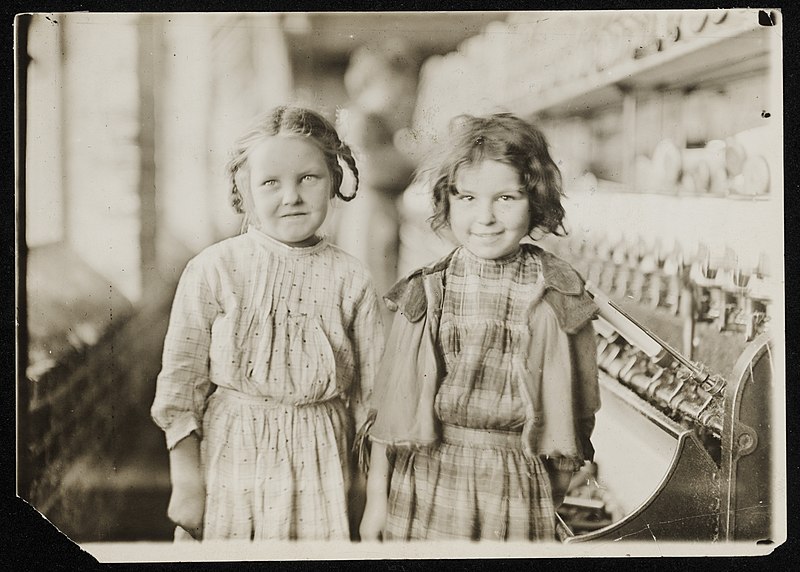
An aged Native American chieftain was visiting New York City for the first time in 1906. He was curious about the city and the city was curious about him. A magazine reporter asked the chief what most surprised him in his travels around town. “Little children working,” the visitor replied.
Child labor might have shocked that outsider, but it was all too commonplace then across urban, industrial America (and on farms where it had been customary for centuries). In more recent times, however, it’s become a far rarer sight. Law and custom, most of us assume, drove it to near extinction. And our reaction to seeing it reappear might resemble that chief’s — shock, disbelief.
But we better get used to it, since child labor is making a comeback with a vengeance. A striking number of lawmakers are undertaking concerted efforts to weaken or repeal statutes that have long prevented (or at least seriously inhibited) the possibility of exploiting children.
Take a breath and consider this: the number of kids at work in the United States increased by 37 percent between 2015 and 2022. During the last two years, fourteen states have either introduced or enacted legislation rolling back regulations that governed the number of hours children can be employed, lowered the restrictions on dangerous work, and legalized subminimum wages for youths.
Iowa now allows those as young as fourteen to work in industrial laundries. At age sixteen, they can take jobs in roofing, construction, excavation, and demolition and can operate power-driven machinery. Fourteen-year-olds can now even work night shifts and once they hit fifteen can join assembly lines. All of this was, of course, prohibited not so long ago.
Legislators offer fatuous justifications for such incursions into long-settled practice. Working, they tell us, will get kids off their computers or video games or away from the TV. Or it will strip the government of the power to dictate what children can and can’t do, leaving parents in control — a claim already transformed into fantasy by efforts to strip away protective legislation and permit fourteen-year-old kids to work without formal parental permission.
In 2014, the Cato Institute, a right-wing think tank, published “A Case Against Child Labor Prohibitions,” arguing that such laws stifled opportunity for poor — and especially black — children. The Foundation for Government Accountability, a think tank funded by a range of wealthy conservative donors including the DeVos family, has spearheaded efforts to weaken child-labor laws, and Americans for Prosperity, the billionaire Koch brothers’ foundation, has joined in.
Nor are these assaults confined to red states like Iowa or the South. California, Maine, Michigan, Minnesota, and New Hampshire, as well as Georgia and Ohio, have been targeted, too. Even New Jersey passed a law in the pandemic years temporarily raising the permissible work hours for sixteen- to eighteen-year-olds.
The blunt truth of the matter is that child labor pays and is fast becoming remarkably ubiquitous. It’s an open secret that fast-food chains have employed underage kids for years and simply treat the occasional fines for doing so as part of the cost of doing business. Children as young as ten have been toiling away in such pit stops in Kentucky and older ones working beyond the hourly limits prescribed by law. Roofers in Florida and Tennessee can now be as young as twelve.
Recently, the Labor Department found more than one hundred children between the ages of thirteen and seventeen working in meatpacking plants and slaughterhouses in Minnesota and Nebraska. And those were anything but fly-by-night operations. Companies like Tyson Foods and Packers Sanitation Services (owned by BlackRock, the world’s largest asset management firm) were also on the list.
At this point, virtually the entire economy is remarkably open to child labor. Garment factories and auto parts manufacturers (supplying Ford and General Motors) employ immigrant kids, some for twelve-hour days. Many are compelled to drop out of school just to keep up. In a similar fashion, Hyundai and Kia supply chains depend on children working in Alabama.
As the New York Times reported last February, helping break the story of the new child labor market, underage kids, especially migrants, are working in cereal processing plants and food processing factories. In Vermont, “illegals” (because they’re too young to work) operate milking machines. Some children help make J. Crew shirts in Los Angeles, bake rolls for Walmart, or work producing Fruit of the Loom socks. Danger lurks. America is a notoriously unsafe place to work and the accident rate for child laborers is especially high, including a chilling inventory of shattered spines, amputations, poisonings, and disfiguring burns.
Journalist Hannah Dreier has called it “a new economy of exploitation,” especially when it comes to migrant children. A Grand Rapids, Michigan, schoolteacher observing the same predicament remarked: “You’re taking children from another country and putting them almost in industrial servitude.”
The Long Ago Now
Today, we may be as stunned by this deplorable spectacle as that chief was at the turn of the twentieth century. Our ancestors, however, would not have been. For them, child labor was taken for granted.
Hard work, moreover, had long been considered by those in the British upper classes who didn’t have to do so as a spiritual tonic that would rein in the unruly impulses of the lower orders. An Elizabethan law of 1575 provided public money to employ children as “a prophylactic against vagabonds and paupers.”
By the eighteenth century, the philosopher John Locke, then a celebrated champion of liberty, was arguing that three-year-olds should be included in the labor force. Daniel Defoe, author of Robinson Crusoe, was happy that “children after four or five years of age could every one earn their own bread.” Later, Jeremy Bentham, the father of utilitarianism, would opt for four, since otherwise, society would suffer the loss of “precious years in which nothing is done! Nothing for Industry! Nothing for improvement, moral or intellectual.”
American “founding father” Alexander Hamilton’s 1791 Report on Manufactures noted that children “who would otherwise be idle” could instead become a source of cheap labor. And such claims that working at an early age warded off the social dangers of “idleness and degeneracy” remained a fixture of elite ideology well into the modern era. Indeed, it evidently remains so today.
When industrialization began in earnest during the first half of the nineteenth century, observers noted that work in the new factories (especially textile mills) was “better done by little girls of 6-12 years old.” By 1820, children accounted for 40 percent of the mill workers in three New England states. In that same year, children under fifteen made up 23 percent of the manufacturing labor force and as much as 50 percent of the production of cotton textiles.
And such numbers would only soar after the Civil War. In fact, the children of ex-slaves were effectively re-enslaved through onerous apprenticeship arrangements. Meanwhile, in New York City and other urban centers, Italian padrones expedited the exploitation of immigrant kids while treating them brutally. Even the then-brahmin-minded, anti-immigrant New York Times took offense: “The world has given up stealing men from the African coast, only to kidnap children from Italy.”
Between 1890 and 1910, 18 percent of all children between the ages of ten and fifteen, about two million young people, worked, often twelve hours a day, six days a week.
Their jobs covered the waterfront — all too literally as, under the supervision of padrones, thousands of children shucked oysters and picked shrimp. Kids were also street messengers and newsies. They worked in offices and factories, banks and brothels. They were “breakers” and “trappers” in poorly ventilated coal mines, particularly dangerous and unhealthy jobs. In 1900, out of one hundred thousand workers in textile mills in the South, twenty thousand were under the age of twelve.
City orphans were shipped off to labor in the glassworks of the Midwest. Thousands of children stayed home and helped their families turn out clothing for sweatshop manufacturers. Others packed flowers in ill-ventilated tenements. One seven-year-old explained that “I like school better than home. I don’t like home. There are too many flowers.” And down on the farm, the situation was no less grim, as children as young as three worked hulling berries.
All in the Family
Clearly, well into the twentieth century, industrial capitalism depended on the exploitation of children who were cheaper to employ, less able to resist, and until the advent of more sophisticated technologies, well suited to deal with the relatively simple machinery then in place.
Moreover, the authority exercised by the boss was in keeping with that era’s patriarchal assumptions, whether in the family or even in the largest of the overwhelmingly family-owned new industrial firms of that time like Andrew Carnegie’s steelworks. And such family capitalism gave birth to a perverse alliance of boss and underling that transformed children into miniature wage-laborers.
Meanwhile, working-class families were so severely exploited that they desperately needed the income of their children. As a result, in Philadelphia around the turn of the century, the labor of children accounted for between 28 percent and 33 percent of the household income of native-born, two-parent families. For Irish and German immigrants, the figures were 46 percent and 35 percent, respectively. Not surprisingly, then, working-class parents often opposed proposals for child labor laws. As noted by Karl Marx, the worker was no longer able to support himself, so “now he sells his wife and child. He becomes a slave dealer.”
Nonetheless, resistance began to mount. The sociologist and muckraking photographer Lewis Hine scandalized the country with heartrending pictures of kids slaving away in factories and down in the pits of mines. (He got into such places by pretending to be a Bible salesman.) Mother Jones, the militant defender of labor organizing, led a “children’s crusade” in 1903 on behalf of forty-six thousand striking textile workers in Philadelphia. Two hundred child-worker delegates showed up at President Theodore Roosevelt’s Oyster Bay, Long Island, residence to protest, but the president simply passed the buck, claiming child labor was a state matter, not a federal one.
Here and there, kids tried running away. In response, owners began surrounding their factories with barbed wire or made the children work at night when their fear of the dark might keep them from fleeing. Some of the 146 women who died in the infamous Triangle Shirtwaist Factory fire of 1911 in Manhattan’s Greenwich Village — the owners of that garment factory had locked the doors, forcing the trapped workers to leap to their deaths from upper floor windows — were as young as fifteen. That tragedy only added to a growing furor over child labor.
A National Child Labor Committee was formed in 1904. For years, it lobbied states to outlaw, or at least rein in, the use of child labor. Victories, however, were often distinctly pyrrhic, as the laws enacted were invariably weak, included dozens of exemptions, and were poorly enforced. Finally, in 1916, a federal law was passed that outlawed child labor everywhere. In 1918, however, the Supreme Court declared it unconstitutional.
In fact, only in the 1930s, after the Great Depression hit, did conditions begin improving. Given its economic devastation, you might assume that cheap child labor would have been at a premium. However, with jobs so scarce, adults — males especially — took precedence and began doing work once relegated to children. In those same years, industrial work began incorporating ever more complex machinery that proved too difficult for younger kids. Meanwhile, the age of compulsory schooling was steadily rising, limiting yet more the available pool of child laborers.
Most important of all, the tenor of the times changed. The insurgent labor movement of the 1930s loathed the very idea of child labor. Unionized plants and whole industries were no-go zones for capitalists looking to exploit children. And in 1938, with the support of organized labor, President Franklin Roosevelt’s New Deal administration finally passed the Fair Labor Standards Act which, at least in theory, put an end to child labor (although it exempted the agricultural sector in which such a workforce remained commonplace).
Moreover, Roosevelt’s New Deal transformed the national zeitgeist. A sense of economic egalitarianism, a newfound respect for the working class, and a bottomless suspicion of the corporate caste made child labor seem particularly repulsive. In addition, the New Deal ushered in a long era of prosperity, including rising standards of living for millions of working people who no longer needed the labor of their children to make ends meet.
Back to the Future
It’s all the more astonishing then to discover that a plague, once thought banished, lives again. American capitalism is a global system, its networks extend virtually everywhere. Today, there are an estimated 152 million children at work worldwide. Not all of them, of course, are employed directly or even indirectly by US firms. But they should certainly be a reminder of how deeply retrogressive capitalism has once again become both here at home and elsewhere across the planet.
Boasts about the power and wealth of the American economy are part of our belief system and elite rhetoric. However, life expectancy in the United States, a basal measure of social retrogression, has been relentlessly declining for years. Health care is not only unaffordable for millions, but its quality has become second-rate at best if you don’t belong to the top 1 percent. In a similar fashion, the country’s infrastructure has long been in decline, thanks to both its age and decades of neglect.
Think of the United States, then, as a “developed” country now in the throes of underdevelopment and, in that context, the return of child labor is deeply symptomatic. Even before the Great Recession that followed the financial implosion of 2008, standards of living had been falling, especially for millions of working people laid low by a decades-long tsunami of deindustrialization. That recession, which officially lasted until 2011, only further exacerbated the situation. It put added pressure on labor costs, while work became increasingly precarious, ever more stripped of benefits and ununionized. Given the circumstances, why not turn to yet another source of cheap labor — children?
The most vulnerable among them come from abroad, migrants from the Global South, escaping failing economies often traceable to American economic exploitation and domination. If this country is now experiencing a border crisis — and it is — its origins lie on this side of the border.
The COVID-19 pandemic of 2020–22 created a brief labor shortage, which became a pretext for putting kids back to work (even if the return of child labor actually predated the disease). Consider such child workers in the twenty-first century as a distinct sign of social pathology. The United States may still bully parts of the world, while endlessly showing off its military might. At home, however, it is sick.
ZNetwork is funded solely through the generosity of its readers.
Donate