
Maya Perry talks to Ben Davis, the author of Art in the After-Culture: Capitalist Crisis and Cultural Strategy (Haymarket).
Nearly ten years ago, Ben Davis’s 9.5 Theses on Art and Class looked at the relationship between art and left politics amid the “embers” of the Great Recession and Occupy Wall Street. “In retrospect,” Davis writes in the introduction to his new book, Art in the After-Culture, “this seems like the exact moment when . . . a new ‘structure of feeling’ was emerging in culture.” The following decade, marked by accelerating wealth accumulation among a tiny investor class and a succession of global upheavals, has also seen the deepening of “digital culture.”
Davis’s latest book examines the relationship between the cultural sphere and on-the-ground politics in light of these changes. He argues that our current historical moment, much like the periods of foment in the 1930s and ’60s, is characterized by a “sense of aesthetic experience being both overshadowed by the spectacle of current events and pressed into new connection with them.” This conversation has been edited for length and clarity. —Maya Perry
Maya Perry: You take a very sociological approach to the art-and-politics conversation, focusing on how art is situated in our day-to-day lives and how our experiences of it are mediated. Why were you interested in exploring the subject this way?
Ben Davis: When you’re inside the art world, the art-and-politics conversation—an understanding of art as a vehicle for social transformation—permeates everything at such a deep level that people don’t even feel the need to justify it. But when you’re outside of that world, the idea of a relationship between art and politics is almost a complete non sequitur because of the nature of what art is: a leisure activity, or an extremely intellectually forbidding, inhospitable space. Most people think about art mainly through their experiences visiting museums as tourists or through news stories about how much money there is in the art market. It’s an interesting bifurcation in the conversation about what art is, and it produces all sorts of strange paradoxes.
Perry: Was there a specific event that made you aware that something was changing in how the art encounter is mediated?
Davis: The explosion of the cultural appropriation debate made me aware of people approaching cultural consumption differently. The sudden ubiquity of smartphones and social media in the last fifteen years so quickly and seamlessly changed how we look at images. The tools of cultural production and criticism are now much more widely distributed, and people increasingly expect to see themselves reflected in the art they look at.
Perry: That reminds me of the discussion of the “prosumer” in your essay on AI-generated art—the “consumer whose customization or participation creates the object in their own image.” For me, so much of the joy of art lies in its public nature and in being able to talk about it with my friends. What are the implications of cultural consumption becoming increasingly individualized?
Davis: Ideally, when you look at a piece of art, you reason through what it is, taking account of your subjective experience, relating it to other people’s subjective experiences, and hypothesizing about the artist’s experience. But that is a very labor-intensive and time-consuming process, which does not make it the most profitable form of aesthetic cognition. The forms of our aesthetic conversation inevitably bend to the material situation we’re in, and lyrical, reflective ideas of aesthetics inherit the ideals of a certain leisure class that is in decline.
The dominant way people approach art today is through a hot-take framework: here’s a thing, here’s how it plugs into a contemporary event, and here’s why it’s “good” or “bad” based on that topical connection. When I started writing about art, the big bogeyman was theory criticism, where people would cite a passage of Foucault to explain why something was worth paying attention to. Both of these modes are ultimately responses to an existential insecurity about what the experience of art is. Before, art needed to call back to something you read in college for it to feel full of meaning. Now it needs to justify itself against the newsfeed.
Perry: You spend a lot of time considering social media as a plane of political and cultural experience. Overall, how do you see its effects on left politics?
Davis: This is a case where a lot has changed since my last book, when one of my focuses was the class position of the artist. Artists are precarious and get pushed around by the whims of power, and one result of this is some reaching for the identification of “worker.” But in a Marxist sense, artists are petite bourgeois subjects, because they have some agency over their own means of production. This means, among other things, that they tend to phrase political problems in terms of their own subjective position and that their politics often focuses on defending individual forms of action. I’ve argued that anarchism has always been the politics of the middle class—of the small producers.
Since the early 2010s, the category of individual cultural small producer has become widespread because of social media, so the problem of the artist’s class position now recurs with greater frequency. We have a contradictory situation where the media space is more politicized—ideas like socialism and racial justice are much more mainstream—but it’s all captured by this digital form that inherently produces a layer of suspicion between people, because everyone is seen as performing a political position in order to build a brand. There’s a latent anarchic individualism in the political conversation; almost any political problem these days is rephrased as a problem of content production, or a problem of interpersonal affect.
I have a socialist disposition in an old-school sense, insofar as I believe the organized working class is the potential agent of change. We need to redistribute wealth, and organizing the people who ultimately create the wealth is, to me, the solution to a lot of problems. But the digital commodification of political speech is accelerating the disintegration of forms of political community that you really need for that to happen, and it’s not clear how we get out of it.
Perry: What are your thoughts are on the so-called “vibe shift” and the concern that the left is in a period of limbo after this intense period of heightened politicization?
Davis: The fact that the politicization of the last five years has taken place on this commodified digital terrain has produced a ton of cynicism about social justice, because you see the machine chew it up such that Gucci is using it to sell handbags. Our civilization is in a slow-motion period of breakdown, and the mainstream media’s explanations for it make little sense, because they’re designed to bracket out the question of redistribution and keep selling handbags. As long as that’s true, people are going to look elsewhere for answers for why this politics feels wrong and tone-deaf.
Framing these contradictions through an anti-capitalist lens gives you a way of thinking about them so you don’t lose faith. But the socialist left is not as big, and certainly not as powerful, as the forms of conservative reaction. The right is making gains a lot faster because the divisions that are implanted into our psyche via the structure of these online spaces don’t have the same kind of corrosive effect on its politics. If you have a strong-man politics, it doesn’t matter if you’re just a bunch of isolated atoms; it’s designed for that.
Perry: As you discuss in the book, art and culture have often served as a neutralizer—or “kettle,” to use art critic Sinéad Murphy’s term—for political sentiments and radical energies, masking the left’s lack of structural power.
Davis: A lot of the culture industry’s techniques for capturing radical energy were invented in the early 1970s, and I think we’re in a similar period. Capital looks at a social movement and says, how do we redirect this energy into a form of cultural consumption: instead of redistributing money for universal child care, why don’t we just give you some better cultural images of working mothers?
But that operation is increasingly transparent, which is why I disagree with some anti-woke leftism. The stunt where the Democrats dressed in kente cloth to commemorate George Floyd? Everyone found that loathsome, and not just for a knee-jerk cultural-appropriation reason, but because it was obviously a cheap symbolic stunt designed to mask the fact that they weren’t really going to do anything. That kind of backlash is not a deflection of political energy into culture; that’s culture serving as a Geiger counter for peoples’ growing sensitivity to how political energies are co-opted.
Perry: One of the chapters in the book examines Tom Wolfe’s 1970 New York magazine article in which he coined the term “radical chic” to describe a Black Panthers fundraiser held at Leonard Bernstein’s Park Avenue penthouse. You argue that the main effect of this label, ultimately, was that it gave a largely liberal smart set the intellectual tools to justify their dismissal of radical politics. The label was even co-opted by federal authorities to discredit the Panthers just as they were beginning to win more popular support.
Davis: I think the radical chic critique—the idea that left politics is a performance for privileged people—can be useful. At the Venice Biennale a few years ago, they staged a reading of the entirety of Marx’s Capital as an art performance. It sounds like a joke. That is a form of capture, where vital forms of thinking about the world are turned into what feels like luxury goods or performance. But this cannot be the full extent of the left critique of political art, because if your whole thing is just that art politics are fake, how do you sound different from a conservative?
People these days have an incredible latent sensitivity to radical chic, to “performative politics” or “virtue signaling,” which most visibly takes the form of calling out other people’s inauthentic relationship to in-the-streets politics based on your perception of them on social media. If you want to be sympathetic to this, you can say that art capitalism is extremely voracious and gobbles up every signifier of authenticity as quickly as it can, and that this is deeply felt by those who grew up in online spaces. But going back to the Wolfe example, what’s important is how this makes it easy for cynical operators to see exactly where they can stick the knife in to split a potential political coalition. The Bernsteins were throwing a silly fundraiser, but they were raising money for a good cause. Wolfe was a conservative who was out to wreak havoc. His story was designed to help starve a movement of the material resources it needed to sustain itself, and it worked.
I was talking about this performative allyship debate with a friend who is a performance artist and also a serious activist, and they said, “I hate it, because performance is the stuff of politics!” It is how we get people’s attention. If you stigmatize performance, you stigmatize a huge aspect of outreach, of movement building, of the joy of being part of these communities. The edges, where politics is a little more symbolic, is where most people enter politics.
Perry: You propose the term “art wedge” as an alternative way of conceptualizing how art and culture are weaponized by conservatives to erode popular support for radical causes.
Davis: We just have to be contextually sensitive to how criticism of radical chic—of “fake” art politics—is being deployed. The charge can sometimes, in my experience, just be a product of people positioning themselves as the critical voice within the same small cultural milieu for status.
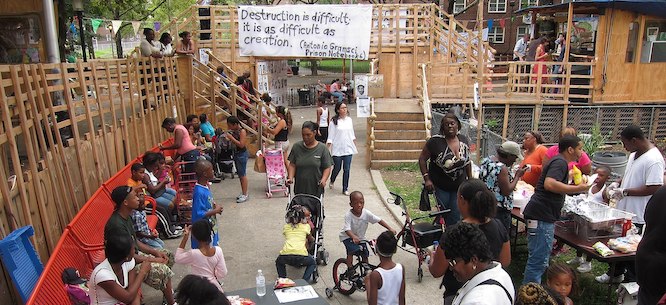
My perspective comes from living between the art and organizing worlds. When it comes to an artwork like Thomas Hirschhorn’s Gramsci Monument from a few years ago, my first reaction is sometimes an eye-roll. But then I’ll talk to someone who lives in the Bronx about how they’re going to give a talk there about their brother who is in prison. That’s the thing about art: symbolic gestures can sometimes be very real for people. Frederic Jameson, quoting Kenneth Burke, talks about how the term “symbolic act” has a double meaning: both, “Oh, it’s just a symbolic act,” as well as, “That’s a symbolic act”—that’s a meaningful intervention in the symbolic sphere.
Perry: That brings us to this paradox: while left politics entering artistic spaces can represent political energy being deflected away from popular struggle, the debate around how politics is expressed culturally can also deflect energy away from popular struggle. How do we navigate these two hazards?
Davis: Unfortunately, we can’t defer to an axiomatic principle here. Art and politics are not “things” with clear borders that you can make rules about. They’re ensembles of relationships and institutions and local contexts and people with mixed material interests. A materialist analysis means having a grasp of all that, having a hypothesis for how social change might happen, and figuring out where you are in that process.
One of the best pieces of advice I’ve heard is to join organizations: unions, study circles, political groups. Building up actual comradeship with people you trust can act as a brake on the latent anarchism of this moment and cut against the tendency to abandon common projects.
Perry: Your book published just before the unionization of the JFK8 Amazon facility, so I loved coming across this line near the close of one of the chapters: “Organizing a single Amazon distribution center would be worth more than a million people making ‘radical content,’ in terms of showing that it is actually possible to change the way society is run.”
Davis: Isn’t that great? Everything revolves around whether the media project meets a non-media project—an organizing project, in other words. The convergence of the politicization of aesthetics and the commodification of culture has created a dangerous situation for the organized left in particular. A lot of these technologies are consciously or unconsciously designed to dis-organize us.
Perry: I’m curious about your chapter on the aesthetics of conspiracy theories. Why was that an important addition to this collection?
Davis: There’s no mono-causal explanation for the rise of conspiracy theories, but by examining them closely you can reverse engineer what social function these outlandish ideas are serving, and perhaps what a left culture might be able to do for people instead. One of the reasons I think conspiracies flourish is that culture is very commodified and feels very inauthentic to people. The more that is the case, the more people look for things on the fringes to recover a sense of authenticity.
I think a lot about the strengths and limits of left politics as a subculture. People don’t just find left politics because they think it is the correct way to change the world; it also offers a set of shared cultural reference points, a history to attach yourself to, a group with whom you can go to the bar—all of which makes you feel less atomized in your frustrations and experiences. It’s a strength of the left that it can feel like an authentic culture. But it is a weakness when we inculcate a habit of scanning others for cultural signifiers to see if they’re on our team or not. We can risk not just sounding like a cult but actually isolating ourselves from others.
Perry: QAnon and similar internet subcommunities are often characterized by their extreme detachment from objective reality, but you argue that the infrastructure of conspiratorial thinking actually has a quasi-hermeneutical quality. There’s a deep desire for truth and meaning, which evidently isn’t otherwise being supplied by culture.
Davis: Writing this book made me think about how people’s sense of meaning is under threat from capital. Commodification turns things into interchangeable units, eliminating the sense that any given position or idea can be meaningful. There’s a constant encroachment upon sacred things and spaces. That produces a crisis of meaning for people, which can push them to the right, because openly toxic ideas aren’t as quickly commodified.
I’m just going to embrace being the corniest possible version of a socialist art critic and say: socialism is the answer to a sense of meaninglessness. I was reading Victor Serge’s Memoirs of a Revolutionary the other day, and he writes about how the historical innovation of Marxism is the insight that “the only meaning of life lies in the conscious participation in the making of history.” Marxism as a theoretical guide for how to take part in historical change isn’t just instrumental; you unpack those ideas and therein also lies the key to a meaningful life.
Unfortunately, that doesn’t translate that well into art, except in corny things like conceptual art projects about the proletariat. I think it’s healthy to just acknowledge the split between art and politics. In the “Manifesto for an Independent Revolutionary Art,” the idea that sticks out to me is that in mass politics, we are Marxists, and in culture, anarchists. That is, on a cultural level, go crazy with whatever forms of art make sense to you. The threshold for making it meaningful is just to make sure it’s placed within a larger context of politics.
Perry: We’re living through what feels like an increasingly despairing time, and while it has galvanized many toward organized politics, I’m also seeing it prompt a widespread sense of hopelessness, even nihilism. I’ve been thinking about the ending of Axel’s Castle, in which Edmund Wilson describes how a diffused political defeatism makes culture very hospitable to an aesthetics of dissociation, one that models a retreat from society into one’s enclosed, interior life.
Davis: This is why I think the liberal version of environmental politics—repeating the magnitude of the problem but taking solutions for actually solving it off the table—is such a failure. Reiterating how deeply corrupt our history is and how deeply despairing our present is while only proposing minor interpersonal gestures of atonement—of course people are going to reject that!
Culturally, it’s not at the level of specific pieces of art that a socialist politics is important, but rather in the larger need for something that breaks through this pervasive melancholy and nihilism: a culture full of possibility that is pushing toward the future. That’s not something you can do intellectually; that’s a practical problem of constructing a true organized form of politics.
In the end, my point is that art and culture have a lot to gain from such politics. From our sense of agency and connection, of living a purposeful life; from our cultural images serving as more than just escapism but instead connecting us with our highest aspirations as people and as a community. Great art depends on that!
Perry: The book ends with the idea of utopia—specifically the role of art in creating positive visions of the future that can act as brakes against hopelessness. It recalls an essay I love from an early issue of Dissent in which Irving Howe and Lewis Coser—acknowledging the pre-Marxist utopian tradition as disconnected from a theory of historical change—write of the need “in an age of curdled realism . . . to assert the utopian image.”
Davis: If what we mean is just a positive vision of a future that is survivable and joyful for people, I don’t think those ideas are “utopian.” The mechanisms for getting there might be obscure, but the goal is also unromantic and prosaic in a way: healthcare, child care, elder care, making sure people have survivable incomes and free time.
What the word “utopia” does is connect political aspirations to art. I think art can be useful play, in the way that children’s games sometimes model the ability to work together. Art doesn’t have to be a little map of the future for it to serve as a place to speculate about the future we want to work toward.
Perry: You observe, however, that the left’s cultural reference points for the future are currently “exclusively dystopian”—Mad Max, Blade Runner, and the like. The only place that utopian thinking really consistently thrives is Silicon Valley. Is part of our task today to re-appropriate something from that utopian tradition?
Davis: It’s not just whether we should have more utopian language, it’s also a question of why we don’t have more utopian language. In the 1960s, 85 percent of popular songs were in a major key; today, 60 percent are in a minor key. There’s been an affective shift. Negativity is more popular now.
But if the thriving industry of self-help books about the power of positive thinking and the rise of mystical thinking tell us anything, it’s that people do need a connection to a hopeful future. If the left doesn’t offer it, people will find another narrative to deliver them from the anxieties of the present. We don’t have the capital investment of Silicon Valley, but the resource we have is that we’re right. Ideally, we should be able to name people’s alienation and offer a solution that’s human and full in a way that the tech solution isn’t.
I don’t write about NFTs in the book, and it’s true that there are a lot of scams there, but you also talk to people in that community who sincerely believe in this crackpot utopia where everyone is going to succeed. “We’re all gonna make it” is literally their slogan. It shows how dry the social terrain is. People are so starved for a positive vision of the future that they’re grabbing a cup of battery acid to quench the thirst. That’s sobering. That’s my case for art that can take the form of a critical utopianism, the “critical” part being just as important as the “utopia” part.
Ben Davis is the author of 9.5 Theses on Art and Class and Art in the After-Culture.
Maya Perry is an assistant editor at Harper’s Magazine and a former Dissent intern.
ZNetwork is funded solely through the generosity of its readers.
Donate