
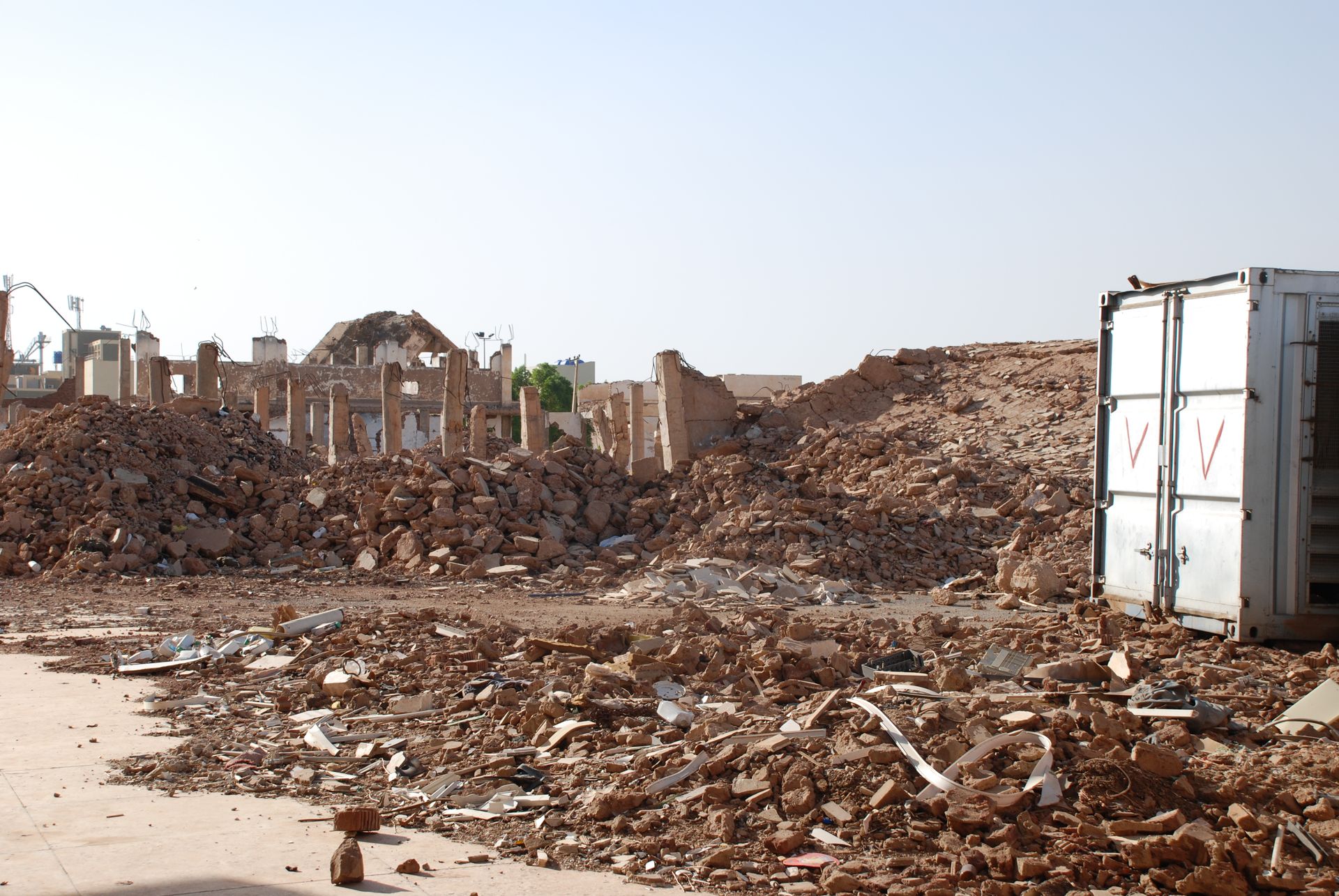
The al-Shifa factory was the largest pharmaceutical factory in Khartoum, employing over 300 workers, producing medicine both for human and veterinary use. It had been operational for only just over a year before the US bombardment, which killed one employee and wounded eleven others.
The attack was completely out of the blue. Prior to the bombing, no US official had ever publicly identified the Sudan as a confirmed chemical weapons proliferator or even “country of concern.”
President Bill Clinton justified the attacks, on the grounds that the al-Shifa plant was involved with producing chemical weapons, the evidence for which was a soil sample collected near the site allegedly containing EMPTA, a compound linked to the production of nerve agents.
Mounting doubts
But as the US journal Chemical Engineering News pointed out a few days later, no such inference can reasonably be drawn from the presence of EMPTA in such a sample. The publication pressed the US Government for more details about the soil sample, but officials refused to provide any information on where it was collected, by whom, how it came into US hands and who had analysed it.
In a UK-exclusive article for the October 1998 edition of Labour Left Briefing, meticulously researched by the late Mike Marqusee, a US research chemist told the magazine: “No US court would accept a soil sample in evidence, for example in an environmental law case, unless all these questions were answered.”
President Clinton also claimed the plant had ties with the Islamist al-Qaeda group of Osama bin Laden, which was believed to be behind US embassy bombings in Tanzania and Kenya. The attack was enthusiastically backed by then-Senator Joe Biden. “I want to applaud and thank the president for being willing to take this action,” Biden said after the strikes.
These justifications for the bombing were disputed by the owners of the plant, the Sudanese government, and other governments. The Chairman of El Shifa Pharmaceutical Industries told reporters: “I had inventories of every chemical and records of every employee’s history. There were no such [nerve gas] chemicals being made here.”
The German ambassador told the German Foreign Ministry on the day of the bombing that the plant could not be called a factory for chemical weapons: it mainly produced medicines.
The bombing of the plant was denounced as a “grave act of terrorism” by Sudan’s Minister for External Relations at the UN General Assembly the following month.
After the bombardment, the Clinton Administration invoked American anti-terrorist legislation, listed the factory owner as a terrorist, and froze 24 million dollars of his assets in accounts with the Bank of America. Eight months afterward, the Government chose not to defend the action in court and released his funds. This was interpreted by most media as an admission of error on the part of the Government.
A month after the attack, the New York Times called into question the US State Department’s claims of official Sudanese complicity in international terrorism. It revealed that two years earlier the CIA had had to withdraw over 100 intelligence reports alleging Sudanese involvement in terrorism because it realised that they had been either fabricated or were simply wildly inaccurate.
Immediately after the strike, the Sudanese government asked the United Nations Security Council to conduct an investigation of the site to determine if it had been used to produce chemical weapons or their precursors. The proposal was vetoed by the US, which also blocked an independent laboratory analysis of its soil sample.
However, an independent investigation conducted by Professor Thomas Tullius, Chairman of Boston University’s Department of Chemistry, conducted detailed tests on the remains of the al Shifa factory. The analysis, carried out in three accredited European laboratories, uncovered no evidence to support American claims that the factory was involved in the manufacture of chemical weapons.
Impact on Sudanese society
The bombed plant had provided 50% of Sudan’s medicines, and its destruction left the country with no supplies of chloroquine, the standard treatment for malaria. The Blair government, which publicly supported the US decision to bomb the factory, refused requests to supply chloroquine in emergency relief until the Sudanese were able to rebuild their pharmaceutical production.
Human Rights Watch reported that the bombing had the unintended effect of stopping relief efforts aimed at supplying food to areas of Sudan gripped by famine caused by that country’s ongoing civil war. Many of these agencies had been wholly or partially staffed by Americans who subsequently evacuated the country out of fear of retaliation.
American officials later acknowledged “that the evidence that prompted President Clinton to order the missile strike on the Shifa plant was not as solid as first portrayed” and that “there was no proof that the plant had been manufacturing or storing nerve gas, as initially suspected, or had been linked to Osama bin Laden.” But at the time the Clinton Administration doubled down: it worked hard to make sure the sloppy decision-making behind the bombing was not revealed.
The Sudanese government wanted the plant preserved in its destroyed condition as a reminder of the American attack. It invited the US to conduct chemical testing at the site, but the US refused the invitation. Sudan has asked the US for an apology for the attack – also refused.
Meanwhile, Washington fought a $35m compensation claim by pleading sovereign immunity. As with other unilateral military actions of this kind – for example when it mined Nicaragua’s harbours in 1986 as part of a campaign to destabilise the country’s elected government – the US has yet to pay any compensation.
The attack set back Sudan’s ability to provide medicines for its struggling people. But it had wider consequences too. One analyst commented:
“Ten years after President Omar al-Bashir seized power, a defiant policy of offering refuge to Muslim brothers had turned Sudan into a pariah state… The economy was in ruins. And so Khartoum was being forced to open up. The terrorists – famously, Bin Laden and Carlos the Jackal – had been kicked out. The government was talking to its neighbours. Then al-Shifa was bombed, and overnight Khartoum was plunged into the nightmare of impotent extremism it had been trying to escape.”
There remains a widespread feeling that the attack on Sudan was motivated by domestic considerations. It took place just one week after the Bill Clinton/Monica Lewinsky scandal broke, prompting some commentators to describe the attack as a manufactured distraction.
Mike Phipps’ book Don’t Stop Thinking About Tomorrow: The Labour Party after Jeremy Corbyn (OR Books, 2022) can be ordered here.
ZNetwork is funded solely through the generosity of its readers.
Donate