

Just as federal regulators move forward with a climate change policy rooted in dozens of complex provisions of law, the Supreme Court on Friday overturned the principle that has guided U.S. regulatory law for the past 40 years.
That principle held that a federal agency’s interpretation of the law should be honored, as long as it is reasonable, in cases where there is any question about the law’s meaning.
Now, the so-called Chevron doctrine has been swept aside by a 6-3 court split along ideological lines. Chief Justice John Roberts, who two years ago authored a major opinion limiting the Environmental Protection Agency’s authority to regulate greenhouse gases, wrote the majority opinion, reining in the power of all federal agencies. The court “gravely erred” in 1984 when it gave the regulators deference to decide what the laws they implement mean, he wrote.
“Chevron’s presumption is misguided because agencies have no special competence in resolving statutory ambiguities,” Roberts wrote. “Courts do.”
In response to the argument by the Biden administration that resolving such ambiguities involves policymaking that is best left to political actors, not to unelected judges, Roberts said Congress—itself a political branch—expects courts to decide the meaning of the law. And Congress can always change the law, he said.
“To the extent that Congress and the Executive Branch may disagree with how the courts have performed that job in a particular case, they are of course always free to act by revising the statute,” Roberts wrote.
But Congress has backed away in recent decades from substantive stand-alone bills like the Clean Air Act, and has included much of its recent health and environmental decision-making in must-pass budget legislation that can leave lawmakers’ intent subject to interpretation. Experts say the end result of the decision to overturn Chevron will be increased power for the courts and less for the executive branch.
The decision to overturn Chevron fulfills a long-held wish of conservative groups that seek a smaller role for the federal government. They are led by a network funded by the Koch family, which made its billions in the petrochemical industry. Although small fishing operations brought the case against federal regulators, they were represented by a titan of conservative law, former U.S. Solicitor General Paul Clement, and lawyers for the Cause of Action Institute, which shares an address and personnel with the Koch-funded organization Americans for Prosperity.
Ironically, the 1984 case articulating the deference principle, Chevron v. Natural Resources Defense Council,was an anti-regulatory decision. In that case, a unanimous court upheld a Reagan administration air pollution regulation that environmentalists challenged as too weak.
That rule was issued by an Environmental Protection Agency then led by the late Anne Gorsuch, a fierce opponent of regulation. Her son, Supreme Court Associate Justice Neil Gorsuch, today wrote a lengthy concurring opinion affirming the wisdom of sweeping away the Chevron precedent, finding the reason in the roots of common law, from ancient Roman law to the efforts of King George to control the American colonies.
“Today, the Court places a tombstone on Chevron no one can miss,” Gorsuch wrote. “In doing so, the Court returns judges to interpretive rules that have guided federal courts since the Nation’s founding.”
“It seems to me that in a world without Chevron very little would change—except perhaps the most important things.”
In the years since Chevron was decided, courts invoked the doctrine repeatedly to uphold regulations that industries chafed at, making the case one of the most-cited in administrative law (it appears in more than 41,000 cases, according to Google Scholar.) Advocates of unfettered industry began to view the legal principle as a tool of government overreach, and called for the courts to abandon it.
No one articulated that view more memorably than Gorsuch when he was a federal appeals court judge, just months before he was hand-picked by the conservative Federalist Society to be President Donald Trump’s first addition to the Supreme Court.
“What would happen in a world without Chevron? If this Goliath of modern administrative law were to fall?” Gorsuch wrote in a 2016 immigration case. Congress would write laws, agencies would “offer guidance on how they intend to enforce those statutes,” and judges would “exercise their independent judgment” on those laws, not bound by what agencies said they meant, he wrote. “It seems to me that in a world without Chevron very little would change—except perhaps the most important things.”
Chevron’s Climate Stakes
When it comes to President Joe Biden’s effort to put a national climate policy in place, the most important things may well be the outcomes of a slew of lawsuits filed against the Environmental Protection Agency and other federal agencies in the past year.
These lawsuits, most of them in the names of Republican-led states that have been joined by fossil fuel industries, essentially accuse the agencies of overstepping their legal authority with regulations to curb greenhouse gas emissions or otherwise address climate change.
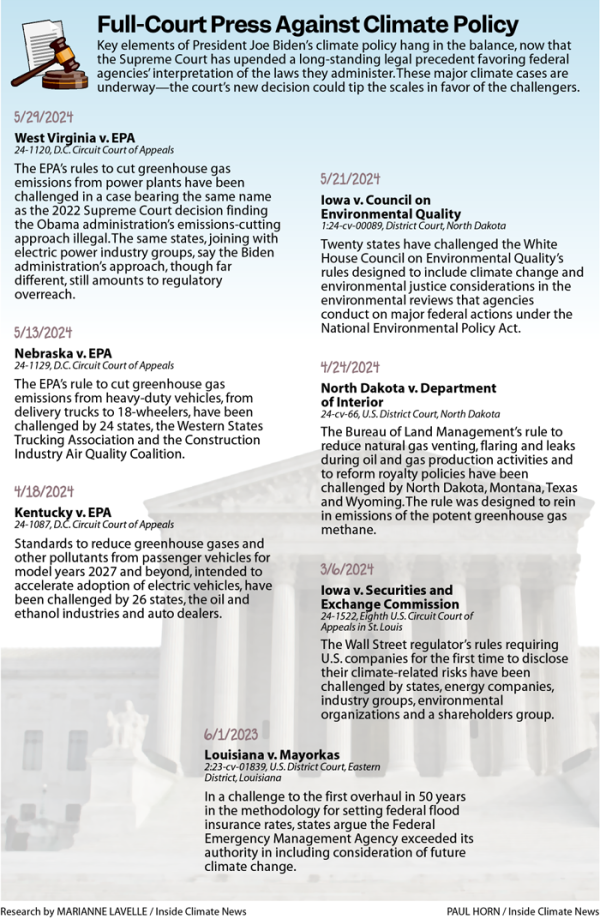
The agencies in most cases are applying broad legal authority Congress gave them years before the dangers of climate change were fully recognized or even contemplated. The EPA’s regulations to cut carbon pollution from the nation’s two leading sources—vehicles and power plants—are based on the Clean Air Act, passed in 1970 and amended in 1990. The Securities and Exchange Commission is seeking to standardize corporate disclosure of climate risks by relying on Great Depression-era laws that require publicly traded companies to fully inform investors of factors that could affect their financial conditions.
In some cases agencies have more explicit direction from Congress than others—for example, the Clean Air Act provisions on vehicles are more specific than those governing power plants. But in virtually all pending challenges to Biden policy, foes have identified what they see as legal ambiguities, or faults in agencies’ interpretation of the law.
“It’s very hard to write statutes in technical, controversial areas and not have a shred of ambiguity,” said Lisa Heinzerling, a professor at Georgetown Law School, in an interview prior to the decision. “Even if someone is really trying to be careful, people with enough money and enough lawyers can, after the fact, really bring ambiguity out of something that was intended to be clear.”
Now that Chevron has been overturned, the Supreme Court has placed the onus squarely on judges to interpret regulatory law, which typically involves application of science and knowledge of the latest technological advances.
In a scathing dissent, Associate Justice Elena Kagan said the court had removed “a cornerstone of administrative law,” upending the structure that supported much of the federal government’s functions.
The Chevron doctrine “has become part of the warp and woof of modern government, supporting regulatory efforts of all kinds—to name a few, keeping air and water clean, food and drugs safe, and financial markets honest.”
Contrary to Roberts’ view, Kagan said that Congress has assigned federal agencies to address interpreting the law in regulatory areas, which often involve scientific or technical subject matter. “Agencies have expertise in those areas,” Kagan wrote. “Courts do not.” Now she said such decisions will be made by courts that have no political accountability and no proper basis for making policy.
“A rule of judicial humility gives way to a rule of judicial hubris,” she wrote.
A Move Long Coming
But the Supreme Court for years has been moving in the direction of giving less authority to federal agencies; the trend accelerated after Trump gave conservatives a commanding 6-3 majority with his three appointees. Although the lower courts still invoked Chevron often, the high court has not relied on the doctrine in any case since 2016. And without mentioning Chevron, the Court recently has displayed little deference for agencies’ reading of the law.
Two weeks ago, for example, the Supreme Court struck down the federal ban on “bump stocks,” rejecting the Bureau of Alcohol, Tobacco and Firearms’ technical and legal analysis that the rapid-fire gun accessories convert rifles to machine guns, long banned by federal law. Associate Justice Clarence Thomas wrote that a converted rifle wasn’t a machine gun, in an opinion accompanied by a highly unusual set of trigger mechanism illustrations.
“What that opinion looks like is pretty much the court figuring out on its own how guns work,” Heinzerling said. “That decision is a sign of things to come.”
On Thursday, in a 5-4 opinion by Gorsuch, the Supreme Court put a hold on the EPA’s effort to address the difficult problem of smog-forming pollutants that drift across state lines, saying the agency had not adequately explained how it would address the cost-effectiveness of the “Good Neighbor” program over time. (Associate Justice Amy Coney Barrett broke from other conservatives in a dissenting opinion, warning the court was downplaying the EPA’s role under the Clean Air Act and leaving “large swaths of upwind States free to keep contributing significantly to their downwind neighbors’ ozone problems for the next several years.”)
Especially relevant to climate law was the court’s 2022 decision in West Virginia v. EPA case, written by Roberts and also settled 6-3 with Republican-appointed justices in the majority. In that case, the Supreme Court set a new standard of skepticism for federal agency authority on “major questions” of national importance, throwing out the Obama administration’s approach for cutting carbon emissions from power plants.
That case, and now the loss of Chevron deference, could well tip the balance against climate policy in the courts, experts say. A case in point is the litigation (Loper Bright Enterprises v. Raimondo, and Relentless, Inc. v. Department of Commerce) that was before the court, brought by fishing operations against the agency charged with enforcing fishing law in U.S. waters, the National Marine Fisheries Service, or NMFS.
For three decades, NMFS has had a program of putting scientific observers on board fishing vessels to prevent overfishing and ensure compliance with other federal laws, like those to protect endangered species. Lack of observer coverage has been a chronic problem in the underfunded program and in 2020, to increase coverage to address strain on the important Atlantic herring fishery, in part due to climate change, NMFS set new rules requiring that the fishing operations pay the cost of the observers.
The fishing operations ended up being reimbursed for 100 percent of their costs (about $30,000), but the Supreme Court did not focus on such details. Instead, it focused on what it viewed as the correct roles of agencies, Congress and the courts. Roberts wrote that it was an error for courts to give the executive agencies the benefit of the doubt whenever there was a question of the law’s meaning.
“By forcing courts to instead pretend that ambiguities are necessarily delegations, Chevron prevents judges from judging,” Roberts wrote.
Tara Brock, Pacific legal director and senior counsel for the advocacy group Oceana, said the result would be less monitoring of the industry at a time when more is needed.
“Things are changing in fisheries,” Brock said. “Suddenly somebody in Alaska is catching species that they historically haven’t. Well, what does that mean for fisheries management? Observers being present and being able to document what we are seeing on the water and having that really critical data is going to become even more valuable as climate change continues to change our oceans.”
But lawyers representing the fishing operations that brought the challenge said that the Supreme Court has restored balance to decision making about federal regulation.
“The Court’s decision puts to rest an interpretive methodology that has seriously distorted how the political branches operate for far too long,” Clement said in a prepared statement. “Courts should ask what the law means, not whether it is ambiguous, and in close cases, the tie should go to the citizen, not the government. We are gratified that the Court restored the constitutionally mandated separation of powers.”
James Valvo, executive director of Cause of Action Institute and chief policy counsel for Americans for Prosperity, called the decision “one of the most consequential administrative law victories for small businesses in recent memory.”
Valvo said the court had “ruled in favor of our clients and all citizens whose livelihoods are threatened by an unaccountable bureaucracy.”
In the majority opinion, Roberts, addressing a problem that some legal scholars have warned about, said that the court was only overturning Chevron, not the tens of thousands of cases that relied upon it. The decision does “not call into question prior cases that relied on the Chevron framework,” he wrote. “The holdings of those cases that specific agency actions are lawful—including the Clean Air Act holding of Chevron itself—are still subject to statutory stare decisis despite our change in interpretive methodology.”
Although those old cases may stand, the Supreme Court has made clear that in new cases—including those already making their way through the courts on Biden’s climate policy—federal courts, not the regulators, should decide what the law means.
Marianne Lavelle is a reporter for Inside Climate News. She has covered environment, science, law, and business in Washington, D.C. for more than two decades. She has won the Polk Award, the Investigative Editors and Reporters Award, and numerous other honors. Lavelle spent four years as online energy news editor and writer at National Geographic. She spearheaded a project on climate lobbying for the nonprofit journalism organization, the Center for Public Integrity. She also has worked at U.S. News and World Report magazine and The National Law Journal. While there, she led the award-winning 1992 investigation, “Unequal Protection,” on the disparity in environmental law enforcement against polluters in minority and white communities. Lavelle received her master’s degree from Columbia University Graduate School of Journalism, and is a graduate of Villanova University.
ZNetwork is funded solely through the generosity of its readers.
Donate