

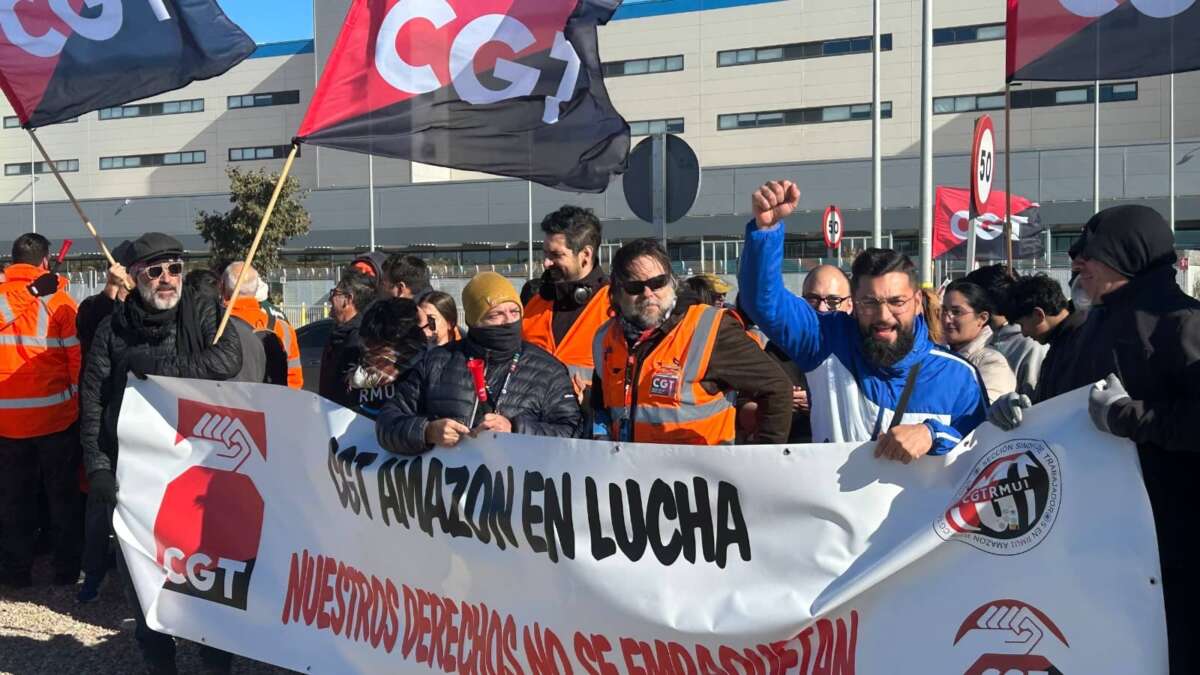
The latest flashpoint of resistance to global logistics juggernaut Amazon has proven, once again, that collective worker power can force the company into improving its miserable working conditions.
Amazon workers in Murcia, in southeastern Spain, struck twice at the RMU1 fulfillment center during the 2025 holiday “peak” season and forced the company into a negotiated settlement in late December.
Workers won a 14 percent wage increase that took effect this month (January). They also won annual increases of 4 percent in each of the next two years, improved Sunday and night shift pay, and more paid time off. Strike leaders cautioned that the 14 percent increase can be somewhat misleading — it’s an increase from 2018 wage tables, thus largely an inflation adjustment. But as Alfonso Martínez Valero, an RMU1 worker and strike leader, told Truthout, benefits like pensions and unemployment pay are calibrated to base wage rates, so those benefits now will increase substantially.
“Have all objectives been achieved? No. But something fundamental has been accomplished: breaking the deadlock, reactivating negotiations and demonstrating that Amazon is not immune to collective organization,” the Murcia worker strike committee wrote following the walkouts. “The strike has shifted the balance of power and sent a clear message to workers in other countries: even within a global multinational, sustained collective action can open real cracks,” they wrote for a forthcoming article in The Amazon Worker, a publication of Amazon Workers International.
Murcia workers struck for three days at the end of November, and when that didn’t produce negotiations, they struck again from December 17 through 19. Amazon ramped up its anti-union campaign after the first strike, sending managers from one workstation to another to tell workers that a December strike action would be futile, that workers would lose money and jeopardize their jobs, according to Martínez Valero.
Of the 2,000 workers at RMU1, the union strike committee estimates that at least 75 percent participated in the December strike. The workers’ return to the picket lines in December appears to have convinced Amazon to bargain. On December 22, the union strike committee announced the settlement, negotiated under the auspices of government mediators.
The strike was organized and led by a feisty, class-struggle-oriented rank-and-file committee of the Confederación General del Trabajo, or CGT, one of four unions at RMU1. Unlike the “exclusive representation” model of U.S. labor relations, in Spain — as in other European countries — multiple unions can have a presence at the same worksite. Minimum standards are covered by provincial or national sectoral agreements, negotiated by unions and employer groups.
In 2024, Martínez Valero told Truthout, CGT members tried but failed to convince the other unions to participate in job actions to raise standards, which had languished without change since 2018. The other unions, he said, wanted “social peace,” but for the CGT, “confrontation is in our essence, to highlight the contradictions of the [capitalist] system, and the democratic struggle to achieve our goals.”
This past September, CGT members convened worker meetings. “Spirits at the warehouse were very high,” Martínez Valero said. “Coworkers were very willing to go on strike, so we started a mobilization campaign. Mainly talking with people, publishing an agitation magazine … and openly talking about the strike.”
The one-on-one, shop floor organizing culminated in a worker vote to strike in both November and December. One of the other three unions officially endorsed the strike call, but judging from picket participation figures, it’s apparent that workers well beyond the CGT and the other union’s ranks joined in the walkout.
Creative strike tactics were decisive. As Martínez Valero explained to Truthout, “this strike was not a classic mobilization, where people don’t go to work.” Instead, he said, “we played a game of deception, which means that everyone showed up for work on the strike days, creating a false sense of demobilization and confidence in the company.” He explained that only when production peaks occurred, “our colleagues left their workstations” and picketed outside. The workers would then return to work when production slowed down. Workers “were coming and going and clocking in and out several times during their shift,” Martínez Valero said, “causing great organizational chaos and confusion [for Amazon] about where to put people.”
“This was disastrous for the company, as in November it was unable to ship out many goods, or did so very late. We know that on the first day of the strike, more than 40 trucks were delayed,” Martínez Valero said.
To carry off this strategy of chaos, “the workers organized themselves into small groups or assemblies, based on their workstations or areas,” he said. “This arose spontaneously, as they know each other and trust each other. We noticed this and encouraged it, giving them free rein to make decisions: best times to leave, coordinate with other groups, organize and help each other.”
By encouraging workers in each department to make their own decisions about when to stop working, “they become empowered and gain confidence and bring more people along with them, and second, this technique allows us to adapt to any changes the company tries to make to minimize the economic impact,” he said.
In addition to sowing chaos inside the warehouse, the RMU1 workers blocked entrances so that trucks couldn’t get through to move goods.
Murcia’s disruptive tactics evoke the UAW’s 2023 “Stand Up” strike, or the Association of Flight Attendants’ CHAOS campaigns, but on a more concentrated and intensive basis.
There are lessons here for unionists everywhere: Strong worker-leadership, movement democracy, and creative, confrontational tactics that disrupt the supply chain can bring the company to heel.
The strike also enjoyed international support from allies. As the first November strike loomed, workers and unions from Japan, India, England, Poland, and the U.S. sent solidarity messages, including videos from North Carolina Amazon workers and Teamsters in New York.
Murcia was not the only site of worker job actions during Amazon’s “peak” holiday season from late November through Christmas. Workers at eight German warehouses struck on Black Friday, demanding collective bargaining — which the company has thus far refused. The ver.di union reported that 3,000 workers walked out, a substantial number but still only a small fraction of the country’s 40,000-plus Amazon workers. The strike built on a two-day wage protest by hundreds of workers at the company’s Bad Hersfeld warehouse in northeastern Germany in late August.
Those Spanish and German strikes followed a one-day nationwide strike of thousands of Amazon delivery drivers in Italy in April. That walkout forced the company to the bargaining table, where they agreed to improve pay and safety for Italian drivers.
But in the U.S. — where Amazon employs about 70 percent of its global workforce of more than 2 million direct-hire and contract workers — the 2025 peak season was quieter on the picket lines compared to Europe, and also compared to 2024.
In December, 200 delivery drivers at Amazon’s DBK1 facility in Queens, New York, organized a job action and announced they had joined Teamsters Local 804. And across the country, a similar-sized group of workers at Amazon’s DJT5 warehouse in Riverside, California, staged a brief walkout and demanded recognition of their Teamsters union. Those protests were small compared to the 2024 peak season, when workers struck at eight Amazon facilities in what the Teamsters union declared “the largest strike against Amazon in U.S. history.” Journalist Luis Feliz Leon estimated that about 600 workers participated in those strikes — indeed the largest number ever of striking U.S. Amazon warehouse workers, but a far cry from the strike percentages reported from European picket lines.
Anti-union blowback from Amazon is responsible for the diminished U.S. strike activity this past December. Following the 2024 strikes, Amazon punished many of the strikers in clear-cut acts of illegal retaliation. Workers responded with group delegations to management, and they filed charges with the National Labor Relations Board (NLRB). But even when the federal agency stepped in to declare the company had broken the law, Amazon held firm.
Then at New York City’s DBK4 warehouse, the site of one of the more active December picket lines, Amazon responded by firing 150 drivers last September. Workers rallied to announce they would fight back. “If Amazon thinks we’re going to take this lying down, they have another thing coming. Our solidarity is only growing stronger,” DBK4 worker Latrice Shadae Johnson told a protest crowd outside the Queens facility. But the DBK4 firings and the company’s nonstop hostility toward unions, combined with the relative toothlessness of U.S. labor law, have had a dampening effect on U.S. strike activity.
It certainly is true that U.S. companies have a freer hand to intimidate workers and bust unions compared to employers in most other countries where Amazon operates. A recent report by the Economic Policy Institute noted that as of last year, there were nearly 350 pending or settled unfair labor practice charges against Amazon and its subsidiaries across 27 U.S. states, many involving fired workers. At the JFK8 facility on Staten Island, workers won a union representation election nearly four years ago but have yet to see their first day of bargaining with the company because of stalling by Amazon’s union-busting lawyers.
These grim realities are all the more reason why the U.S. labor movement needs to put exponentially more energy and resources into the Amazon organizing project.
Doing so is an urgent necessity for workers outside of Amazon as well. The largest private sector union contract in the nation is at United Parcel Service (UPS), covering some 300,000 delivery drivers and warehouse workers. The Teamsters UPS contract, which provides good pay, benefits, and rights to workers, expires in July 2028. That’s just 30 months from now.
Over the last few years, Amazon has overtaken UPS in package volume, and industry analysts believe the behemoth will surpass even the U.S. Postal Service by the end of the decade. Without an energetic organizing campaign at Amazon, Teamsters should expect UPS to come to the bargaining table demanding major concessions to match Amazon’s much lower pay and benefit standards.
This is a big challenge not just for the Teamsters, but for the entire labor movement. Because of its size, the UPS contract is a bellwether agreement — the terms for UPS workers set expectations for workers and bosses far beyond parcel delivery work. For example, the July 2023 Teamster-UPS settlement, which included substantial pay raises, gave momentum to UAW auto workers, who two months later launched their rolling strikes at the Big 3 automakers. Conversely, a defensive, concession-riven 2028 bargaining round for UPS Teamsters would augur poorly for all unions.
The strike victory in Murcia, Spain, isn’t a copy-and-paste template for U.S. trade unionists. The legal and political terrains between the two countries are quite different. Amazon’s warehouse network is much denser in the U.S. compared to other countries, rendering single-site strikes here much less effective. But the core principles of Murcia’s success — rank-and-file leadership, union democracy, a confrontational posture, and a majority-participation, production-disrupting strike — are exportable anywhere Amazon workers seek justice. “It’s a collective effort, and we have to dispel the myth that Amazon is untouchable,” Martínez Valero said. “As the Spanish saying goes, ‘torres más altas han caído’ — taller towers have fallen.”
ZNetwork is funded solely through the generosity of its readers.
Donate