

In a conversation with PTB General Secretary Peter Mertens, UAW President Shawn Fain addresses the challenges of organizing the working class and the fight for workers’ rights
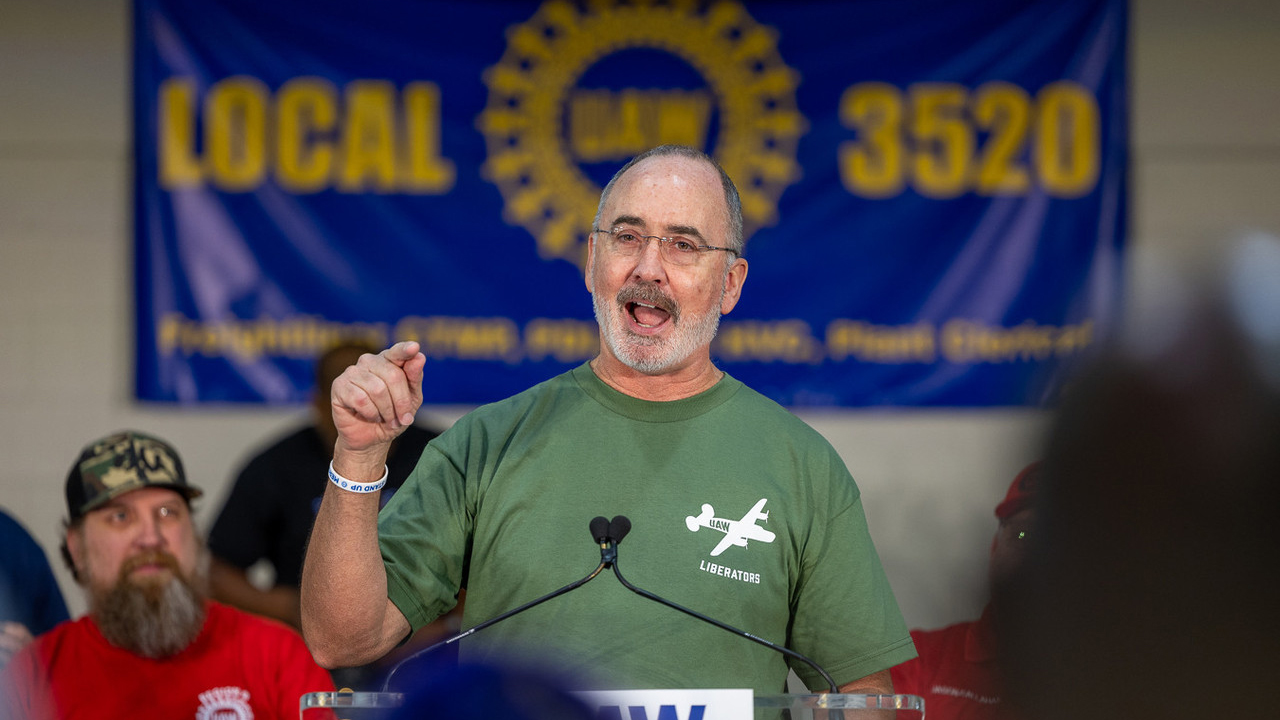
At ManiFiesta 2024, Shawn Fain, president of the United Auto Workers (UAW), sat down with Peter Mertens, General Secretary of the Workers’ Party of Belgium (PVDA/PTB), to discuss his journey to union leader, the challenges of organizing the working class in the United States, and the recent victories won by the UAW.
In this interview, Fain shares his insights on the importance of empowering workers, the fight against corporate greed, and the need for global solidarity in an era of increasing inequality.
—
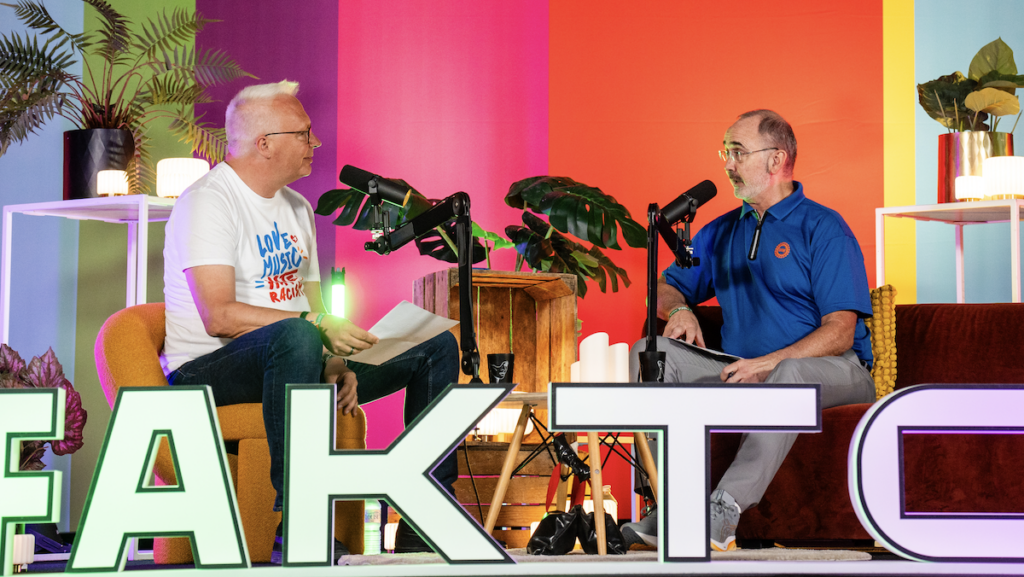
Peter Mertens (PM): I’m here in Studio Fakto with Shawn Fain. For those who don’t know him, Shawn Fain comes from the United States and is the president of the United Auto Workers (AUW). How do you find Belgium for now, Shawn?
Shawn Fain (SF): It’s a beautiful country, and meeting with the workers here, visiting workers at AUDI and different labor leaders, is just great.
PM: You are an electrician. How did you decide to become an electrician?
SF: When I graduated high school, I really didn’t know what I wanted to do. Everybody in those times pushed people to go to college. That was always the path and I went to college for about a year and a half. I didn’t do well. I really didn’t know what I was passionate about at that time. And so I ended up getting into an apprenticeship as an electrician and that really opened a whole new world to me.
At the time I was in construction, and construction was very slow. I endured a lot of layoffs and unemployment. This really impassioned me to do better and to do more for people: when I saw how the unemployment system in America works, and how the right always tries to attack such programs, it emboldened me to get more active and become more involved in the union movement. Then I was hired at Chrysler, and the rest is history.
PM: The rest is history—you’re still writing history. But while you were working as an electrician, you immediately became a member of the union. How should one see unionization in the United States?
SF: I went through an apprenticeship in a union, the International Brotherhood of Electrical Workers. Later on, when I was hired into the Chrysler factory, that was represented by the UAW, so I joined the UAW.
PM: I’ve been told that your father and grandfather were also members of the union. Is that something that is still passed through generations in the United States, or has it become more difficult to unionize people?
SF: All four of my grandparents at one time worked in UAW factories, General Motors and Chrysler. Three of them actually retired as UAW members. When they graduated high school, my father and mother both worked at a factory, but then they went on to other careers.
There’s a lot of generational workers in the auto industry. Not as many as how there used to be, but there’s a lot of people who have sons and daughters working at the factory or they had a parent or a family member that worked at the factory before them.
PM: Then, at one point you became president of the UAW. Has it always been a dream of yours, to be president of the UAW, or did it simply come on your path?
SF: When I was hired at Chrysler in 1994, 30 years ago, I just wanted a stable job. I had one child at that time and just wanted to be able to be home and support my family. I really had no ambition to be president of the union. As I got involved in my local union, I started running committees and then I ran for election and became a steward, a committee person or shop chairperson.
As things kept happening in our work lives, plants were closing. The union wasn’t really fighting. It was very complacent, you know, we had what I call a company union. The company and the union were working way too closely together, and it did not benefit the workers. It benefited only one side. As I kept progressing in my career, I ended up taking on more responsibility. And then, we were able to get direct elections in the UAW for the first time. The way the system was set up previously, a reformist really could not run against the faction that was in power for 80 years because they had control over everything. Having a direct election is the reason why I’m sitting here today.
PM: You became president of the UAW, and it was not long before the first big conflict. You were barely elected president, and then there was a big fight against the Big Three. How was that experience?
SF: Yes, I went through a runoff in the election, so it took a lot longer to get the election finished. When they declared me the winner, it was March 26, 2023. On Monday, March 27, we had a convention to prepare for bargaining. I had to run a convention that I had [given] no input in, and we had roughly 90 days to prepare for Big Three bargaining at that point. I had to put a team in place and then we really focused and went to work. We started devising how we want to go about this, how we want to do things differently.
Really, the contract campaign and the Big Three fight that we had [a lot to do] with my 28 years of experience in this union and what I thought didn’t work well. We were trying to figure out how do we make the union work for the workers and put the workers in power. So that was really the first thing we tried to do, unifying the membership and letting the members drive the movement.
PM: You said in your speech on the main stage of ManiFiesta that it’s important that the workers are in control of the union, that there have to be worker leaders of the union. Why is it so important? Have you seen a difference after implementing that approach?
SF: It’s still a work in progress because we’ve been so accustomed in our union to almost an authoritarian type of leadership. Typically when the president or a vice-president spoke, everyone was just supposed to follow. They were somewhat untouchable, you couldn’t really have access to them.
What I really tried to do since I’ve been in the presidency was to give members access. Doing social media lives, trying to speak at different conferences, interacting with workers. We never ran a contract campaign before anyway, and this one was really important also because it was a very divided house when I was elected. There were people that weren’t happy [about it] to people that were happy.
When we started our contract campaign, we were hoping to have 14 actions across the country before the contract deadline and we had about two months to do that. But when we asked the members to plan actions and rallies, practice pickets or do redshirt days, there were over 140 actions held. To me, that was a great testament to how, when you trust the membership and you give them the keys, they run with it.
PM: You won this big strike. How important was it to win again as a trade union? Do these victories hold importance for the whole working class, or was it only important for automobile workers?
SF: When we started, we were just trying to focus on what our plan was, what our strategy was. When it comes to our communication strategy, in the past, during bargaining and contract negotiations, the leadership of UAW would always tell everyone, ‘Do not talk to the media.’
Complete silence. It was basically a blackout bargaining, no one knew what was going on except the people involved in it. And we wanted to keep the membership engaged with what was happening. We were doing Facebook lives every week, updates on where bargaining was.
And the interesting part of that was, the entire public started tuning in. Then the media started tuning into it. We got to a point where they were calling bets to go out on strike. The media was airing our Facebook lives, millions of people were watching.
I think the important part of that was that it brought everyone into our fight. I’m not talking only about the UAW or about union workers, I’m talking about all working class people. In reality, all working class people in America are living like many in the world. With the wealth and disparity we have, working class people have been left behind and unionized or not, workers were fed up with wages being suppressed, not having adequate benefits, and struggling to get by paycheck to paycheck.
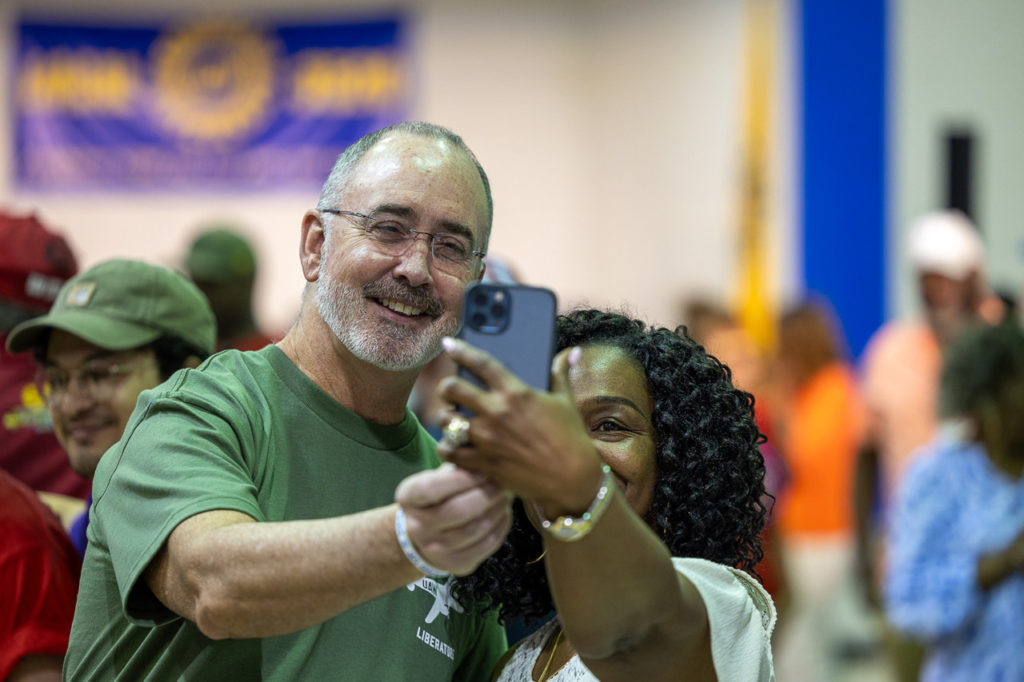
I think all that brought everyone into our fight, and it was never more evident than in the polling that was done during our strike. 75% of Americans said they supported us in that fight, which is a great thing to hear.
PM: It’s a great thing to hear here as well. There is a sentiment in European media that there is no working class, that there is only a middle class. And then comes the UAW and Shawn Fain, and they talk about the class struggle in the United States. I saw a video of one of your members with a big beard in a car near the picket lines, and he was talking about the working class in the United States. While everyone is claiming it’s all middle class, you’re proudly using the term working class again. How important is that?
SF: It’s simple to me in my mind, because I believe there’s just two classes of people. There’s the rich and there’s everybody else. If you’re not rich, you’re working class. If you own your business and you don’t have a safety net, you’re a working class person. Most of us are in that category. That’s what we talk about when we talk about the 99% and the 1%, about how things have gotten way out of whack in this world, with a few at the top and everybody else paying the price for that. That’s something that we talk a lot about.
And every time I speak, I talk about the working class. And when I talk about the working class, I always say, union or not. If you work for a living, we’re in this fight together.
PM: Is unionizing in the United States becoming more popular in general, or is it difficult to say? Are you seeing a new generation of people join unions, or does that depend on sector and service?
SF: Throughout our fight we started seeing people that were signing union cards and wanting to organize, including in non-union auto plants. And that was without us even asking, people were just searching us out. It was a great sign that we organized a Volkswagen plant in Tennessee, when we had never been able to organize a plant in the southern United States in my lifetime.
That was a major win, a major turning point. I also think that when we bargained for our successful contract, a lot of workers saw that. Right away, Toyota, Honda, they gave their employees 10, 11% pay increases. They reduced progression to full pay from eight years to four years. They were following our pattern, and right away I said, we’re gonna claim that. They’re doing this because of what we bargained for. We called it the ‘UAW bump’, and we started telling workers, ‘You are welcome, that’s what UAW stands for.’
The companies did that because they want to try to keep the workers from organizing. But we always tell them, prior to us bargaining that contract, what was your last raise? For many of them it was 25 cents in the last three years or nothing, or they’ve taken away their healthcare benefits. So it has definitely had a bigger impact.
It’s not so much the auto industry or about [any other] sector. I think that workers are really just fed up. I also think the younger workers in our country, and I’m very proud of this, see that this is not a good path for them in the future, and that the way to have a decent standard of living is by joining the union. I believe we’re going to see those increases as we keep going.
PM: This might be a naive question from my side, but the United States is a very big country and so the car factories are scattered around. How do you manage to organize even the automobile workers? How do you manage to create unity among all these different plants?
SF: Well, we break our union down into regions, so we have regional directors that oversee those areas. Then, when we do actions or plan things, we work with the workers down to the plant level. We do a lot of conferences and things where we bring workers in, whether it’s on diversity issues, civil and human rights issues, or bargaining training. We also interact with our members from all over the country on women’s issues.
The thing I’m most proud of is that when I took over, it was a very divided union. By the time we went on strike, it was as unified as I’ve seen in my lifetime.
PM: When you say it was a very divided union, what does it mean?
SF: It was our first ever direct election, so we were taking on an establishment that had been in power for roughly 80 years. They had never been defeated, except for one instance in a regional case. There were people who were behind the old way of doing things and didn’t want to change. So, you know, some people weren’t happy with the results. Many would say, ‘These guys have no idea what they’re doing.’
You’ve got to prove it, do the work and prove with your actions that you can get results. We did that. We did it by embracing the membership and bringing the members together. There was some resistance to the contract campaign we ran, initially. Some people didn’t want to do it, some of our leaders weren’t on board with it. But by the time we had a few big rallies, you could see the passion in the membership. It just grew and everyone wanted to be a part of it. By the time we got to the contract expiration everyone was together. We knew that either we come together and we fight, or we divide and lose.
That’s the big issue in the world right now. The wealthy have been united for decades, and they divide the working class people over whatever issue they can. Then they continue to extract more wealth while we continue to suffer and struggle to get by. In unifying people and in mobilizing and inspiring people, you become a power in society. I don’t think everyone likes it that we are becoming a power.
PM: I heard that Donald Trump calls you his worst nightmare. What’s your impression on being Donald Trump’s worst nightmare?
SF: He says a lot of things about me. He calls me a stupid person. But I don’t really focus on what he says about me because it’s not really about me. It’s not about him. It’s about working class people. We’ve already seen the preview of what happens if Trump is president, and we can’t afford another Trump presidency. It would be a disaster for America and for the world. We’re going to do everything we can to ensure that he does not win. That is our objective. If he doesn’t like me for that, that’s okay. I’m not going to lose any sleep over it.
PM: If I’m well informed, you already announced the May 1 campaign for 2028. That’s in four years. What’s the objective to announce a campaign four years in advance?
SF: We had the economic recession in 2008-2009, followed by a recovery period. Then we went through the COVID-19 pandemic. During COVID-19, for all the horrible things and all the lives that were lost, there was a good lesson for America at least.
We saw it in the fast food industry, where workers in McDonald’s and Burger King were making USD 10, 12 an hour. They were saying, basically, ‘Screw this, I’m not going to work and risk my life to make hamburgers.’ So the companies started raising their pay to USD 20, 25 an hour and more.
To me, that was a great lesson about the power that we have as working class people when we withhold our labor. That’s what May Day 2028 for us is about. We need time to plan and time for people to get contracts aligned or to be able to take action, figure out how to work across borders and so on.
Our ultimate goal is to build solidarity in our country, but also globally. Because we can win all the fights we want in the US, but at the end of the day, if we don’t raise the standard and we don’t work to have good standards everywhere in the corporate world [it comes down to nothing.] We’re taking on global corporations. [If we don’t amplify the struggle] they’ll close the plant in Brussels and they’ll move it to Mexico or Turkey or wherever. There’s always gonna be that threat of driving that race to the bottom.
We have to figure out how we make this happen from a global standpoint. Really, May Day 2028 for us is about building solidarity, and the labor movement has to lead this. Those workers that worked in the fast food industry weren’t in a union. They stood together, didn’t show up and they did better. But there are no protections [in that case]. If you don’t have a union in the US, you’re an employee at will and you can be fired for any reason, or no reason at all. You have no rights based on the job. It’s our job as labor unions to lead this movement and to unite all working class people, union or not, and then take action.
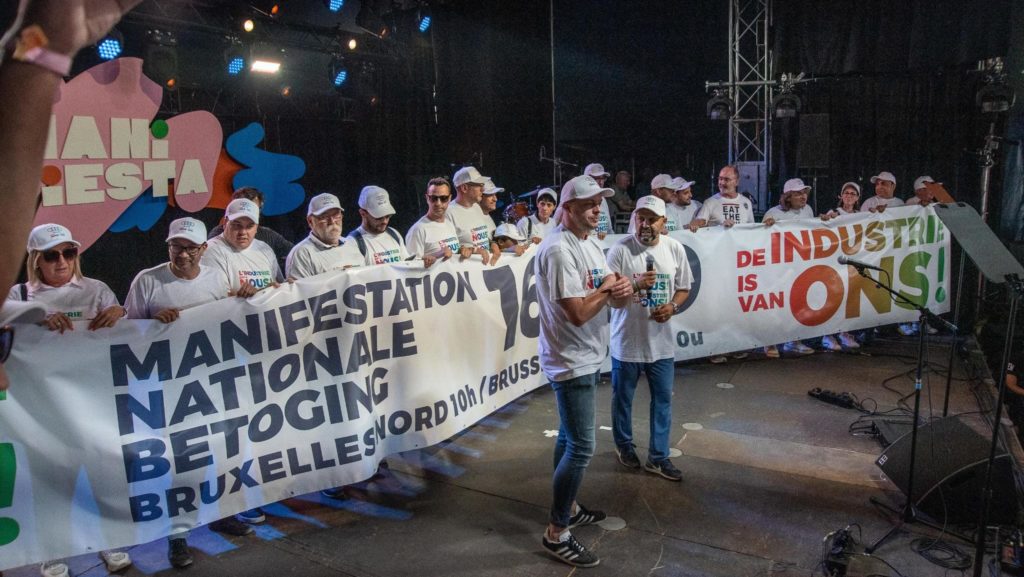
PM: You visited the Volkswagen factory in Wolfsburg. I believe there were some 25,000 workers there. What was your impression?
SF: It was amazing seeing 25,000 workers standing there and protesting with the company executives, chanting and blowing whistles. It was great to see that type of solidarity, especially considering that the leadership of the Volkswagen company was saying they were looking at the possibility of closing four plants in Germany.
Ultimately, what I would love to see is that type of solidarity when they say they’re going to close a plant in Brussels; that those same 25,000 people rise up and say, ‘No, you’re not.’ We’ve got to find ways where we can, as labor organizations, work together and try to figure out how we can work across borders and stand for each other.
It’s easy to say those things, but we need to start really focusing on how we can assist each other. We saw some of that in our organizing drive at Volkswagen in Chattanooga, Tennessee. We’ve been trying to organize that plant for over a decade, and the company would violate the law. We had government officials getting involved, threatening workers. But this time around, we worked with the works council and IG Metall, and we were able [to make progress.] Previously, the company was planning to bring the governor of Tennessee in to speak to workers and tell them basically that if they voted for the UAW, they would close the plant or they wouldn’t get new products. Through IG Metall and the works council, we were able to get them to pressure the leadership, and they basically barred the governor from being allowed on the property at Volkswagen while the election was going on.
It may not seem like a lot, but that was a very important action. We’re trying to find if there are ways we can take action like that. We filed charges in Germany against some violations Mercedes did as a company in an organizing drive. We’re already working together in a way, but we got a long way to go.
PM: In some way, all this system says to working class people is that they are small and they have no power at all. The whole purpose of unionizing is to make people more powerful and to make people believe in themselves. What’s your opinion about that?
SF: When I took over the UAW, I told our membership there’s two words we need to eliminate: ‘can’t’ and ‘fear.’ All I ever heard in the previous 28 years was why we can’t bargain better contracts, why we can’t ask for things, why we can’t demand things. And they would use fear to make sure we didn’t.
To me, organized labor brings hope to workers. You’ve got to be able to do things to do that and to prove that we can win. Throughout the Big Three campaign, I spoke a lot about faith. You know, how scripture says, with faith the size of mustard seed, you can move mountains and so on. By organizing in the South where people said it couldn’t be done, we’ve made believers out of people.
You’re not always going to win, you know, that’s just reality. But when workers see a change in philosophy and they see a change in direction in their union and they see success that they haven’t seen in our lifetimes, they want to be a part of that.
I go back to my grandparents’ generation that went through the Great Depression. I mean, they lost everything. They were destitute. And they were able to migrate north in the US and got jobs at General Motors and Chrysler. It changed their lives. They lived what we called back then the American dream.
That American dream has been dead for decades now, but we have to revive it. I use that moment in the time of my grandparents’ generation to compare with the times we’re in now, because after the recession and after the pandemic, I really believe this is a generation-defining moment. If we focus on the right things and we unify people, I think this could be the same type of moment.
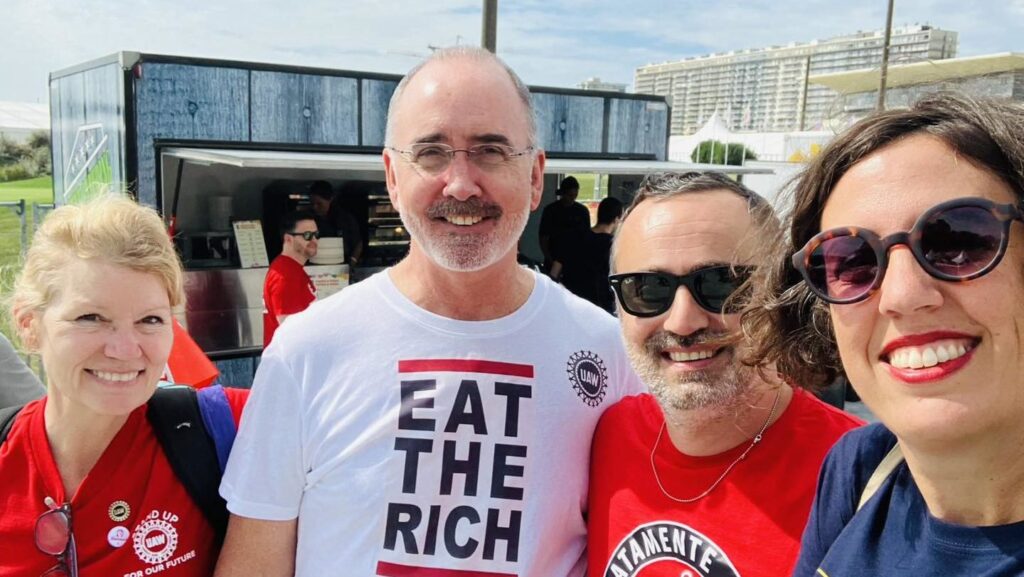
PM: You have a T-shirt that says, ‘Eat the rich.’ What does it mean, ‘Eat the rich’?
SF: To me, it’s basically saying we want to take our lives back. It speaks about wealth disparity around the globe. In America, I talk about the fact that three families have as much wealth as the bottom 50% of Americans.
PM: Wait, three families?
SF: Three families that have as much wealth as the bottom 50% of Americans. That is criminal, and it’s a crisis. There’s also a reason why that’s happening. We [workers] do the work. We generate profits, but we keep getting left behind, and they [the owners] keep driving a race to the bottom.
With technological advances, we should be mastering technology in a way to make workers work less and not have to work as hard, and still have a good quality of life. But instead, the corporate world uses technology advances to eliminate jobs and make the remaining workers work harder and longer for less. When we talk about eating the rich, it’s about turning this around. They’ve been eating our lunch for 40 years and it’s time that we turn the table on them. It’s our turn.
PM: Advancing technology and communication technology is definitely some kind of generational moment, just like artificial intelligence and batteries. In the automotive industry, there is also a lot of change and people might be afraid to embrace the change while protecting jobs and workers’ skills. How do you cope with a challenge like that?
SF: Donald Trump, for instance, talked about how I’m stupid because I’m allowing us to go with batteries and that this will end all of our jobs. This is not true. I’m sure when people went from horse and buggy to automobile, there were a lot of people saying ‘I’ll never buy a car.’ I think it’s the same way now.
There has to be an infrastructure in place and proper timing with this. Maybe the [current] timelines are a little aggressive, but we already see people buying battery and combustion engine combinations [hybrid cars]. I think it helps people adjust more than just going straight out to a battery vehicle. Those who don’t want to see that change are naturally going to drive a narrative that this is going to be the end of your job, that it’s going to be the end of the world. But the Earth is on fire. We have to act. We’ve needed to act for 30 years or longer, and we haven’t. I go back to the 1970s; 54 years ago they were talking about the internal combustible engine and how it’s poisoning our environment. And I mean, really, nothing’s been done in these 54 years in America.
I think that as the infrastructure gets put in place, people will get more comfortable with it. I think you’ll see an easier shift to it. Just like computers, when computers first came out, or cell phones, only certain people had them. No one really understood a lot about them. Now everyone carries a cell phone. We can do our taxes on our cell phones. So I believe as technology improves and as infrastructure improves, things will get better, but we have to build standards into this type of work. If we’re going to have a transition, it needs to be a just transition.
That means that if powertrain work goes away, those workers should have a path to the battery work. They should be making the same [they are making now] or more. Some of the battery work actually is more dangerous. There’s fire risk, exposure risk of the chemicals they’re working with. So we’re really pushing to establish strong standards with the government in that area.
One of the biggest things we’ve been vocal about with our government leaders is that it has to be a just transition. The Biden administration did do a good job with putting language in some of the documents they created for this transition to say that they want companies to partner with unions. That’s an important piece of language for America, because typically it never happens. Workers are an afterthought. We’re trying to make sure that the workers are thought of at the top of this. Some would argue that as a union, we should stick with salaries and wage issues alone, and not talk about just transition, climate, the rich as a class, Palestine. Those are not union issues, some would argue.
PM: How do you respond to this kind of thinking?
SF: Well, I always find it funny when the rich complain about class warfare, whenever working class people rise up. What they don’t talk about is that class warfare has been going on in this world for 40 years. They’ve been taking everything quietly while they have us fighting over race, or LGBTQ+ plus issues, or immigration. They want to point a finger at someone or something else, and say that’s why your life isn’t getting better. They don’t want workers to focus on the reality that corporate greed is why your life is a struggle.
When it comes to situations like the situation in Gaza, we’ve been very vocal about that. And I believe we should [be]. The UAW has always stood for peace and humanity. We’re going to continue to weigh in on those issues. And if someone doesn’t like the fact that we’re going to speak about those things, I don’t know what to tell them.
We have to fight. Everything we fight for is about humanity. The transition, our jobs, working class power, all of that is about having a better human race and everyone sharing the wealth and the fruits of their labor. Unfortunately, only a handful of people are taking all the wealth and they’re leaving everybody else to struggle to get by.
PM: As a union leader, how important is education in the union [to you]?
SF: We have training centers. We have our family education center in northern Michigan that workers go to. We do all kinds of conferences and bargaining training. It’s important to us to talk about work skills and, as technology changes, making sure that our members are trained for those skills through apprenticeship programs, in order for them to have a better life.
I’m a beneficiary of an apprenticeship program. That’s why I’m sitting here right now. If I would have never gone through that apprenticeship, I don’t know where I would be. There’s a lot that we’re doing a lot that we continue to do. We’re trying to work with other unions and talk about things we can do, things we can share, and ideas to keep building on.
PM: I have one last question. If you look at the world, there’s a lot of problems. There’s a lot of wars, lots of misery. There’s a lot of hate too. Where do you see the hope?
SF: To me, the signs of hope are what we’ve witnessed in the last year and a half, just seeing people come together. When the rich and the wealthy try to divide us, they’ll use religion. They’ll use anything they can. But, you know, the conservative class, the Republican Party in the US, the right wing, they love to hold up a Bible, they love to wrap themselves in a flag and talk about the love of country. But everything that they put forward is against all those things.
Any religion I know of in this world is founded on the principle of love of your fellow human being. When you see a disaster, a hurricane or something, no one sits around and asks, ‘Are you a right wing person? Are you a union person?’ It’s because they feel compassion for people who are suffering and they want to fix that. They want to help. All human beings, I believe, are decent, and they want to see a better world. We have a built in love of humanity.
I see people coming over here and just, reaching out with love. That is the world I see. That’s the world we need to see more of, and quit listening to people who just want to preach division. Sometimes we tend to focus on negative things and we lose focus of all the great things that are going on. We really need to get our focus in the right places.
ZNetwork is funded solely through the generosity of its readers.
Donate