
A young boy, no more than sixteen, steers a battered trawler boat with an unyielding focus on the darkness ahead. Between the congestion of bodies on board, a pregnant woman passes in and out of consciousness. “I know you don’t want to come,” the boy cries into the boat’s phone. “You want to let us die here in the middle of the sea,” his voice cracks. There’s silence on the other end of the line. He returns to the wheel. The boat bumps across the waves.
Io Capitano tells the story of Seydou and Moussa, sixteen-year-old cousins from Senegal who dream of becoming world-famous musicians. They carefully stash their savings until they have enough money to cover a trip to Italy, involving a bus through Mali, a trek across the Sahara Desert, a thousand-mile boat ride from the Libyan to the Italian coast, and several life-threatening conflicts in between. Despite having an Italian director at the helm, Io Capitano joins a wealth of films from and about Africa centered on human mobility—a theme that’s become a defining characteristic of the continent’s narratives.
In seminal works like La noire de…, Soleil Ô, and Touki Bouki, characters travel to or fantasize about traveling to France and ultimately confront the reality that a life elsewhere rarely guarantees ease and luxury. In more recent films, such as Queen of Katwe, characters seek socioeconomic mobility by using the Western trope of the hero’s journey as a benchmark to determine what laudable success looks like. Mobility in Mati Diop’s Atlantique is, on the other hand, shrouded in obscurity. These depictions of departure from Africa undoubtedly point to a collective preoccupation about the continent. But what does the actual journey look like for Africans seeking a life across the sea?
According to the UN Refugee Agency, 2023 saw 157,651 people reach Italian shores via “irregular crossings” of the Mediterranean Sea. This crossing from North African countries to Italy is referred to as the Central Mediterranean migration route. The images of these migrations one is most likely familiar with are those pushed by Western outlets. So, suddenly, those 157,651 individuals with distinct nationalities, cultures, and desires are cast into the generic role of hopeless African migrants desperately seeking an escape from one—or all—of the many ills thrust upon their continent by mainstream media. Yet in Io Capitano, writer-director Matteo Garrone offers a perspective that humanizes the individuals behind these vacant tallies.
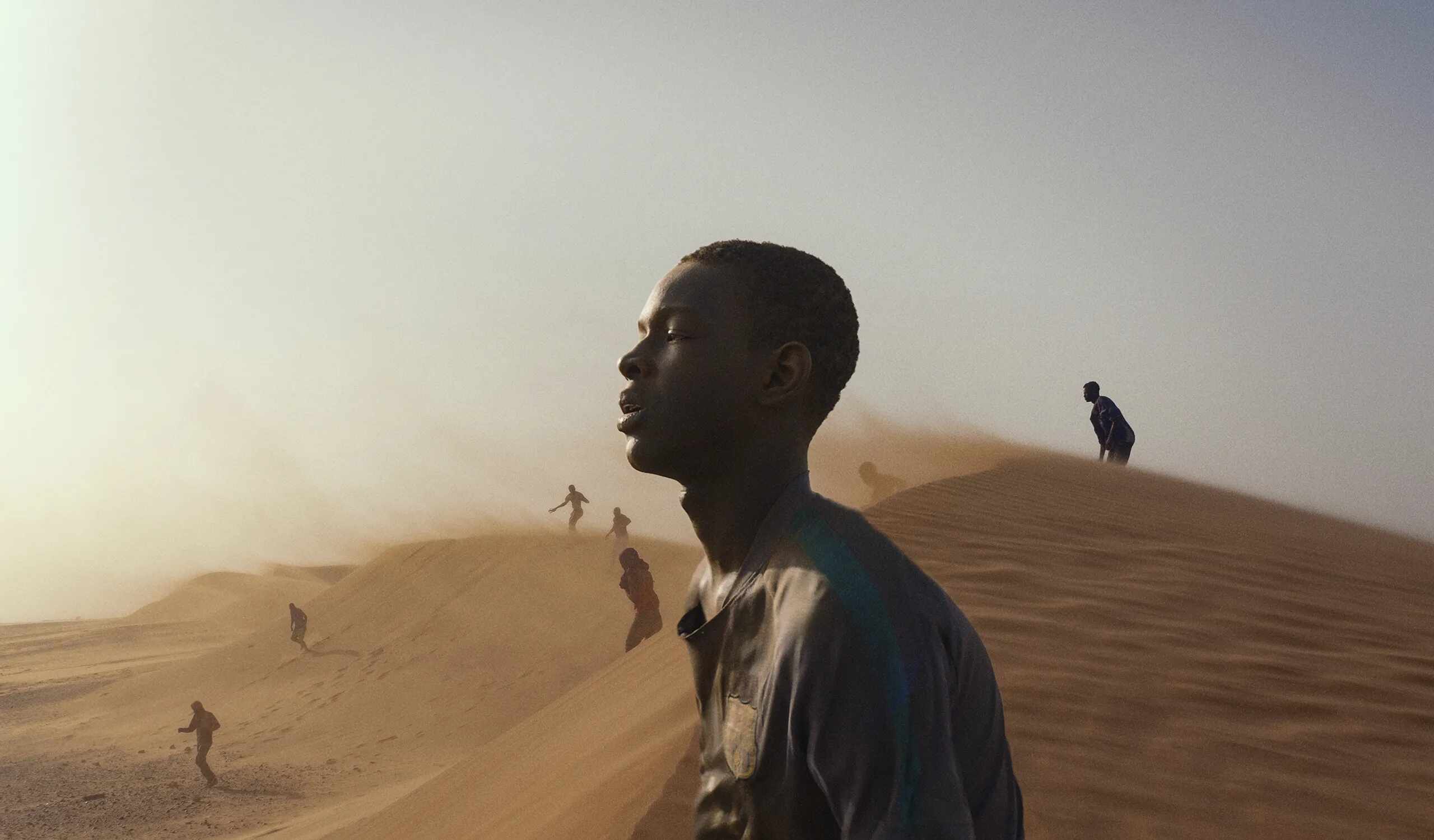
“We are used to having the camera in Europe,” Garrone tells The Guardian, “watching people arriving over the sea: sometimes alive, sometimes dead. I wanted to show the part we should know about but don’t.” Through what Garrone terms a “reverse shot,” Io Capitano delves into what it means for humans to have the right to move and—more crucially—what it means when humans are systematically excluded from this right, leading them to pursue unregulated, high-risk routes abroad. One such route is across the Sahara Desert, which Seydou and Moussa traverse atop a truck crammed with about two dozen other people. As the vehicle hurtles across the dunes, a man flies off the back and tumbles across the sand. The group bangs on the car, screaming to get the driver’s attention. “I told you to hold on tight. Shut up!” the driver shouts back as the car speeds onwards.
In an interview for Democracy Now, Mamadou Kouassi, whose own migration inspired Io Capitano’s story, explains that once you reach the desert, it’s difficult to return: “You see people dying around you and you can’t go back.” He points out that the struggle to get a travel visa and even just an appointment to apply leaves many people who don’t have privileged passports at international borders with no other choice but to cross the desert. Io Capitano’s distinguishing contribution to this discussion is its insistence that an African person’s dream of traveling is decidedly worthy, whether it’s rooted in a desire to build a “better” life or simply in the very human desire to experience the world. This is especially shown in the motivation behind Seydou and Moussa’s embarking on what has been called their “odyssey” from Senegal to Italy.
One evening after work, Seydou and Moussa watch videos on their phone. The various languages, accents, and music illustrate the internet’s role in bringing a geographically distant world into a centralized, accessible space. Later, when the boys’ aspirations of becoming successful musicians are threatened, they remind themselves that one day white Europeans will be asking them for their signatures. In showing the future that the boys imagine for themselves, Io Capitano captures the irony in virtually having the world at your fingertips yet, at the same time, facing systems established to prevent African citizens from the same possibilities as citizens of Western continents.
While holders of Western passports hop between countries and across oceans at the flash of an identity document, citizens of African countries are made to provide reams of evidence justifying why they deserve to experience the Earth as much as their favored counterparts. On top of this, there are the blatant forces, recently seen in the United Kingdom’s Rwanda Bill, deterring asylum seekers from accessing refuge overseas. In this light, Io Capitano’s outlook addresses the discriminatory imbalances in mobility rights and, as Kouassi expresses, serves as an instrument to not only bring awareness to the crisis of irregular migration but also call for the development of formal migration policies that allow humans to move around the world freely and equally without putting their lives on the line.
ZNetwork is funded solely through the generosity of its readers.
Donate