
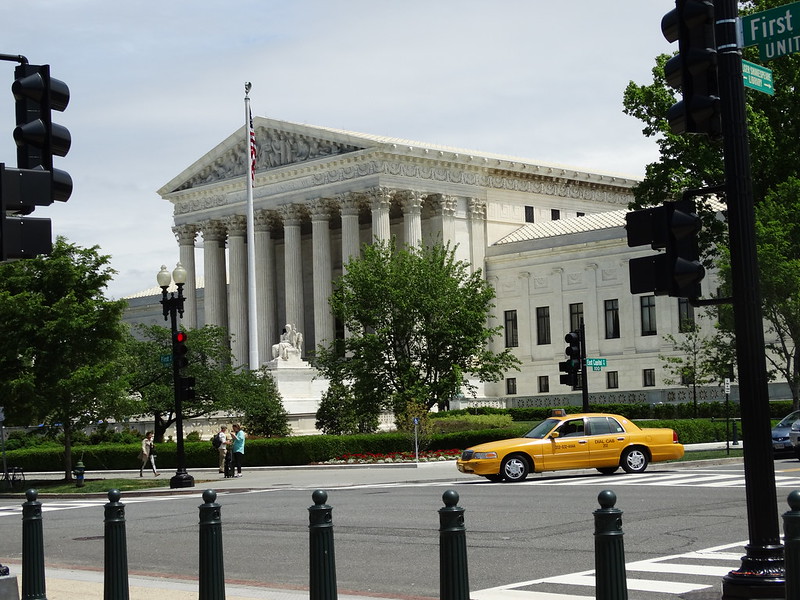
I was in a Roman Catholic seminary for a few years where I picked up, and keep working on, the ethic of love. I have, however, dropped any patience with religious administrative bodies and their omniscient intrusions into politics and personal life. Sadly, the Supreme Court has become a frequent source of those intrusions. It makes love more difficult.
The Court’s decision to overturn Roe vs. Wade has quickly become the classic example of such an intrusion: judicial misogyny wrapping itself in grace and originalist hokum. The chauvinists include the Court’s males, of course, especially Sam Alito, whose opinion often cites a prominent 17th century English jurist, the puritan Matthew Hale, and whose tone echoes the sanctimony of our own Salem Witch Trials – in that same 17th century. Also included is the devout Amy Barrett. She and her majority mates are united under the GOP’s fundamentalist umbrella and, with the exception of Neil Gorsuch, the growing reactionary wing of Roman Catholicism. A sort of curia which sees women with breeding blinkers, citizens who lose full citizenship the minute they conceive: the better half as cattle.
The underpinnings of the decision lie in religious tradition. The six-vote majority embraces authoritarian patriarchy and its foundations: simplistic, sharply defined good and evil, Biblical or Vatican-decreed infallibility, Eve-bequeathed original sin, and more than a whiff of white supremacy. About the present Supreme Court Linda Greenhouse, a longtime observer, has written that, “Religion is the lens through which the current majority views American society…there is no other way to understand the overturning of Roe v. Wade.” That truth is not lost on sign-carrying protesters: “Keep your rosaries out of my ovaries.”
A second intrusion recently extended into the workplace. The court ruled in favor of Lorie Smith, who refused to design websites for same-sex wedding, ignoring Colorado law barring discrimination based on sexual orientation, race, and gender.
A third intrusion extended into public safety. The Court’s striking down New York State’s
concealed weapons law, part of a general expansion of gun rights, reflects traditional patriarchal thinking and the fire and brimstone scent of Old Testament (or 17th century) vengeance. (The fusion of faith and firearms is no better summed up than in recent seasonal greetings from Representatives Andrew Ogles of Tennessee and Thomas Massie of Kentucky, which picture their families, both kids and adults, heavily armed next to Christmas trees.)
A fourth intrusion extended into education. The abolition of minority-based affirmative action is a shocking rejection of precedent as well as the pledges made to it during confirmation hearings. Bowing to legal fashion, we must call these pledges misstatements. In any case, obeisance to dogma does not even recognize dishonesty, not in the light of an absolving duty to higher authority. Thus, more omniscience and the inevitable return to more familiar, entrenched, white male affirmative action.
The Supreme Court is now, justifiably and broadly, recognized as a political institution. And if the Court is not the leader on workplace, gun, or education issues as it is on abortion, it’s certainly being swept up in the political movements it fosters. As Jamelle Bouie has written, “The truth about the Supreme Court is…that it is a political institution, jockeying for power and influence among a set of political institutions.” And a faith-based institution at that. The sort of questions once asked of candidate John Kennedy, whether as president he would accept Vatican authority over the Constitution, do not seem antiquated today.
The founding fathers had deep experience with theocratic power and recognized the great truth that the democratic ideal, with its codifying of inalienable rights, had evolved past tribal, religious absolutism. They created the walls of protection for the new democracy that are now being removed. They knew well the dangers of those who, like Salem Sam and the Vaticanettes, unquestionably, miraculously, know better than the rest of us.
ZNetwork is funded solely through the generosity of its readers.
Donate