

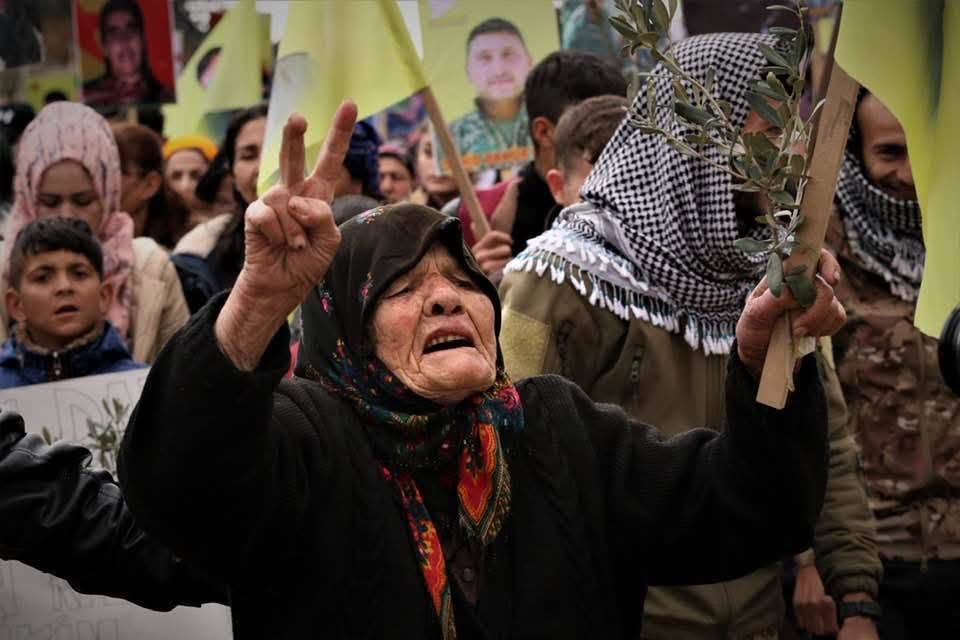
The attacks targeting the Kurdish neighborhoods of Sheikh Maqsoud and Ashrafiyah in Aleppo are not the products of instantaneous military developments or local clashes; they are inherently a part of a multi-layered and conscious political sabotage strategy of the invader, colonialist Turkish state.
The brutal massacre attacks directed at the Kurdish neighborhoods in Aleppo through the Turkish state and the jihadist paramilitaries it supports named Hayat Tahrir al-Sham (HTS) and the Syrian National Army (SNA) are an organized move aimed at neutralizing the political impact of Kurdish People’s Leader Abdullah Öcalan’s message for the year 2026 and his February 27 statement, which constitutes its essence.
These attacks are neither a tactical reflex nor a secondary extension of the struggles for control on the ground. They are a counter-revolutionary intervention, planned with the state mind, aiming to prevent even the possibility of a solution to the Kurdish question from becoming visible.
The February 27 statement is dangerous for Ankara as much for the calls it contains as for the historical moment it represents. This statement has once again revealed that the Kurdish question cannot be managed with policies of armed denial, suppression, and distraction; it has expanded the address of the solution to point not only within the borders of Turkey but to the entirety of the regional Kurdish reality.
The 2026 perspective has also temporarily squeezed the state policy based on making the Kurds’ lack of status permanent. This very squeeze has triggered the fundamental reflex of the AKP–Erdoğan regime: Not to advance the solution, but to annihilate even the fragments of the possibility of a solution.
At this point, the fundamental goal of the fascist Turkish state is clear: To break the military and political backbone of the de facto Kurdish status emerging in Rojava, Northern and Eastern Syria. The YPG, YPJ, and Syrian Democratic Forces are not only the military power of this status but also the concrete realization of Öcalan’s paradigm on the ground.
Therefore, the problem for Ankara is not only the armed structures but the political-ideological ground upon which these structures rest. Öcalan’s message was targeted precisely because it carries the potential to legitimize this ground and make it visible again on a regional scale.
In line with this goal, the Turkish state first tried the path of direct political pressure. For example, the impositions toward Öcalan carried the aim of expanding the content of the message and establishing the connection that it is not only an intra-Turkey call but also directed toward Rojava. All these attempts of the fascist Turkish state were neutralized by Öcalan. Subsequently, parliamentary delegations were put into play, and meetings were held, but again, the desired result could not be obtained.
Because Öcalan’s February 27, 2025 call and the Manifesto of Democratic Society are only related to the PKK. They were not made toward organizations in other parts of Kurdistan. The PKK, for its part, has taken the steps falling upon it based on Öcalan’s calls until today. Through the steps it has taken, the PKK has clearly diagnosed and exposed that the fascist Turkish state does not show a sincere and concrete will for a solution.
The critical point that must be underlined here is this: The fascist Turkish state has no solution plan regarding the Kurdish question. This is not a deficiency but a conscious choice. If there were such a plan, it would have had to be reflected in legal and constitutional regulations by October 2025 at the latest.
However, the state deliberately spread the process over time and tried to pacify the Kurdish Freedom Movement with tactics of distraction and postponement. It did not limit this only to Northern Kurdistan (the part in Turkey) but tried to spread it to the parts of Kurdistan in Iran, Iraq, and Syria as well. This is the classic fascist Turkish state mind that does not produce a solution but manages the lack of solution.
While this distraction continued inside, a harsher tool was put into play outside: Proxy war.
The driving of jihadist gangs HTS and SNA onto the stage in Aleppo, especially in Sheikh Maqsoud and Ashrafiyah, is a direct result of this strategy. These Kurdish neighborhoods were not chosen randomly. Sheikh Maqsoud and Ashrafiyah are the military, political, and social vanguards of the Rojava revolution in Aleppo.
These neighborhoods are living examples of how Öcalan’s paradigm can be vitalized even under urban conditions, siege, and war. Therefore, the attack toward these areas is directed not only at Kurds but at an idea, a model, and a future.
The role of HTS and SNA in this process is not limited to simple subcontracting. These structures are the most functional tools that the fascist Turkish state mind can use on the ground.
Because they both possess anti-Kurdishness ideologically and are actors who can be easily criminalized in the international arena and discarded when necessary. In this way, Ankara aims to achieve strategic benefits from the results without appearing as the direct perpetrator of the attacks. This is a classic dirty war method.
The timing of the attacks against Sheikh Maqsoud and Ashrafiyah also gains meaning in this context. These attacks intensified at a moment when Öcalan’s message began to be discussed much more by the public as of 2026, and the possibility arose for the Kurdish question to be talked about again on the axis of a political solution.
The aim is clear: To pull the agenda back to the axis of security and violence, to create distrust toward Öcalan among the Kurdish people, to create distrust and contradictions between the PKK and Öcalan to fracture and weaken the Kurdish Freedom Movement. And most importantly, to imprison Kurds in a defensive position and suffocate the solution discussion. War, here, is not only a result but inherently a tool.
The targeting of Sheikh Maqsoud and Ashrafiyah is also a threat. The message is clear: If there is no laying down of arms by the Syrian Democratic Forces in Rojava, Northern and Eastern Syria, there will be civilian massacres in Aleppo. And this will not be limited only to the two Kurdish neighborhoods in Aleppo.
This is a message given not only to Kurds but also to the international community. The Turkish state is putting the Kurdish issue on the table again as an element of instability and trying to show that it holds the key to this instability.
The political meaning of the attacks directed at Sheikh Maqsoud and Ashrafiyah in Aleppo cannot be explained only by Ankara’s tactical choices. These attacks are a current manifestation of the structural reflexes of the fascist Turkish state mind regarding the Kurdish issue, spanning over a century. This reflex, at every moment a possibility of a solution appears, turns toward destroying the possibility of a solution, not the problem.
Because for the Turkish state, the Kurdish question is not an issue to be solved, but an anomaly to be managed, spread over time, and suppressed with violence, blood, and massacres under suitable conditions.
Öcalan’s February 27 statement and the 2026 perspective could not be stomached and were targeted because they created a threshold that disrupted this management strategy. This threshold forced a rethinking not only of intra-Turkey balances but also of regional Kurdish geopolitics. The self-governance model that emerged in Rojava has de facto surpassed the paradigm that imprisons the Kurdish issue within nation-state borders.
YPG, YPJ, and the Syrian Democratic Forces, beyond being military forms of this surpassing, are the social-political expression of Öcalan’s paradigm. The moment these forces lay down their arms, the issue will not be solved; on the contrary, the military, political, and social gains of the Kurds will be left defenseless and put into a liquidation process. Ankara’s persistent imposition of disarmament stems not from a will for a solution but from an intention for liquidation.
For this reason, the Turkish state wanted to expand Öcalan’s message and not reduce it only to a “call for disarmament” inside Turkey. The regional dimension of the message, the political horizon covering Rojava, Northern and Eastern Syria, is unacceptable for Ankara. The fact that the impositions remained inconclusive directed the state mind to harsher and indirect tools.
The putting of parliamentary delegations into play was the soft face of this harshness. But these attempts also did not produce a solution because the state did not offer a concrete roadmap. Distraction, uncertainty, and spreading over time were operated as a conscious strategy.
The complementary pillar of this strategy in foreign policy is the use of proxy forces. HTS and SNA are as functional here as they are ideologically anti-Kurdish. But structures provide Ankara with two advantages: First, the capacity to produce violence without taking direct responsibility. Second, deniability thanks to their ability to be presented as “out-of-control actors” in the international arena. However, the logistics, timing, and target selection of the attacks in Aleppo show that this denial is not convincing.
The selection of Sheikh Maqsoud and Ashrafiyah is not a coincidence. Because these neighborhoods are the political reflection of Rojava in Aleppo. The life established here has shown that Öcalan’s paradigm can become socialized even under war conditions.
Communes, councils, women’s leadership, and self-defense have been able to produce order, not chaos, in the absence of the state. It is precisely this reality that Ankara fears most. Because as long as these neighborhoods stay on their feet, the discourse of “if you lay down arms, there will be a solution” loses its credibility.
HTS’s role in these attacks cannot be explained only by ideological fanaticism. HTS is a theocratic power project supported by the USA, EU, Saudi Arabia, Qatar, and the Turkish state, aiming to take society under absolute obedience. This project is in an existential conflict with a pluralistic, women-liberated, and communal life.
Sheikh Maqsoud and Ashrafiyah are not only a military target for HTS but an ideological bankruptcy. As long as these neighborhoods exist, HTS’s claim of an “Islamic order” collapses. For this reason, the attacks are fed by ideological hatred more than military necessity.
The SNA, on the other hand, performs a more naked function in this picture. Demographic transformation, looting, and forced displacement are the basic practices of the SNA. These practices overlap exactly with the long-term goals of the Turkish state regarding Rojava and its surroundings.
The fragmentation of the Kurdish population, the breaking of social continuity, and the dispersal of the political subject is a much more effective liquidation method than disarmament. The attacks in Aleppo are the testing ground for this method.
The fact that the PKK has taken the steps falling upon it inside has not strengthened the state’s hand; on the contrary, it has made the state’s distraction politics more visible. Because every step taken toward a solution requires concrete regulations in return.
However, as of October 2025, the legal regulations that should have been made were not made, constitutional discussions were not started, and instead of preparing the public for the idea of a solution, it was surrounded again by security discourse. This shows that the process was consciously suspended.
The attacks in Aleppo are precisely the external front complement of this suspension policy. An equation has been established in which Kurds are distracted by the discourse of “adherence to the process” on one hand, and forced to pay a price on the ground on the other.
This equation is built on either pushing the Kurdish side out of the process with a defensive reflex or forcing them into unconditional disarmament. In both cases, the winner will be the state mind that aims for liquidation, not a solution.
The form of the attacks directed at Sheikh Maqsoud and Ashrafiyah in Aleppo reveals in all its nakedness how the Ankara-centered strategy operates. The violence applied here is not the product of a war logic aiming for military gain; it is a calculated and time-spread social destruction technique aimed at producing political results.
Civilian massacres, siege, the targeting of infrastructure, and forced migration are the real language of the disarmament imposition on the ground. This language is the language of threat, not negotiation.
The systematic targeting of civilian areas cannot be explained as a control error or a lack of discipline. The houses, schools, markets, and health points hit in Sheikh Maqsoud and Ashrafiyah are the result of a conscious choice aiming to weaken the collective living capacity of Kurdish society.
Because Ankara’s strategy assumes this: The more price the society pays, the more effective the pressure for disarmament will be. This assumption is an expression of having never understood Kurdish history and the sociology of resistance.
Siege is the central tool of this strategy. Siege is not only a military technique; it is a political practice that paralyzes social time, fragments daily life, and aims to erode hope. Sheikh Maqsoud and Ashrafiyah have been wanted to be taken over many times with this method.
But every time, it has been seen that the siege did not produce the expected result. Because in these neighborhoods, society takes its strength not from the security provided by the state, but from its own organized existence. Hunger and deprivation have produced solidarity, not dissolution.
Forced migration and demographic pressure are the complementary elements of the disarmament policy. The aim is to break social continuity rather than to physically destroy Kurds. With every family forced to migrate, a memory line, an experience of organization, and a political bond are intended to be broken. However, the example of Sheikh Maqsoud and Ashrafiyah shows that this calculation also does not hold. Because these neighborhoods have produced a political culture that is not limited to space. The one who migrated carried this culture along with them.
At this point, it is necessary to read correctly the equivalent of the disarmament imposition on the ground. The expectation of the Turkish state is that the increasing violence will narrow the Kurdish movement with a defensive reflex and distance it from political initiative. However, what is experienced is exactly the opposite.
The attacks in Aleppo have made it clearer in Kurdish society not the need for a solution, but under which conditions a solution cannot be possible. Calls for laying down arms toward Rojava, Northern and Eastern Syrian defense forces are perceived under these conditions not as the name of peace, but as surrender.
For this reason, the goal of disarming the YPG, YPJ, and Syrian Democratic Forces finds no response on the ground. Because these forces are not only military structures but the institutionalized forms of social defense. In Sheikh Maqsoud and Ashrafiyah, the weapon is not a tool of power but a limited defense mechanism that protects the continuity of life. When this mechanism was removed, not peace but massacre arrived. The experience in Aleppo has revealed this truth with all its clarity.
The attitude of international actors is also an inseparable part of this process. Silence is not neutrality but a functional approval. As long as the Great Powers see the goal of disarming Kurds as compatible with their strategic interests, they have ignored what happened in Aleppo. Human rights discourse functioned as a showcase at this point and veiled the reality on the ground. This situation has once again confirmed the following for Kurds: A people who entrust their own security to someone else’s conscience is historically doomed to lose.
The language of the media also forms the ideological ground for this approval. Concepts like “clash,” “mutual fire,” and “security operation” erase the difference between the aggressor and the defender. However, what is experienced in Sheikh Maqsoud and Ashrafiyah is not a mutual clash but a unilateral attack aimed at suffocating the possibility of a solution. This language not only distorts the truth but also normalizes violence.
This whole picture clearly shows why the goal of disarmament is doomed to fail. As violence increased, Kurdish society turned not toward laying down arms but toward stronger organization. Because what has been experienced has proven many times that weaponlessness does not bring security; on the contrary, it creates vulnerability. The attacks in Aleppo are the most current and most painful example of this historical lesson.
The massacres directed at Sheikh Maqsoud and Ashrafiyah were designed not to accelerate the disarmament process, but to force consent to this process. However, this design worked in reverse on the ground. The stage reached by the attacks directed at Sheikh Maqsoud and Ashrafiyah in Aleppo makes visible the bankruptcy of a political mind, not just a military concentration. This bankruptcy declares the non-solution of the solution imposed by the gun, that the politics of distraction has been exhausted, and that proxy violence cannot cover the truth.
At the point reached today, the aggression carried out by Ankara through HTS and SNA has not eliminated the historical threshold pointed out by Öcalan in his February 27 statement; on the contrary, it has made the inevitability of that threshold even more distinct.
The reason why Öcalan’s paradigm is strengthened under these conditions is not a superiority of discourse, but a correctness of practice. Sheikh Maqsoud and Ashrafiyah have made possible a life where the weapon is not sanctified but defense is mandatory, and where power is not centralized but politics is socialized.
This life has surrendered to neither the statist security doctrine nor to jihadist theocratic tyranny. For this reason, the attacks aimed at denying the possibility of this life more than weakening these neighborhoods militarily. But denial does not eliminate the truth; it only makes it more visible.
The fundamental fallacy of the Turkish state is that while presenting disarmament as a prerequisite for peace, it has not been able to guarantee security and life. What happened in Aleppo clearly showed that weaponlessness produces not a solution but a fragility under these conditions.
For this reason, the idea of laying down arms in Kurdish society has become identified not with peace but with defenselessness. This identification is the product of concrete experiences, not an ideological stubbornness. The attacks in Sheikh Maqsoud and Ashrafiyah have engraved this experience into the collective memory.
At this point, the conditions for a solution have become clearer. A solution is possible through mutual and concrete assurance, not through imposition. A solution advances with open legal and constitutional steps, not with distraction calendars. A solution can be established with a political courage that recognizes the regional Kurdish reality, not with proxy wars. The regulations not made in October 2025 showed not the deficiency but the absence of this courage. This absence was tried to be compensated for with violence in Aleppo.
The resistance of Sheikh Maqsoud and Ashrafiyah is, therefore, not only a defense success but a political criterion. These neighborhoods have clarified under which conditions there cannot be a solution. There can be no solution on a ground where weapons are silent but justice does not speak, where negotiation is voiced but the law is not operated, and where peace is promised but security is not provided. The attacks in Aleppo have revealed this truth with all its clarity.
The presence of HTS and SNA on the ground has shown that these attacks do not produce legitimacy but only multiply the dirty face of violence. The language, method, and goals used by these structures supported by the fascist Turkish state have not distanced Kurdish society from a solution; on the contrary, they have confirmed that a solution can only be protected by self-defense and political organization. This confirmation is not a temporary mood but a historical lesson.
The silence of the international system is also a part of this lesson. The atrocity experienced in two Kurdish neighborhoods in Aleppo has once again exposed how conditional and interest-oriented the peace discourses of hegemonic powers are. This silence did not produce a new illusion in the political mind of the Kurds; it reinforced an old truth: Peoples who tie their own fate to someone else’s calendar have to postpone their own future.
The resistance in Sheikh Maqsoud and Ashrafiyah is the concrete expression of rejecting this postponement. It must be clearly stated here once again: The attacks directed at Kurdish neighborhoods in Aleppo are not a security problem. They are a political sabotage. This sabotage aimed to suffocate the historical opportunity opened by Öcalan’s 2026 perspective and the February 27 statement. However, this goal did not find its response on the ground. Because what is defended in these neighborhoods is not just a call, but a lived and living truth.
Sheikh Maqsoud and Ashrafiyah stand today not only as two resisting neighborhoods but as İwo political laboratories showing on which ground a solution is possible. The result of this laboratory is clear: Peace begins not with the silencing of weapons, but with the securing of life.
A solution is possible through mutual recognition and concrete transformation, not through surrender. This truth has become even more clear among the ruins of Aleppo.
ZNetwork is funded solely through the generosity of its readers.
Donate




