

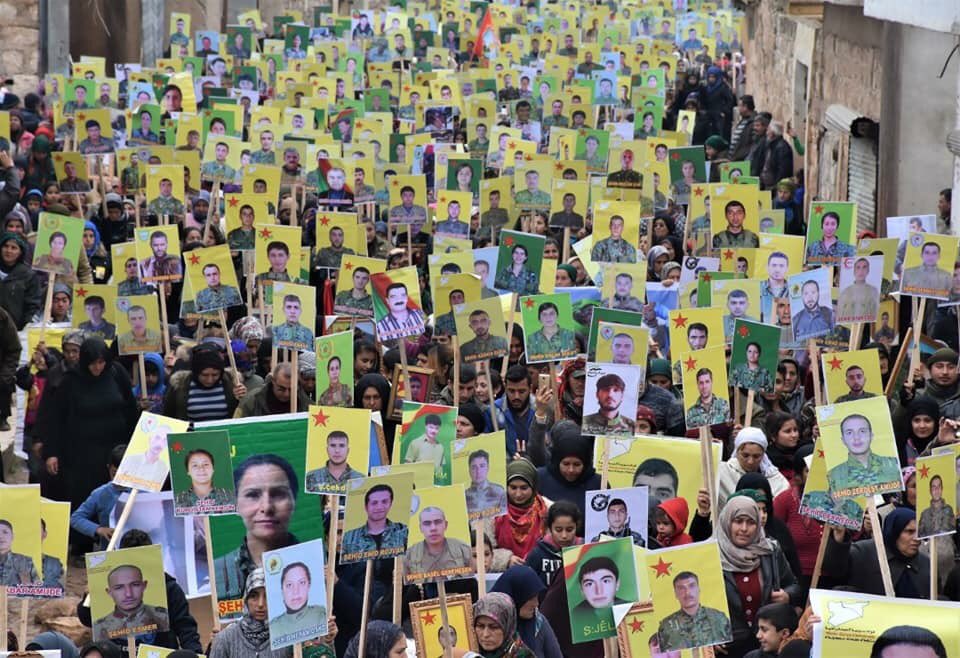
I am not seeking a balance here. I make no claim to neutrality. I consciously reject the language of “both sides.” Because I am a warrior of my people. Because in the face of the attacks directed at the Rojava Revolution, neutrality is not merely political naivety; it is functional complicity. At certain moments in history, there is no room for a mere difference of opinion; there is only alignment. Today, when it comes to Rojava, the issue is not interpretation; it is position.
The attacks on the Rojava Revolution are not a crisis. They are not a miscalculation, a case of getting out of hand, or a mere local tension. What is happening is a conscious process of liquidation, woven over a long period, patiently matured, and executed in a multi-layered fashion. This liquidation is not limited to military destruction. It encircles through diplomacy, dissolves through special warfare, and attempts to rot the movement from within by producing local treachery. Weapons are merely the visible face. The real war is the targeting of meaning, legitimacy, and hope.
Therefore, the attacks on Rojava cannot be explained by the concept of security. No state’s border has been threatened. No global power perceives a direct military risk from Rojava. The problem is not what Rojava does, but what Rojava is.
Rojava is not a “model”, it is a threat
The Rojava Revolution is not an abnormality for capitalist modernity; it is a direct threat. This is because Rojava has physically shattered the core assumptions that the system believed could never be challenged. It has demonstrated that a society can govern itself without a nation-state, that life can be organized without the hegemony of the market, and that freedom is not possible without breaking the back of male dominance. This demonstration is dangerous because it is not a theoretical claim, but a living practice.
Capitalist modernity is not entirely opposed to freedom. On the contrary, it encourages it as long as it remains controllable. Individual freedoms, consumer choices, and ballot-box democracy are not problems for this system. The problem arises when freedom becomes collective, institutionalized, and begins to transform power relations. The freedom built in Rojava is precisely this: a freedom that cannot be regulated, centralized, or imprisoned within representative mechanisms.
This is why the Rojava Revolution is being suffocated with offers of integration. Rhetoric such as “be realistic,” “respect regional balances,” and “don’t go too far” are not calls for peace; they are exhortations to surrender. The system is not against Rojava existing; it is against Rojava existing as Rojava.
The fear of ungovernable freedom
The real crisis created by Rojava is neither military nor diplomatic. It is ontological. It is the crisis of ungovernable freedom. Rojava has rendered the classical tools of power dysfunctional. It has produced a structure that is not centralized around a single leader, not reduced to a single party, and not dependent on external intervention. This is a nightmare scenario for the modern logic of power.
Capitalist modernity, in crisis zones, desires neither total stability nor total destruction. What it needs is controlled chaos. This chaos legitimizes intervention, prevents local subjectivities from taking root, and produces an uncertainty that can be rearranged at any moment. Rojava has broken this pattern. It has produced collective order out of chaos and political will out of uncertainty. This is exactly why Rojava is ungovernable. Any form of freedom that cannot be governed is, for the system, an anomaly that must be liquidated.
The women’s revolution: the red line
One of the primary reasons the Rojava Revolution is so targeted is that it has made women’s liberation a foundational principle rather than a secondary one. Here, women are not just holders of rights; they are subjects who actively share power, organize defense, and govern society. This situation is unacceptable not only for local patriarchal structures but for the global capitalist system.
Capitalism operates in alliance with patriarchy. Male dominance is not just a cultural issue; it is the backbone of production relations, property regimes, and political representation. The breaking of this backbone in Rojava is an attack on the most sensitive point of the system. Consequently, women’s leadership is constantly targeted, criminalized, and branded as radical. Women’s freedom here is not an ornament; it is the redistribution of power. No power structure voluntarily consents to its authority being stripped away in this manner.
The diplomatic lie: the myth of neutrality
The stance of international powers becomes clear at this point. The US and the EU have never recognized Rojava as a political subject. For them, Rojava is, at most, a militarily useful apparatus. It was tolerated as long as it was useful in the fight against ISIL, but the moment it began to produce its own political will, they sought to constrain it.
Terms like neutrality, balance, and restraint are the ideological cloaks for this containment. This language consciously erases the distinction between the aggressor and the defender. Attack is stripped of being an action and reduced to a situation. Defense, meanwhile, is presented as a problem that escalates tensions. This is the raw reality of how modern diplomacy functions as another form of war. The goal here is not to stop the conflict, but to stop the revolutionary defense.
The logic of liquidation is permanent
The attacks on Rojava are not temporary. As long as this revolution exists, it will be a target. Because Rojava represents a possibility for the future; not just for a geography, but for humanity. This possibility forces the following question in the Middle East and beyond:
“Is a life without the state, without patriarchy, and without capitalism possible?”
The moment this question is asked, the system trembles. Because when this question is answered, it becomes clear that the current order is not mandatory. The Rojava Revolution is targeted because it answers this question not theoretically, but practically.
This is why the logic of liquidation is so persistent, multi-layered, and ruthless. At this point, the question is: Will Rojava be defended, or will we watch its step-by-step strangulation under the guise of realism? History records the answers given to this question, not those who remained neutral.
The liquidation that began in Aleppo
The attacks directed at the two large Kurdish neighborhoods in Aleppo, Sheikh Maqsood and Ashrafiyah, were not the beginning of the liquidation process against the Rojava Revolution; they were its first overt declaration. These attacks did not arise from military necessity. They were not carried out by forces out of control on the ground. There was no misunderstanding or sudden tension. What occurred was the conscious and planned targeting of revolutionary freedom as it manifested in urban space.
Therefore, reading what happened in Aleppo as a mere front is insufficient. Aleppo is a laboratory. It is the first area where the logic of liquidation tested which tools and under what conditions it could be deployed. Sheikh Maqsood and Ashrafiyah became the most symbolic targets of this experiment.
Fear of the urban revolution
For modern power, the city is not just a settlement. The city is the space where legitimacy is produced, where power is visible, and where memory is institutionalized. Many things tolerated in the countryside are never accepted in the city. Because a revolution that takes hold in the city ceases to be temporary and becomes irreversible.
The presence of the Rojava Revolution in Aleppo crossed the threshold of tolerance for precisely this reason. Sheikh Maqsood and Ashrafiyah are not just Kurdish neighborhoods. These are spaces where women’s leadership, multi-ethnic councils, communal life, and self-defense were materialized at an urban scale. They proved that the revolution was not a rural experiment but could thrive in the metropolis. The message was clear: the revolution may be squeezed into the countryside, but it must not take root in the city.
The Turkish state and Jihadist apparatuses
The perpetrators of these attacks are not ambiguous. The Turkish state is not conducting a classical occupation by deploying jihadist structures like HTS and the SNA. What is being applied here is an updated version of modern counter-guerrilla logic: violence that appears stateless but is directed by the state.
HTS and the SNA are neither independent actors nor do they have their own political agendas. They are apparatus structures used by the Turkish state to vacate areas without taking direct responsibility. Their task is not to win a military victory, but to make life unsustainable. The targeting of civilians, the siege of neighborhoods, and the destruction of infrastructure are not coincidences. The goal is to force the people to migrate, to scatter collective memory, and to empty the revolutionary space. This is not classical war. This is demographic and political liquidation.
The strategy of civilianized destruction
The character of the attacks on Sheikh Maqsood and Ashrafiyah is clear: civilian life was targeted more than military objectives. This cannot be explained as a mistake or lack of control. It is a conscious strategy. Because a revolution lives through social continuity before it lives through armed force. When that continuity is broken, military resistance loses its meaning.
Making neighborhoods uninhabitable targets not just today, but tomorrow. The return of the displaced population is made difficult. Communes are dispersed. Women’s organizations are fragmented. Fear is planted in the memories of children to replace collective memory. The essence of modern colonial violence is exactly this: occupying the memory, not just the land.
The resistance of the Asayish: ethical-political defense
Under these conditions, the resistance displayed by the Asayish forces was not a military counter-attack. This resistance was an ethical-political defense. The goal was not to gain territory, but to protect the people, prevent the spread of the attack into the heart of the neighborhood, and buy time. This is a clear example of what revolutionary defense means.
Revolutionary defense is not always built on winning in the conventional sense. Sometimes, resisting in the right place means preventing a much larger destruction. This is exactly what was done in Sheikh Maqsood and Ashrafiyah. A balance was maintained between means and responsibility. This balance is the very essence of revolutionary ethics.
Diplomatic intervention: the operation to halt the defense
As the resistance lengthened, the larger plan behind the attack was revealed. The goal was not to quickly topple the neighborhoods, but to push the resistance to a certain threshold. This threshold is the point where international actors would step in. Indeed, at this stage, the intervention of the Syrian Democratic Forces in Aleppo came to the agenda, but it was blocked by diplomatic pressure before it could even happen.
At this point, no masks remained. If the issue had been the protection of civilians, the aggressor would have been stopped. If the issue had been preventing the conflict from growing, the source of the attack would have been targeted. But the opposite was done. While the attack continued, the expansion of the defense was prevented. This is not neutrality. This is a clear political preference.
Withdrawal: not defeat, but exposure
The withdrawal of the Asayish forces from Sheikh Maqsood and Ashrafiyah was a necessary decision taken under these conditions. This was not a surrender; it was a strategic withdrawal to prevent a more destructive scenario. However, the responsibility for this necessity lies not with those who resisted, but with those who consciously left the resistance isolated.
It was seen once again in Aleppo that the diplomatic arena is not an alternative to the military arena, but its complement. The siege established at the table is intended to complete the liquidation that remained unfinished on the ground.
Aleppo is not an exception, it is a model
What happened in Aleppo did not end there. On the contrary, the model tested here would later be reproduced in Der Hafir, Meskenah, and the Raqqa–Tabqa line. The same actors, the same justifications, the same results. This repetition proves that what occurred was not accidental, but systematic.
In this sense, Sheikh Maqsood and Ashrafiyah are not just experiences of withdrawal. They are areas of exposure that reveal the true function of the international system, diplomatic rhetoric, and the fables of balance.
The attempt to purge the revolution from the city was meant to be stopped here. But this attempt could not be suppressed. Because what happened in Aleppo showed not the weakness of the Rojava Revolution, but how terrifying it is perceived to be.
Siege under the guise of diplomacy
While Sheikh Maqsood and Ashrafiyah were under siege in Aleppo, what descended upon the field was not peace. What was brought to the table was not a solution. The mechanism put into play was not a diplomatic process in the classical sense at all. It was the completion of a military liquidation through diplomatic means. This is the most refined, most hypocritical, and least visible front of modern war.
Today, what is called diplomacy does not produce peace. Diplomacy freezes power relations. It protects the status quo. It limits the revolution. And it does so while appearing not to shed blood. Yet, blood flows exactly at the moment this neutral fable is established.
Neutrality is a lie, balance is a weapon
The US and EU-centered diplomatic discourse served two main functions during the Aleppo process. First, to make the perpetrator of the attack invisible. Second, to push the defender into a guilty position. Expressions like de-escalation, restraint, and preventing the spread of conflict are not innocent. These are not technical concepts; they are political ammunition.
This language consciously erases the difference between the aggressor and the defender. The attack is stripped of being a will and becomes an abstract situation. Defense is presented as a part of this situation. Thus, while the responsibility of the aggressor is evaporated, those resisting are put under moral pressure. This is not neutrality. This is a preference that protects the aggressor.
The real target of diplomacy: revolutionary self-power
The decisive factor in Aleppo was this: an intervention by the Syrian Democratic Forces in the city would not have escalated the conflict, but rather stopped the attack. This was known by everyone. Despite this, the intervention was blocked through diplomatic channels. Because the issue was not the spread of conflict. The issue was the legitimization of revolutionary self-power in the city.
The active presence of the Syrian Democratic Forces as a defensive force in Aleppo would have confirmed that the Rojava Revolution was not just a structure squeezed into the countryside, but a political subject on a metropolitan scale. It is this confirmation that the logic of liquidation can never accept. Therefore, diplomacy was operated as a prevention mechanism. What was prevented was not war. What was prevented was the victory of the resistance.
Production of knowledge: epistemological war
In this process, diplomacy has not only a political but also an epistemological function. The knowledge produced here is this: The Rojava Revolution is a source of instability. This is not said openly; if it were, it would be exposed. Instead, it is hidden within neutral concepts like local actors, chaos on the ground, or uncontrolled elements. These expressions anonymize the attack. They blur the perpetrator. They distribute the responsibility. In the end, no one is guilty. Everyone is just trying to manage the situation.
This is a classic technique of modern power. As Michel Foucault stated, power operates not only through force but through the production of knowledge. The knowledge produced here codes the revolution as the problem and the status quo as the solution. Thus, a moral issue is transformed into a technical one.
Hopelessness as a weapon
Another dimension of the diplomatic siege is the intended destruction of social morale. The feeling that Rojava has been left alone in the international arena has been consciously produced. Messages like “No one is standing up for you,” “Everyone can sacrifice you,” and “Be realistic” are the psychological ammunition of special warfare.
In modern war, victory is not only won on the front. It is won in the minds. Hopelessness is a weapon here. When the idea that the revolution is alone becomes widespread, the meaning of resistance begins to be questioned. At this point, diplomacy becomes more destructive than direct military violence.
The guardians of the status quo
The stance of the US and the EU is not a contradiction. This stance is perfectly consistent. For them, the problem is not ISIL. ISIL is a threat that can be eliminated when necessary and summoned back when needed. The real problem is uncontrollable freedom. This is why the Rojava Revolution is dangerous.
For this reason, diplomacy has never offered Rojava an equal partnership. Rojava has always been treated as a temporary, exceptional, and postponable structure. This approach is part of the strategy to suffocate the revolution by spreading it over time.
The limit of diplomacy is the righteousness of the revolution
However, this siege has, despite everything, revealed a truth. If Rojava were truly a marginal, temporary, and insignificant experiment, such a comprehensive diplomatic siege would not be necessary. The limits of diplomacy have turned into indirect proof of the revolution’s righteousness.
Truly ineffective structures are not limited so systematically. They are not watched so carefully. They are not sought to be suppressed with such meticulousness.
The same scenario after Aleppo
The mechanism put into play in Aleppo is not an exception. It is a model. In Der Hafir, Meskenah, and the Raqqa–Tabqa line, the same language, the same justifications, and the same results will be reproduced. Military failures will be attempted to be compensated for with diplomatic successes. Diplomacy here is the language of liquidation, not peace.
Der Hafir – Meskenah: the recurring model
Aleppo was not an exception. What happened in Sheikh Maqsood and Ashrafiyah was not a deviation, an excess, or a tension unique to the field. What was tested there was a functioning model of liquidation. What happened in Der Hafir and Meskenah is the generalized, refined, and more quietly implemented version of this model. The same mind, the same tools, the same diplomatic covers. Only the location has changed. This repetition is not a coincidence. Repetition is strategy.
The goal: spatial continuity
The choice of Der Hafir and Meskenah is not accidental. These areas are not merely geographical transitions between the Aleppo and Raqqa lines; they are the political arteries of the revolution’s spatial continuity. When these arteries are cut, the revolution is forced into a fragmented, disconnected structure condemned to defense. The goal is not to conquer an area. The goal is to choke the political flow between areas.
This is the fundamental principle of the modern counter-revolutionary mind: instead of targeting the whole, sever the connections. Divide the revolution into individual fronts. Present each front as a local problem. Then, leave each one isolated.
Same scenario, same masks
The method applied in Der Hafir and Meskenah mirrors Aleppo exactly. First, jihadist apparatus structures like HTS and the SNA are deployed. Then, the attacks are serviced as local conflict, uncontrolled development, or chaos on the ground. Diplomatic channels step in. The same words are put into circulation: restraint, balance, de-escalation.
This language is not innocent. This language erases the perpetrator. When the perpetrator is erased, the attack is no longer seen as a plan. It is severed from being a will. Thus, the revolution is presented not as the victim of a planned liquidation, but of unfortunate circumstances. This is the most effective masking technique of modern warfare.
Low-intensity destruction
The aim in Der Hafir and Meskenah is not a rapid military result. The method preferred here is constant pressure. Intermittent attacks, threats directed at civilian areas, the targeting of infrastructure. The goal is not to win in a day, but to wear down over months.
This strategy differs from classical war logic. Here, rather than seizing land, the priority is to make life unsustainable. The people are forced to migrate, if not today, then tomorrow. Communes become dysfunctional. Social bonds loosen. The revolution is intended to be brought to a state where it appears to be standing but is exhausted from within. This is the silent form of demographic engineering.
The lie of preventing the spread of conflict
The same scenario was repeated in these regions: the room for maneuver for the Syrian Democratic Forces and local defense forces was narrowed through diplomatic pressure. The justification was familiar: conflict must not spread. Yet, the conflict was already spreading. The only thing they wanted to prevent from spreading was the revolutionary counter-response.
At this point, it is no longer possible to make well-intentioned interpretations. The limitation of defense is not a mistake but a conscious choice. Because when defense expands, the liquidation plan is disrupted. When the aggressor is repelled, the diplomatic discourse collapses. Therefore, defense is halted, while the attack is managed.
The limit of controlled chaos
The experience of Der Hafir and Meskenah has also shown the internal limits of the controlled chaos strategy that capitalist modernity relies on so heavily. Chaos cannot always be controlled. Structures like HTS and the SNA do not always produce violence in the desired dosage. The instability created begins to challenge the control capacity of the forces organizing the attack at a certain point.
This contradiction is the system’s weak point. Because constant chaos erodes not only the revolution but also the mind that manages it. Therefore, the logic of liquidation is forced to constantly recalibrate its military and diplomatic moves. Der Hafir and Meskenah have been the fields for these recalibrations.
A lesson for the revolution
What happened in these regions has once again revealed a painful but instructive truth for the Rojava Revolution: defense is not merely military. Defense must be simultaneously political, social, and ideological. When spatial continuity is broken, political continuity is also put at risk.
Der Hafir and Meskenah showed that the revolution cannot survive solely through frontline defense, and that social organization, popular participation, and political clarity must be strengthened simultaneously. Because if the attack is multi-layered, the defense must be as well.
The next stage
After this stage, the logic of liquidation turned toward a more advanced target. Der Hafir and Meskenah served as intermediate stops, preparing the ground for the real target: the Raqqa–Tabqa–Deyr Zor line. Here, not only external attacks but strategies of internal dissolution, deepening local contradictions, and the production of treachery would be deployed more prominently. The model was set. It was time for dirtier tools.
Raqqa–Tabqa–Deyr Zor: internal collapse and the production of treachery
The Raqqa–Tabqa–Deyr Zor line is the most complex, calculated, and immoral stage of the liquidation process carried out against the Rojava Revolution. This is because it is no longer possible to achieve results through naked attacks alone. This line is targeted not militarily, but through its social fabric, historical vulnerabilities, and consciously deepened contradictions. Here, the war is fought not on the front, but inside homes, at tribal meetings, in marketplaces, and in minds.
At this stage, the logic of liquidation knows very well: if the Rojava Revolution collapses on this line, the claim of a multi-ethnic revolution collapses. If this claim collapses, the moral superiority of the revolution collapses. If moral superiority collapses, the military result follows automatically.
ISIL: the unextinguished threat, the used appartus
The first tool deployed on this line is the re-emergence of ISIL. However, this is not a comeback. ISIL is used here not as an organization, but as a constant sense of threat, a ghost, a psychological weapon. Sleeper cells, cellular attacks, targeted assassinations. The goal is not territorial control, but the production of insecurity.
The reactivation of ISIL in this manner cannot be explained as a weakness. It is an overt preference. Finance channels, intelligence leaks, freedom of movement. None of these are remnants that escaped control. ISIL is not the absolute enemy here. It is a manageable element of fear. For capitalist modernity, the danger is not radical violence; the danger is radical freedom. Therefore, as long as violence is kept at the right dose, it is functional for the system.
The weaponisation of the tribal issue
The second pillar of special warfare on this line is the conscious politicization of tribal structures. Tribes are neither inherently reactionary nor spontaneously revolutionary. They are social structures shaped by historical conditions. However, here, tribal identity is sought to be used as a weapon against the revolution.
Economic problems, embargo conditions, infrastructure deficiencies. These are real. But these real problems have been consciously billed to the revolution as a whole. Occupation, siege, and international isolation are made invisible, while autonomous administration is placed in the crosshairs. This is the classic method of special warfare: blaming the result, not the cause.
The rhetoric of Arab–Kurdish conflict was deployed at exactly this point. This rhetoric does not reflect the reality on the ground. It is the pre-propaganda for the reality they wish to create. Because the strongest aspect of the Rojava Revolution is its structure, which is not based on ethnic supremacy. If this structure collapses, the revolution collapses.
Treachery: a structural production, not a moral one
The concept of treachery must be correctly positioned here. Treachery cannot be explained by individual character weakness. Treachery is a political result produced in an organized manner. Material promises, security guarantees, bargains for the future. Local collaborators are created on this ground.
For this reason, you cannot solve the problem by making a list of traitors. That only serves the logic of liquidation. The real issue is to dry up the ground on which treachery feeds. That ground is uncertainty, loneliness, and the feeling of having no future.
This is the most dangerous dimension of special warfare: instilling in people the feeling that the winning side is already determined. When this feeling spreads, even the most resilient social structures begin to crack.
Perception seeks to replace reality
Much of the war waged on this line is a war of perception. Constant news of crisis, assassinations, sabotages. Meanwhile, the transformations created by the revolution in daily life are systematically made invisible. The councils governed by women, common life practices, collective production. These are consciously ignored.
Because that which is not seen becomes undefendable. That which cannot be defended is abandoned. That which is abandoned results in treachery. This chain is not accidental.
The failure of special warfare
Despite this, special warfare has not fully produced the intended result. This is because the Rojava Revolution is not just a management model, but an ethical-political stance. The people know who paid the price, who fled, and who bargained. This memory is more resilient than propaganda.
Treachery has not become widespread; it has remained limited and exposed. This is proof that the revolution is still alive.
Where does the revolution response begin?
The struggle against local treachery cannot be conducted solely through security reflexes. Explaining every problem with the label of treachery is to fall into the trap of special warfare. The real revolutionary response is the organization of truth.
Problems must be discussed without denial, criticism must be institutionalized without being suppressed, and the people must have a real say and decision-making power. Because special warfare feeds on silence. The struggle on this line is being waged not just with weapons, but in the council, in the market, in the school, and in the home. As long as the logic of liquidation cannot destroy this social depth, it cannot achieve permanent results.
Revolutionary self-power: the only true guarantee
There is no longer any uncertainty left to discuss. What happened in Aleppo, Der Hafir, Meskenah, and the Raqqa–Tabqa–Deyr Zor line has proven a single truth repeatedly:
The Rojava Revolution will not be protected from the outside.
The Rojava Revolution will not be secured through diplomacy.
The Rojava Revolution will not survive through balance policies.
Any approach that still refuses to accept this is, consciously or unconsciously, an extension of the logic of liquidation.
The bankruptcy of external alliances
The relations established with the US, the EU, and similar powers have been conjunctural, not strategic, from the beginning. These relations never aimed to guarantee the existence of the revolution. Their goals are clear: to manage the area, to limit the revolution, and to keep it as an element that can be sacrificed when necessary.
None of these powers care about women’s liberation. None of them care about communal life. None of them care about the equality of peoples. Their only concern is a controllable order. Rojava, however, produces an uncontrollable freedom.
Therefore, every support is temporary. Every partnership is conditional. Every guarantee is revocable. Despite this, still expecting strategic protection from external actors is either political blindness or an escape from responsibility.
What is self-power and what it is not?
Revolutionary self-power is not just military capacity. Self-power starts with weapons but is not defined by them. Self-power is:
The participation of the people in politics,
The foundational will of women,
The dynamism of the youth,
The councils being real decision-making mechanisms,
A political culture where criticism is not suppressed but organized.
To reduce self-power merely to a security issue is to narrow the revolution.
Because the logic of liquidation most easily collapses structures that have the most weapons but the weakest politics. Rojava’s strength lies in the meeting of weapons and politics on the same ethical ground.
Women’s leadership: the red line
The fundamental difference that distinguishes the Rojava Revolution from all other regional experiences is women’s leadership. This leadership is not a showcase. It is not a symbol at all. This leadership is the backbone of the revolution. And for that very reason, it is the most targeted area.
The moment women’s liberation recedes, the revolution collapses. It is that simple. Every step where women are excluded from decision-making mechanisms and where the military and political spheres are managed with male-dominated reflexes is a conscious or unconscious support given to the logic of liquidation.
Therefore, the first line of defense for revolutionary self-power is the uncompromising protection of women’s leadership.
Communes and councils: real or nothing
Communes and councils are either real decision-making mechanisms or they are meaningless. There is no middle ground. If the people are only being informed but cannot actually participate in decision-making processes, if criticism cannot go up but instructions come down, then there is management, not revolution.
The logic of liquidation seeps in most from here: through bureaucracy, through hierarchy, through silence. The way to protect the revolution is not to make it harder, but to deepen it. The stronger the political will of the people, the more ineffective special warfare becomes.
The four parts of Kurdistan: the regional truth
The Rojava Revolution has never been merely an issue for Rojava. The reality of the four parts of Kurdistan is both the advantage and the burden of this revolution. Regional balances, the fears of states, and international bargains are directed at this revolution for this very reason.
It is impossible to escape this reality. To present Rojava only as a local experience is to leave it defenseless. The revolution is the product of a regional truth and can only survive by facing this truth. This is not adventurism; it is realism.
Conclusion
There is no longer a need for flowery sentences, diplomatic politeness, or vague expressions. The reality is this:
The logic of liquidation cannot win as long as it cannot dissolve the revolution from within.
The logic of liquidation cannot achieve results as long as the people claim their politics.
The logic of liquidation cannot advance as long as women’s leadership stands tall.
The future of the Rojava Revolution lies not at the tables, but in the communes, in the councils, on the line of resistance, and in the will of the people. This is not a wish. This is the necessary conclusion of what has been lived.
ZNetwork is funded solely through the generosity of its readers.
Donate





1 Comment
Just as the sun sets, it will rise again. As long as the people exist the Rojava Revolution will continue in another form. Even in the dark, the sun is merely on the other side of the Earth. That other side is ongoing and strong in Chiapas, the Zapatista Revolution. Like Rojava, Chiapas “has demonstrated that a society can govern itself without a nation-state, that life can be organized without the hegemony of the market, and that freedom is not possible without breaking the back of male dominance.”