

The Washington Post on Friday reported a genuinely alarming event: Russian hackers have penetrated the U.S. power system through an electrical grid in Vermont. The Post headline conveyed the seriousness of the threat:

The first sentence of the article directly linked this cyber-attack to alleged Russian hacking of the email accounts of the DNC and John Podesta – what is now routinely referred to as “Russian hacking of our election” – by referencing the code name revealed on Wednesday by the Obama administration when it announced sanctions on Russian officials: “A code associated with the Russian hacking operation dubbed Grizzly Steppe by the Obama administration has been detected within the system of a Vermont utility, according to U.S. officials.”
The Post article contained grave statements from Vermont officials of the type politicians love to issue after a terrorist attack to show they are tough and in control. The state’s Democratic Governor, Peter Shumlin, said:
Vermonters and all Americans should be both alarmed and outraged that one of the world’s leading thugs, Vladimir Putin, has been attempting to hack our electric grid, which we rely upon to support our quality-of-life, economy, health, and safety. This episode should highlight the urgent need for our federal government to vigorously pursue and put an end to this sort of Russian meddling.
Vermont Senator Patrick Leahy issued a statement warning: “This is beyond hackers having electronic joy rides – this is now about trying to access utilities to potentially manipulate the grid and shut it down in the middle of winter. That is a direct threat to Vermont and we do not take it lightly.”
The article went on and on in that vein, with all the standard tactics used by the U.S. media for such stories: quoting anonymous national security officials, reviewing past acts of Russian treachery, and drawing the scariest possible conclusions (“‘The question remains: Are they in other systems and what was the intent?’ a U.S. official said”).
The media reactions, as Alex Pfeiffer documents, were exactly what one would expect: hysterical, alarmist proclamations of Putin’s menacing evil:
Our Russian “friend” Putin attacked the U.S. power grid. https://t.co/iAneRgbuhF
NEW: “One of the world’s leading thugs, [Putin] has been attempting to hack our electric grid,” says VT Gov. Shumlin https://t.co/YgdtT4JrlX pic.twitter.com/AU0ZQjT3aO
— ABC News (@ABC) December 31, 2016
Yikes. https://t.co/cXsyd1RHOK
— Paul Farhi (@farhip) December 31, 2016
The Post’s story also predictably and very rapidly infected other large media outlets. Reuters thus told its readers around the world: “A malware code associated with Russian hackers has reportedly been detected within the system of a Vermont electric utility.”
What’s the problem here? It did not happen.
There was no “penetration of the U.S. electricity grid.” The truth was undramatic and banal. Burlington Electric, after receiving a Homeland Security notice sent to all U.S. utility companies about the malware code found in the DNC system, searched all their computers and found the code in a single laptop that was not connected to the electric grid.
Apparently, the Post did not even bother to contact the company before running its wildly sensationalistic claims, so they had to issue their own statement to the Burlington Free Press which debunked the Post’s central claim (emphasis in original): “We detected the malware in a single Burlington Electric Department laptop not connected to our organization’s grid systems.”
So the key scary claim of the Post story – that Russian hackers had penetrated the U.S. electric grid – was false. All the alarmist tough-guy statements issued by political officials who believed the Post’s claim were based on fiction.
Even worse, there is zero evidence that Russian hackers were responsible even for the implanting of this malware on this single laptop. The fact that malware is “Russian-made” does not mean that only Russians can use it; indeed, like a lot of malware, it can purchased (as Jeffrey Carr has pointed out in the DNC hacking context, assuming that Russian-made malware must have been used by Russians is as irrational as finding a Russian-made Kalishnikov AKM rifle at a crime scene and assuming the killer must be Russian).
As the actual truth emerged once the utility company issued its statement, the Post rushed to fix its embarrassment, beginning by dramatically changing its headline:
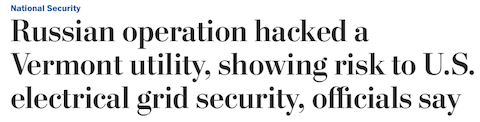
The headline is still absurd: they have no idea that this malware was placed by a “Russian operation” (though they would likely justify that by pointing out that they are just stenographically passing along what “officials say”). Moreover, nobody knows when this malware was put on this laptop, how, or by whom. But whatever else is true, the key claim – “Russian hackers penetrated U.S. electricity grid” – has now been replaced by the claim that this all shows “risk to U.S. electrical grid.”
As journalists realized what did – and did not – actually happen here, the reaction was swift:
1) Not an infiltration of the power grid.
2) “Russian” malware can be purchased online by anyone.
3) See 1 & 2. https://t.co/bVIG8zQBsk— Dell Cameron (@dellcam) December 31, 2016
Pretty amazing how badly the Post appears to have mangled this one. You didn’t call the Vermont utility regulator before publishing?
— Eric Geller (@ericgeller) December 31, 2016
My money’s on this all turns out to be commodity malware and not even APT28/APT29 and everyone jumping on the bandwagon will look v silly
— Pwn All The Things (@pwnallthethings) December 31, 2016
This matters not only because one of the nation’s major newspaper once again published a wildly misleading, fear-mongering story about Russia. It matters even more because it reflects the deeply irrational and ever-spiraling fever that is being cultivated in U.S. political discourse and culture about the threat posed by Moscow.
The Post has many excellent reporters and smart editors. They have produced many great stories this year. But this kind of blatantly irresponsible and sensationalist tabloid behavior – which tracks what they did when promoting that grotesque PropOrNot blacklist of U.S. news outlets accused of being Kremlin tools – is a by-product of the Anything Goes mentality that now shapes mainstream discussion of Russia, Putin and the Grave Threat to All Things Decent in America that they pose.
The level of group-think, fear-mongering, coercive peer-pressure, and über-nationalism has not been seen since the halcyon days of 2002 and 2003. Indeed, the very same people who back then smeared anyone questioning official claims as Saddam sympathizers or stooges and left-wing un-American loons are back for their sequel, accusing anyone who expresses any skepticism toward claims about Russia of being Putin sympathizers and Kremlin operatives and stooges.
But it’s all severely exacerbated by social media in ways that we don’t yet fully understand. A large percentage of journalists sit on Twitter all day. It’s their primary window into the world. Because of how intense and raw the emotions still are from Trump’s defeat of Clinton, the social media benefits from tweeting and publishing unhinged claims about Trump and Putin are immense and immediate: thousands upon thousands of re-tweets, a rapidly building follower count, and huge amounts of traffic.
Indeed, the more unhinged it is, the greater the benefits are (see some of the most extreme examples here). That’s how otherwise rational people keep getting tricked into posting and re-tweeting and sharing extremely dubious stories that turn out to be false.
And that’s to say nothing of the non-utilitarian social pressures. It’s not news that coastal elites – particularly media and political figures – were and are virtually unified in their unbridled contempt for Trump. And we have seen over and over that any time there is a new Prime Foreign Villain consecrated – now Putin – U.S. media figures lead the campaign. As a result, any denunciation or accusation toward Trump or Russia, no matter how divorced from reason or devoid of facts, generates instant praise, while any questioning of it prompts instant peer-group denunciation, or worse.
Few things are more dangerous to the journalistic function than group-think, and few instruments have been invented that foster and reinforce group-think like social media, particularly Twitter, the platform most used by journalists. That’s a phenomenon that merits far more study, but examples like this one highlight the dynamic.
In this case, the effect is a constant ratcheting up of tensions between two nuclear-armed powers whose nuclear systems are still on hair-trigger alert and capable of catastrophic responses based on misunderstanding and misperception. Democrats and their media allies are rightly alarmed about the potential dangers of Trump’s bellicose posture toward China, but remarkably and recklessly indifferent to the dangers of what they themselves are doing here.
* * * * *
Those interested in a sober and rational discussion of the Russia hacking issue should read the following:
(1) Three posts by cyber-security expert Jeffery Carr: first, on the difficulty of proving attribution for any hacks; second, on the irrational claims on which the “Russia-hacked-the-DNC” case is predicated; and third, on the woefully inadequate, evidence-free report issued by the Department of Homeland Security and FBI this week to justify sanctions against Russia.
(2) Yesterday’s Rolling Stone article by Matt Taibbi, who lived and worked for more than a decade in Russia, entitled: “Something About this Russia Story Stinks.”
(3) An Atlantic article by David A. Graham on the politics and strategies of the sanctions imposed this week on Russia by Obama; I disagree with several of his claims but the article is a rarity: a calm, sober, rational assessment of this debate.
Since it is so often distorted, permit me to once again to underscore my own view on the broader Russia issue: of course it is possible that Russia is responsible for these hacks, as this is perfectly consistent with (and far more mild than) what both Russia and the U.S. have done repeatedly for decades.
But given the stakes involved, along with the incentives for error and/or deceit, no rational person should be willing to embrace these accusations as Truth unless and until convincing evidence has been publicly presented for review, which most certainly has not yet happened. As the above articles demonstrate, this week’s proffered “evidence” – the U.S. Government’s evidence-free report – should raise rather than dilute suspicions. It’s hard to understand how this desire for convincing evidence before acceptance of official claims could even be controversial, particularly among journalists.
UPDATE: Just as The Guardian had to do just two days ago regarding its claim about WikiLeaks and Putin, the Washington Post has now added an editor’s note to its story acknowledging that its key claim was false:

Is it not very clear that journalistic standards are being casually dispensed with when the subject is Russia?
ZNetwork is funded solely through the generosity of its readers.
Donate