
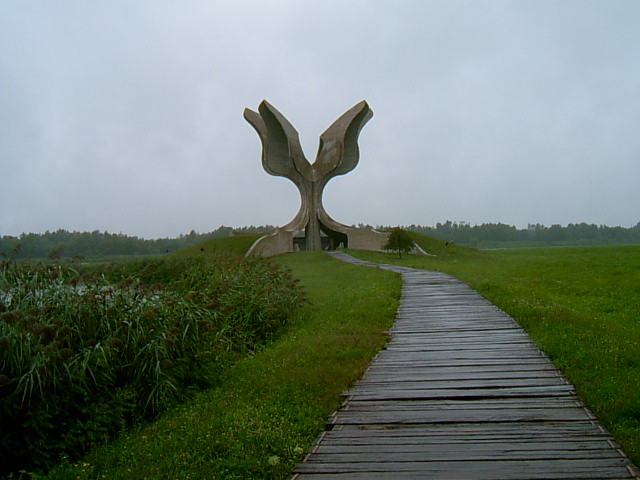
In the Croatian Parliament, a gathering was held of charlatans and obscurantists without a single scholarly reference—individuals whose trade truly demands a new term, and the most fitting one, it seems to me, would be necromisia. For to call Igor Vukić, Nikola Banić, Pero Šola, and the organizers of their assembly—the official bodies of the Republic of Croatia—“necrophiles” for their treatment of the Jasenovac death camp as a mere “labor camp” would be an insult, first to the dead whose terrible fates they trifle with, and then to the protagonists themselves, since it would be a sin to dignify their pathological hatred of the Jasenovac martyrs with the suffix “-philia.”
For the uninitiated: Jasenovac was a concentration camp established in 1941 by the Nazi puppet state known as the “Independent State of Croatia,” governed under the patronage of the Third Reich by Croatian fascists—the Ustaše. In that camp, approximately 99,370 Serbs, Jews, Roma, and Croatian and Bosnian Muslim opponents of the Ustaša regime were murdered.
And yet, those responsible within the Croatian Parliament (the national legislature) managed to assemble individuals who have faithfully replicated the reductionist methodology of Holocaust deniers.
The parties “Sovereignists” and “Domino”—which sounds like a blend of a serious mental disorder and a board game—once again regurgitated a heap of indigestible nonsense long ago effortlessly refuted by every serious historian, especially by Milan Radanović in recent years. Jasenovac, they claim, was not a camp of death and extermination of Serbs, Jews, and Roma, but a “labor camp.” There, the renowned “scholars” have determined, the “craft workshops” were of such renown that students from across the so-called Independent State of Croatia “volunteered for apprenticeships” in them. Imagine such idyll! While some worked in the human-meat butcher shop—immortalized in the pious patriotic hymn “Jasenovac i Gradiška stara” by the well-known singer Thompson—others, it seems, were busy sharpening knives and participating in “advanced training in applied bestiality.”
Vukić — a Serb for hire, a man without shame, and a person who has clearly never crossed paths with a conscience, not even in passing — declares: “Jasenovac was not a sanatorium, but neither was it a torture camp.”
The sponsors of this obscene spectacle in the Croatian Parliament aren’t even capable of producing, let alone paying for, a coherent relativization. Jasenovac most certainly was a sanatorium — but for the undesirable. A place where doctors without diplomas, yet armed with knives and mallets, treated the state of the “virus of Serbs, Jews, and Roma,” and later of Croatian and Bosnian Muslim “traitors” who failed to show sufficient enthusiasm for Ustaša methods of healing. Those misunderstood medical laborers devoted themselves to relieving their patients of pain, suffering — and finally, of life itself. In that sense, Vukić’s sponsors are right: it was not torture, but rather a very special therapeutic procedure.
Jasenovac was, indeed, a kind of national sanatorium — only with mallets instead of stethoscopes, and clubs instead of thermometers. Admission was completely free, and discharge was not anticipated. People did not “die” there, as the malicious communists and “Greater Serbs” claimed — they merely ceased to be a health problem.
In Jasenovac, no crimes were committed. It was merely a matter of excessive doses of Croatian patriotism. There were no victims — only patients whose constitutions were too weak to withstand such a potent treatment. Jasenovac, in truth, was a vast rehabilitation center for a state and society suffering from every ailment except empathy.
And so, in some parallel — pardon me, Croatian — present, that failed version of the world where the Nazis prevailed, a “Department of National Memory” has just been inaugurated in Parliament. There, the lecturers are people who have translated history into a genre of subpar fantasy, and every lesson begins with the sentence: “Jasenovac was a labor camp.” The students eagerly take notes, Professors Vukić, Banić, and Šola nod approvingly, and the state calmly prints a new edition of textbooks in which atrocities are reclassified as misunderstood therapeutic procedures.
While in Parliament the revisionists lecture on the “craft workshops” of Jasenovac, in the stadiums sings Thompson — the state minstrel of collective amnesia — accompanied by a half-million-strong choir chanting “Za dom!” as if it were the latest slogan of the national tourism board.
(Perhaps I’ll regret writing this, because they might actually implement that idea.)
All of this unfolds under the blessing of the high Roman Catholic clergy, who treat Nazi salutes as expressions of popular piety, and the death camp itself as a “controversial workplace” — one unfairly discredited by those damned communists.
And who could possibly believe the sincerity of Croatian Prime Minister Andrej Plenković’s statement that the Croatian state — a proud member of the European Union, no less — had nothing to do with a manifestation held within its own parliament? Only those unfamiliar with the old tactic of releasing trial balloons.
In this case, the Croatian authorities are not launching them merely for the sake of their own revisionist agenda, but as an experiment — a pilot project in historical distortion — designed for the benefit of all the emerging “sovereigntists” of the new Europe that is taking shape.
At a press conference held in Zagreb on Thursday, the minority Serb National Council and other Serbian organizations voiced a joint protest against the obscene gathering — a gesture destined to have about the same effect as a petition from the people of Gaza addressed to AIPAC.
One must admit, however, that today’s Croatia appears to possess a truly unique vision of reconciliation: the victims — who, as we are now told, were merely inadequately treated patients — will forgive everything; the sympathizers of their executioners will sing; and the state will solemnly finance the whole spectacle from its Ministry of Culture’s budget.
In the end, it only remains for Parliament to proclaim the neo-Nazi singer Thompson the official interpreter of historical truth, and Vukić the chief archivist of the future Ministry of Truth. For in a country where, only a few months ago, half a million people sang Ustaša anthems under episcopal blessing, and where the national parliament serves as the makeup artist, pedicurist, and manicurist of the Ustaša regime, the only thing truly being produced — day and night, in three shifts, without pause — is mass oblivion.
ZNetwork is funded solely through the generosity of its readers.
Donate