


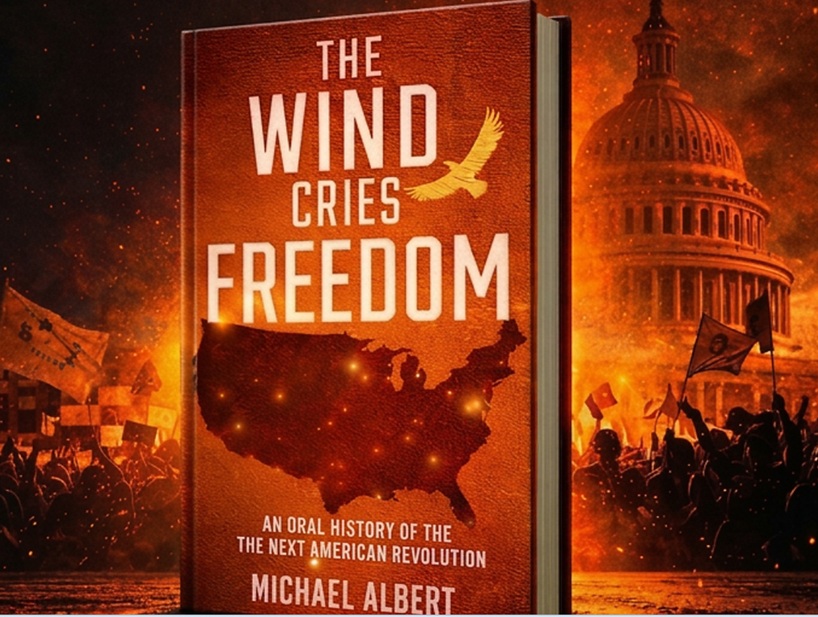
Climate-focused progressive author Phil Wilson (ZNet, July 24, 2026) writes that “out of our current predicament there are two (and only two) possible outcomes – a world of stagnant oceans, burnt banana plantations, death camps and survival bunkers, or a world of unprecedented international cooperation.” Michael Albert’s new book The Wind Cries Freedom: An Oral History of the Next American Revolution (Manhattan Books, 2026), in a sequence of imagined interviews from a vantage point in the not overly distant future, celebrates the triumph of the latter, seen with faith and hope as inevitable (it is not the author’s purpose to ponder the darker version). The positive life-affirming outcome is measured in a near future history of strategies and deliberate activist events, breaking through politics as usual in the United States, that come to power in the intervening decades. Here in 2026, the author urges us to believe that during the next quarter century we humans will somehow have overcome the massive anti-life forces arrayed against us. I say “somehow” because most of the interviewees (let us call them characters) are never sure themselves how all the disparate hopes and fears and actions of so many people came together to generate such huge unprecedented change in society – “fear gives way to necessity”, one of them suggests.
The Wind Cries Freedom is a worthy project, and one that I hope gets wide serious attention. It is not a utopian fiction. Its purpose, rather, is to suggest that if, collectively, we can get our act together, as the book’s characters have done during the years between Trump and 2050, then it is still possible that a better world can be prized from the all-destroying jaws of the life-denying juggernaut. It can be understood as a set of “available remedies” (to use a legal phrase) with rich anecdotal context. The author adroitly sidesteps overt proselytizing, building a readable collection of “stories” (though the book is best read a chapter at a time with reflection, conscious or subconscious, in between.)
Several interviews contain memorably scalding indictments of our 2026 US regime. There are passages about young mothers crushed by economic/cultural pressures, adults damaged by childhood and adolescent sexual abuse, the cruel illusions of the Hollywood ‘beauty trap’, and the moral, social, and psychological trajectories of prominent and aspiring athletes. We experience the enormous difficulties involved in organizing a “founding convention” of the fragmented left, the promises of which can never be fully fulfilled, even with a genuine commitment to socioeconomic equality. Yet the book demands we accept the advent of such a convention, taking advantage of political trends even in 2026 – “cracks forming in the ranks of repression” during Trump II – and building on the influence of prior historic near-successes and failures. Of course it is a necessary prolegomena that some Trump simulacra is roundly defeated in 2028, although The Wind Cries Freedom is sparse in ideas on how this will occur. (We’ll know soon enough!) Chapter 23 asserts that the old economy persists in 2050, but is on the way out. As Rashida Tlaib said the other day, “Congress wasn’t built for people like us”, and there seems to be an implication in the book that this may no longer be the case in 2050. Beyond this even, the book’s US-centric focus may be skewed – given the implied demise of the US Empire, another country may be dominant in 2050.
The book is excellent on analyzing and exposing the social and psychological pitfalls that beset activism confronted with entrenched power. Many of Albert’s urgings from earlier work – respecting MAGA people’s feelings and trying to educate them about how they are exploited; making the price of repression too high for the system to bear; countering the impulse to say “abolish” rather than “redefine”; and items from his and Robin Hahnel’s participatory economics – appear in the interviews. “Naming flaws is how we move forward” is highlighted as a necessary corrective to tactical initiatives. And the coordinator class central to the author’s analysis is exposed as a specific entity that MAGA hates; “Trumpers” have never been exposed to the ruling class either personally or through education or reading, and are consequently unresponsive to criticisms of Trump, Musk, Thiel, etc., or of Silicon Valley; they have no reason to believe that these oligarchs are the people who are in fact exploiting them, whereas various professionals and officials are everpresent “in their face”.
Although the book’s appeal may be limited, such appeal should not necessarily be regarded as “preaching to the choir”. I suspect that if a vaguely interested, even negatively inclined person gets as far as the Table of Contents – which indicates specific areas such as health, housing, sports, religion, education – there’s a good chance curiosity will drive them to pick a chapter and start reading. This may be particularly true of “left-leaning” people, pro-Palestinian and/or “No Kings” protestors, but with no sustained activist commitment.
I especially commend Chapter 20 on religion, where the character interviewed is a priest who speaks with great clarity about (among other things) the sanctuary cities movement and the spiritual stultification inherent in Christian fundamentalism. For sheer, skin-crawling horror, read Chapter 21 (by an ex-criminal trial lawyer, later a judge) on legal procedure and prisons. Chapter 22 on media could be augmented by Shoshana Zuboff’s The Age of Surveillance Capitalism; her subject matter is touched on in Chapter 29. However, the approach to artistic “production” (Chapters 17 and 18) – an activity never truly tackled anywhere in social theory – focuses on artists already recognized, skipping the pervasive reality where aspiring artists face the “needle-in-a-haystack” obstacle that renders “success” available only to “the lucky and the strong” and terminally out of reach for the vast majority. Artistic quality is of zero capitalist value; only numbers (YouTube “hits”, “likes”, etc.) matter, not to mention being young and good-looking or conventionally weird. Consequently, most available artistic “product” is of little or no cultural power. Who knows how many “great” artists disappear? The old patronage system, whatever its faults, was superior in its recognition and respect for genuineness and quality. This blockage of art that might matter is a serious issue unaddressed in the book.
Chapter 30 (the last chapter) has a whiff of utopian prophecy – “by 2028, the working class vote for the far right started to collapse”, a general strike in 2045, and an incandescent campaign speech by the to-be-elected US president in 2052. This chapter transcends the book’s essential raison d’être, and for its projective power should be widely broadcast in its own right.
Cynics (on politics, human nature, the future) will need a significant nudge to develop any interest in The Wind Cries Freedom. But one should not deny the possibility that the book has the power the change attitudes. There’s plenty of emotion-driven content mixed with the logic. And the narrative-like chapters are quite appealing and progress naturally. A well-meant friendly nudge by a not-quite-so-cynical friend might have an effect.
The emotion and the narrative style are likely to be what kindles the enthusiasm of younger readers. I think there’s a fertile audience there already, especially if a charismatic teacher speaks, even if it’s only gently saying something à propos. In fact, I think there’s a possibility that The Wind Cries Freedom could catch on among college or even high school students, like Zinn’s People’s History did all those years ago.
In summary, Michael Albert has organized his deeply informed wisdom, nurtured over many years, and written a creative and visionary book – one that can truly be called “unique” in the best sense of the word, and that harbors the potential to make a real difference.


Songwriter Poet Musician Editor Dublin-bred NYC and Boston.
ZNetwork is funded solely through the generosity of its readers.
Donate




