

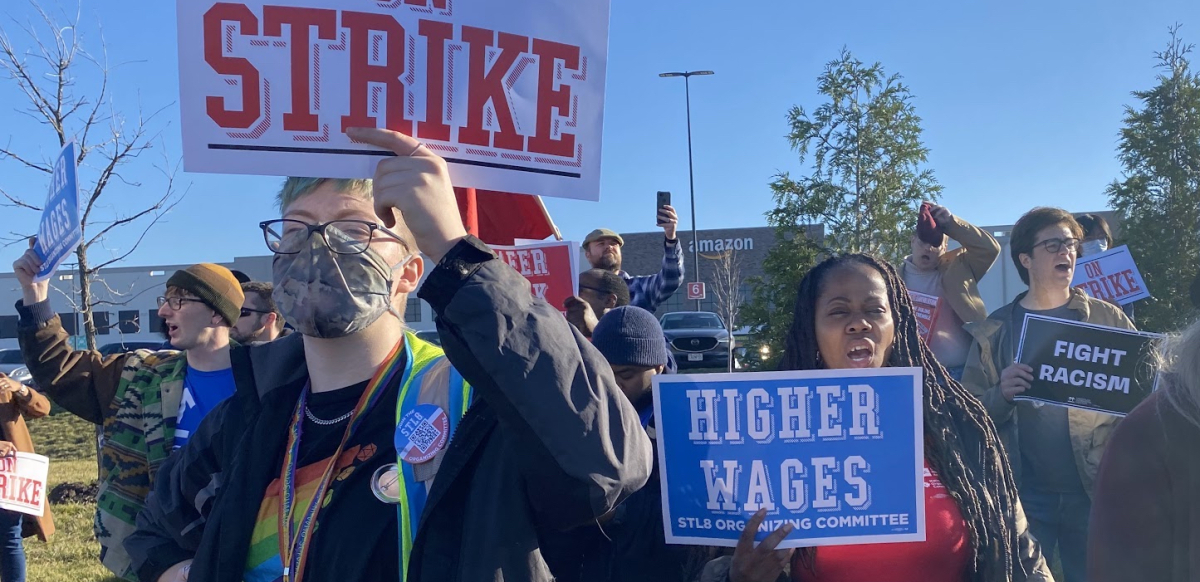
When Amazon workers at a St. Louis fulfillment center walked out on Black Friday demanding $30 an hour, the Twitter trolls came out, too: They’re wimps, they’re whiners, they’re making inflation worse. Quit if you don’t like the job!
But it’s not just trolls. Many people are confused about how when one set of workers stands up, it raises the standards for all working people. They assume that if someone demands a bigger piece of the pie, the rest of us will get less.
In fact it’s just the opposite.
We’re all familiar with the race to the bottom: One big employer cuts health care coverage, and the next thing you know, they’re coming for yours. “How can we compete?” the employer complains. “We have to cut costs, too.”
But the ratchet also works the other way. When Amazon workers started organizing, the company immediately raised wages (and spent millions more advertising what a great workplace it is).
Other warehouse employers realized they couldn’t keep their workers unless they paid more. Next, manufacturing workers start to think they should get as much as those in warehouses, and so on, across the economy.
In the past year, Starbucks workers organized 7,000 workers in 265 stores. Starbucks corporate freaked out, giving raises and better benefits to the 240,000 workers who hadn’t organized.
They did it because they cared and wanted their workers to thrive… joking. They did it to tamp down organizing. “We believe the recent wage hikes [at Starbucks] … are having an adverse effect on the labor unions,” a restaurant investment analyst wrote wishfully in August.
That’s why we owe thanks to the Starbucks workers who are doing the hard part, putting their jobs on the line and ratcheting up standards for café and food service workers across the country. (Of course, Starbucks’ actions are illegal punishment of the workers who dared to organize—they could make it legal by giving everyone the same raise.)
GOTTA COMPETE
Even at the height of unionization in the U.S., after World War II, only around a third of workers had a union, but non-union workplaces had to match their pay and conditions to compete.
Productivity and wages rose together for a while. The entire economy ran better because wages were a closer reflection of the work that people did. And unlike rich people, ordinary people use those wages to buy the kind of goods that keep the economy humming.
Sure, employers always want to cut costs, but they’re also in a constant competition for workers. The effect is magnified when unemployment is low, as it is now. Plus, workers are less scared to lose their jobs when everyone’s hiring. Paradoxically, that makes it easier to take a risk on improving the job you already have.
DON’T WAIT
It may soon get harder. The Federal Reserve is raising interest rates in an attempt to reduce what they call inflation. They don’t care that we’re being overcharged for milk or gas, though—that price gouging is not their concern. The inflation they care about is workers getting paid more.
That’s why the Fed wants to “slow down the economy.” In real terms that means they want to drive some companies out of business and squeeze public budgets, leading to layoffs and misery and making working people more circumspect about speaking up on the job. They want to get back to the business as usual of racing to the bottom.
Despite their recent efforts, though, employment is still high—so if you’ve been thinking about strengthening the union where you work, or organizing one, now’s still a good time!
And thank you, Amazon Black Friday strikers—your bravery benefits us all. Even the trolls.
ZNetwork is funded solely through the generosity of its readers.
Donate