
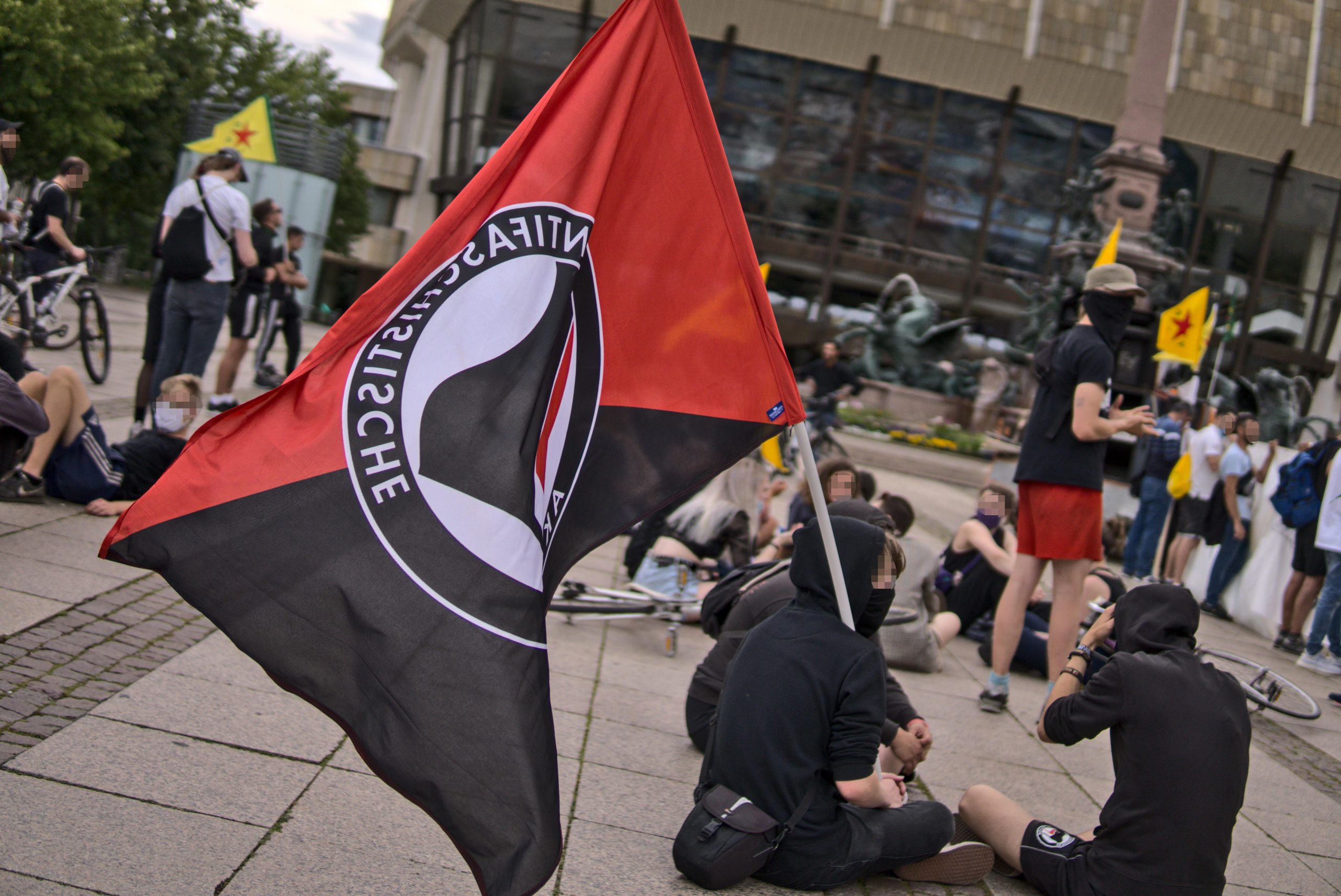
The United States’ decision to welcome Abu Muhammad al-Jolani (leader of the jihadist group Hay’at Tahrir al-Sham, or HTS) into the White House while simultaneously branding ANTIFA-affiliated organizations as “foreign terrorist organizations” reveals an ontological crisis at the heart of the contemporary international political order’s concept of legitimacy, violence, and sovereignty.
This is far more than a simple case of policy hypocrisy. It is an epistemic symptom of a deeper structural tension, highlighting the inherent contradictions within hegemonic modernity and signalling the definitive collapse of the state-centric security paradigm.
Viewed through the lens of the Kurdish Freedom Movement’s critique of modernity, Washington’s decision to court al-Jolani and shun SDF Commander Mazlum Kobane, or to criminalize ANTIFA is a textbook example of the state’s relentless drive toward self-reproduction.
Sovereignty, by its very nature, grants legitimacy to actors of violence that pose no existential threat, or that it can deploy functionally, while immediately labelling any actor proposing an alternative societal vision or an authentic idea of freedom as an inherent “threat.” This confirms that the “monopoly on legitimate violence,” as illuminated by Kurdish People’s Leader Abdullah Öcalan’s analysis of the modern state, is fundamentally an ideological construct, not merely a legal one.
The US classification of al-Jolani as a “manageable jihadist actor,” confirmed by his acceptance, shows the nation-state geopolitical mindset tolerates violence that serves its interests. Conversely, it immediately codes any political or social formation capable of challenging its global capitalist order, its hetero-patriarchal nation-state modernity, and the Atlantic-centric hegemonic security architecture as fundamentally “dangerous.”
The criminalization of ANTIFA, therefore, is not directed at the opposition to Fascism itself, but at the state’s deep-seated perception of any autonomous, anti-fascist organizational structure as a profound menace.
In the current stage of capitalist modernity, the term “terror” is divorced from any objective definition; it remains a fluid, political label continuously redefined by the state to suit its immediate interests. Thus, placing ANTIFA on the terror list is not motivated by legitimate US “security concerns” but is instead linked to the deepening structural crisis of modernity itself.
In this context, al-Jolani’s White House visit is not merely a diplomatic faux pas; it is a moment of stark clarity, laying bare the operational realities of the global hegemonic system.
In 2014, when Kobane teetered on the brink, the entire global community, including ANTIFA groups, witnessed the YPG and YPJ fighters holding the last defensive line for humanity against the sheer barbarity of the ISIS gangs (also known by the Arabic acronym DAESH).
What I witnessed firsthand while fighting ISIS during those desperate days was the initiation of a new chapter in the global history of the Anti-Fascist struggle. ANTIFA volunteers poured into Rojava from cities spanning Paris to Seattle, Athens to Hamburg, Rome to Montreal. They stood shoulder-to-shoulder with us on the front lines. Some were martyred in Kobane, others in Manbij, Raqqa, Tabqa, or Deir ez-Zor.
This was the embodiment of a shared moral-political principle, transcending any specific political or military alliance: where fascism manifests, resistance is an absolute imperative. This confirms the clearest physical manifestations of Leader Öcalan’s vision of the “moral-political society.” Non-state entities, those unaligned with the nation-state, and all identities and communities marginalized by modernity converged in a collective defense of human values.
The US designation of ANTIFA as a “terrorist organization” today is a direct attempt to erase this history. More critically, it reflects the entrenched bias of the hegemonic modernity’s epistemic framework the intellectual system linking security bureaucracies, diplomacy, military elites, and think tanks which defaults to classifying any actor embodying the “idea of freedom” as dangerous.
This is precisely why Commander Mazlum Kobane remains uninvited to the White House. The SDF not only defeated the ISIS gangs but, in doing so, presented an alternative social project outside the prevailing nation-state paradigm at both regional and global scales.
This model is Democratic Confederalism: centered on women’s liberation, built on direct democracy, ecologically sound, and based on local autonomy. Al-Jolani poses no threat in this context, because his offering is not an alternative societal vision, but merely a manipulable jihadist micro-statelet, a pawn in regional power plays.
For the US, such actors can, at times, be “functional.” However, democratic modernity defined by Leader Öcalan as a non-state, non-hierarchical, non-capitalist social organization is the structural antithesis of the state system. Thus, Commander Mazlum Kobane and the Kurdish Freedom Movement are “dangerous” in the eyes of state logic, because they demonstrate the tangible possibility of a non-state democracy.
The targeting of ANTIFA stems from this identical reasoning. ANTIFA’s goal is not state formation but organizing social self-defense against fascism. Consequently, whether ANTIFA fights in Rojava or mobilizes on the streets of Western cities, state logic classifies it as “uncontrollable.”
The capitalist state recognizes no legitimate violence outside its own domain. Yet, structurally, it will not hesitate to functionally deploy jihadist groups, putschist organizations, or paramilitary militias for its own benefit, even while officially rejecting them. This is the state’s inherent nature; the concept of “terror” serves as its ideological tool for legitimizing this duality.
The US opening its doors to al-Jolani, the leader of the HTS group, confirms the strategic production of a “good jihadist” category within the global geopolitical order. This is a long-standing strategic tradition, tracing a direct line from support for the mujahideen in 1980s Afghanistan to present-day proxy wars in Syria.
Movements like ANTIFA or the Rojava Freedom Forces, however, are fundamentally non-integrable into the imperial system’s framework. They are genuine freedom projects aimed at transforming the system itself.
From Öcalan’s critique, this distinction is crucial. Capitalist modernity can absorb or co-opt any structure that merely parallels it. But it is structurally compelled to suppress and destroy any model that transcends it and challenges its established logic of social engineering. This explains why al-Jolani can be hosted at the White House while Commander Mazlum Kobane remains a “problematic” figure in the international system.
The Kurdish people understand this reality clearly. The epic war fought against the ISIS gangs, though witnessed globally, has been conveniently forgotten by states. ANTIFA volunteers are being criminalized today precisely because they stood shoulder-to-shoulder with us, the Freedom Fighters, against the ISIS gangs.
States operate without memory; they are driven solely by interests. But the peoples possess memory. The memory of Kobane, Manbij, Raqqa. The memory of resistance etched by the bodies of YPG and YPJ fighters. The memory of the moral-political bond forged through international solidarity by ANTIFA volunteers. This popular memory runs far deeper than the official narratives manufactured by states.
Today, the US attempt to place ANTIFA into the terror category also serves the domestic goal of suppressing social dissent. As the crisis of capitalism intensifies, criminalizing Anti-Fascist movements is the state’s preemptive effort to stifle the possibility of radical social transformation.
Similarly, the marginalization of Rojava is an attempt to prevent an alternative Democratic Modernity from gaining global legitimacy. These two processes are not separate events; they are the products of the same overarching systemic logic.
The core conclusion is this: The US acceptance of al-Jolani and the listing of ANTIFA are not contradictory acts, but a perfectly consistent state reflex.
The state views every movement that diverges from its nature, exceeds its logic of power, and seeks to establish social freedom through non-state mechanisms as an existential threat. This explains why Rojava is suppressed, ANTIFA is criminalized, and al-Jolani is legitimized. This is why al-Jolani, and not Commander Mazlum Kobane, walks through the doors of the White House.
But this picture simultaneously confirms that Democratic Modernity is the true antithesis of nation-state modernity. The social model that emerged in Rojava was not just the force that defeated ISIS. It demonstrated the capacity for a social construction that can breathe outside the nation-state hegemonic system. ANTIFA’s support for this model is no coincidence; it is the manifestation of the same line of freedom across two distinct geographies.
The lesson for the Kurdish people is stark: States will never recognize any freedom struggle or its vanguard military and political force that surpasses their own strategic interests.
Yet, the solidarity shared between peoples is a reality too profound for the state logic to ever define. The legacy left by ANTIFA in Rojava remains vividly alive. And despite all the lists produced by the US, the Anti-Fascist struggle cannot be criminalized. Democratic modernity cannot be suppressed. The peoples’ search for freedom simply does not fit into the security categories of states.
ZNetwork is funded solely through the generosity of its readers.
Donate