
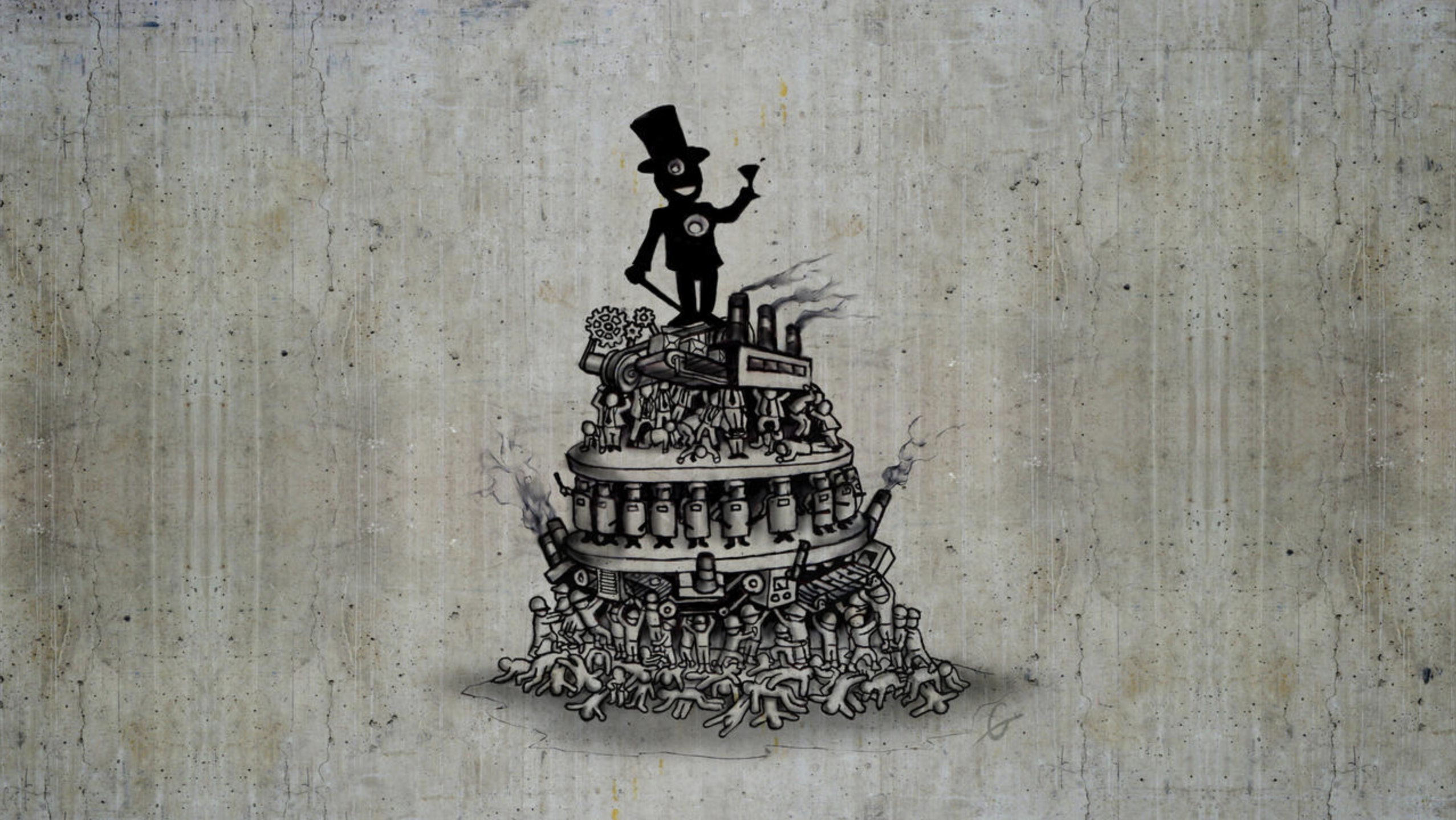
The Trump administration’s move to introduce 50 year residential mortgages speak to a core hollowness of the alt-right program.
The alt-right in its various guises – post-liberal, nationalist, identitarian and what-have-you – positions itself as the West’s last defence against cultural decay and elite betrayal. Its diagnosis of displacement, precarity and lost sovereignty resonates in deindustrialised heartlands.
Yet its prescription is empty.
It offers no economic program. Rather, it’s a politics of cultural grievance. The alt-right’s failure is structural, reflecting the foundations of a political economy that has – for at least four decades, and perhaps more – hollowed out the foundations of a half-decent life for a growing proportion of people.
The alt-right program refuses to challenge finance capital, techno-rentiers or the neoliberal order that generates the anxieties it exploits. It refuses to engage in a meaningful root cause diagnostics, and offers up a feel good symptomology instead. In this, it mirrors the “woke left” and the “globalists” it despises. Both substitute symbolic performance for material reconstruction.
The alt-right has distorted questions of economic power into ones of cultural-cum-racial identity, often mixed in with a good dose of eschatological ‘end of days’ mythology. Calls for a return to “traditional values” neglect to wonder about the material foundations that make such “values” even possible, let alone viable. The politics speaks wistfully of a return to traditional “family values” but refuses to countenance the need for real wages growth to make this even remotely possible. The growing focus on migrants, at times melding into discourses of neo-eugenic purity, ignores the political economy of structural inequality that cuts across racial lines, enabling a politics of cleansing without a politics of structural transformation.
Its post-liberal cultural politics is, ultimately, hamstrung by its liberal economics.
The People’s Republic of China, by contrast, rejected liberalism at its founding in 1949 and has since built a developmental state that delivers tangible goods: housing, infrastructure, poverty alleviation and technological sovereignty. Arguably, China – as a civilisational state – was never encumbered by the ontologies of liberalism to start with, despite various efforts from the mid-to-late 1800s to introduce them. Where Western politics devolves into culture war, China grounds its political economy in production and circulation. The alt-right is not merely incapable of this; it is unwilling, for the very reason that it seeks to at the same time preserve the very capital the effects of which it claims to oppose.
The alt-right’s platforms across various countries are united by what they lack: a serious economic vision grounded in structural root-causes. Anti-immigration, anti-globalism and “So-and-So First” slogans dominate, but no serious industrial or economic policy follows. Tariffs are proposed; assorted economic protectionist programs are threatened; but no fundamental reform of the institutions of finance are contemplated. Automation’s threat to labour is ignored, other than as a form of neo-Luddite cringe. Housing financialisation – private equity, Airbnb and zoning chokeholds, and now, 50 year mortgages – goes unaddressed beyond scapegoating the poor.
When in power, the record is threadbare. Trump’s 2017 tax cuts funnelled 83% of benefits to the top 1%. The “Big Beautiful Bill” promises to accelerate this process of wealth redistribution, upwards. Yet, manufacturing hasn’t been revived. As the average age of homeowners rise as the cost of housing as a proportion of incomes increase, the answer is a lifetime of mortgage servitude. A fifty year mortgage drops the monthly repayments in exchange for a lifetime of repayments that almost double the earnings of the bankers.
The alt-right mourns the demise of the Fordist bargain – stable wages, home ownership, family and community – but offers no alternative to flexible labour, asset inflation and debt servitude. It speaks to the Rust Belt, the banlieues, the North of England, yet proposes no mechanism to re-embed markets in social purpose. Its economic rhetoric is defensive (“stop the bleeding”) rather than constructive (“build the future”).
The alt-right’s cultural fixation is that of the left’s, but in a negative image. The centre-left governed the West’s decline with social liberalism – assorted campaigns around rights, multiculturalism and whatever other form of identity politics you can imagine – while wages stagnated, factories closed and finance ran amok. The centre-left was left hollowed out after the dismemberment of the Soviet Union, and had nothing to say about the economic structures and institutions of the west. As for the disempowering effects of the democratic ruse of parliamentarism, the centre-left was incapable of articulating a meaningful alternative.
Blairite “third way” masked the realities of neoliberalism; it applied lipstick framed by marketing, but not much more. Privatisation and outsourcing of governmental functions transferred profit into private hands, while leaving the public to carry the risk, the reduced service standards and the need to pick up the tab for reparations and maintenance. Clinton’s “triangulation” and rhetoric of the “the reinvention of government” concealed the ongoing hollowing out of the post-war institutions of the socio-economic compact that took the rough edges of capitalism. The forty-year experiment has failed.
The alt-right now governs the backlash with social conservatism; it is anti-“woke,” pro-“heritage,” and promotes border walls; all the while, finance still runs amok. The same old finance.
Both evade the material. Culture is cheaper than steel. Debating pronouns or statues requires no budget, no confrontation with the structures of capital and ultimately no risk of strike. Both externalise failure: it’s always someone else’s fault. Both treat politics as identity branding; for them, voters are constructed as tribes to be mobilised, not citizens to be housed, employed and empowered.
The left’s cultural turn masked neoliberal discipline (“inclusion” for global supply chains). The alt-right’s cultural turn masks neoliberal inertia (“sovereignty” for national oligarchs). Both leave the economic base intact. The alt-right did not invent this evasive move; it has merely inherited it. In this sense, it is post-liberal culturally in a neoliberal materialist straightjacket.
The alt-right’s refusal to challenge capital is not incidental. It is constitutive of the politics of the alt-right itself. Western economies run on finance, rent and shareholder primacy. To reverse displacement anxieties – arising from the housing crisis, employment precarity and loss, and community dissolution – would require dismantling these.
Median U.S. home prices tripled since 2000; wages did not. The alt-right blames immigration, not private equity’s bulk buys or NIMBY zoning. A real response, including the prospects of land-value tax, public housing and corporate ownership bans and zero interest loans, would crash suburban asset values, alienating its financial base while undermining the promise of a return of the promised land of liberty. Instead, we get 50-year mortgages.
Big Tech extracts rent via data, app taxes and cloud lock-in. The alt-right hails Musk and Thiel as heroes, ignoring their role in automation, technological monopolies and extended surveillance. Breaking platforms or mandating open protocols would threaten its own media platforms and channels. Instead, the alt-right buy into the Musk-Thiel style imagination in which they as enlightened technology founders represent the prospects of a redeemed social order.
The donor class – real estate moguls, hedge funds and latterly crypto whales – depends on low capital-gains taxes and asset inflation. Taxing wealth or redirecting flows into public industry is unthinkable. Tariffs raise consumer prices; corporate profits for the sectors of fictitious capital stay safe. Gary C. Hufbauer, a nonresident senior fellow at the Peterson Institute of International Economics and an expert on international trade, has recently noted that up to August 2025, “US business firms have absorbed about 75 percent of the tariffs through compressed profit margins.” He went on to say that, “Consumers have paid the other 25 percent in higher prices, particularly household items like clothing, footwear and furniture. This division of the burden is not sustainable. Within a few months, certainly by the spring of 2026, most of the burden will be shifted to consumers through higher prices.”
The alt-right needs the system it critiques. It has no alternative power base. Its intellectuals – podcasters and assorted influencers – profit from outrage; they are not in the business of institution-building let alone structural change. A serious program would mean confronting the economic base that funds, houses and flatters them. They choose catharsis and financial psychosis.
China offers a counter-model. Founded in 1949 on the explicit rejection of liberalism, the PRC prioritised production over markets; it imposed sovereignty over the powers of capital. Its achievements are not ideological abstractions but are tangibly concrete.
Over 800 million has been lifted since 1978 via education, rural industrialisation, land reform, infrastructure and urbanisation and the rest, all underpinned by state banking and critical infrastructure development. There’s 90% homeownership, and when the price of real estate began to skyrocket as speculators got active, the state moved in. Housing is for living in, not for speculating. As for infrastructure, the evidence is extensive: 40,000 km of high-speed rail, 99% electrification and 5G in every county to name just some of the key accomplishments.
State-owned enterprises dominate steel, rail and energy delivering these ‘infrastructure of flow’ as cornerstone public goods, while non-government firms (Tencent, Alibaba, Huawei and BYD, for instance) were nurtured via credit allocation but propelled under conditions of intense domestic competition. Technological development continues apace. Where it once copied and then emulated with modification, Chinese firms and institutions are now at the frontiers of discovery, leading in EVs, batteries, materials and renewable energy. Public R&D aligned with IP absorption and market scale to create an intense innovation ecosystem that was not exposed to the western-style venture capital roulette.
China challenges capital when needed; it banned cryptocurrency trading and ICOs; it reined in tech giants when they lost sight of the public good (Alibaba’s Ant Financial push to list was thwarted by the state); and the government has enforced data localisation and sovereignty from early days. It uses markets but does not worship them. Finance serves industry, not vice versa. This is “socialism with Chinese characteristics” with a national purpose.
The alt-right cannot emulate this because it accepts liberalism’s economic premises while rejecting its cultural ones. China rejected both. Indeed, it was never lumbered by them.
The alt-right’s base is hooked on symbolic wins. Online ecosystems monetise rage: “owning the libs,” banning books and renaming bases. Governance – priorities, trade-off compromises, long-term planning, budgets and even delays – cannot compete. The alt-right movement’s thought leaders profit from crisis. They are not in the business of resolution through structural reform.
A real program would demand structure and patience. It presupposes a commitment to building the factories of the 21st century, training workers and funding apprenticeships that focus on what’s coming rather than bask in the nostalgia of an imagined past. It requires commitments to massive infrastructure upgrades in energy systems and entire supply chains. None of this is properly on the agenda, though they get passing reference as part of a politics of culture. Instead, the alt-right offers enemies. The factory stays closed. Rents rise. Algorithms tighten. The cycle repeats.
The alt-right is a pressure valve for a system it refuses to replace.
The alt-right is the woke left’s shadow: same evasion but in different garb. Both manage decline through culture while fictitious capital feasts. China shows another path: reject liberalism’s economic premises, not just its social ones. Build; own; direct; and deliver.
A true post-liberal politics would tax rentiers and break platforms to birth competitors. It would tackle the hallowed halls of fictitious capital and reject the political authority of private finance. It would say: Capital serves the real economy; it serves the people and the nation, or it serves no one.
Until then, the alt-right remains a ghost in the machine it dares not unplug. It is condemned to culture war in a civilisation that forgot how to build.
ZNetwork is funded solely through the generosity of its readers.
Donate