

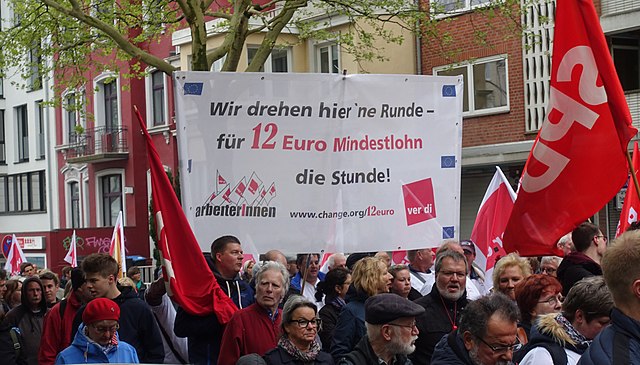
Self-evidently, strikes are nothing new in Germany. In fact, they date back over 200 years. Yet for the first hundred years of that history, German conservatives deliberately engineered the backwardness of Germany – confining it to timid industrial development, anti-democratic ideologies, and miniature states [Kleinstaaterei].
Still, the economic forces of capitalism proved stronger than German conservatism, and Germany’s industrialization began in earnest in the middle of the 19th century. By comparison, England and France industrialized several decades earlier, and strikes have a longer history in both countries.
One of Germany’s earliest strikes was that of textile workers in 1850 – a kind of pioneer event of the working class. Yet German capital and conservatism soon struck back. During the 1850s, trade unions and trade-union-like associations were banned. Still, in 1857 alone, there were 41 strikes in Germany.
Then and now, a strike is an industrial dispute involving a temporary stoppage of work by workers who seek to achieve a common goal. Strikes take place within a framework of industrial or labor relations.
According to German labor law, a strike or collective stoppage of work does not violate a worker’s [an invented] “obligation” – capital, company bosses, and management prefer to see work as an obligation. For that reason alone, capitalism must always come with an adjacent ideology that stabilizes the entire regime.
In German labor relations, a work stoppage is seen as a “suspension.” Strikes can have very different goals and addressees. In Germany, strikes take place within a legal and union-supported framework known as “collective bargaining autonomy.”
This conjures up the liberal hallucination that the state is a neutral actor and does not interfere in the bargaining between labor and capital.
Still, many of the rules and regulations surrounding strikes are guaranteed by Germany’s constitution, the so-called Basic Law (Grundgesetz). One regulation states that a strike is permissible only after something called the “peace obligation” has expired.
Germany’s system to regiment workers and trade unions operates a lot with “obligations” – for workers not management. This serves several purposes:
- Management: It assures management that unions will not interfere with their self-invented right to manage.
- No-Strike Clause: Management is always interested in long periods in which a strike is virtually forbidden; unions seek the opposite, and the length of such a “no strike” period often becomes a point of negotiation.
- Supporting Capital: Ideologically, the “peace obligation” disadvantages trade unions. Corporate mass media can present management as the keeper of the peace, while unions are portrayed as “breaking” the peace when they strike. The system is set up for management – not for workers.
In short, Germany’s labor-relations system is not designed to persuade management or employers to comply with union demands. Instead, it puts trade unions on the spot. While the entire structure puts unions on the defensive, most participants know that the effective enforcement of workers’ interests is possible only if unions can press their demands through strikes.
Perhaps because of this anti-union setup, there are wildcat strikes [insinuating: union or workers have gone wild and uncontrollable]. Such strikes are work stoppages organized directly by workers without union authorization.
In those cases when strikes for better working conditions, shorter hours, or higher wages go beyond that, the German system deems them as “political strikes.”
Unlike other strikes that target management and employers, a political strike may aim to pressure parliaments or governments – for example, to prevent a slide toward an illiberal democracy, an authoritarian regime, or an outright dictatorship. Beyond such extreme cases, the aim of a political strike is simply that workers’ interests be taken into account.
In politically charged situations – such as, for example, the hypothetical takeover of government by Germany’s neo-fascist AfD – a political strike could grow into a general strike that paralyzes the economy and forces such an authoritarian regime to back down.
As a linguistic latecomer, Germany borrowed the word “Streik” from the English “strike,” a term apparently coined around 1810 from the expression “stop the work, strike.” The English term itself dates back to 1768, when sailors in Sunderland – fighting against abhorrent working conditions – boarded ships in harbor and “struck” (lowered) the sails to prevent them from leaving.
Today, the English “strike” appears in many languages: Danish strejke, Swedish strejk, Norwegian streik, Croatian štrajk, Serbian страјк, Polish strajk, and Hungarian sztrájk.
In Germany, the legal issues surrounding political strikes have recently received renewed attention. One key issue is the supposed “distinction” between a labor-law-backed strike and a political strike – as if both could neatly be separated and put into boxes and the former had nothing to do with politics. In reality, numerous conceptual attempts to define the “essence” of a strike have ignored this artificial distinction.
Much of this dates back to a shady figure named Hans Carl Nipperdey, who became one of the most influential architects of Germany’s post-Nazi labor law – and (worse) the way political strikes are understood (and restricted) to this day.
Before 1933, Nipperdey leaned toward nationalism. During the Nazi regime, he authored the “Law on the Order of National Labor” (January 20, 1934) and served as one of its chief commentators.
Nipperday’s Nazi law introduced the authoritarian “Führer principle” into the workplace. The superior – the Betriebsführer or “company Führer” – was endowed with absolute authority.
Subordinates (Untertanen) were reduced to mere followers, bound by unconditional obedience. Nipperdey’s Nazi labor code became a cornerstone of Germany’s war economy, making rearmament and World War II possible.
In post-Nazi Germany, Nipperdey artificially – and ideologically – divided strikes into legal and political categories, implying that the latter were illegal.
He defined a “legal strike” as a joint, planned cessation of work by a large number of employees for a specific goal, with the intent to resume work afterward. His definitions excluded any consideration of the content or legitimacy of workers’ demands.
Even Nipperdey, however, admitted that a political strike was still a labor dispute – just one with “political goals.”
His 1932 textbook – written on the eve of Nazism but already shaped by Nazi ideology – continued to influence German legal thought after 1945. It framed strikes as a “problem” for capital rather than a right for workers.
Thus, through pre-Nazi, Nazi, and post-Nazi continuities, German labor-law scholars have consistently treated political strikes as illegitimate.
Yet, the right to political strike is clearly protected under international law – for example, by the International Labour Organization (ILO). The International Court of Justice (ICJ) supports this interpretation. Recent examples are:
- A 24-hour general strike in Greece (October 2025) against government plans to extend the working day to 13 hours.
- Political strikes in Belgium against pension cuts.
- Strikes in Italy against the genocide in Gaza.
- In France, political strikes are never questioned; workers routinely take to the streets during work hours.
In Germany, such strikes are reported on – but the fact that political strikes are illegal domestically is never mentioned. For decades, German labor law has thus violated both the European Social Charter and ILO Convention No. 87 on freedom of association.
In effect, German labor law represents a permanent violation of international law. Meanwhile, the side of capital has been waging a global campaign against the right to strike for at least a decade. In response, the ILO’s Board of Directors appealed to the International Court of Justice in The Hague, asking:
“Is the right to strike of employees
and their organizations protected by
the Convention on Freedom of Association (No. 87)?”
Between October 6th and 8th, 2025, the ICJ heard submissions from governments, unions, and business associations.
Meanwhile, the ILO, founded in 1919 – making it older than the UN itself – brings together governments, unions, and employers from 187 countries in its tripartite structure.
Among its first acts, ILO Convention No. 1 (1919) established the eight-hour day and the 48-hour week. Germany, tellingly, never ratified it. This is deeply shameful for a country like Germany.
Worse still, Germany’s current government – under businessman Friedrich Merz – seeks to abolish the eight-hour day – one of the great achievements of the 1918/19 Revolution.
Convention No. 87 guarantees the freedom to form associations. For decades, ILO committees have interpreted it to mean that the right to strike is protected. Even Germany’s Federal Labor Court has admitted:
“Collective bargaining without
the right to strike would be collective begging.”
Importantly, the ILO does not limit the right to strike to collective bargaining – it also covers political and protest strikes, including those opposing war or militarization.
Germany’s Bundestag ratified Convention No. 87 decades ago. Yet its labor courts continue to ignore it, maintaining that political strikes are illegal – an obvious contradiction of international law.
About ten years ago, the dispute within the ILO escalated when the employers’ side refused to accept the interpretations of the Committee of Experts on the Application of Conventions and Recommendations (CEACR), which had long criticized violations of the right to strike. This paralyzed the ILO for years – perhaps deliberately.
Eventually, the ILO referred the issue to the ICJ. If the Court upholds the traditional interpretation, it will strengthen the ILO’s authority. The Spanish ILO representative supported this view at the hearing.
Germany’s representative, however, insisted that freedom of association protects the right to strike only insofar as it enforces collective agreements – not political aims. This position remains rooted in Germany’s Nazi and post-Nazi legal tradition.
It appears the German state intends to continue ignoring the ILO. As the great German novelist Bertolt Brecht once said:
“Dass du dich wehren musst, wenn du nicht untergehen willst, wirst du doch einsehen.”
You’ll go down if you don’t stand up for yourself. And you will, you know. You will.
ZNetwork is funded solely through the generosity of its readers.
Donate