
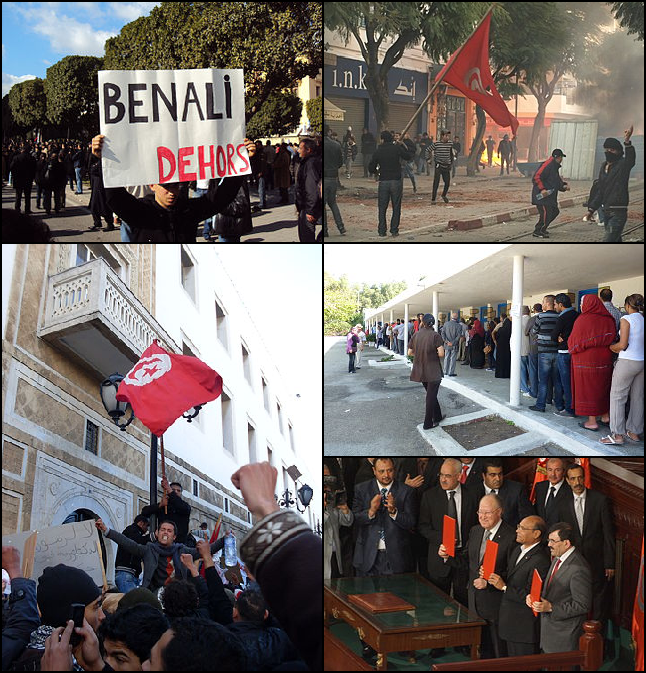
Fifteen years ago this month, a mass movement in Tunisia overthrew the 24-year reign of U.S.-backed despot Zine El Abidine Ben Ali. What seemed impossible merely weeks prior became real.
Today, living in the United States, things feel daunting, hopeless, terrifying: It is hard to imagine how to reverse the intensification of the police state, the erosion of whatever pretenses of democracy this country had, the looming fascism, the open occupation by Immigration and Customs Enforcement (ICE) in our cities, or the kidnapping and execution of our neighbors by masked agents prowling our streets.
Before the fall of President Ben Ali, people in Tunisia faced a situation even more difficult than the conditions that have descended on the U.S. today. For this reason, engaging with the history of the uprising that occurred 15 years ago in Tunisia can be a beckoning whisper in U.S. ears conveying how quickly things can change, how powerful we can be, and how “all that is solid” — to quote Marx and Engels — sometimes “melts into air.”
Life Under Totalitarian Rule in Tunis
Living in Tunis, the capital of Tunisia, in the early 2000s, it was clear to me that we were living in an authoritarian police state. While walking to the Sidi El Bahri market near my apartment to do my shopping, I would routinely witness cops randomly rounding up men into vans — this appeared to be a constant occurrence.
As a Western expat I had a degree of immunity from most of the police repression, but the fact that I lived in a populaire (working-class) neighborhood meant that I encountered police checkpoints multiple times a week. At the checkpoints, police would demand my identification, conduct mini interrogations, and generally be a hassle. The omnipresent portrait of Ben Ali observed people going about their days, along with constant surveillance by the state.
In February 2005, after Ben Ali announced that he was inviting Israeli President Ariel Sharon to a technology conference, a wave of crackdowns on potential protest occurred. Leading opposition figures and activists like Mohamed Abou were arrested.
I remember peeking out between the curtains of a friend’s apartment on Avenue Habib Bourguiba — Tunis’s central road. Through the window I saw rows upon rows of jackbooted cops lining the whole thoroughfare, to ensure there was no protest. A Tunisian friend of mine stepped onto the balcony to take a picture on his phone of the show of force, and within 10 minutes a plainclothes policeman knocked on our door and abducted our friend and confiscated the phone.
The internet mysteriously became especially censored and erratic over those days, and there was a rumor that the police had killed some students at a protest in one of the smaller cities. The police state was a topic as commonplace as the weather — sometimes discussed in hushed, careful, and furtive words, and sometimes alluded to through mocking jokes.
I remember walking home late from a bar in the summer of that year with a Tunisian friend named Walid, who asked to be identified here by first name only due to ongoing concerns for his own safety. An unmarked cop car pulled over, and an officer aggressively grabbed him and demanded his identification, asking him to explain why he was “with these Westerners.” Terrified, Walid yelled to not let them take him because he would “disappear.” I tried to break him free, even cavalierly trying to climb in the back of the truck and insist they take me with him until six more cop cars descended, tossed him in the back of the truck, tossed me into the street and whisked away.
With Walid’s brother’s help, we got him out of jail the next morning and saw how Walid’s wrist was swollen and bruised: the police had hung him from handcuffs in the station while interrogating him. Over breakfast, Walid told me about how he was imprisoned in his teens and tortured for several months with no charge for driving somewhere he was not “supposed” to. His family was given no information on his capture.
He also told me that his earliest memory was of the mass protests against the attempt to lower the bread subsidy in the early 1980s. His neighborhood was an epicenter of the protests, which were met with government tanks in the streets: the army shot demonstrators in the streets. His entire political life had involved contending with totalitarian rule.
The Earth Trembles
Five short years later, everything changed.
“I can’t breathe anymore,” Mohamed Bouazizi — a produce seller from the central Tunisian city of Sidi Bouzid — told his cousin one week before he was harassed by police yet again in what was a regular pattern of harassment. And in a story immortalized by the events that followed, Bouazizi set himself on fire in December 2010 in Sidi Bouzid.
In less than a month, the quarter-century reign of a “near perfect” strategic partner of United States imperialism fell, fleeing the country in disgrace. Authoritarianism was swept away with a rapidity that was completely stunning.
After his death, the police could not keep the masses of people off the streets of Avenue Habib Bourguiba — the entire country erupted in protest. What seemed improbable strode bravely into the field of history, singing like the prominent Tunisian singer Emel Mathlouthi that they were “those who are free and never fear” and a “thorn in the throat of the oppressor.” In less than a month, the quarter-century reign of a “near perfect” strategic partner of United States imperialism fell, fleeing the country in disgrace. Authoritarianism was swept away with a rapidity that was completely stunning.
Something was set loose. A dam was broken that had remained solid for decades, not just in Tunisia but also across the Middle East and North Africa. People in the millions saw in a stroke of lightning that fighting was possible, fighting could win, freedom could be grasped, and revolution was an actuality.
This is not to say the events were purely spontaneous — important networks of underground activists in numerous countries and worker organizations like the Tunisian General Labor Union played invaluable roles in trying to harness and organize an energy unleashed. But masses of people learned by doing. We often don’t grasp our power or what is possible until we actively are taking part in mass struggle.
As the Russian revolutionary Vladimir Lenin remarked of Russia’s revolutionary events of 1905: “Only struggle educates the exploited class. Only struggle discloses to it the magnitude of its own power, widens its horizon, enhances its abilities, clarifies its mind, forges its will.”
The wave of pro-democracy protests, uprisings, and rebellions that took place in the early 2010s — which collectively came to be described in some quarters as “the Arab Spring” — shook not just the region but the world. Over the next year, in every country from Morocco to Iraq, major protests against undemocratic regimes and neoliberal economic conditions changed the political landscape, toppling governments.
The 30-year rule of Hosni Mubarak in Egypt, the 32-year rule of Ali Abdullah Saleh in Yemen, and the 42-year rule of Muammar Gaddafi in Libya were all were brought to an end either by the protests themselves or events related to mass upheaval. In total, 130 combined years of despotic rule were torn down in weeks and months.
In Syria, the despotic rule of Bashar al-Assad held on despite almost toppling, and the situation turned into an armed conflict. In Bahrain, the government almost fell. For a brief moment, Palestinians began marching from Jordan and Lebanon to the dividing lines of the Israeli occupation with raised aspirations as Palestinians in the West Bank kicked off a short-lived protest movement directing slogans of the revolutionary wave at the head of the collaborationist Palestinian Authority.
A “revolutionary process” was taking place. This process was born of local conditions in Southwest Asia and North Africa, but it was also thoroughly internationalized. The communards of Tunis, Cairo, and Homs raised aspirations of other people in struggle across the world, leading to the anti-austerity indignados movement in Spain; the anti-austerity “movement of the squares” in Greece; the Wisconsin Capitol occupation in Madison; and the Occupy movement across the U.S. In Madison I remember signs drawing parallels between the detested Wisconsin Gov. Scott Walker and the detested Egyptian President Hosni Mubarak who was kicked out by the revolution. And in Chicago I remember leading Occupy protests awkwardly in chants in Arabic marching to the Egyptian consulate in solidarity.
After a series of blowbacks and defeats, the revolutionary process reemerged years later with another wave of uprisings in 2019 in Algeria and Sudan that similarly overthrew entrenched governments. In Iraq and Lebanon, another round of governments toppled, though the states remained intact. It is not hard to argue that just like in 2011, internationally this revolutionary process reverberated into a year of revolt that saw insurgent movements challenge power in Hong Kong, Chile, Colombia, Nicaragua, and Haiti.
Weeks Where Decades Happen
The power of these movements caught nearly everyone off guard. It is a common sentiment of those involved that they were unexpected. I remember an old comrade of mine, an Egyptian revolutionary socialist who would often jokingly recount how he flew back to the U.S. literally days before the revolution in Egypt began, with no awareness that the solid ground was about to split.
Meanwhile, as Tunisia and Egypt were rising up, The Guardian asked a prominent Syrian revolutionary living abroad, Robin Yassin-Kassab, if the revolution was going to come to Syria, and he replied “Of course not.”
The swiftness that mass movements can swing into action can be stunning. And these movements transform how people see themselves, each other, their world, and their ability to act in alchemical ways. Omar Aziz — the Syrian anarchist who died in 2013 as a result of enduring torture and incarceration at the hands of Assad’s jailers, and who played an important early role in the Syrian revolution — wrote: “A revolution is an exceptional event that alters the history of society while also transforming each human being.”
Soberly we must reflect on the fact that these high points of struggle have since been tragically beaten back by counterrevolution. New police states are entrenched in Egypt and Tunisia. Sudan’s revolution — perhaps the most advanced and organized of them all — has been drowned in a genocidal civil war. Syria finally got rid of Assad, but it has now entered a complicated new situation in which the new reality under the government of Ahmed al-Sharaa still brings repression and sectarianism. The balance sheet is not positive: In the end, the mass uprisings for economic justice and democracy did not win. And a revolution half-made — as the French revolutionary Louis Antoine de Saint-Just is oft quoted as saying — digs its own grave. But people strived, and tried, and glimpsed a world that they could have taken hold of and won.
Is a Tectonic Shift Against U.S. Authoritarianism Possible?
So what of today? Here in the U.S., our society’s repression sometimes feels overwhelming. On January 24, 2026, federal agents occupying Minneapolis, Minnesota, executed a nurse named Alex Pretti on the street in full view of a crowd, as he was pinned to the ground by a half-dozen masked goons. On January 7, 2026, a federal agent shot Renee Nicole Good in the face. On September 12, 2025, federal agents killed Silverio Villegas González in Chicago — to much less outrage.
Meanwhile ICE is abducting small children. Federal immigration agents are dragging child care workers away in front of the kids they care for. People are disappeared to other countries, to concentration camps in swamps. Masked paramilitaries prowl our streets, shooting tear gas into residential streets, and shooting rubber bullets and chemical weapons at peaceful protesters.
With chaotic malevolence on the international stage, Donald Trump is now overtly talking about conquering Greenland and abducting presidents of other countries. Meanwhile, the Trump administration is doing its best to try to essentially outlaw trans people, who are told they don’t exist. A McCarthyite purge is underway in higher education. History is being erased in an unironically Orwellian fashion.
Despite the tremendously inspiring turnout of everyday people to defend their neighbors against ICE in Chicago, Charlotte, Los Angeles, Minneapolis, and elsewhere, the U.S. still stinks of fascism from sea to shining (and warming) sea.
How can we possibly stop this? What we are up against can feel insurmountable. The presence of far right movements connected with the White House is scary; descriptors of ICE and the Border Patrol as “Gestapo” seem apt. The flurry of Trump’s attacks and how quickly things have felt to be spinning out of control is dizzying, destabilizing. Many sharp political people I know feel some sense of hopelessness. It haunts me as well. I have argued that all capitalist states should be called police states, but the current iteration of the U.S. police state is intensified, blatant, and unveiled in Trump’s fantasy of strongman authoritarianism. Will we have another election? Trump in his erratic ravings has certainly made ominous claims. The Democrats, in their flimsy charade of being a “resistance” have abandoned us all — as they always have. It all seems so bad.
Dwelling for a moment on the anniversary of revolutions that flamed into existence 15 years ago can remind us that police states do fall, and that the force of people, of mass movements, and of uprising, is swift and powerful.
Faced with this dire situation, dwelling for a moment on the anniversary of revolutions that flamed into existence 15 years ago can remind us that police states do fall, and that the force of people, of mass movements, and of uprising, is swift and powerful.
Even in crushingly difficult political environment of suffocating totalitarianism, people filled their lungs, raised their voices, and breathed fire against their oppressors. Voices and arms and feet and labor crumbled the powerful, even if briefly.
As the great historian Howard Zinn wrote: “If we remember those times and places — and there are so many — where people have behaved magnificently, this gives us the energy to act, and at least the possibility of sending this spinning top of a world in a different direction.”
It is far from certain that we will win liberation, but the possibility of the collective gasp of a people taking a breath before the leap should hearten us.
In more difficult times and places people have done heroic things that they themselves did not expect. If anything, the steadfastness of Palestinians who resist erasure, who refuse to leave, who stand up against all odds and still live and love amid the rubble, should be our compass. We should hold these lessons to our hearts not out of a Panglossian certainty that things will change despite us, but out of a resolve that a new world is possible if we act together.
ZNetwork is funded solely through the generosity of its readers.
Donate