
Britain is usually highly critical of countries where democratic freedoms are under assault. Could it possibly have been consulted over Khan’s arrest? Or even tacitly consented to it?
Let’s try a mental experiment. Let’s suppose that the charismatic and massively popular leader of Iran’s main opposition party had been arrested as part of a paramilitary assault that looks to many like a kidnapping.
Let’s suppose his lawyer had been brutally assaulted at the same time and that many senior members of the opposition had been detained alongside the leader amid a massive media clampdown.
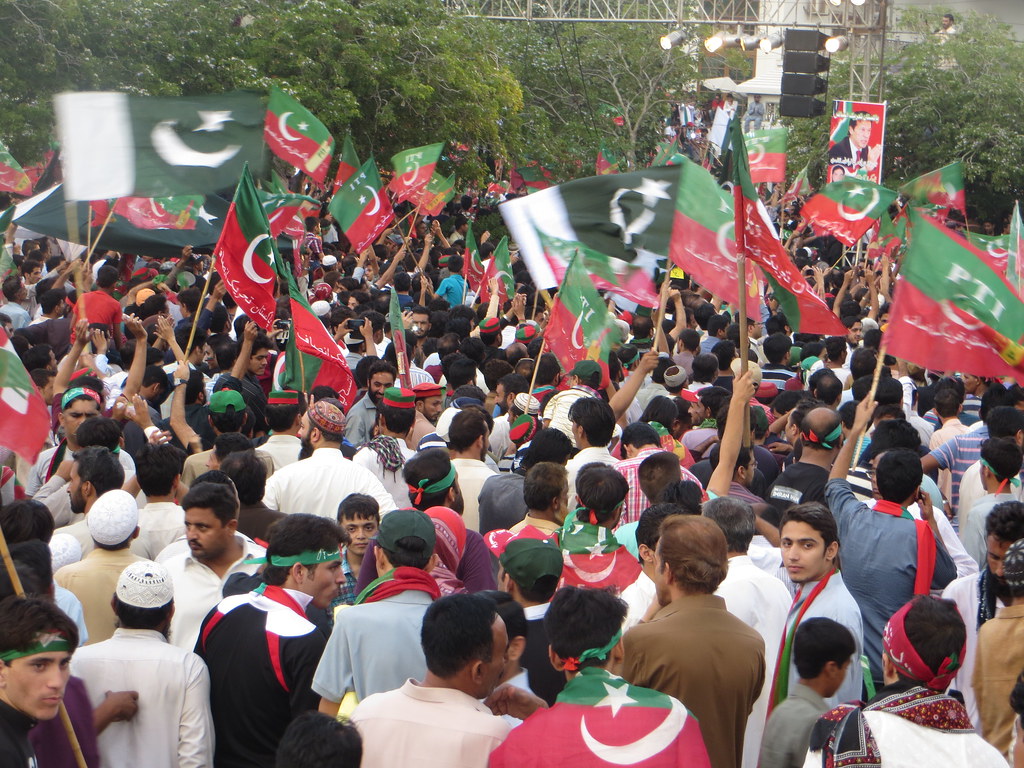
Let’s also imagine that several protesters had been killed in state-sponsored repression as the military took control of the country and that all this took place just six months before a general election the opposition was on course to win.
It needs no great effort of the imagination to envisage the scale of official condemnation, or the barrage of commentary denouncing Iran.
But the British government has not uttered one word of criticism of the Pakistan government’s decision to detain Imran Khan, the country’s former prime minister who was released on Thursday, along with senior members of the party leadership.
Bottom of Form
Nor of the brutal methods used to attack Pakistani citizens who took to the streets in protest.
In the British parliament on Wednesday, Prime Minister Rishi Sunak told MPs that Khan’s arrest was “an internal matter for Pakistan”.
Pakistan PM in London
This remark makes zero sense. Britain is habitually free with commentary on the affairs of other countries where democratic freedoms have come under assault. To give one current example, this week British Foreign Secretary James Cleverly denounced the decision to readmit Syria to the Arab League.
By contrast, Cleverly has not even taken the routine step of summoning Pakistan’s ambassador to the Foreign Office for a dressing down.
The situation is made all the more extraordinary by the fact that the arrest of Khan took place when Shehbaz Sharif, Pakistan’s new prime minister, was in London.
Sharif came to London for last Saturday’s coronation and, according to Dawn Newspaper, stayed on in the capital till Wednesday for talks involving Nawaz Sharif, Shehbaz’s brother who was himself for many years Pakistan prime minister.
The Pakistan government says that the decision to arrest Khan was made according to due process by the National Accountability Bureau in the country’s capital Islamabad. Be that as it may, a decision of such immense consequence could not have been made without the full knowledge and approval of Shehbaz Sharif, who appears to have been in London when it was made.
And the fact the decision was made in London raises the question of how much Britain knew of Sharif’s plan to arrest his main political opponent. Was the British government consulted? Did Britain even give tacit consent?
Events in Pakistan are of grave importance to Britain, for two reasons. First, this nation of more than 200 million people has vast strategic significance as Britain and its allies struggle to come to terms with the aftermath of the Afghanistan debacle and the rise of China.
Second, more than two million British citizens boast Pakistani heritage. Many of them travel regularly to Pakistan to see friends and family. The consequences for Britain if Pakistan collapses into chaos are vast.
Humanitarian disaster
There were no more than an estimated 4,000 British citizens and dual nationals in Sudan when the country subsided into civil war last month, yet Britain struggled to get her people to safety. Now Pakistan is hovering on the verge of something similar.
If, God forbid, this was to happen, the humanitarian disaster would be countless times worse.
Cleverly was asleep at the wheel when Sudan fell into civil war. Warning signs were ignored till much too late, meaning that Britain was obliged to rely on other nations to rescue trapped nationals.
In an ominous repetition of events in Sudan, there is no sign that Cleverly has woken up this time either. Is there any evidence that Britain has made plans to evacuate its citizens if chaos turns into mass disorder? Has the high commission in Islamabad assembled a list of British nationals?
Insha’Allah all this may never happen – and the sensible intervention of Pakistan’s Supreme Court that ordered Khan’s release seems to have calmed the situation. But Britain failed to prepare for the worst in Sudan, and we should do so now in Pakistan.
But most troubling of all is Britain’s inert posture over the mass round-up of the leadership of Pakistan’s most popular political party. Cleverly loves to claim that Britain stands four square in defence of human rights, freedom and democracy. Britain’s refusal to demand the release of Khan and other political prisoners from the Pakistan Tehreek-e-Insaf (PTI) opposition party proves that claim is hollow.
Worse than that, Britain’s refusal to condemn the actions of the Sharif government is beginning to look awfully like complicity.
ZNetwork is funded solely through the generosity of its readers.
Donate