
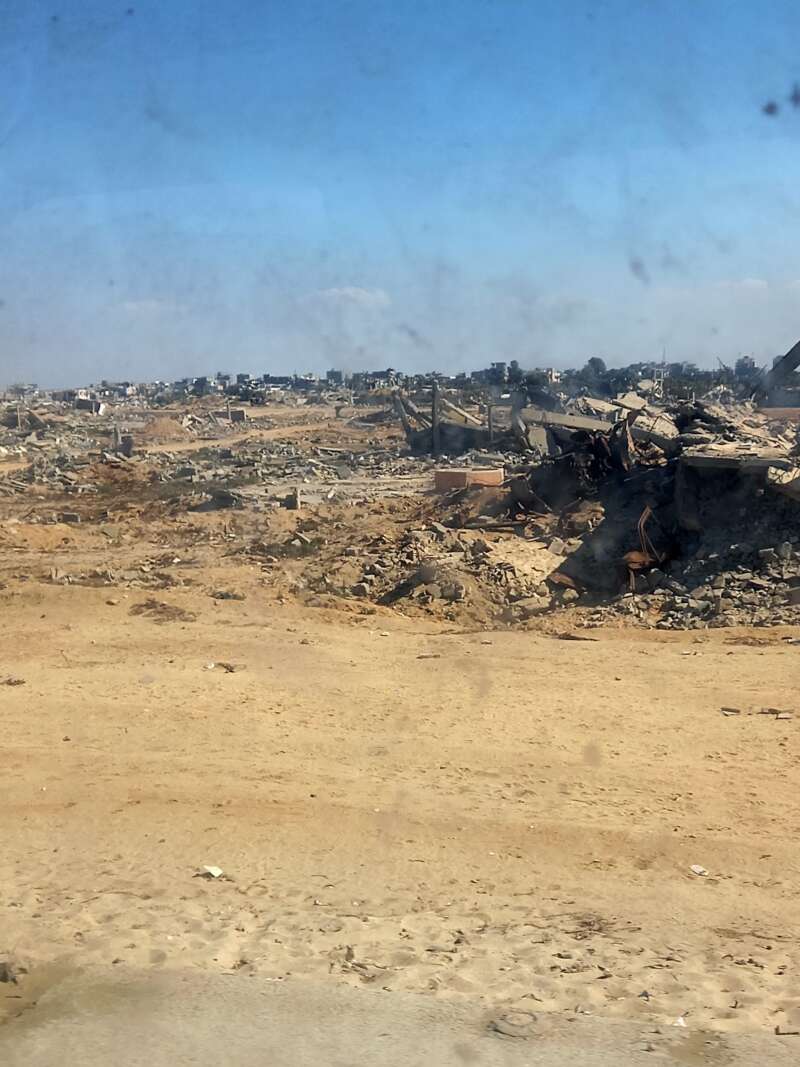
When I finally fled from my home in Gaza City to Khan Younis in southern Gaza this September, I left behind everything that reminded me of myself. I dreamed of returning, yet I kept wondering whether there was anything left for me to stay for in this land.
In the south, I felt like a stranger. If exile feels this hollow inside Gaza, what would life abroad be like? I spent a whole month in a tent among the trees, haunted by the details of Gaza — its streets, its scent, its mornings. The most painful part was knowing that I was still in Gaza, yet unable to reach my own city. I was displaced by force, not by “choice”: The tower I lived in was bombed twice. The situation was unbearable.
Every night, I sat outside the tent asking myself: How can they keep me away from my home, my life, my place, and all my memories? I dreamed of returning to a place only about 25 kilometers (15 miles) away — and yet, it felt unreachable. I became a stranger in my own land.
The day I was displaced to the south, September 23, was one of exhaustion and terror. Our area was heavily bombed, and when death began to close in from every direction, we decided to flee.
The journey took 10 long hours — filled with fear, fatigue, and chaos. Everyone was running from death, yet there were no vehicles to escape in. The few vehicles that existed were weak, overcrowded, and painfully expensive because of the soaring fuel prices.
Taking the Road Back to Gaza City
This October, when I finally left my tent in Khan Younis and set off once again for Gaza City, the road wasn’t much different. On October 10, the ceasefire was officially declared and enforced, but most of the conditions of our lives remain unchanged: I thought the war had finally ended — that I would no longer hear the sound of another explosion. But the opposite happened. The bombings and killings continued, justified by claims that displaced people were “illegally returning” to their homes in areas like Shujaiya, where Israeli forces remain present. Anyone found near the so-called “yellow line” — the border Israel drew to divide the territories it occupied, now controlling over half of Gaza’s land (nearly 60 percent) — was targeted. Since the ceasefire, at least 245 Palestinians have been killed. Meanwhile fuel remains scarce and costly, transportation nearly nonexistent, and demand overwhelming due to the huge population.

We managed to book a bus to carry us — along with our mattresses — back to Gaza City. But because of the difficulties and the high cost of transport, we couldn’t return until October 26. As I prepared myself for the journey and said goodbye to the relatives whose land in Al-Mawasi near Khan Younis had sheltered us, I felt something strange. I asked myself: How can everything change in a single moment?
We had left believing Gaza would be wiped out completely — that we would never come back, that another year of war awaited us. I still remember when our neighbor, Marwan Al-Namra, told my father: “Take everything you own to the south — we will never return.”
And yet, here we are, returning. It’s as if the occupation has taught us not to hold on to any place — not even the tent that had become warm and safe for us, the tent we left behind after just one month.
We left Khan Younis at eight in the morning, boarding the bus with our belongings, our hearts swelling with joy at the very thought of returning. As my father always says, “Our souls are bound to Gaza.”
No matter how long or exhausting the road was, the mere idea of going back filled us with a happiness we hadn’t felt in months.
But how could such pain exist on a road meant to lead us to hope? The journey was supposed to carry us home, yet it was heavy with despair. I tried to cling to my joy, but I couldn’t. It wasn’t physical exhaustion that broke me — after two years of war, that kind of tiredness had become part of us — but what I saw along the road.
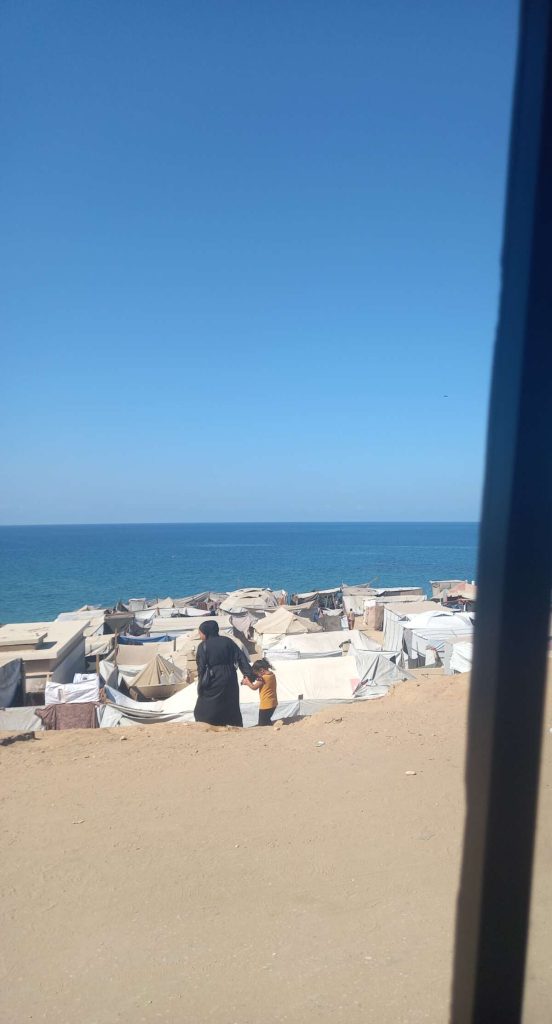
People walked in silence, carrying their belongings, worn down by the impossibility of paying for transport. I saw a family returning on a donkey cart — their journey took 15 hours, a fragile ride through a land that felt dragged back to the 1950s.
As we passed the sea, the scene grew heavier. The shore was lined with tents; entire families were living on the sand. Children, barely 2 years old, sat under the burning sun, their only shelter a worn-out piece of fabric. I asked myself: How can a child survive both the heat of summer and the cold of winter inside a tent?
I knew, deep down, that nothing would truly change after the ceasefire. No one was speaking of rebuilding the city. And even if reconstruction began, as the driver murmured quietly, “Gaza would need at least 10 years to be rebuilt — but it will never be the same again.”
The Beauty We Remember Haunts the Destruction We See Before Us
As I took all of this in, memories of my former life flooded me: the streets once beautiful, filled with cars and smiling faces, people strolling for leisure or exercise with those they loved.
For a moment, I stopped comparing, because I was comparing two entirely different cities: Gaza — warm by day, skies clear and bright, and by night illuminated with the soft glow of yellow lights and bustling cafés — versus today, a city that feels like a battlefield, a ghost town.
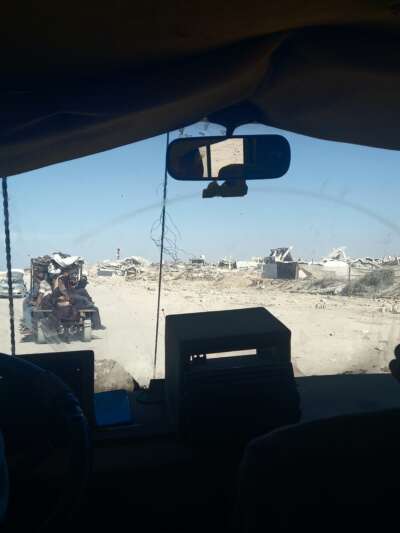
I reflected on this contrast while witnessing the tragedies along the road: How has selling vegetables and clothes on the street become normal? How are people living along the beach? Nothing is in its natural place.
I also remembered the suffering in my own neighborhood: the house I had taken refuge in for two years had no water, and some of its walls were destroyed.
I asked myself: How many wars are we living through? The war of weapons, of hunger, of lost homes, of scarce water?
After three hours on the road, we reached Gaza Valley — the valley that separates the north from the south. The Israeli occupation had classified everything before the valley as the north, and everything beyond as the south. It was a strange feeling, for how many tragedies have happened at this boundary? About 20 meters in, the driver told us that to the right of the valley there was a road designated by the occupation for displaced people. And from there, I saw Gaza City — I saw its destruction from afar.
Seeing it pierced my heart. I wanted to cry. A city like a bird with broken wings! And the closer we got, the closer we drew to the devastation. I passed many formerly beautiful places, like Al-Rashid Street, which was once lined with upscale restaurants overlooking the sea. I looked at the destruction and remembered the Lighthouse restaurant we used to visit on school trips. It felt as though the reel of my life was passing before my eyes.
An hour later, we arrived at Al-Rimal neighborhood, the neighborhood I had fled after it was heavily targeted and the Israeli army shelled the residential high-rise buildings where my neighbors and I were living. The scene was unbearably bleak: Since I last set foot in Al-Rimal, the destruction of the neighborhood had deepened, with the Israeli military turning more and more buildings to rubble.
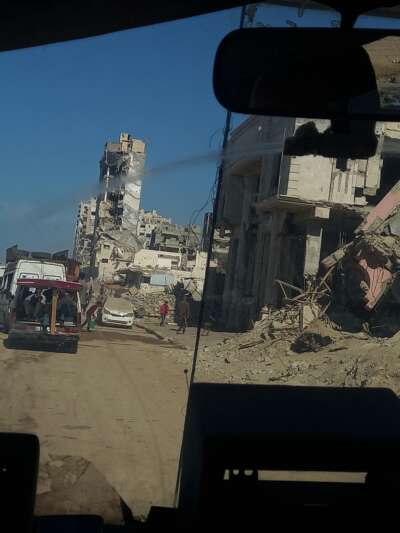
On October 28, my father tried to repair our house and block its many openings with plastic sheets to keep out the dust and debris, but his attempts at repair were repeatedly undone by the force of nearby bombardments. On October 29, despite the ceasefire, there was a severe airstrike nearby around 3 am that destroyed everything my father had managed to fix. Even now, due to the lack of journalistic reporting, we don’t know the exact location of the airstrike. And the next day, at 10 in the morning, Trump announced a return to the ceasefire. Those who had been killed were reduced to numbers with no value. Life returned to its cruel cycle: bombardment, then ceasefire — and this is how we continue to live today.
This is life in Gaza: bombardment and death, followed suddenly by the announcement of a ceasefire. It’s as if we are living on land that is not ours, forced to endure everything. In Gaza, Israel is imposing collective punishment on us during its negotiations with Hamas. Whenever Hamas fails to meet certain demands, Israel immediately restricts food supplies, causing prices in the markets to skyrocket due to the limited availability of essential goods. We are still struggling to get meat and eggs — so far, we have eaten meat only twice, and eggs not at all. Meanwhile, Israel allows luxury goods to enter, while basic food remains nearly impossible for us to obtain.
I wish I had never lived to witness all of this — it is a kind of pain that steals the meaning of life itself.
ZNetwork is funded solely through the generosity of its readers.
Donate