

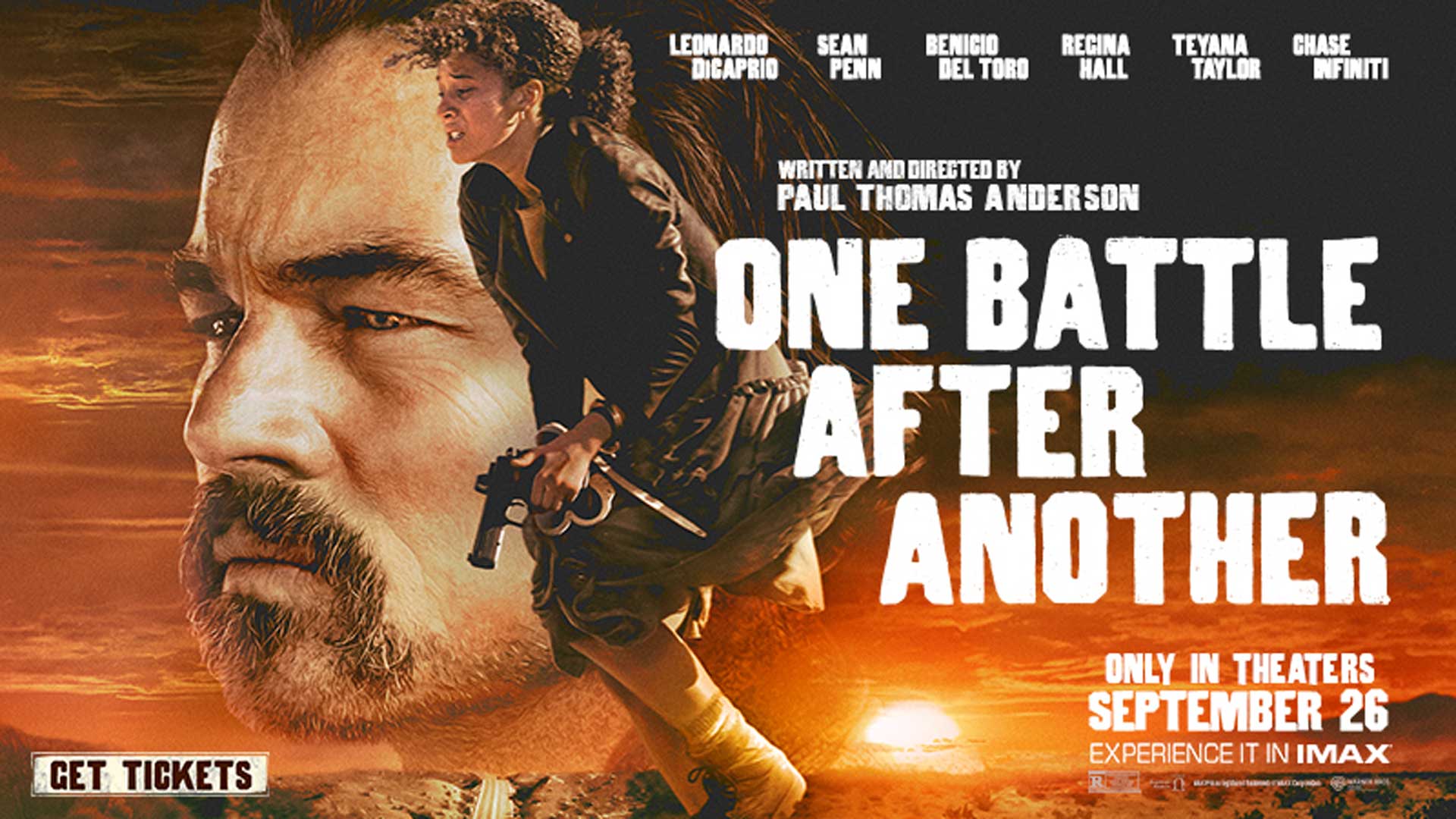
After sweeping the Golden Globes and other awards, One Battle After Another has 13 Oscar nominations. Given the film’s clear relevance, if it does end up a winner, those who created it will probably do more than thank their agents, publicists, partners, and pets. They’ll likely talk about the times we’re living in, as every creative artist or public figure should, given the stakes. We hope they’ll present the film as a cautionary tale, not an endorsement of violent resistance.
It’s easy to see why One Battle has been so successful. It’s gripping, funny, and wonderfully acted. It’s a satire of political madness, left and right. But parts of it also feel real in ways that most movie satires or political thrillers don’t. Although it was completed before Donald Trump’s reelection, its images of vicious immigration raids and out-of-control police now echo America’s daily reality.
When the film played in theaters, audiences cheered for those fighting the forces trampling human dignity. But emulating the movie’s violent resistors would be a trap, confirming the justifications President Trump and his enablers give for brutalizing ordinary Americans and shredding the law.
In the movie, Leonardo DiCaprio’s lead character is part The Dude (complete with ratty bathrobe), and part follower of the 1960’s-era radical group, the Weathermen. But one of us, Mark, cofounded the Weathermen after helping lead successful student protests at Columbia—and now sees the group’s embrace of violence as a destructive trap.
I remember the moral rage I felt when I realized how many innocent Vietnamese we were killing every day. Along with millions of others, young and old, I joined the anti-war movement under the banner “Bring the troops home now!” That powerful movement was fundamentally nonviolent.
But then, having helped organize increasingly powerful protests, some of us grew impatient, fueled by anger, guilt, machismo, revolutionary delusions, and the need to prove ourselves true to the cause. We convinced ourselves that only “revolutionary violence” would stop the greater violence of the war. Calling ourselves the Weathermen, we began fighting the cops sent to control our protests. We adopted a new slogan, “Bring the war home!” Eventually, some in the group escalated to planting bombs in government buildings. Our heroic actions, we thought, would wake even more people up.
The results, instead, were disastrous. Many people left the movement because of our violence and that of others who emulated us. Because of all the patient and nonviolent organizing, public opinion gradually turned against the war. But it also turned against “the radical students,” who Richard Nixon made a prime scapegoat. In doing so, those of us who embraced “revolutionary” violence played into every aspect of the fear that Nixon and his administration worked to exploit and severely damaged the movement we’d once helped build and expand. This in turn helped Nixon prolong the war, even as the broader movement eventually forced withdrawal.
That history shapes how we both see the present moment. Now, as in the movie, Trump and his regime are violently attacking immigrants and those who support them. They label even nonviolent resistance as “terrorist.” Given the brutality, it’s tempting to respond with violence. But think of the political boost Trump got from the assassination attempts, or how he and his allies weaponized the killing of Charlie Kirk—even though both were perpetrated by lone and disconnected individuals. Global research shows that violent movements lose when facing dictators and would-be dictators, while nonviolent ones have far greater chances of winning. Nonviolence takes discipline and persistence, but we’ve seen exactly that from the courageous citizens who’ve nonviolently resisted masked men taking their neighbors in cities like Minneapolis, Chicago, and Los Angeles. And that resistance has helped shift American public sentiment.
Let’s reject revolutionary mythologizing and hope that the creators and stars of One Battle make clear that what authoritarians fear most is disciplined nonviolence, not out of control rage.
Mark Rudd was the cofounder of the Weathermen, spent seven years underground, and then became an organizer and community college math instructor in Albuquerque, NM. He’s the author of Underground: My Life with SDS and the Weathermen.
Paul Rogat Loeb was kicked out of Stanford University for nonviolent anti-war activism, and is the author of Soul of a Citizen and The Impossible Will Take a Little While, whose third edition is coming out in September.
ZNetwork is funded solely through the generosity of its readers.
Donate





1 Comment
What perhaps should also be remembered is that the historical/political situation within USA in 1969/1970 period (even before Fox News/Murdoch media, etc. existed) and the historical/political situation within USA in current “post-Biden/Trump administration support for IDF’s genocidal war/pre-possible US military attack on Iran 2026 period”, is that a mass-based revolutionary left Black Panther Party existed in 1969-1970 that was being violently attacked, as part of U.S. government’s COINTELPRO program.? So, not surprisingly, in January 1970, 1967-1968 Columbia SDS Vice-Chairperson Ted Gold “was arrested along with seven other Weathermen” for protesting at “a Philadelphia television station” on Jan. 10, 1970, “after it broadcast what they called a `slanderous’ TV documentary on the Black Panthers,” according to an article that appeared in the Apr.13, 1970 issue of The Nation magazine. And Ted Gold and the other arrested Weathermen explained the reason for their protest action at CBS’s WCAU-TV station, according to an article that appeared in the Jan. 12, 1970 issue of the Philadelphia Free Press newspaper, in a leaflet which stated the following:
“On Tuesday, January 6, Pig AmeriKKKa escalated its brutal attack on the black liberation struggle by means of a slanderous TV documentary about the Black Panther Party. Behind the façade of liberalism, CBS henchman Mike Wallace accused the party of wanton violence, the desire to be martyrs, and even of corrupting little children’s minds about the good things in AmeriKKKa…We want Channel 10 in Philadelphia to publicly refute these lies, since they spread them in Philly…”