

Over the last 40 years, the U.S. government has relied on extreme fear-mongering to demonize transparency. In sum, every time an unwanted whistleblower steps forward, we are treated to the same messaging: You’re all going to die because of these leakers and the journalists who publish their disclosures! Lest you think that’s hyperbole, consider this headline from last week based on an interview with outgoing NSA chief Keith Alexander:
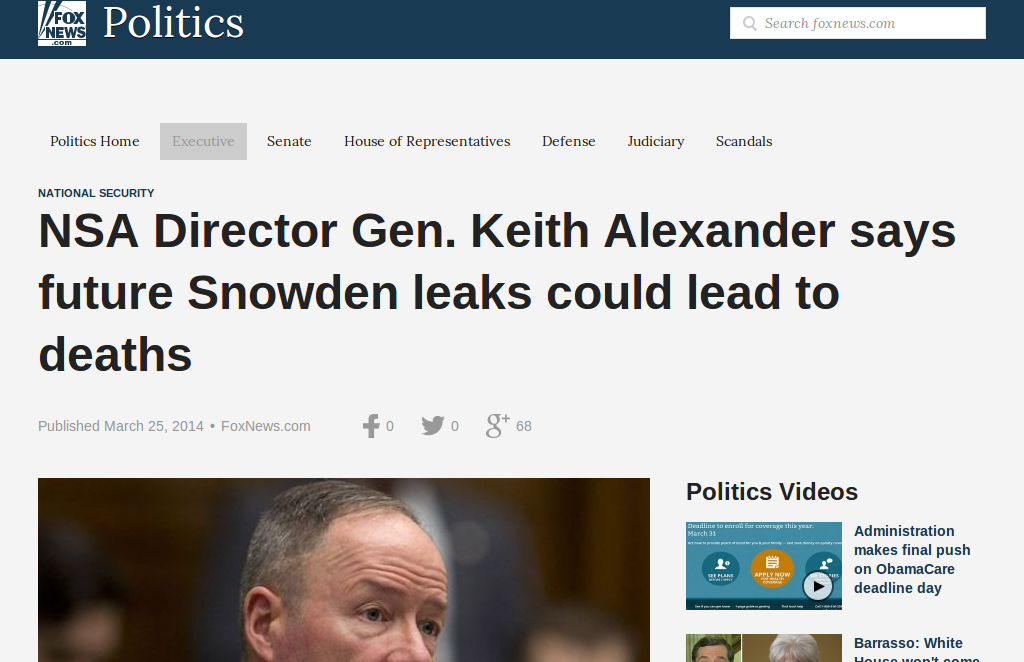
The NSA engages in this fear-mongering not only publicly but also privately. As part of its efforts to persuade news organizations not to publish newsworthy stories from Snowden materials, its representatives constantly say the same thing: If you publish what we’re doing, it will endanger lives, including NSA personnel, by making people angry about what we’re doing in their countries and want to attack us.
But whenever it suits the agency to do so–meaning when it wants to propagandize on its own behalf–the NSA casually discloses even its most top secret activities in the very countries where such retaliation is most likely. Anonymous ex-officials boasted to the Washington Post last July in detail about the role the agency plays in helping kill people by drones. The Post dutifully headlined its story: “NSA Growth Fueled by Need to Target Terrorists.”
And now, Keith Alexander’s long-time deputy just fed one of the most pro-NSA reporters in the country, the Los Angeles Times‘ Ken Dilanian, some extraordinarily sensitive, top secret information about NSA activities in Iraq, which the Times published in an article that reads exactly like an NSA commercial:
FT. MEADE, Md. — In nearly nine years as head of the nation’s largest intelligence agency, Gen. Keith Alexander presided over a vast expansion of digital spying, acquiring information in a volume his predecessors would have found unimaginable.
In Iraq, for example, the National Security Agency went from intercepting only about half of enemy signals and taking hours to process them to being able to collect, sort and make available every Iraqi email, text message and phone-location signal in real time, said John “Chris” Inglis, who recently retired as the NSA’s top civilian.
The overhaul, which Alexander ordered shortly after taking leadership of the agency in August 2005, enabled U.S. ground commanders to find out when an insurgent leader had turned on his cellphone, where he was and whom he was calling.
“Absolutely invaluable,” retired Gen. David H. Petraeus, the former U.S. commander in Iraq, said in an interview as he described the NSA’s efforts, which led to the dismantling of networks devoted to burying roadside bombs.
John “Chris” Inglis just revealed to the world that the NSA was–is?–intercepting every single email, text message, and phone-location signal in real time for the entire country of Iraq. Obviously, the fact that the NSA has this capability, and used it, is Top Secret. What authority did Chris Inglis have to disclose this? Should a Department of Justice leak investigation be commenced? The Post, last July, described Alexander’s “collect-it-all” mission in Iraq which then morphed into his approach on U.S. soil (“For NSA chief, terrorist threat drives passion to ‘collect it all,’ observers say”), but did not confirm the full-scale collection capabilities the NSA had actually developed.
What makes this morning’s disclosure most remarkable is what happened with last week’s Washington Post report on the MYSTIC program, which, said the Post, provides “comprehensive metadata access and content” for entire countries where it is used. The agency “has built a surveillance system capable of recording ’100 percent’ of a foreign country’s telephone calls, enabling the agency to rewind and review conversations as long as a month after they take place,” reported the Post.
The program, noted the Post, has been in use in one country since 2011, and “planning documents two years later anticipated similar operations elsewhere.” Specifically, the fiscal year 2013 intelligence budget identified ”five more countries” in which the agency planned to implement the system.
The Post did not report the names of any of those five countries, nor did it name the one where MYSTIC is already operational. Instead, “at the request of U.S. officials, the Washington Post is withholding details that could be used to identify the country where the system is being employed or other countries where its use was envisioned.” The paper posted a short excerpt from the budget document’s discussion of MYSTIC but withheld and redacted the passages that revealed the names of these countries.
A primary argument NSA typically makes in such cases is that disclosure would endanger the lives of NSA personnel by inviting retaliation from people in those countries who might become angry when learning that their calls are being intercepted en masse. From the Post article: ”NSA spokeswoman Vanee Vines, in an e-mailed statement, said that ‘continuous and selective reporting of specific techniques and tools used for legitimate U.S. foreign intelligence activities is highly detrimental to the national security of the United States and of our allies, and places at risk those we are sworn to protect.’”
Leave aside how corrupted this rationale is: It would mean that no bad acts of the U.S. government should ever be reported, lest those disclosures make people angry and want to attack government agents. Indeed, that is the rationale that the Obama administration used to protect evidence of Bush-era torture from disclosure (to disclose torture photos, Obama said, “would be to further inflame anti-American opinion and to put our troops in greater danger”).
What is so extraordinary is that the NSA–at exactly the same time it is telling news organizations that disclosing its collect-it-all activities will endanger its personnel–runs to its favorite L.A. Times reporter and does exactly that, for no reason other than to make itself look good and to justify these activities. (“‘Absolutely invaluable,’ retired Gen. David H. Petraeus, the former U.S. commander in Iraq, said.”)
This demonstrates how brazenly the NSA manipulates and exploits the consultation process in which media outlets are forced (mostly by legal considerations) to engage prior to publication of Top Secret documents: They’ll claim with no evidence that a story they don’t want published will “endanger lives,” but then go and disclose something even more sensitive if they think doing so scores them a propaganda coup. It also highlights how cynical and frivolous are their claims that whistleblowers and journalists Endanger National Security™ by reporting incriminating information about their activities which they have hidden, given how casually and frequently they disclose Top Secret information for no reason other than to advance their own PR interests. It’s the dynamic whereby the same administration that has prosecuted more leakers than all prior administrations combined freely leaks classified information to make Obama look tough or to help produce a pre-election hagiography film.
Thus, writes the L.A. Times:
Thanks to Edward Snowden, a former NSA contractor, the world came to know many of the agency’s most carefully guarded secrets.
Actually, in this case, the NSA’s “most carefully guarded secrets” were spilled thanks to Chris Inglis and the paper’s own Ken Dilanian. But because the purpose was to serve the NSA’s interests and to propagandize the public, none of the people who pretend to object to leaks–when they shine light on the bad acts of the most powerful officials–will utter a peep of protest. That’s because, as always, secrecy designations and condemnations of leaks are about shielding those officials from scrutiny and embarrassment, not any legitimate considerations of national security or any of the other ostensible purposes.
ZNetwork is funded solely through the generosity of its readers.
Donate