
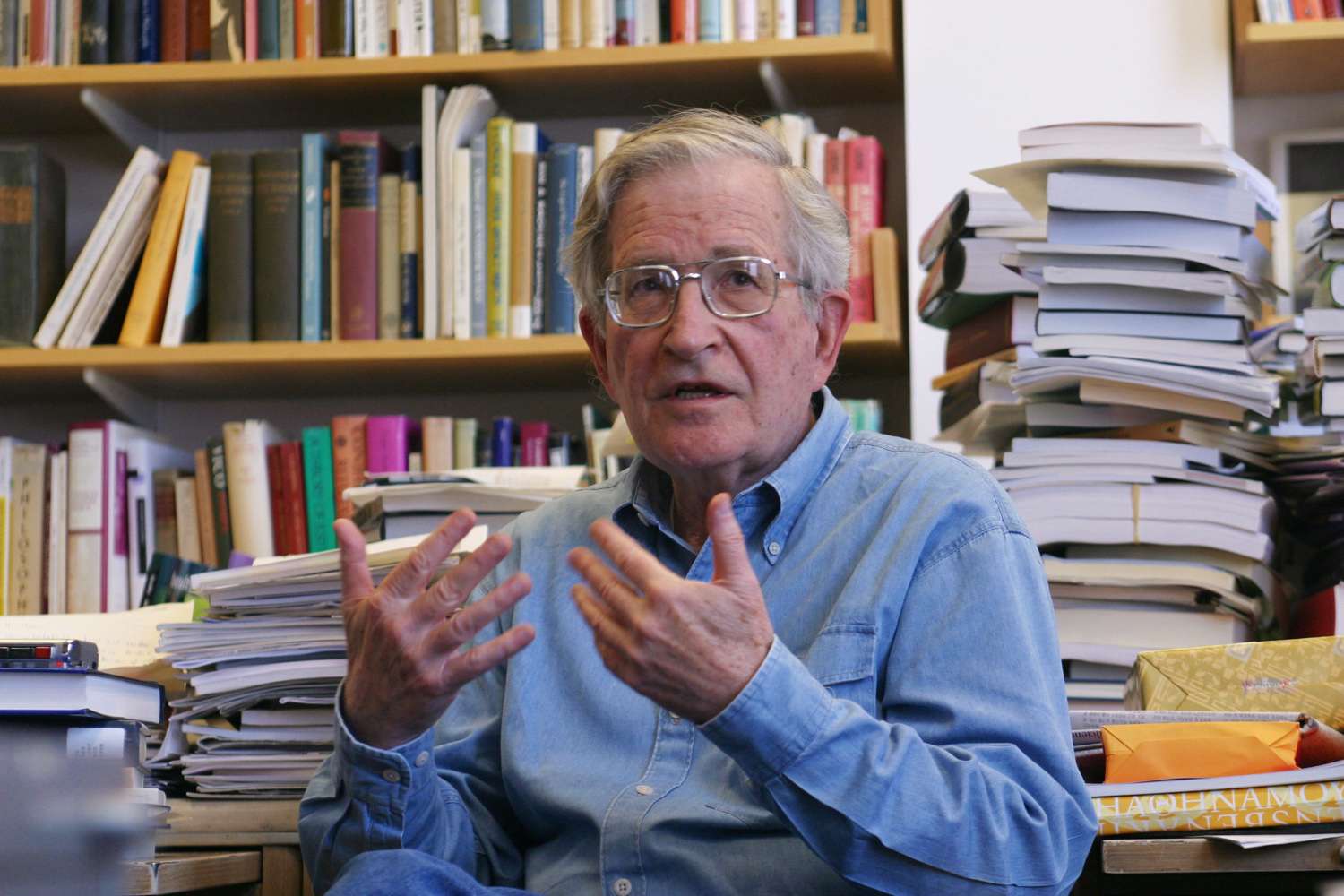
Noam Chomsky has been in the news lately for titillating and unpleasant reasons. For me, his relationship with Jeffrey Epstein is relatively unimportant. All it proves is that Chomsky–currently unable to communicate and thereby defend himself because of a stroke suffered several years ago–is a human being at bottom: not always with perfect judgement and not without hypocrisy.
Perhaps Chomsky was drawn into the orbit of Epstein because of the latter’s massive donations to scientific research; or Epstein’s reputation as a genius financial investor; or Epstein’s facilitation of Chomsky’s search for information via his relationship with such figures as Ehud Barak. In any case, there is no evidence that Chomsky is linked to any of Epstein’s illegal and evil activities. Epstein, although a deeply psychotic predator, was clearly a very intelligent person: perhaps, with his cynicism, he offered insights about the real operations of the ruling class.
We did not yet know the full context or content of the Chomsky/Epstein interactions. Knowing what we do know, those interactions bring up for me an issue of moral contingency. All of us, unless we are somehow able to stay indoors all the time and take a vow of poverty to protect our chastity, are forced to associate ourselves to some degree with economic, political and social structures–as well as the individuals that represent them–which are fundamentally evil and present extremely difficult moral choices. At this point, I have no desire to lay upon Chomsky the hammer of outright moral condemnation.
With that being said, as someone–not an established intellectual but a relatively ordinary person–who has been profoundly influenced by Chomsky, I wish to take this opportunity not to dwell on the Epstein controversy but to offer reflections of modest length below on my personal interaction with a few elements of his legacy.
Chomsky as Oracle
I first read Chomsky when I picked up an original edition of The Fateful Triangle at the Borders bookstore in downtown Seattle in July 1997. I had just graduated high school and it was a deeply fateful moment in my life. From reading that book I soon delved into his other works and found Znet, his main writing forum. From Chomsky’s influence, I became a radical leftist, which I remain to this day.
Today, it seems not fully possible to convey how magnificent he was to many people coming to political consciousness as I did during the neoliberal era of the 90’s and the truly dark post-9/11 War on Terror. He was an absolute beacon of truth and sanity in a world full of darkness (darkness which, needless to say, is more than ever present). As many others have similarly attested, to me the sources of many of the world’s injustices and seemingly inexplicable phenomena in foreign and domestic affairs all began to make sense by reading Chomsky. He had such a compelling way of presenting his case; moreover he omnivorously devoured newspapers, books, government documents and periodicals to get his vital information.
As the late Pakistani socialist Eqbal Ahmad once remarked, Chomsky was unique–and in this way I like to think he influenced me most–for virtually never being taken in by any progressive veneer the American ruling class presented for its imperialist or exploitative domestic policies. Ahmad gave the example of Chomsky not being deceived by the “human rights” foreign policy branding given to the presidency of Jimmy Carter (known to Chomsky primarily as the leader who accelerated US support for Indonesia’s genocide in East Timor).
His access to vital but obscure information and the clear headed analysis he offered made him a true oracle to a person like myself. I well remember in the late 90’s and 00’s how eagerly I awaited Chomsky’s replies on the old Znet forum system to queries made by forum users about current events. Over the course of years, I peppered him with innumerable questions and he responded to them probably much more frequently than I deserved, for I could be slightly obnoxious sometimes.
Chomsky’s willingness to patiently engage with people from a wide variety of backgrounds and varying levels of education–even with long-winded bores like myself–was an impressive trait of the man. It was clear that with his scientific background and libertarian socialist beliefs he saw the potential for real educational and civilizational advancement in almost every human being and sought to do what he could to cultivate it. As Znet writer Paul Street recently suggested in a Facebook comment, this mindset was perhaps the source of a certain naivete in his relations with Epstein: he seemed to see the “good” and potential in every human being, even in an evil if curiously intelligent person like Epstein.
Chomsky and the Khmer Rouge: A Personal Lesson
He could show consternation when people asked him to respond to attempts to discredit him by establishment media hacks; at one point even I was a target of his criticism in this area. The incident demonstrates once again Chomsky’s curiously wide willingness to engage patiently with any human being with whom he came into contact.
The incident happened in 2013 when Slavoj Zizek–who himself, of course, is not an “establishment hack” although he may be worthy of similar negative labels)–repeated the well worn establishment mantra that Chomsky (and the late Edward S. Herman) defended and minimized the Khmer Rouge genocide of the late 1970’s.
At the time Chomsky was responding heatedly to Zizek, I simultaneously was going through a short period where reading right wing propaganda about Chomsky’s Khmer Rouge views had caused me some slight misunderstanding of those views. In July 2013, in the comments section of Chomsky’s Znet article responding to Zizek, I made some remarks reflecting my misunderstanding.
Chomsky then published a fairly blistering response to my comments. He said that my remarks were a symptom of the deep hold of the indoctrination system even on people like myself who tried to see beyond that system. I, of course, then, as now, was a person of not the slightest consequence in journalism, activism, academia or any such worthy field. I had not made the comments with the intention of Chomsky responding to them. I was merely an unemployed, overeducated, rapidly aging gentleman idly making comments on Znet’s website during a sweltering 2013 summer day. Nonetheless, he took my words seriously enough to write a lengthy response.
In stern tone but patient detail he proceeded to lay out the sort of talking points that I myself (before my temporary confusion on the issue) had used for years defending Chomsky on internet chat forums and similar humble platforms, against the charge of being a Khmer Rouge apologist. He went through the points one by one: for example, that he and Herman were not defending the Khmer Rouge genocide but rather comparing mainstream US media response to Khmer Rouge atrocities with its reaction to Indonesia’s US backed genocide in East Timor; as well as pointing how the 1969-73 US bombing of Cambodia massacred hundreds of thousands of that country’s people and made it such an unlivable hell on the earth that it substantially created the conditions for the Khmer Rouge to rise to power.
I think the exchange shows the flaws in my own thinking. It shows Chomsky and I concentrating on different things: me focused on small details in pursuing the question of whether he and Herman were completely accurate in every minutiae of their views on Khmer Rouge atrocities. He, on the other hand, was directing my focus to what, as an American, should have been my primary attention: horrific US war crimes in Cambodia and support for state terrorism in the Third World.
Years later, I wrote my own defense of the Chomsky/Herman views on the Khmer Rouge for Counterpunch.
Final Thoughts
I am most grateful to Chomsky for teaching me critical thinking when it comes to the policies of the American ruling class. I don’t agree with everything he has ever argued. Nonetheless his libertarian socialist vision of human beings eventually being completely liberated from economic oppression so they can exercise what Karl Marx called their “species being”–their ability to use their own minds to create, build and associate with others in complete freedom–remains deeply inspiring to me.
This inspiration remains particularly acute to me as a so-called high functioning Autistic person. I’ve always connected a section of the late liberal journalist Steve Silberman’s 2016 book on Autism entitled NeuroTribes with Chomsky’s glorious libertarian vision. In that book Silberman describes how one of the mid-20th century pioneer researchers into Autism, Leo Kanner, came to a key insight: Autistic people, who were classified while children as severely mentally impaired and in need of lifetime institutionalization–actually developed impressive intellectual capacities in many cases, with some becoming prestigious academics. Kanner discovered that these Autistic persons were able to make these achievements when given conditions of substantial freedom to live, learn and communicate according to their own desires and the particular needs of their own various Autistic neurotypes.
In conclusion, I will say that Noam Chomsky has made a major contribution to developing whatever intellect I possess and for that I’m eternally grateful.
ZNetwork is funded solely through the generosity of its readers.
Donate
8 Comments
“ Perhaps (Chomsky) was drawn into the orbit of Epstein because of (x)..,,”
Would we replace (Chomsky) with the other billionaire names in the files? “Perhaps Musk was drawn into the orbit…” “Perhaps Mandelson was drawn into the orbit…”
No we wouldn’t and shouldn’t. After 2008 anyone associated with that sick billionaire fuck in even the most tenuous ways loses ALL moral credibility.
Admit it friends, this time power has snuffed out one of the greats. They won this battle.
I did your criticism of Chomsky/Herman was correct. It doesn’t really matter if their critics have ‘no moral leg to stand on’. It doesn’t change the fact that Chomsky/Herman got Cambodia wrong and never corrected their mistakes (a pattern that got worse with them as time went on).
https://josephgrosso.substack.com/p/a-game-gone-tilt
Meant I ‘think’ your criticism obviously
No, Chomsky is definitely not one to rush to admit that he was wrong, but I disagree with your contention about Chomsky/Cambodia–I am probably more agreeable to what you might say about things like Chomsky’s views on Syria. I already follow you on Twitter; I’ve seen your Substack and can’t agree with some of its logic on Chomsky but it is fine to have your contribution because you got to keep us on our toes in relating to leftist icons.
I am surprised that the ending comment is not a steadfast call to try to ensure that all and any (or none) additional links are uncovered. I picked up a copy of an anthology in Swedish, “Man kan inte mörda historien” at 17 back in the 90s and was similarly influenced, if not maybe to that degree, but together with other influences it lead to me becoming a member of the anarchosyndicalist movement in any town I’ve lived in since since then. As a fellow person with autism I do appreciate the connection to Neurotribes, but most important is to find out if there are any other links or if there is nothing more that can be found out.
Hi Micke,
Yes, I agree that for truth’s sake, the full details of the Epstein-Chomsky connection should come out.
One of the things that initially astonished me about the revelations which have come out is that Chomsky has often been so careful in trying to avoid anything that might allow mainstream media or academic hacks to try to discredit him. Then he goes and associates with Jeffrey Epstein of all people. But since it seems that so many people in establishment circles are in the Epstein files, maybe the sting of Chomsky being in it is slightly diluted–although it obviously is being used to try to discredit him.
Loved this. Thanks for sharing.
Thanks!