


Turning the spotlight on the King while letting the barons off the hook will not stop Donald Trump and his copycats from amassing feudal powers. The illusion of the strong man who will fix everything cannot be dispelled by reviving the illusion that oligarchy offers the population democratic choices.
The United Kingdom, the United States, and even Germany are all in fiscal jeopardy, with ballooning liabilities for pensions, welfare programs, and military expenditure that politicians dare not shrink nor fund through higher taxes. Some conclude that democracy cannot deliver fiscal prudence because the demos cannot be persuaded to live within its means. But there is an alternative explanation: The cause of our fiscal woes is that we live not in democracies but, rather, under oligarchic rule punctuated by periodic elections.
Free and fair elections enable people with spare time and money to win office, which is a very different thing from gaining power. Once elected, central-bank independence denies them control over monetary policy, while already overburdened budgets and fear of bond vigilantes limit what they can do in the fiscal domain. Is it any wonder that talented people turn their backs on a political career, rather than helplessly observing forces beyond their control? Meanwhile, extortionate power is exercised elsewhere. In France, the latest ground zero of fiscal distress, the richest 500 families’ wealth has soared from 6% of national income in 1996 to 42% in 2024. Something similar has happened across the rest of Europe, including in Germany and even the Nordic social-democratic havens. Almost none of this surge in the fortunes of the wealthy can be reasonably attributed to their swelling productivity or their exceptional entrepreneurial spirit. The main drivers of wealth concentration are a secular reduction in real hourly wages and the descent of large segments of the population into precarity; new schemes that enable big business to extract value from the state in a manner that degrades public services and amplifies governments’ future liabilities; and new opportunities for tax avoidance for those with significant resources.
As capital owners exploit labor and state resources with a degree of efficiency unseen in the 1950s and 1960s, they are also skimping on their insurance premia – the taxes that enable the state to pacify the discontented and safeguard property rights. Additionally, states bail them out when their bets go south, pay them exorbitant fees for steadily worsening privatized services, and maintain cartels of formerly public utilities that further deplete most people’s disposable incomes through skyrocketing prices. Hemorrhaging public support, governing politicians respond by piling unfunded social welfare and pension liabilities on increasingly impecunious states. When the bond markets inevitably throw a tantrum, the news media fill the airwaves with warnings of an imminent debt crisis, often featuring vintage footage of Greek demonstrators rioting against the International Monetary Fund and external creditors. “Everyone must tighten their belt,” is the message, “lest we become another Greece.”
Except that, when they say “everyone,” they don’t mean it. While few dare openly dispute the ethical case for taxing the super-rich more, the moment proposals for wealth taxes surface, the oligarchs trot out a seemingly irresistible argument: if you tax us, we will flee to Dubai, Monaco, maybe even Mars. Viewing it as axiomatic that this would be a bad thing, the governing politicians buckle and take wealth taxes off the table.
In the middle of this one-sided class war, governments feel increasingly squeezed between jittery bond markets and populists who make all kinds of promises while whipping up nationalist sentiment and targeting convenient scapegoats – from single cat ladies and trans people to Muslims, Jews, and desperate refugees.
Once in government, xenophobic populists develop selective amnesia, forgetting their promise to look after the suffering multitudes. Invoking the government’s permanent fiscal woes, they embrace the same austerian cuts that caused the discontent which they exploited to win power. They slash social security. They lecture the overtaxed, exploited, underpaid, and underserved on their patriotic duty to grin and bear it. And, of course, none of this belt tightening advances the declared goal of fiscal consolidation, because they offer tax cuts to those who have turned tax avoidance into an Olympic sport.
To keep their base agitated and on side, they stage vile scenes of gross cruelty toward the chosen scapegoats, a pastiche of medieval authoritarianism reeking of militarism, patriarchy, and divine providence. With liberalism tainted as the freedom of the elites to rob the many, the absolutist promise of “One People, One Party, One Leader” becomes their ideological touchstone.
Good people incensed with this rendition of a hideous past fill the streets in response, proclaiming “No Kings.” But while the sight of so many refusing to accept the Great Leader’s power grab is uplifting, it is hard to be optimistic.
Listening to the lofty humanist speeches and reading the fiery editorials in support of the No Kings movement, what is striking is the lack of introspection about what propelled Donald Trump to the White House: the recklessness of the Democrat Barons who, in partnership with the Reagans and the Bushes, gamed the system for a half-century, impoverishing the state, marginalizing workers, and subjecting entire generations to lives of persistent insecurity.
What would happen if, by some miracle, the centrists were returned to government? Judging by the track record of mainstream Democrats in the US, of President Emmanuel Macron in France, and of Prime Minister Keir Starmer in the UK, the discontented masses will once again be told that they must accept the delinking of their pensions from the consumer price index, or that cuts in disability payments are essential to counter idleness and sloth.
Turning the spotlight on the King while letting the barons off the hook will not stop Trump and his copycats from amassing feudal powers. The illusion of the strong man who will fix everything cannot be dispelled by reviving the illusion that oligarchy offers the population democratic choices. The King will be safe as long as the barons remain unchallenged.

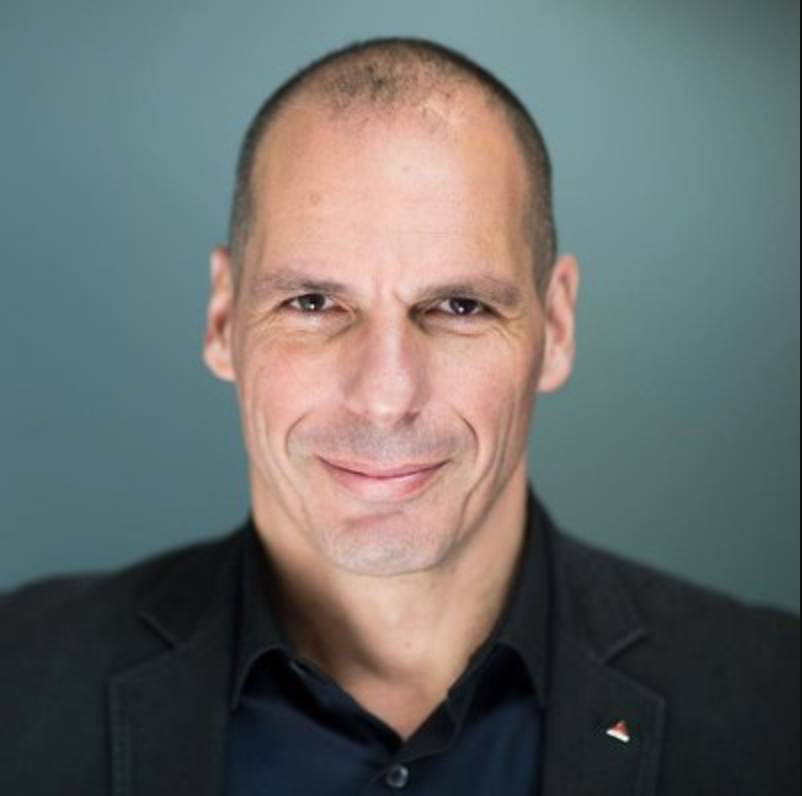
Yanis Varoufakis born 24 March 1961 is a Greek economist, politician, and co-founder of DiEM25. A former academic, he served as the Greek Minister of Finance from January to July 2015. Since 2019, he is again a Member of Greek Parliament and MeRA25 leader. He is the author of several books including, Another Now (2020). Varoufakis is also a professor of Economics – University of Athens, Honorary Professor of Political Economy – University of Sydney, Honoris Causa Professor of Law, Economics and Finance – University of Torino, and Distinguished Visiting Professor of Political Economy, Kings College, University of London.
ZNetwork is funded solely through the generosity of its readers.
Donate





1 Comment
Dear Yanis,
All your writings and work in general is very much appreciated. And this is, probably, one of the best articles on the subject in the left press and certainly on this website. The universal solution of most authors is more of the same – let’s have these protest every month, every week, let’s flood the Washington, DC with people, etc. All these protests are against something “bad”, and it would have been absolutely reasonable and practical if elimination of this “bad” could lead to some durable and reliable “good”. Unfortunately, as you’ve mentioned in the article it’s not an option at the present time. Of course, some specific demands, such as elimination or restriction of ICE, changing tariff policies, etc. make perfect sense, but, fundamentally, they will not change the current economic, social, and political situation, which is critical.
Can the change of the slogan make a difference? Very unlikely. After all, it’s relatively easy to remove the king (at least for now), but it’s extremely difficult to eliminate or even affect the barons, because it would require fundamental modifications of the existing capitalist economic system.
Also, the elites (barons) have never been “reckless”, they have always been very consistent, diligent, and persistent in doing what exactly the subjects of the capitalist mode of production are supposed to do – maximizing profits. Right now, the only hope (illusive and unsubstantiated so far) to restore profitability using civilized means (without a major war or another disaster) is related to AI, which can fundamentally change economic and social relations. In any case, it’s very unlikely to expect that it will produce something like a Star Trek society.
The current period of liberal capitalism as we know it in the developed Western countries (with working middle class, etc.) is rather an exception than the rule in the history of capitalism. And a sober analysis might indicate that the time of (neo)liberalism or benign (social-democratic) capitalism is over. The main reason is simple – profitability. Preservation of the status quo in this country, and all developed countries in general, is becoming increasingly difficult economically by using liberal-democratic methods. Growing economic austerity and political reaction is a chosen solution that requires a “strong man” politically and ideologically. Therefore, the rise of the radical Right and attempt to install authoritarian (or worse) government simply because this is the most convenient form of power for the ruling elite(s) in the current social, political, and economic situation.
Marches, demonstrations, meetings, petitions, and other liberal forms of protest are only effective under bourgeois democracy and are very unlikely to change and even influence the policies that are intended to establish a different style of governance.
While “the Trumpian tyranny” (of course, Trump is just an incidental historic character, but very suitable for an autocratic regime) has not solidified and even not clearly materialized, the most urgent organizational task of the Left is to create a united front for social progress, democracy and anti-authoritarianism. The time for civilized resolution of a looming social, economic, and even environmental/ecological crisis is running out, and a broad popular left front is the most (if not the only) viable option for various left oriented organizations, organized working class, and all progressive forces in general not only to remain politically and socially relevant, but maybe even contribute to the preservation of human species.