


Books discussed:
- Fight Like Hell: The Untold History of American Labor by Kim Kelly, Simon and Schuster, 2022.
- The Future We Need: Organizing For a Better Democracy in the Twenty-First Century by Erica Smiley and Sarita Gupta, Cornell University Press, 2022.
Kim Kelly’s Fight Like Hell: The Untold History of American Labor describes the heroic battles of workers to gain their rights and create a better life for all working people. It illuminates those who have often been left out of historical accounts, like “poor and working-class women, Black people, Latino people, Indigenous people, Asian and Pacific Islander people, immigrants of all backgrounds, religious minorities, queer and trans people, disabled people, the sex workers and undocumented people whose work is criminalized, and people who are incarcerated.” Many of them have been excluded not only from the history books, but from the self-declared “House of Labor” itself. This is labor history for the era of diversity.
Fight Like Hell not only recounts worker action in the past, it describes how these struggles are continuing today. Contemporary accounts range from the effort to win a union election at the Amazon warehouse in Bessemer, Alabama to recent struggles for equal rights for Black, LGBTQIA, and sex workers. Like workers in the past, such workers today have to put their jobs, their well-being, and sometimes even their lives on the line to win the most elementary rights on the job.
But although the courage and commitment of workers has far from vanished, organized labor is in desperate decline. The proportion of workers in unions is lower than before the rise of the modern labor movement more than 80 years ago. Barely 10% of U.S. workers are union members, and barely 6% of private-sector workers.[1] Union membership declined by over two million since 2000, a nearly 13% decline.[2] Notwithstanding the upsurge in strikes in late 2021 rapidly dubbed “Striketober,” the total number of workers idled by work stoppages in 2021 was barely 80,000, compared, for example, to 485,000 in 2018 and 1.8 million in 1974.[3]
This is despite high favorable ratings for unions and a high proportion of workers who would like to be in a union. A Gallop poll conducted last September showed 68% of Americans approve of labor unions — the highest rate since 71% in 1965[4]. 77% of those age 18 to 34 approve of unions. Petitions for new union elections at the National Labor Relations Board increased 57 percent during the first half of fiscal year 2021.[5]
There is a lively debate on how workers can fight for better conditions and a better world today. Proposals range from tweaks like labor law reform or bigger union organizing budgets to efforts to replacing collective bargaining with individual employers with government-sponsored industry-wide national bargaining tables, from replacing “union jurisdiction” with multi-union organizing coalitions. to “solidarity unionism” focused on direct action on the job by independent “worker-led” unions.
Erica Smiley and Sarita Gupta’s new book The Future We Need: Organizing For a Better Democracy in the Twenty-First Century makes a significant and original contribution to that debate. Smiley and Gupta are respectively the present and past executive directors of Jobs with Justice, a labor rights organization with coalitions in over 30 cities and states advocating that all workers should be able to bargain collectively. Jobs with Justice provides an ideal location to observe both the difficulties and the new developments in worker organization. The Future We Need showcases “the creative strategy of Black workers, immigrant workers, southern workers, and workers from the global south” as “models to be scaled up in ways that viably challenge trends in today’s global economy” so that we can build “a society that works for all of us.”
The institutions of today’s labor movement go back nearly 90 years to the legal structure of collective bargaining established in 1935 by the National Labor Relations Act (the Wagner Act, AKA “Labor’s Magna Carta”). The NLRA established the right of workers to organize, bargain collectively with their employers, and engage in concerted action. Over the next decade millions of workers joined unions and won higher wages and better working conditions.
But as Smiley and Gupta point out, The NLRA excluded protection for employees in sectors that employed predominantly Black and Brown workers, particularly Black domestic workers and Mexican farmworkers. And it provided little protection for service workers in jobs mostly held by women, such as waitresses and others dependent on tips. Many unions themselves excluded or discriminated against female and African American workers. The result was a divided working class, with a predominantly white male sector empowered by unions and the NLRA while women and people of color faced lower wages and were far less likely to be represented by a union. That “pits the interests of organized union workers against those of the unorganized majority.”
Over the past fifty years, economic and social changes have reduced the power of workers and eroded what gains working people have been able to make. Control by hedge funds, private equity firms, and other forms of financial capital has replaced owners’ interest in the long-term health of their corporations with single-minded pursuit of short-term “shareholder value.” Globalization lets corporations move jobs to the lowest-wage, least-regulated locations in the world, promoting a race to the bottom. The expansion of subcontracted, temporary, part-time, and other forms of precarious, contingent work to one-third of the workforce undermines labor standards for all workers. A “fissured economy” has fragmented work among multinational production chains, subcontractors, short-term, “just-in-time” production practices, labor agencies, and labor migration. They give as an example a Marriott hotel, which may be owned by a small group of investors but managed by “management service providers” who then subcontract to different companies such functions as front office work, landscaping, restaurants, other food service, and cleaning — companies which may in turn contract out work to temp agencies and labor brokers.
The workforce itself has also been transformed. Managerial and technical workers now make up well over half the work force—more than the total of crafts, operatives, and service employees. Smiley and Gupta cite Charles C. Heckscher’s study The New Unionism to characterize the “cross-cutting identities of race, ethnicity, gender, religion, and other social categories” that have become “increasingly important alternatives to older occupational identities of workers and managers.”[6]
But Smiley and Gupta make clear that the problems of the labor movement are not solely the result of such external factors. Many of the practices of organized labor itself contribute to its decline – and to its inadequacies as a vehicle for working people to meet their needs and realize a world more like the one they need and want.
Under US labor law and conventional trade union practice, unions are primarily a means for a particular group of workers to bargain with their immediate employer over wages and conditions on the job. But most of the things that affect working people lie beyond their direct relations with their employers. Problems that lie outside the workplace, from healthcare to breakdown of public services to racial injustice to climate change, can’t be fixed by bargaining between workers and their immediate employer. Even within the realm of work, the immediate employer is often not the real power determining conditions on the job; the “fissured economy” means that the company by whom workers are hired may be merely a franchise, subsidiary, agency, or shell owned by a chain of intermediaries with the ultimate power holders hidden or protected from any accountability to those who are actually working for them.
What is exciting about The Future We Need is not so much the familiar litany of organized labor’s difficulties as the creativity of the solutions it proposes. Smiley and Gupta call for “a new kind of movement for organizing and collective bargaining” – and they spell out much of what that would mean.
The centerpiece of their approach is to extend collective bargaining beyond the workplace. They propose an expanded definition of collective bargaining as
the process whereby working people take collective action in negotiating with any entity that has power over their wages, living conditions, and overall economic well-being in a way that produces an enforceable agreement that can be renegotiated as conditions change.
The purpose of this expanded form of collective bargaining is to re-ground the workers movement in the needs and potentials of the worker as a whole person, addressing “the material and cultural needs of the modern worker” who “does not solely identify as a worker” but rather has “a diverse array of identities.” The understanding of workers as “whole people” must “fundamentally shift our strategies” and “how we think about what collective bargaining can entail.” It must “apply the mechanisms working people use in the workplace” to “all the ways in which humans relate to capital.”
The Future We Need presents dozens of examples of ways that such expanded collective bargaining is or could be used to address the full range of working people’s needs. They describe how tenants, debtors, homeowners, consumers, and many others have joined together to directly confront and negotiate with specific forces of capital—corporations, banks, and elements of the state. Their examples range from rent strikers, to tenant unions, to unions of transit riders. They suggest how consumers, renters, debtors, and other “account holders” could similarly establish collective bargaining relations with banking and financial institutions. These initiatives could be even stronger if they represented disparate but allied forces.
Imagine transit riders negotiating directly alongside transit workers with similar proposals around wages and fares. Imagine Amazon Prime members negotiating with the company alongside warehouse, tech, and delivery workers around the company’s behavior in their county or state.
But why would power holders agree to bargain with their lowly “beneficiaries”? The same reason employers eventually decide to bargain when their employees threaten to strike. The power of workers both at work and in the wider economy is based on “the power to collectively withhold participation in an economic relationship in order to force concessions from those who seek to get rich through exploitation.”
Smiley and Gupta describe this as “community-driven bargaining” which places “working people organized around a specific economic relationship” as a bargaining unit “at the table with decision-makers.”
In community-driven bargaining strategies, organizations representing tenants, community and neighborhood residents, debt holders, and consumers sit across from landlords and building owners, government agencies, developers, and others. The result is still a legally enforceable agreement.
Community-driven bargaining complements another strategy to extend collective bargaining to meet the needs of the whole worker and the whole working class: “bargaining for the common good.” This involves lasting alliances with community partners in which community objectives are incorporated within union bargaining demands and, if possible, community representatives are actually brought to the bargaining table along with worker representatives. The 2019 strike of the United Teachers of Los Angeles embodied this approach. UTLA president Alex Caputo-Pearl said, “UTLA is part of a growing national movement that is centered on the idea of bargaining for the common good. By the time we get to the bargaining table, we’re taking demands and proposals that have come out of months of working with community organizations, youth, and parents, and that bring to light things that are not typical, mandatory subjects of bargaining.” More than 80% of the public supported the strike; 50,000 rallied in support. In addition to a wage increase, the strike won many demands that benefited teachers, students, parents, and the community, such as a nurse in every school, a librarian in every secondary school, counselors, reduction in testing, investment in Community Schools and ethnic studies, limiting random searches, expanding green space, and supporting immigrant families.[7]
Much of The Future We Need addresses the situation of workers who have been second class citizens or excluded altogether from the “House of Labor.” It emphasizes not only the importance of “a movement that includes and organizes all people,” but of one that “fights against white supremacy, patriarchy, xenophobia, homophobia, and all other strategies of exclusion, division, and oppression.” Labor leaders urgently need to “expand organizing and collective bargaining in ways that address the needs of Black and Brown communities as a central part of their strategy.” The book provides many personal accounts – at once poignant and enraging – of abusive or condescending behavior by union leaders toward members of such groups.

Photo: Jobs with Justice
Jobs with Justice has been at the center of efforts by workers who have been excluded by labor law or union practice to form their own independent unions and other worker organizations. Indeed, this is one of the most promising developments pushing the envelope of conventional union practice. Smiley and Gupta have had a ringside seat – indeed, an inside-the-ring seat – for those struggles. Workers in industries ranging “from meatpacking to farming, hospital work to domestic employment, fast food restaurants to grocery stores, transportation to delivery services” have formed their own independent organizations that in fact perform many of the roles of unions even if they are not recognized as unions.
Smiley and Gupta describe a wide range of such organizing initiatives. Domestic Workers United led the state of New York to pass a Domestic Workers Bill of Rights which organized domestic workers, nannies, and other caregivers to negotiate with the state to include them in the basic labor protections afforded by law. Domestic Workers United then helped form the National Domestic Workers Alliance and the International Domestic Workers Federation, “creating the potential for setting labor standards nationally through a federal domestic workers bill of rights as well as the establishment of a global framework for domestic work.” The National Day Laborer Organizing Network established new standards in the residential construction industry. And the Coalition of Immokalee Workers and other farmworker organizations “leveraged consumer influence over multinational food brands to ensure safe, worker-defined standards” for workers in agriculture.
Recent breakthroughs at Amazon and Starbucks and the proliferation of informal direct action on the job in response to the COVID pandemic point to the emergence of what are being called – in contrast to staff-organized and led organizations — “worker-led unions.”[8] According to long-time labor journalist Steven Greenhouse,
“Workers have embraced a long-neglected strategy, called self-organizing or bottom-up organizing that’s proving highly successful. With self-organizing, employees at a workplace, dissatisfied with their pay and working conditions, conclude that unionizing is a smart way to improve matters (and they’re often doing that with little or no help from large, established unions).”[9]
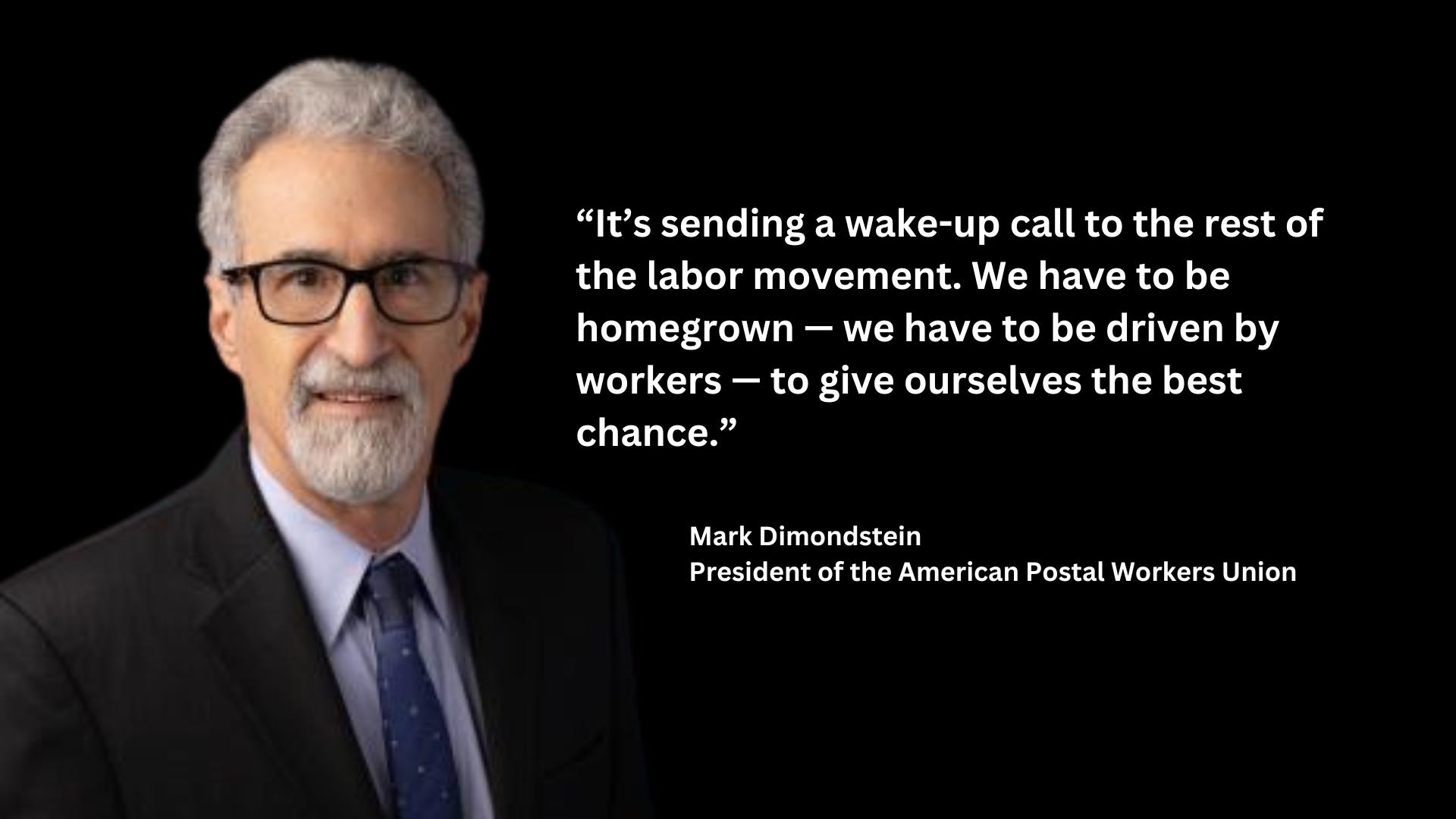
“It’s sending a wake-up call to the rest of the labor movement,” said Mark Dimondstein, the president of the American Postal Workers Union. “We have to be homegrown — we have to be driven by workers — to give ourselves the best chance.”[10] But Greenhouse warns, “with their inertia and lack of imagination, many of today’s older unions seem inexplicably reluctant to seize – and build on – this promising moment for labor.”
Many labor leaders might hesitate to back today’s burst of self-organizing because they won’t control those efforts and won’t get the members and the dues money resulting from them. But if labor leaders are serious about ending decades of decline and about strengthening unions to win a better deal for workers, they need to jettison their old-style thinking and provide money and lawyers to help today’s union surge grow and then grow some more. If they don’t do this, it will show that all their talk about reversing labor’s decline is empty rhetoric.
In the 1930s the leaders of the dominant labor federation, the American Federation of Labor, bitterly fought the rise of industrial unions that organized all workers in an industry regardless of craft. But some craft unions and many of their local leaders and members provided meeting halls, public support, and even money for the new industrial unions. Similarly, today the Amazon Workers Union on Staten island received office space, pro bono legal help, and a messaging platform for mass texting from established unions, and Starbucks workers similarly received legal services and the help of a paid organizer.
A particular sticking point both in years past and today is the question of union jurisdiction – who gets the right to represent workers and collect their union dues. Postal Workers president Dimondstein told the New York Times, “We need to make sure this doesn’t break down into jurisdictional fights — who’s getting these types of workers, these members.” But asked whether he thought established unions would be able to resist that temptation, Mr. Dimondstein replied, “I know it’s necessary.” But “I don’t know how confident I am.” If existing labor organizations want to encourage workers to organize, they will have to accept that worker-led unions need to be worker led not only while they are organizing but also thereafter.
While Smiley and Gupta emphasize the importance of new forms of worker action from below, they also recognize the need for working class movements to meet the globalization of corporations through “globalization from below” to counter “the futility of trying to organize and collectively bargain solely at the factory level.”[11] To combat global capital, “unions and progressive organizations will have to unite across national borders, not just in moral solidarity but also through shared organizing and collective bargaining demands on multinational corporations and their government supporters.”
Smiley and Gupta give as an example the Asia Floor Wage Alliance (AFWA), a “strategic network” of garment-sector unions and other worker organizations from countries across Asia with support from Jobs with Justice and India’s New Trade Union Initiative. AFWA calculates comparable living wage standards in different Asian countries (somewhat like state cost-of-living standards in the US). Worker organizations then use those standards to pressure transnational corporations to provide uniform minimum wages across the region. The idea is to put a common floor under wages to block the corporate race-to-the-bottom. The standards allow garment workers to negotiate with their direct employers in textile and apparel factories while “undermining the ability of multinational corporations to pit one country’s workers against another” in search of the lowest wage. The AFWA has also pressured a number of multinational companies into agreeing to a global convention to end gender-based violence at work.
Finally, Smiley and Gupta take on the problem of the fissured economy and the elusive holders of its real power by targeting those they refer to as the “ultimate profiteers.” They give as an example John Stumpf, former chairman and CEO of Wells Fargo. He had direct control over the working conditions of hundreds of thousands of people employed by Wells Fargo; ultimate control over tens of thousands of subcontracted workers, such as security guards and custodial workers; control of the mortgages of millions of homeowners and their families; the debt of hundreds of thousands of students with Wells Fargo loans; tens of thousands of small business owners dependent on the bank for lines of credit; millions of Wells Fargo credit card holders; and county, state and local governments, school districts, and other public entities reliant on Wells Fargo for cashflow loans, bond financing, and banking services. Wells Fargo was a major shareholder of other major corporations, with representation on their boards of directors, and a major contributor to powerful political organizations like the American Legislative Exchange Council (ALEC). “There were literally millions of people suffering” because of the “unfair practices and influence” that Stumpf wielded. And that leaves to the side Wells Fargo’s power over people in the rest of the world outside the US!
Workers increasingly find that their direct employer does not actually have the power to change their conditions. The real power lies with “ultimate profiteers” like John Stumpf, whose power is concealed behind multiple layers of corporate deception. As a result, “there simply is no winning plan to build a shared prosperity” without “confronting these individual owners and their corporate power directly.”
Smiley and Gupta call for a movement that engages the ultimate profiteers in the new global marketplace, “targeting and forcing to the bargaining table the individuals and organizations that control the international corporations that now wield most of the power over the lives of working people.” For example, governments could require that banks receiving benefits put popularly elected representatives on their boards. And homeowners could bargain with banks to collectively renegotiate unfair loans. In short, working people would “bargain with the ultimate profiteer.”
The Future We Need presents extended collective bargaining not just as a way for working people to address an immediate problem, but as a way to “enable working people to play a permanent, direct role in governing the institutions that impact them rather than merely winning occasional concessions or policy improvements.” It could provide a means to establish “true economic democracy” not only in the workplace, but also “in our communities, our schools, our courthouses.”
Of course, making such change requires power, and that is often seen as being exclusively the possession of powerful existing institutions. But Smiley and Gupta assert,
Power is not dependent on following traditionally prescribed paths. Instead, it grows from the collective action of people in shared economic relationships who are determined to work together to make their voices heard and to have their needs met from common decision-makers.
Their actions are “evolving the unions of the future.”
These two books convey a powerful message to all working people who want to “make their voices heard” – go for it! Sara Nelson, International President, Association of Flight Attendants-CWA, ends her Foreword to Kim Kelly’s Fight Like Hell, “Our history reminds us of a fundamental truth: the labor movement belongs to all of us.” And Smiley and Gupta in The Future We Need point out that, “Regardless of where the groups in this book started, they all did just that—they started.”
[1]John Hiatt, “By Helping Self-Organized Workers, Labor Can Save Itself,” American Prospect, April 11, 2022. https://prospect.org/labor/by-helping-self-organized-workers-labor-can-save-itself/
[2] “Union Membership, Coverage, and Earnings.”
[3] Margaret Poydock et al, “Data show major strike activity increased in 2021 but remains below pre-pandemic levels,” Economic Policy Institute, February 23, 2022.
https://www.epi.org/publication/2021-work-stoppages/
[4] Megan Brenan, “Approval of Labor Unions at Highest Point Since 1965”, Gallup, September 2, 2021. https://news.gallup.com/poll/354455/approval-labor-unions-highest-point-1965.aspx
[5] National Labor Relations Board, “Union Election Petitions Increase 57% In First Half of Fiscal Year 2022,” April 6, 2022. https://www.nlrb.gov/news-outreach/news-story/union-election-petitions-increase-57-in-first-half-of-fiscal-year-2022
[6] Charles C. Heckscher, The New Unionism (New York: Cornell University Press, 1996). https://www.cornellpress.cornell.edu/book/9780801483578/the-new-unionism/#bookTabs=1
[7] For an account of the 2019 UTLA strike, see Jeremy Brecher, Strike! 50th Anniversary Edition (Oakland, CA: PM Press, 2020) pp. 442-446. https://www.pmpress.org/index.php?l=product_detail&p=1085
[8] For strikes and other worker action during the COVID pandemic, see Jeremy Brecher, Don’t Starve – Fight! People Power in the coronavirus pandemic (Labor Network for Sustainability, 2021) https://labor4sustainability.org/files/LNSpdf_strike_strivetofight.pdf For recent nonunion strikes, see Michael Sainato, “I cannot survive on $260 a week: US retail and fast-food workers strike,” Guardian, May 16, 2022.
‘I cannot survive on $260 a week’: US retail and fast-food workers strike | US news | The Guardian
[9] Steven Greenhouse, “The key to worker power in America? Let a thousand Chris Smalls bloom,” The Guardian, May 12, 2022. https://www.theguardian.com/commentisfree/2022/may/12/the-key-to-worker-power-in-america-let-a-thousand-chris-smalls-bloom
[10] Noam Scheiber, “Amazon Workers Who Won a Union Their Way Open Labor Leaders’ Eyes,” New York Times, April 7, 2022. https://www.nytimes.com/2022/04/07/business/economy/amazon-union-labor.html
[11] For background on worker resistance to the global “race to the bottom,” see Jeremy Brecher and Tim Costello, Global Village or Global Pillage (Boston: South End Press, 1994) https://www.jeremybrecher.org/global-village-or-global-pillage-book/ and Jeremy Brecher, Tim Costello, and Brendan Smith, Globalization from Below (Cambridge, MA, South End Press, 2002). https://www.jeremybrecher.org/globalization-from-below-2/
ZNetwork is funded solely through the generosity of its readers.
Donate
1 Comment
The membership…is the Union….NOT the elected reps.
https://monthlyreview.org/product/why_unions_matter/
Retired
Canada
UAW/ CAW & TCA/ Unifor
Local 199