


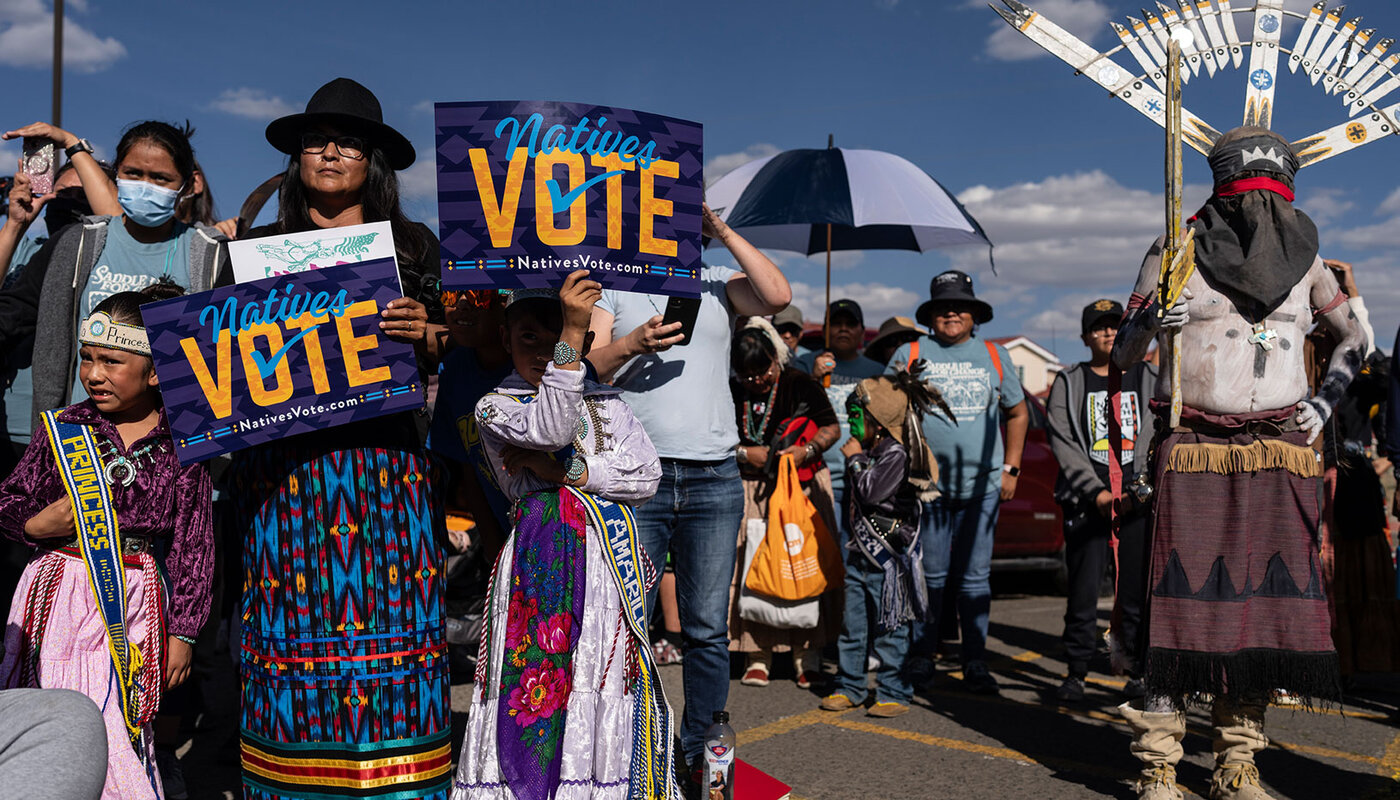
Greg Lembrich is hoping for the best but planning for the worst in the upcoming midterm elections. Legal director of the national nonprofit Four Directions Native Vote–Indian Country, Lembrich is worried about ever-higher barriers tribal voters may face in polling places nationwide as well as in South Dakota, where Four Directions is headquartered.
Voting rights are essential to Native Americans, says Judith LeBlanc. A citizen of the Caddo Nation, she is executive director of Native Organizers Alliance (NOA), which supports grassroots Indigenous groups. For the midterms, her organization will work with the Native American Rights Fund, a national Native-run law firm, to train election observers for Indian reservations around the country.
A Navajo family gathers around a table in their hogan to fill out mail-in ballots. (ThePalmer, iStock)
“We have a unique position in the history of democracy in this country,” LeBlanc says, reminding non-Natives that Native people have governed this land since what she calls “the beginning of time.”
Enduring discrimination against the Indigenous electorate arises in part from the fact that tribal citizens make up powerful voting blocs in the so-called swing states, despite constituting minorities, even small minorities, in each. According to the Brookings Institution, tribal voters lean Democratic and in swing states’ nearly divided electorates can bolster a Democratic win or wipe out a Republican advantage.
“In an electorate with razor-thin margins, a few hundred or a few thousand Native voters can tip the scales,” Lembrich says.
Four Directions’s director O.J. Semans, Rosebud Sioux, agrees that swing-state influence propels persistent efforts to hinder the Native vote. But, he says, you’ve also got to look closer to home. “Everyone talks about the congressional or presidential races,” Semans says, “but what this boils down to is the county races—seats on the school board, the water board, the county commission.”
Non-Native inhabitants of bordertowns surrounding reservations want to control the resources of their local jurisdictions. “That’s a given,” Semans says. As a result, they resort to numerous disenfranchisement tactics, as Barn Raiser has reported, from gerrymandering election districts to setting up election offices far from the reservation.
This long-term and bitter racism has been backed up by violence. In 2000 and 2007, the U.S. Civil Rights Commission issued reports documenting the hate crimes, murders and police shootings that Natives face in white-inhabited areas bordering their reservations. This data was updated in reports from the National Institute of Justice in 2016 and by Congress in 2023. Combined, the reports and Native advocacy groups make clear the stakes: the fight for equal justice and Native self-determination is bound together in the fight for tribal sovereignty and voting rights.
Federal fiascos
The Trump administration’s ongoing attempt to sow discord in the midterm elections—Lembrich calls it “hysteria”—is based on an unfounded narrative that “somehow ineligible voters are going to turn out in large numbers and will each risk a federal felony to cast a ballot.” The false claim is supported by arrests, abductions, even killings, of American citizens and others by Immigration and Customs Enforcement (ICE) officers.
These horrifying events are distractions, according to Lembrich—a way to deflect blame for the nation’s ills onto those perceived as “other.” To sustain the turmoil created, Trump has threatened to prosecute the relevant election officials if non-citizens are caught voting and even insisted on the creation of a national citizenship database using Social Security information ahead of the midterms.
Importantly, Trump has tried to exert federal control over voting—which the U.S. Constitution delegates to the states. His March executive order charged the U.S. Postal Service to use various means to restrict mail-in voting, such as refusing to deliver mail-in ballots in states that do not hand over their voter rolls to the federal government.
An estimated one-third of all American voters use mail-in ballots to vote, including 1 in 4 rural voters.
With the federal restrictions on mail-in ballots blocked by several federal-court rulings, including the Supreme Court on September 14, the Trump administration’s focus has turned to the Department of Homeland Security (DHS) sending ICE officers and the military sending soldiers to patrol polling places and seize ballots and voting machines.
As far as ICE is concerned, the head of DHS announced in September the agency “has no plans for such a thing.” According to the advocacy group Democracy Project, it is unlikely in any case that ICE agents could hope to cover the nation’s 95,000-plus polling places, many open 13 hours a day for a month or even more, including each state’s unique early-voting period and Election Day. In some states, these places are “vote anywhere” locations; if voters learn one has ICE presence, they can go elsewhere.
Gen. Dan Caine, Chairman of the Joint Chiefs of Staff, has said he has no plans to send troops to the polls, calling such an order “unlawful.” Civil-rights and voting-rights groups and the city of Denver agree; they have filed a lawsuit to prevent armed presence at the polls, citing federal and state laws prohibiting it, according to the advocacy group Democracy Forward.
The administration’s efforts follow lawsuits by the Department of Justice (DOJ) against 30 states that have refused to hand over rolls with voter data. So far, the DOJ is 0 for 23 in those lawsuits. The other cases are still pending.
“[W]e still believe, with good reason, that the upcoming midterm elections will be safe, secure, lawful, fair and accurate,” says the Democracy Project.
Still, Native and other rural voters could find the election unmanageable in other ways.
Where the postman never rings
Even though the Supreme Court has spoken, and there will be no post office involvement in the election, mail-in voting remains challenging for tribal members. Mail on some tribal homelands is so unreliable, Native voters who wish to, or must, vote by mail can’t be certain they’ll receive a ballot, much less get it back to the election office in time. The timing is critical. According to the National Conference of State Legislatures, 35 states require mailed ballots to arrive on or before election day; the rest of the states and territories accept ballots after the election for a particular number of days that’s unique to each.
A 2026 report by NARF found a 134% increase in the rejection rate of mail-in ballots between 2020 and 2024 from counties where Native Americans make up more than 25% of the population. In contrast, the national rejection rate rose by 55%. NARF says this is “strong evidence that USPS network disruptions had a significant impact in Indian Country.”
Semans says his organization is currently advising all tribes to avoid the mail-in-voting issue altogether—to set up ballot drop boxes for their voters, organize get-out-the-vote programs that drive voters to the polls and arrange for election officials to come to the reservation during their state’s early-voting period to register voters and allow them to cast a ballot on the spot.
When push comes to shove
Lembrich says his most important duty as Four Directions’ legal director is ensuring that Native voters have the same access to the polls as non-Native voters. This right has been settled law for 102 years, according to Lembrich—since passage of the Indian Citizenship Act of 1924. “Every vote saved is a win for democracy,” he says.
As Lembrich has done for the last 24 years, this fall he will field dozens of lawyers and law students to polling places on South Dakota’s Sioux reservations. Trained to observe election administration, the legal eagles will ensure that Native voters aren’t thwarted by poll workers, intentionally or inadvertently.
Across the country, polling places are “where the rubber meets the road,” Lembrich says. He notes that while poll workers are trained for their task, they do it at most twice a year. As a result, his legal teams can be resources for them as well as for voters.
As problems arise, the legal observers will deal with them immediately and locally or turn them over Lembrich. When necessary, he will escalate the issues to county, state or federal election officials. After nearly a quarter-century of this work, Lembrich has acquired a long list of contacts that lets him reach decision-makers quickly. On election day, Lembrich says, “time is of the essence.”
When it comes to casting ballots, bright lights glimmer on the Crow Creek Sioux Tribe’s reservation, in Fort Thompson, South Dakota. For about the last decade, tribal member and elected official Donita Loudner has hired tribal members as poll workers. When Crow Creek voters go to the election office, they see someone sitting behind the counter who looks like them, she says. They are reassured. They feel that such a person will facilitate their voting, not hinder it.
Leaping barriers
These days, tribal members aren’t just seeking to vote. Undaunted by barriers to the ballot box and the potential disorder of the 2026 midterms, they are running for office in local, state and federal races, says the national Native publication Indian Country Today. They aim to join the ranks of numerous politicians, mostly but not all Democratic, who have credited Native support for their success.
Indigenous candidates have broad appeal in majority-non-Native as well as majority-Native jurisdictions, according to LeBlanc. They focus on uniting disparate communities and working together for everyone’s rights, she has told Barn Raiser. She saw this typically inclusive Native outlook manifest dramatically during the ICE surge in Minneapolis during the winter of 2025–2026. People of many backgrounds pulled together to offer each other care and safety, LeBlanc recalls.
Those headed for November Congressional races include Claire Valdez, a citizen of Ysleta Del Sur Pueblo, running for New York’s 7th District; Sean McCann, Citizen Potawatomi Nation, running in Michigan’s 4th District; and Brenton Awa, Native Hawaiian, in Hawaii’s 2nd District, reports Indian Country Today. Pueblo of Laguna citizen Deb Haaland, former Congresswoman (D-N.M.) and Interior Department Secretary under President Biden, is running for governor of New Mexico.
More standouts include U.S. Rep. Sharice Davids, Ho-Chunk (D-Kan.), running for re-election, and two Native women vying for Senate seats, former U.S. Rep. Mary Peltola, Yup’ik (D-Alaska) and the Democratic Lt. Gov. of Minnesota, Peggy Flanagan, White Earth Nation.
Flanagan labeled her dramatic August primary results “the many versus the money.” Outspent 4-to-1, she was supported by hundreds of thousands of volunteers and attained a 20-point win that garnered more votes than all of the Republicans combined in their Minnesota Senate primary. She also confounded the prediction markets, which offer financial trades based on estimates of future outcomes and had come out against her.
Loudner lauds the female Indigenous candidates. “Native women are strong,” she says. “They carry a lot of weight.”
Upending a rational process
American democracy depends on orderly elections. According to Article 1 of the U.S. Constitution, the states administer elections, a function that has been politicized in recent years—even before the current chaos created by the administration’s threats to restrict mail-in voting, send armed federal agents to the polls and prosecute election officials.
As Barn Raiser reported in May, the Supreme Court’s Callais opinion, gutting the Voting Rights Act of 1965, kicked off a spate of redistricting—a process that normally happens after each 10-year U.S. Census population count. However, states including Alabama, Florida, Georgia, Mississippi, South Carolina, Tennessee and Wyoming did not wait for 2030. They began immediately altering election districts to eliminate those dominated by voters of color and to favor Republicans.
LeBlanc told Barn Raiser that this was “gerrymandering with a political purpose” and likely to increase obstructions to Native voting.
The Callais-driven redistricting came after a flood of restrictive voting laws, reports The Brennan Center for Justice. Arizona, Arkansas, Idaho, Indiana, Kansas, Louisiana, Montana, Texas and Wyoming have each enacted at least five restrictive voting laws since 2021, the Center says.
The laws and their constraints vary from state to state, though most demand some form of identification that proves citizenship and eligibility to vote, such as a birth certificate or passport. In this way, they emulate the administration’s failed “show-your-papers” SAVE [Safeguard American Voter Eligibility] Act, which Congress did not pass after concerns about widespread public opposition.
We have yet to see how all these many, varied and complicated changes will play out at the polls, Lembrich cautions.
Long and winding road
For prospective Indigenous voters, the journey to the ballot box starts with registration. NARF estimates that over 4.7 million Native Americans are eligible to vote, but only 66% of those eligible are registered.
You could even say that the arduous journey begins at birth. Many tribal members were born at home, so may lack the birth certificate that would prove their citizenship and right to vote, Navajo Nation Council Speaker Crystalyne Curley told WBUR, an NPR affiliate. Obtaining a birth certificate ($10–$50 in most states) or other acceptable documentation, such as a passport ($165 or more), may be prohibitively expensive for many.
Each of the individual state SAVE-like laws mentioned above has its own provisions that control which documents can be used there to register to vote and in what form—originals, copies or electronic versions, for example. The rules affect not just a state’s Native American population but its portion of the approximately 80 million Americans of all ethnicities who register or update their registration each election cycle—to reflect a new home address, for example.
That group includes the more than 60 million people who live in rural America. For them, the average round-trip to register, much of which may be on unpaved country roads, can take four-and-a-half hours, according to the Center for American Progress. Any of these prospective voters—Native or non-Native—may lack the time, vehicle or gas money to embark on such an expedition. Some, particularly in Alaska and Hawaii, may have to take a flight, says the Center.
If mail registration is allowed in the prospective voter’s state, that has its own challenges for tribal voters. Native homes, even entire tribal villages, may not have regular mail delivery. Though tribal members may be able to receive their mail at post offices on or near reservations, these facilities are relatively farther apart and open for fewer, often irregular, hours and days compared to post offices in most American towns and cities.
In the end, all of this effort and expenditure may turn out to be irrelevant, according to a stark assessment in a policy brief in Vote.org. “Verifying the authenticity of birth certificates and passports is a task most election offices are not currently equipped to perform,” the brief reports.
The final mile
About 33% of registered voters in the U.S. live in rural areas, necessitating challenging trips to the polls, such as those for registration described above. Residents of rural reservations must often drive several hundred miles round-trip, which discourages voting, says a 2024 U.S. House of Representatives report, “Voting for Native Peoples: Barriers and Policy Solutions.”
These distances are tough countrywide but are especially formidable in rural Alaska, where some communities lie far beyond where roads end and can be reached from the outside only by air or water. They count on the arrival of election workers to open the polls. During the August 2026 primaries, the Alaska Beacon reported, bad weather grounded flights, stranding election workers and causing some polls to open for just a few hours. This was, however, an improvement over the 2022 and 2024 primaries, when some polls could not open at all.
Inadequate, though federally-mandated, language assistance for primary speakers of tribal languages adds another burden, according to the U.S. House report. It concludes, “discrimination in voting is alive and well, and has a significant impact on Native people.”
A pivotal moment
Americans, Native and non-Native, have to work together to reimagine what an inclusive, multi-racial democracy looks like, according to Judith LeBlanc. Ultimately, she says, we need to figure out “what will make it possible to have a good life, healthy communities and economic well-being and to take steps in the present to prepare for our descendants.”


Stephanie Woodard is an award-winning reporter who covers human rights and the rights of nature. She is the author of American Apartheid: The Native American Struggle for Self-Determination and Inclusion.
ZNetwork is funded solely through the generosity of its readers.
Donate




