


Only a few years pass before events emerge that reaffirm the thesis that what began in Tunisia on December 17, 2010, and culminated the following year in a massive wave of popular uprisings that spread to six countries in the region and included various forms of mass mobilization in other countries—the wave known as the “Arab Spring”—was not an isolated or accidental event. Rather, it marked the beginning of what I described as a “long-term revolutionary process” (in The People Want: A Radical Exploration of the Arab Uprising, 2013, 2nd edition 2022).
The foundation of this assessment lay in the understanding that the sociopolitical explosion across the Arabic-speaking region was the manifestation of a deeply entrenched structural crisis. This crisis resulted from the dismantling of developmental economic policies and their replacement by neoliberal ones over the last quarter of the past century. These changes occurred within a system of regional states that were fundamentally at odds with what is required by the ideal of market capitalism upon which the neoliberal dogma is based.
As a result, the region suffered from notably low economic growth compared to other parts of the Global South, marked by high unemployment—particularly among the youth. Youth unemployment rates in the region reached record highs, particularly among university graduates. These social realities fueled the regional revolts, which, while locally varied in their political causes, shared a common socio-economic foundation. The implication of this analysis was clear: as long as the structural crisis remained unresolved, sociopolitical turmoil would continue, and more uprisings and popular movements would inevitably follow.
Indeed, despite the defeat of the 2011 revolutionary shockwave —due to repression by the Gulf monarchies in Bahrain, the military coup in Egypt, and the descent of Syria, Libya, and Yemen into civil war—a second wave of uprisings began on December 19, 2018, in Sudan, spreading to Algeria, Iraq, and Lebanon the following year. This second wave was ultimately stifled by a combination of repression and the COVID-19 pandemic. However, it persisted in Sudan even after the military coup on October 25, 2021, until the country descended in turn into civil war on April 15, 2023, as a result of a conflict between two factions of the armed forces.
Meanwhile, Tunisia’s democratic system, the last remaining success of the 2011 uprisings, was dismantled in a coup led by President Kais Saied, who, with the support of the security services, suspended the constitution on July 25, 2021. Along with the outbreak of the war between military factions in Sudan and the Zionist genocidal war in Gaza six months later, which further dampened regional hopes, it seemed as though the social eruption of the Arab uprisings had fizzled out.
However, such impressions are unreliable when assessing the true state of social tensions in the region. For this assessment, one must rely on concrete social and economic data—particularly youth unemployment, a key indicator. According to the International Labor Organization (ILO), the Middle East and North Africa still have the highest youth unemployment rate in the world, with nearly one-quarter of the youth population (ages 15-24) out of work.
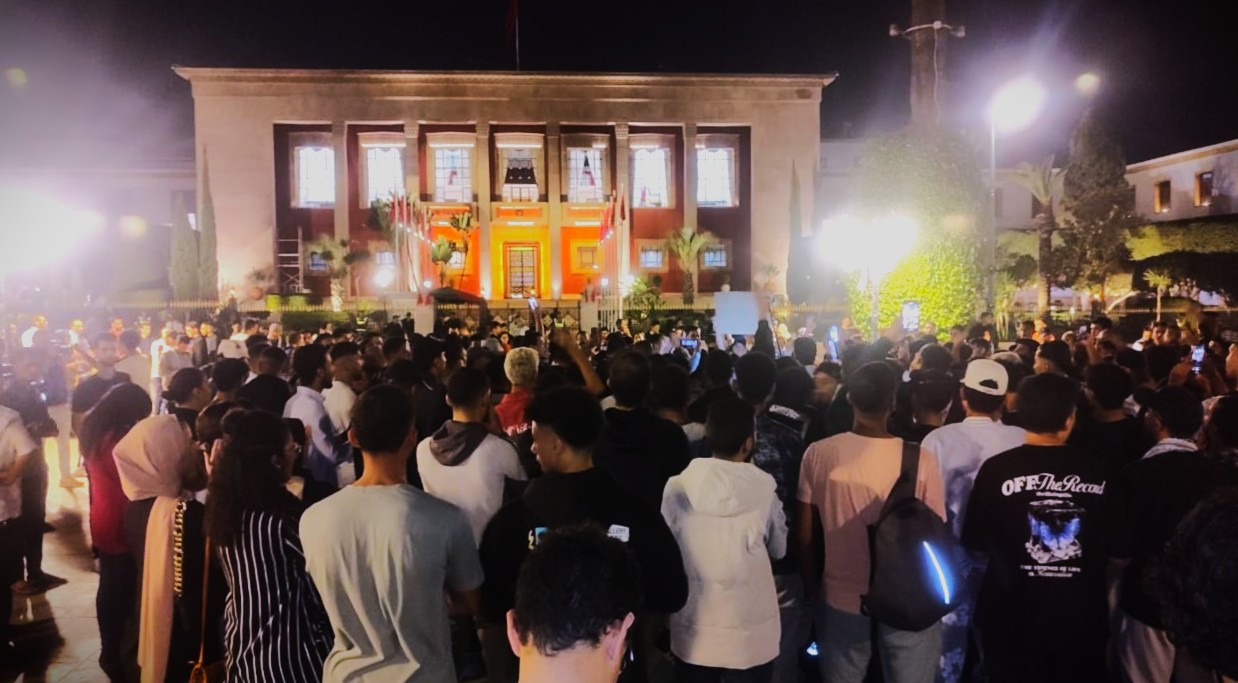
The massive youth-led movement that began in Morocco on September 27th, which has not yet ended despite a recent pause, underscores that the region’s social volcano remains active. Given the country’s alarming unemployment data, it is no surprise that Morocco’s youth have taken to the streets. According to the Moroccan High Commission for Planning, the unemployment rate among 15-24-year-olds (the group to which the majority of Generation Z belongs) reached nearly 36% this year, with almost half of this age group (47%) unemployed in urban areas. Among those aged 25-34, the rate stands at 22%, and 27.5% in urban areas. These are very high rates indeed, which are compounded by graduate unemployment, which approaches 20% of all graduates. Additionally, nearly one-fifth of women in the labor force are unemployed. These numbers help explain the high participation of students and young women in Morocco’s Gen Z movement.
This new generation of activists is also ushering in new forms of organization, particularly through the use of social media technology. Educated youth, adept at navigating digital platforms, have become central to these movements. While the first two waves of regional uprisings relied heavily on Facebook, the Moroccan Gen Z movement has embraced Discord, a platform that allows for faster and more decentralized democratic decision-making. Over 200,000 users on Discord voted on whether to continue their demonstrations, reflecting a more advanced level of grassroots organization, even compared to the Sudanese “Resistance Committees,” which represented a significant step forward in the democratic self-organization of the youth revolutionary movement.
However, what remains absent from all these experiences is a radical, country-wide political movement capable of joining forces with the democratic grassroots youth movement to offer a credible alternative to the status quo. This movement would need to embody the aspirations for freedom, democracy, and social justice, and possess the political capacity to replace existing regimes. Without the emergence of such an alternative, the success of any future uprising in the region will remain uncertain. While the regional revolutionary process is bound to continue, the absence of a viable alternative could lead to a dangerous stalemate—where existing regimes hold onto power through brute force, while others collapse into the chaos of civil war.
Translated from the Arabic original published in Al-Quds al-Arabi on 21 October 2025. Feel free to republish or to publish in other languages, with mention of the source.


Gilbert Achcar grew up in Lebanon. He is a Professor of Development Studies and International Relations at the School of Oriental and African Studies (SOAS) in London. His books include The New Cold War: Chronicle of a Confrontation Foretold. Morbid Symptoms: Relapse in the Arab Uprising; The People Want: A Radical Exploration of the Arab Uprising; The Clash of Barbarisms; Perilous Power: The Middle East and U.S. Foreign Policy; and The Arabs and the Holocaust: The Arab-Israeli War of Narratives. He is a member of Anti-Capitalist Resistance.
ZNetwork is funded solely through the generosity of its readers.
Donate




