


I just got back from Labor Notes. It’s the biggest conference of the grassroots, activist wing of the labor movement. Thousands of union members who are fired up to make the world a better place. It’s a thing that will make you feel hopeful.
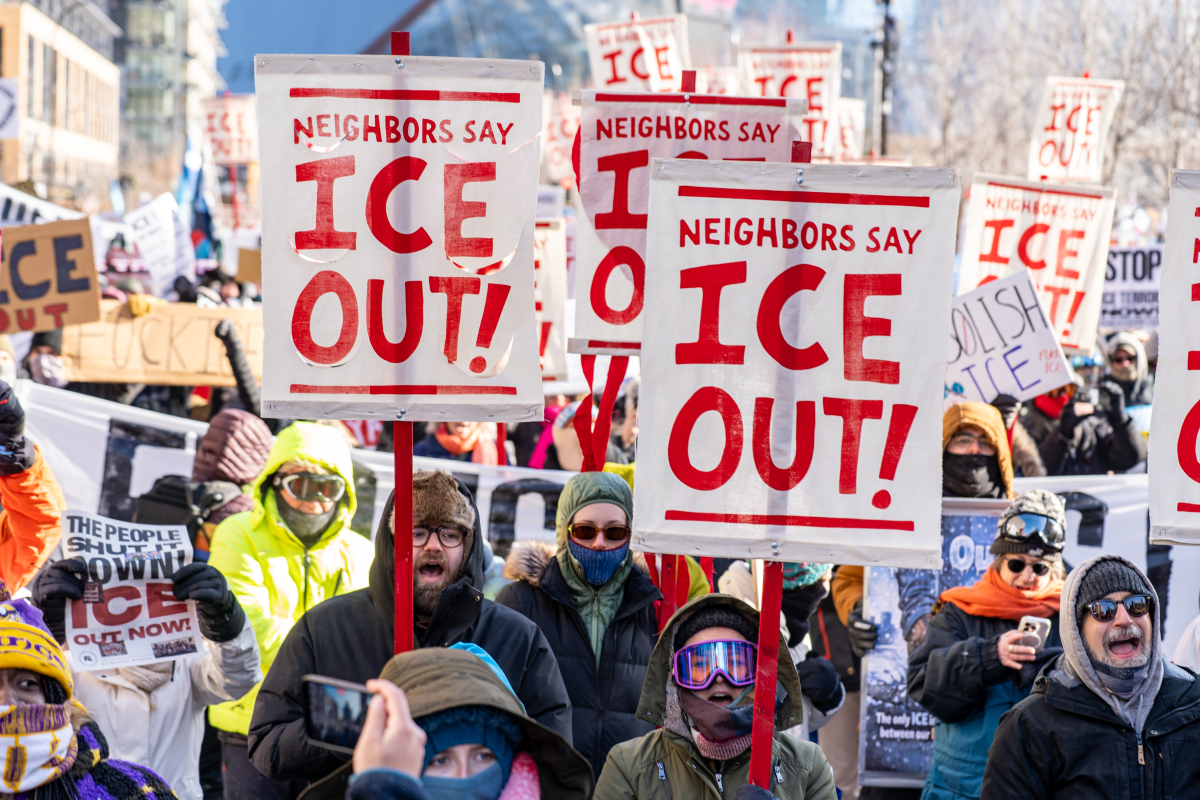
There are hundreds of panel discussions and workshops at Labor Notes, and no one can go to more than a small fraction of them. But I want to discuss one of them, which focused on what is, to my mind, the most important union action of the past year: the long and ultimately successful struggle by the people of Minneapolis and St. Paul against ICE’s militaristic occupation of their cities.
I got to moderate a panel that included both elected union leaders and rank and file members from the Twin Cities, who talked about the nuts and bolts experience of the ICE surge, the rapid resistance to it, the enormous citywide march against ICE on January 23, and the aftermath. It was fascinating and inspiring and it helped to show us all not just what unions are, but what they can be.
These were unions representing teachers and hotel workers, service workers and janitors and telecom technicians. Regular working people. They spoke about the brutality of ICE’s operations, and how they sprung into action. The teachers made plans to protect their students and schools. The unions all plunged themselves into mutual aid and protection for their immigrant members. And, after an initial phase of figuring out how to safeguard their own people, they threw themselves into a staggering citywide effort to resist ICE in every way possible.
The Minneapolis area has one of the most impressive citywide labor movements in America. It has a rich history of strikes. The leaders of the city’s unions today have had the benefit of going through both the George Floyd protests of 2020, and of planning and executing a multi-union, multi-industry coordinated citywide contract fight in 2024. They have practice working together—like a real movement, rather than an atomized collection of interest groups. When ICE came to town, they were able to exercise those muscles immediately. When they decided, with only a couple of weeks’ notice, to have a huge march and shut down the city on January 23, they were able to pull it off. And the city’s unions were able to bolster the larger projects of mutual aid and immigrant protection and protest and resistance that pulled in everyone, not just organized labor. One union leader described speaking to leaders churches and community groups and saying: You figure out how to build the most power in your thing, and we’ll figure out how to build the most power in our thing, and we’ll all do it on this timeline. Decentralization with a common cause. It works.
Resistance is not free of consequences. Minnesotans who were watching ICE were killed. Thousands more were arrested and assaulted by federal troopers, and some 1,700 were deported. The economic loss to the city as a result of ICE’s operations has been estimated to be $700 million. The human cost is incalculable.
Yesterday, the Trump Justice Department announced that it has indicted 15 anti-ICE protesters from Minnesota, branding them “Antifa.” Workday Magazine reports that some of those indicted are trade unionists whose presence at worker assemblies organized by local unions is included as evidence of their criminal activities. Kieran Knutson, the president of a Communication Workers of America local in the Twin Cities (and who spoke passionately on the panel at Labor Notes) told Workday that the worker assemblies were organized as a way to allow members of different unions across the area to come together “across different unions, across different industries, across different trades, in a way that’s directly democratic, to talk about and discuss and debate issues.” In other words, the basic stuff of movement building is being met with criminal charges.
We are all antifa now. We have been since last September, when the White House’s memorandum titled “Countering Domestic Terrorism and Organized Political Violence” instructed federal law enforcement agencies to investigate and prosecute those practicing “anti-fascism,” which is described like so: “Common threads animating this violent conduct include anti-Americanism, anti-capitalism, and anti-Christianity; support for the overthrow of the United States Government; extremism on migration, race, and gender; and hostility towards those who hold traditional American views on family, religion, and morality.”



Hamilton Nolan is a labor writer for In These Times. He has spent the past decade writing about labor and politics for Gawker, Splinter, The Guardian, and elsewhere. More of his work is on Substack.
ZNetwork is funded solely through the generosity of its readers.
Donate




