


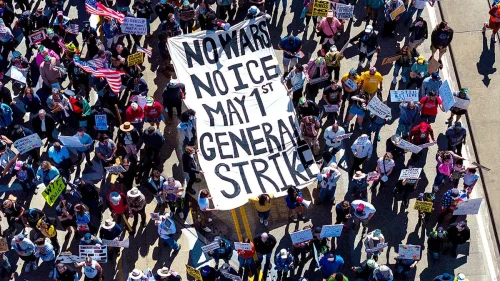
Tens of thousands of working people across the United States joined the May Day Strong protests in 3,500 cities demanding “Workers over billionaires,” “No ICE” (immigration police) and “No War.” The movement was organized by dozens of labor unions with millions of members and by other workers organizations, such as immigrant workers’ centers and domestic workers groups. May Day Strong called for “no school, no work, no shopping.” The Democratic Socialist of America (DSA) helped to organize the protests and Sun Rise, made up of young climate activists, engaged in civil disobedience. Sun Rise activists blocked the New York Stock Exchange, leading to their arrest. [1]
While not as large as the No Kings demonstrations that brought out millions, May Day Strong had more working class and more Black and Latino participants in many cities. The protests varied from state to state and city to city. In New York City my wife and I marched with her union of the 30,000 workers of the City University of New York. Our mayor, socialist Zohran Mamdani, needs money to implement his program of free buses, universal childcare, and low-cost housing, and so the dominant slogan was “Tax the Rich.”
In Los Angeles, where there are millions of Latino immigrants, the slogan of hundreds of unions, community groups, and faith-based organizations was “Somos el Pueblo [We Are the People]—Shut it Down.”
In North Carolina the major theme was “Kids Over Corporation” as thousands of teachers, parents, and students marched in various cities. Abbey Brook, a teacher for six years, told reporters, “I’m out here for my students, I’m out here for all students across North Carolina. We’re under-funded and I’m here to make a statement to our government.”
All of this, of course, forms part of the resistance to President Donald Trump, his Make America Great Again Movement, and the Republican Party. In many places people carried signs and chanted against Trump, billionaires, and oligarchy and warned of the danger of fascism.
May Day had its origins in a strike movement for the eight-hour day in 1886 in Chicago led by German immigrant workers. At an anarchist-led rally at the city’s Haymarket Square there was a bombing that killed two demonstrators and injured many others including police. Eight men were tried and sentenced to death and one to 15-years, for the bombing, but one of them committed suicide and Governor Richard J. Oglesby commuted two of the death sentences. In 1904 the Socialist International called upon all socialist parties to commemorate the events on May 1 and it became the international workers’ day, perpetuated by Socialists and Communists.
But for most of the post-war period, from 1947 until the 2000s there was no May Day in the United States to speak of. During the Cold War, the Soviet Union and other Eastern European Communist States turned May Day into a celebration of military, might parading tanks and missiles on Red Square. In the United States, the government and the unions celebrated the American Labor Day on the first Monday in September with parades and barbecues. May Day as the International Workers’ Day was revived in the United States by Latino immigrants from Puerto Rico, Mexico, and Central America as a day for workers and immigrants’ rights.
Leah Greenberg of Indivisible, which has played a key role in organizing the No Kings protests, said that May Day Strong was a “structure test” for the movement.
“We are asking people to take a step into further exerting their power in all aspects of their lives – as workers, as students, as members of local organizing hubs,” she said. “It’s important as it builds muscles towards greater non-cooperation.”
We will need more such stress tests if we are to have the power to actually interfere with business and government.
ZNetwork is funded solely through the generosity of its readers.
Donate

