

Source: Common Dreams
Conservative Democratic Sen. Joe
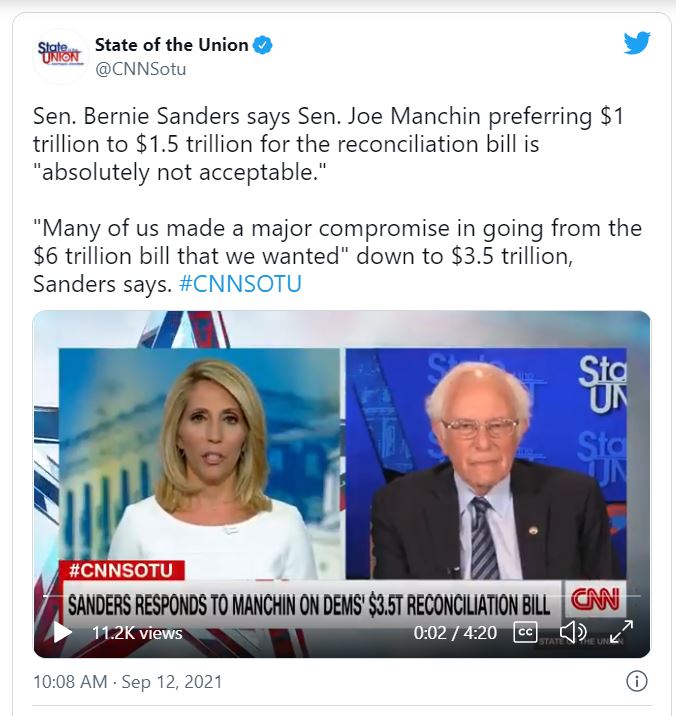
Manchin’s recent vow, repeated on Sunday morning, to oppose a reconciliation bill larger than $1.5 trillion is “absolutely not acceptable,” Senate Budget Committee Chair Bernie Sanders made clear this weekend.
“We are not going to build bridges just so our people can live under them,” Sanders (I-Vt.) said on Saturday night. Invoking a phrase that he and other progressive members of Congress have repeated for months, Sanders added, “No infrastructure bill without the $3.5 trillion reconciliation bill.”
During an appearance on CNN‘s “State of the Union” on Sunday morning, Sanders told host Dana Bash that “many of us made a major compromise in going from the $6 trillion bill that we wanted” to the Build Back Better Act (BBBA), a popular plan endorsed by President Joe Biden that would invest $3.5 trillion over a decade to improve social welfare, advance workers’ rights, establish a path to citizenship for millions of undocumented immigrants, and strengthen climate action.
Referring to “the enormously unmet needs of working families,” Sanders said: “We’ve got to lower the costs of prescription drugs for people. We’ve got to expand Medicare to include dental, hearing aides, and eyeglasses. We have to maintain the $300 direct payments we’re giving to working parents, which have lowered childhood poverty in America by 50%.”
Moreover, the lawmaker stressed, scientists warn that “we’ve got a few years left before there will be irreparable, irreversible harm to our planet if we do not address climate change.”
Sanders acknowledged the key role played by Manchin (D-W.Va.) in developing the bipartisan Infrastructure Investment and Jobs Act (IIJA), which proposes $550 billion in new spending to upgrade the nation’s roads, bridges, and ports.
Manchin—who has made more than $4.5 million from his family’s coal business since joining the Senate in 2010 and received praise from an ExxonMobil lobbyist for undermining climate action—was the chief architect of the energy-related measures in the bill, which progressives have criticized for prioritizing fossil fuels over renewables.
The Senate passed the Biden-backed IIJA last month, but in an effort to ensure passage of the more ambitious BBBA, House Speaker Nancy Pelosi (D-Calif.)—with the support of Senate Majority Leader Chuck Schumer (D-N.Y.) and the president—is pursuing a “two-track” strategy that advances both pieces of the legislation simultaneously, linking each bill’s fate to the other.
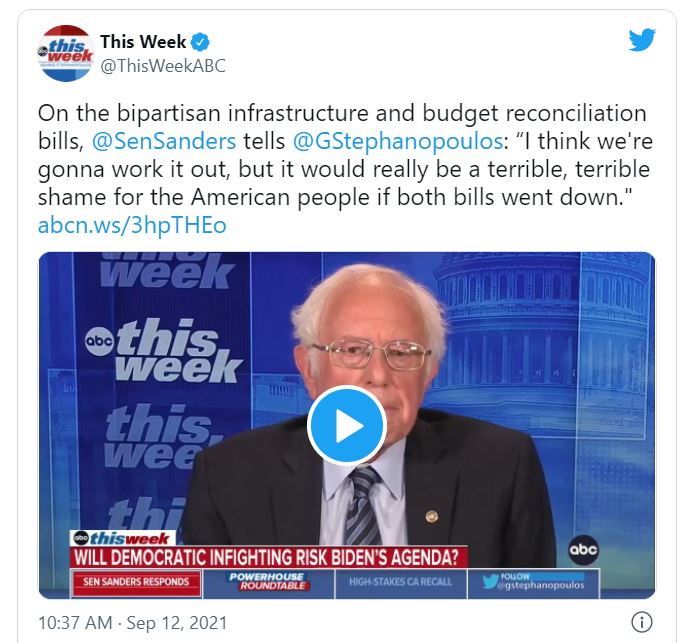
“What we have worked on,” Sanders noted, “is working both of those bills in tandem. They go together. And it would be a really sad state of affairs for the American people [and] for Congress if both of those bills went down.”
Asked by Bash if it’s “possible that that could happen right now,” Sanders replied: “Yeah,” before adding, “I don’t think it will.”
A few minutes later, George Stephanopoulos, host of ABC‘s “This Week,” asked Sanders if it he would vote for a $1.5 trillion reconciliation package to avoid ending up with “no bill.” Sanders and other lawmakers who wanted to invest $6 trillion to address inequality and the climate emergency—including Reps. Rashida Tlaib (D-Mich.) and Pramila Jayapal (D-Wash.), chair of the Congressional Progressive Caucus—have been adamant that, having already bargained, $3.5 trillion is the lowest they are willing to go.
Given that most Americans, the president, and the vast majority of congressional Democrats want both the physical infrastructure bill and the social infrastructure package to pass, Sanders said Sunday, “the real question you should be asking is, ‘Is it appropriate for one person to destroy two pieces of legislation?’”
While the BBBA can be passed without Republican support through the filibuster-proof budget reconciliation process, doing so requires the support of every member of the Senate Democratic Caucus due to the chamber’s 50-50 split. Sen. Kyrsten Sinema, a right-wing Democrat from Arizona, has joined Manchin in expressing disapproval of the reconciliation package’s overall cost.
“The sense of urgency is that we live in a country today where the wealthiest people and the largest corporations are doing phenomenally well, while working-class people are struggling… People are dying in floods in New York City.”
—Sanders
In addition to opposing a price tag over $1.5 trillion, Manchin on Sunday claimed “there’s no way” Congress can meet Schumer’s goal of passing the BBBA before September 27, which is when Pelosi agreed to hold a House vote on the IIJA. Citing fears of “inflation” and “geopolitical challenges,” the West Virginia Democrat reiterated his desire to “hit the pause” button on government spending, even though recent polls show that a majority of U.S. adults are in favor of bolstering public goods and greening the economy right now.
“What’s the urgency that we have?” Manchin asked Bash, apparently unaware of worsening economic insecurity and extreme weather disasters.
As journalist David Dayen pointed out, Manchin and a small but potentially consequential group of conservative House Democrats—who last month tried unsuccessfully to decouple the IIJA from the BBBA— have been anything but patient. Dayen and other critics have made the case that the demand for an expedited vote on the bipartisan infrastructure bill is a thinly veiled attempt to kill the social safety net and climate provisions contained in the reconciliation bill.
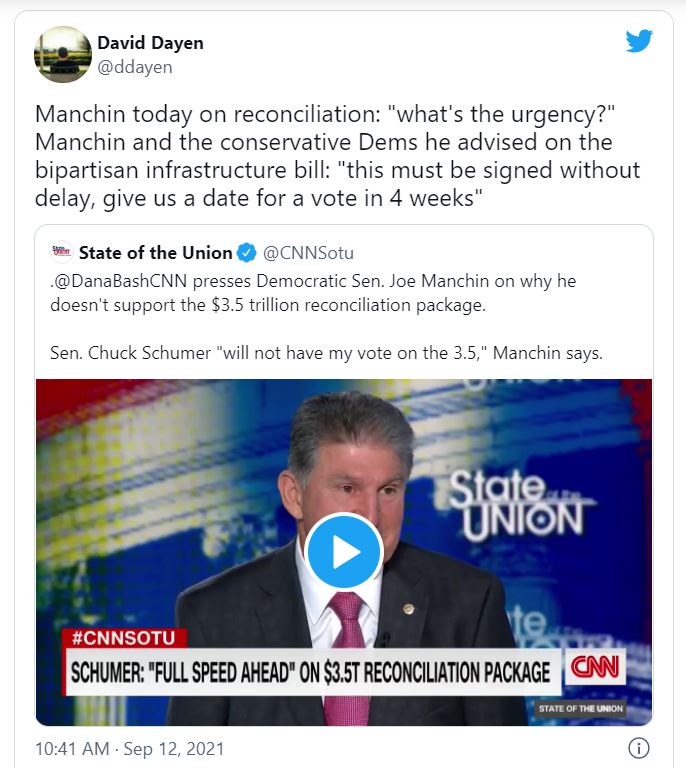
On Sunday, Manchin called for immediately enacting the IIJA, but when referring to the BBBA, he argued that there is “not the same urgency that we had with the American Rescue Plan. We got that out the door quickly. That was about $2 trillion.”
Unlike the American Rescue Plan, which represented a more immediate outlay, the reconciliation package proposes spreading out $3.5 trillion of spending over 10 years, and much of that would be offset by the trillions of dollars in revenue raised through proposed tax hikes on wealthy individuals and corporations.
As David Moore wrote last week in Sludge:
$3.5 trillion is an estimate of the budget plan’s gross spending over 10 years, ignoring revenue increases and other planned spending reductions, not a calculation of net cost. Late last month, the nonpartisan Center on Budget and Policy Priorities (CBPP) wrote that the package’s net cost would be $1 trillion to $1.75 trillion over a decade, which as a share of the anticipated $24 trillion GDP in 2022 and beyond would come to a total of only 0.3% to 0.6% of GDP over 10 years.
… Simply averaging the higher net cost estimate over a 10-year budget window, $175 billion per year is less than the roughly $188 billion that the U.S. paid in 2020 to just three defense contractors: Lockheed Martin, Raytheon, and Boeing. In 2019, the Department of Defense spent half its budget, around $370 billion, on contracting, often without a competitive bidding process, according to Pentagon watchdogs. The 10-year net costs of Senate Democrats’ budget plan would come in far under the $2.3 trillion spent on the wars in Afghanistan and Pakistan, according to a recent tally from Costs of War.
By voting for last year’s Pentagon budget, Stephen Semler of the Security Policy Reform Institute noted, Manchin and other deficit hawks approved funneling more public money to a handful of weapons manufacturers than the annual net cost of the BBBA they say is too expensive.
Despite Manchin’s objections to the reconciliation package’s costs, Schumer said last week that Senate Democrats are “moving full speed ahead” with the BBBA, which he wants a complete draft of by Wednesday.
When asked by Bash if he was willing to appease Manchin and give the bill “more time,” Sanders emphasized that “there is a sense of urgency.”
“The sense of urgency is that we live in a country today where the wealthiest people and the largest corporations are doing phenomenally well, while working-class people are struggling,” said Sanders. “You got 90 million people uninsured or underinsured, people can’t afford to pay [for] prescription drugs, can’t afford to send their kids to college—kids are leaving school deeply in debt.”
“You got almost 600,000 people in America who are homeless today,” the Vermont Independent continued. “And you got the climate crisis. Oregon is burning, California is burning, Siberia is burning. People are dying in floods in New York City.”
“There is a sense of urgency which I think the American people understand,” said Sanders. “And what they want, is finally—maybe, just maybe—the Congress of the United States will act for them, and not just for the wealthy campaign contributors.”
Echoing recent Common Dreams reporting, he added that “the rich and the powerful… are pouring huge amounts of money—the drug companies, the insurance companies, fossil fuel industry—in trying to defeat us.”
Corporate opponents of the reconciliation package, Sanders said two weeks ago, are “going to lose this round.”
[Kenny Stancil is a staff writer for Common Dreams.]
ZNetwork is funded solely through the generosity of its readers.
Donate