
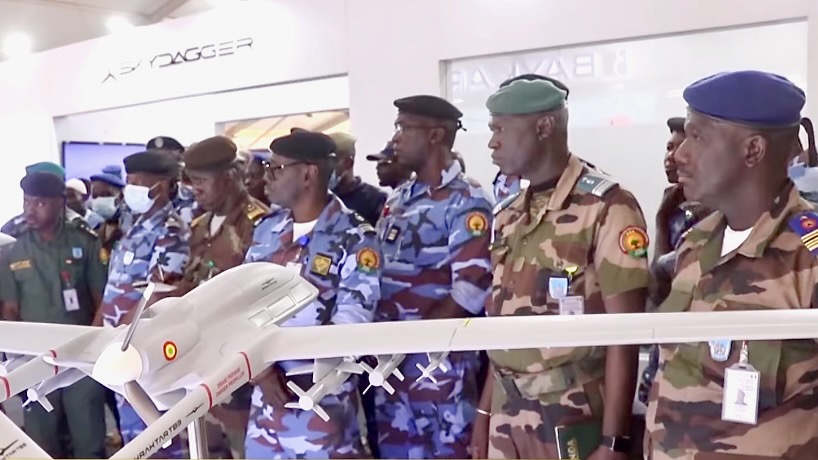
Amid a barrage of media reports prophesying the fall of Mali to an Al Qaeda affiliate disrupting its fuel supply by attacking tankers, delegates from ten African countries, Iran, and Turkey attended a defense expo in the capital Bamako from November 11 to 14.
The city was reported to be “under siege”, encircled by jihadists closing in on power. Some version of “Is Mali about to fall?” was a rhetorical question across headlines, while the Atlantic Council declared the country was “unraveling”.
Dismissing this portrayal as a scenario “concocted in the office of foreign intelligence services”, Foreign Minister Abdoulaye Diop insisted that “the fate of Mali, and the destiny of the people in the West African region will not be decided” by the media.
He made these remarks on November 12, addressing a press conference on the sidelines of BAMEX 25, Mali’s first international defense expo, aimed at building “an autonomous security architecture” for Africa in the face of “unprecedented security and geopolitical challenges”.
This expo, he said, is yet another indication of the Malian government’s priority to strengthen its defense and security to combat the threat of terror groups that were spawned across the Sahel by NATO’s destruction of Libya in 2011.
French-spawned terror groups
Mali was among the first and worst affected by these terror groups. Its former colonizer, France, which was a key participant in Libya’s destruction, then deployed its troops, ostensibly to protect Mali. Over the years, its military presence expanded across the Sahel. Alongside, the armed groups also grew in strength, increasing attacks and the area under their control.
This led to a growing perception that French troops in the region were not fighting the terror groups it helped create but guarding its own economic and political interests in maintaining its neocolonial grip over the troubled former colonies.
Amid mass protests against the French troop deployment, Mali’s France-backed regime of the then-president Ibrahim Boubacar Keïta was removed in a popular military coup in 2020. A military government replaced the regime with the support of the protest movement, trade unions, and other progressive formations.
In 2021, then-prime minister Choguel Kokalla Maïga recalled in an interview the active role played by France in handing over Mali’s territory to terror groups.
“Upon arriving in” the northern town of Kidal in 2013, “France forbade the Malian army from entering. It created an enclave,” and handed it over to Al-Qaeda affiliate Ansar al Dine and Tuareg separatists brought together, he said. Later in 2017, Ansar al Dine coalesced with other terrorist groups to form the Jama’at Nusrat al-Islam wal-Muslimin (JNIM), which became one of the most dangerous groups in the Sahel.
“It’s an enclave controlled by France. They have armed groups trained by French officers. And we have evidence of this,” Maiga added in his 2021 interview. “Mali has no access to Kidal.”
However, the new government retook Kidal in November 2023, less than a year and a half after expelling the French troops.
“On the ground today, terrorist groups are no match for Mali’s defense and security forces,” Diop told reporters at the press conference. “There have been enormous efforts to equip Mali’s defense and security forces, which have achieved resounding successes” against the terror groups, he said, adding that this has “forced them to change their strategy and now attack softer targets.”
Attacks on fuel convoys
Early this September, the JNIM started attacks on drivers and their tankers carrying fuel from the Ivory Coast in the Sikasso region of southern Mali. “Due to disruptions in fuel supplies that are affecting the movement of school staff,” the Education Ministry suspended classes for two weeks on October 26.
“Do Not Travel to Mali for any reason due to crime, terrorism, kidnapping, unrest, and health,” the US State Department said in a travel advisory on October 25. Three days later, the department issued a second alert, insisting that its citizens in Mali “should” leave the country “using commercial aviation, as overland routes to neighboring countries may not be safe for travel due to terrorist attacks along national highways.”
Australia followed suit on October 29, warning, “If you’re in Mali, you should depart immediately using commercial means while the international airport in Bamako remains open and flights are available. If you decide to remain in Mali, be prepared to shelter in place for an extended period.” Italy and Germany also asked their citizens to leave the country.
Amid the panic-inducing travel advisories and doomsaying media reports, Mali’s president, Col. Assimi Goïta, inaugurated the country’s second Lithium mine on November 3, setting Mali en route to becoming Africa’s leading Lithium producer by 2026.
The mine is located in Bougouni, about 170km south of Bamako in the Sikasso region, where the JNIM had attacked fuel convoys in September.
Government restores fuel supply
Two days later, on November 5, residents of Bamako cheered on the streets as large convoys of fuel tankers entered the city under the protection of the armed forces. Nevertheless, France 24 persisted with headlines like “Jihadists threaten to overrun Mali as blockades continue“, “fuel blockade squeezes Mali’s military rulers“, etc.
“There have been disruptions in the supply system,” but “the state organized itself, put in place a strategic plan to resume supplies, to ensure the security of convoys … And gradually, you see that hundreds of trucks are arriving every day to resume supplies to Bamako and other localities,” Diop added in his press conference. “As I speak, Mali is able to ensure the supply of hydrocarbons and petroleum products to its population.”
However, two days after the fuel convoys started arriving, France “advised” its citizens on October 7 to leave Mali “as soon as possible using the remaining available commercial flights” because the “security situation has been deteriorating.”
Mali’s first-ever National Electronic Payments Exhibition was organized in the capital that day by the Professional Association of Banks and Financial Institutions of Mali (APBEF-Mali) and the West African Economic and Monetary Union’s Interbank Electronic Payment Group (GIM-UEMOA).
Schools reopened on schedule on November 10. That day, President Goïta inaugurated the Presidential Emergency Hospital Project to upgrade six existing health centers in Bamako to district hospitals by the end of 2026, for which a health budget of USD 349.2 million has been allocated. The inauguration also marked the start of construction of nine new hospitals, including in Bougouni, Bandiagara, and Nioro, where attacks had been reported in the recent past.
Despite these indications of improving security, the UK government claimed on November 13 that “Terrorist group Jama’a Nusrat ul-Islam wa al-Muslimin (JNIM) has implemented blockades on key routes throughout Southern and Western Mali, including the capital city of Bamako,” where the international defense expo was underway.
“These blockades are targeting fuel trucks and are enforcing checkpoints for individuals attempting to pass through them. Attacks can occur at any time,” added its travel advisory.
A proxy war
“We must not think we are simply facing terrorist groups,” Diop maintains. “No, this is a proxy war, where certain powers, cowardly and unable to confront us directly, are using terrorist groups and asymmetric forces to fight us … These terrorist groups have drones. Where do they come from? Who manufactures them? Who provides them in areas where people cannot even eat?”
Le Monde had reported last year that Ukrainian authorities are training an armed group to use drones. Spokesperson of Ukraine’s military intelligence, Andriy Yusov, had said in an interview that it provided “information, and not only information,” to armed groups fighting the state in Mali.
Earlier in 2022, Diop had written a letter to the UN Security Council, saying Mali had evidence that France was flying missions in Malian airspace to collect intelligence and airdrop arms and ammunition to terror groups.
Mali’s southern neighbor, Burkina Faso, and eastern neighbor, Niger, have also since accused France of supporting terror groups to destabilize their countries after its troops were expelled following a similar sequence of anti-France protests and popular coups.
“Africa is now the epicenter of terrorism,” Nicolas Lerner, head of France’s General Directorate for External Security (DGSE), told France Inter radio on November 10. Calling it a threat to Europe, he insisted it “directly threatens our interests,” effectively trying to set up the case for another military intervention.
Curiously, he went on to add that while the “JNIM wants the fall of the junta and the installation of authorities who back the establishment of a caliphate,” the group itself “is not necessarily capable of controlling Mali, nor does it actually want to.”
Lerner is “saying … it is not even their intention to take Bamako … How [does he] know their intention? Is it you who gives them this intention? Is it you who commands them? Is it you who decides,” questioned Diop.
“This should help us understand how deep the collusion is today between hybrid forces. These are not terrorists – it is a proxy war. But I can assure you that Mali will endure.”
He reiterated that Mali, Burkina Faso, and Niger, which have formed the Alliance of Sahel States (AES), are fighting together, convinced that this proxy war is waged on them because they “chose to break the chain of dependency, to break the chain of subjugation to colonial domination.”
He added, “Our countries are being attacked first to break this dynamic and then to prevent other African countries from following this path. And we have understood the political message behind this.” The African Union (AU), however, has not.
“We are not reaching out to the so-called international community to come to our aid”
Amid the chorus by Western countries, the AU’s chairperson, Mahamoud Ali Youssouf, called for “a robust, coordinated, and coherent international response to counter terrorism and violent extremism in the Sahel.”
“No action can be … taken in Mali without Malians, without the consent of the Malian state, without the Malian state requesting it,” Diop retorted, affirming, “we are not reaching out to the so-called international community to come to our aid.”
“This call for international action is all the more worrying since Mali has emerged from this type of paradigm,” he added. Having expelled the French troops and asserted sovereignty, “the new paradigm [in the AES] is to trust ourselves and take charge … to ensure the security of our countries rests first and foremost on the shoulders of the people and leaders of our countries.”
ZNetwork is funded solely through the generosity of its readers.
Donate