

In the second part of our interview with Italian philosopher and professor of political theory Sandro Mezzadra, we discussed a range of topics, from the destruction and consequences caused by the “War Regime” in Afghanistan, particularly the 2014 Shengal Genocide attack by ISIS, to the wars escalated across the Greater Middle East and the genocidal policies inflicted upon the Palestinian people.
Mezzadra drew attention to the international interest generated by the democratic, ecological, and women’s liberationist politics developed by Kurdish people’s leader Abdullah Öcalan, and to what this politics can teach peoples engaged in struggles of resistance and progressive circles.
The first part of the interview can be read here.
On August 3, 2014, ISIS carried out a genocidal attack against the Yazidi Kurds in Shengal; it massacred thousands, abducted and sold women, and the fate of thousands more is still unknown. Beyond some states recognizing this as genocide, it did not enter the left’s agenda. Why?
I remember writing an article in late summer 2014, when Kobane was under siege. And I mentioned quite emphatically the attack on the Yazidi Kurds in Sinjar. That article was translated into several languages; it was one of myriad statements by scholars, activists, and political organizations and modestly contributed to a significant internationalist mobilization in solidarity with the Kurdish movement and Rojava.
You know better than I do that it was a significant mobilization, including demonstrations in Europe and elsewhere, international delegations to Rojava, and even the participation of internationalist fighters in the Kurdish armed resistance. The Kurdish struggle and Rojava came to figure prominently on the agenda of the global left – or at least a part of it. But I come back to a point I made earlier. Allow me to put it personally: when I wrote that article, I was not speaking “for the Kurds,” nor was I expressing an abstract solidarity. I felt compelled to write and to take action on the basis of a relatively long-standing relationship with the Kurdish movement. And this is, of course, not merely a personal circumstance.
It was the dense web of international relations, exchanges, and networks established around the Kurdish question that made solidarity campaigns with Kobane and Rojava possible. We can discuss the limits of those campaigns, of course, and you may also say that the fate of the Yazidis in Shengal was often subsumed under the broader question of solidarity with Rojava. But for me, the relevance of political relations and infrastructures built over time constitutes a key point of method for internationalism.
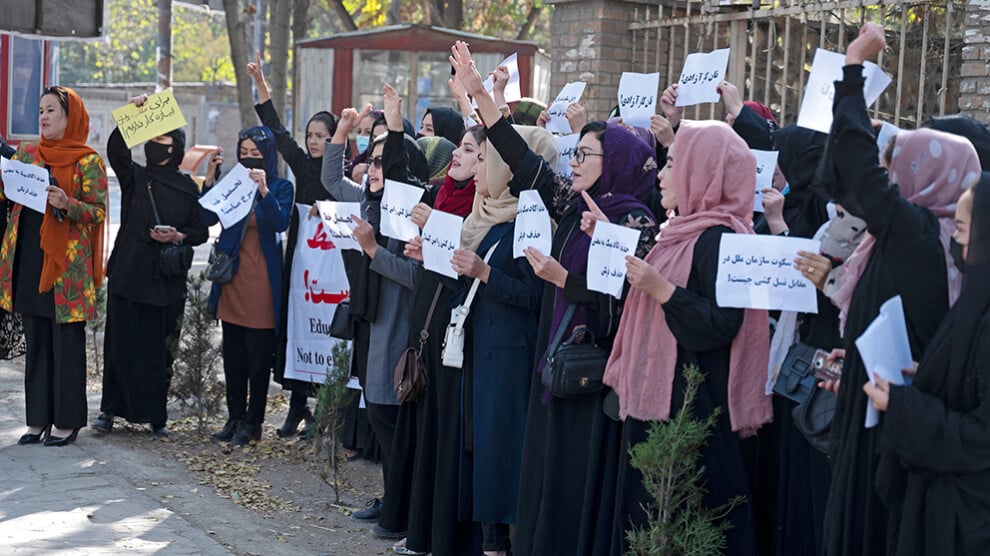
Similarly, the war regime withdrew from Afghanistan and left the country to the Taliban regime. There is a terrible situation, especially for women. Whose responsibility is solidarity with the Afghan people?
I feel a certain unease about speaking of “responsibility” for solidarity, since this may suggest that solidarity can simply be assigned to a particular actor. I am perfectly aware that speaking of a new internationalism implies confronting a myriad of situations that put the effectiveness of internationalist practices to the test. Afghanistan is one of those situations, and I am acutely aware of the terrible situation in that country, especially for women.
The fact that the US withdrew from Afghanistan after twenty years of war is an instance of the obstacles and limits encountered by the most powerful war machine in history – of its inability to win a war. Acknowledging the responsibility of the US for the current situation in Afghanistan does not in any way obscure the brutality and the reactionary character of the Taliban. At the same time, the situation we now have in the country is a kind of prolongation of the war regime, meaning that there is neither war nor peace. In such a situation, there are people working on the ground to provide assistance and solidarity to the Afghan people.
I think for instance of the NGO Emergency, which runs three surgical centres, a maternity centre, and a network of more than thirty first-aid posts and healthcare centres in the country. You see here how the boundary between humanitarianism and internationalism is blurred. The continuity of such initiatives can play a key role in creating the conditions for broader solidarity campaigns. At the same time, such initiatives are also connected with practices of resistance (even the most elementary ones) of people in Afghanistan, and we know that women have always refused to be reduced to the status of mere victims of the Taliban. Creating forms of articulation among these practices of resistance, solidarity on the ground, and broader internationalist initiatives is a difficult but crucial task.
When the Palestinian people in Gaza were subjected to genocide by the Israeli state, everyone around the world who could protest took action. Why did it have no effect?
In the wake of October 7, 2023, the movement against the genocide and in support of what has widely come to be termed “global Palestine” has been a powerful instantiation of the potentialities of a new internationalism. That movement has taken different forms, from encampments to demonstrations, and has developed at different paces in many parts of the world.
The Global Sumud Flotilla has acted as a catalyst and accelerated mobilizations since the late summer of 2025. In a country like Italy, where I am based, in September and October 2025 the movement reached unprecedented levels of mass participation and radical forms of struggle. Logistical nodes, like ports, highways, and railway station were blocked by thousands of people, in an attempt at least to prefigure the blockade of the machinery of genocide and war. This is not to say that there have not been limits and problems in the movement for “global Palestine” – I think of controversies over the role of Hamas and the “axis of resistance” and of different shades of anti-imperialism sometimes bordering on “campism” within the movement.
But it was and continues to be a powerful movement, consisting of variegated forms of expression and based on real connections with the situation and struggle of the Palestinians in the occupied territories and in the diaspora. I think there is a lot to learn both from the power and from the limits of that movement, which has had significant political and even cultural effects. Sure, it did not stop the genocide or the plan of Trump’s “Board of Peace,” which takes the genocide as the condition for a nightmarish project of a capitalist enclave based on real estate and logistics as well as on the subjugation of the remaining Palestinian population. But we have already discussed the enormous asymmetry in power relations today, which we need to continue to struggle to transform. The movement’s inability to stop the genocide demonstrates the urgent need to transform that asymmetry, not the absence of effects.
From Western Sahara to Pakistan, countless conflicts and crises are occurring across the greater Middle East. What is the role of the “war regime” in this? What can be done against it?
This is a very important question. Whatever we call it – Greater Middle East, West Asia, or Southwest Asia – this is a world region that at least since World War 2 has been crucial to US geopolitical calculations. This was due not only to oil but also to the financial and monetary arrangements surrounding it. Today, as you rightly note, the region is torn by wars, conflicts, and crises. One could say that there was a strategic project, let us call it an imperialist project, to reconstruct the foundations of US hegemony in the region by consolidating the role of Israel and promoting a new architecture of alliances through the Abraham Accords.
I think that the genocide in Palestine, the expansionist politics of Israel in the West Bank, in Lebanon, and in Syria, and above all the failure of the war against Iran have undermined the bases of that project. As Marc Lynch argues in the latest issue of Foreign Affairs, the US-led regional order in the Middle East appears to be in ruins today. And what emerges, in very general terms, is a situation that closely resembles the one captured by the concept of the war regime. This means that even where there is no war, it is not possible to speak of peace and the logics of war permeate economic, social, and political life. We have to support resistance and struggles against the war regime and we have to intensify our campaigns in support of the Palestinians and the Kurds, creating a political field within which the claims and experiences of other peoples can become visible. And above all, we need to be attentive to the ways in which movements and political forces across the region are struggling to imagine a new politics of liberation – one that also implies new regional arrangements in the Middle East.
The Kurdistan Freedom Movement has an important theoretical and practical accumulation of experience in Middle Eastern internationalism debates and struggle. The Rojava Revolution – with which you yourself have shown solidarity since 2014 – developed as a result of this effort. What does the Rojava Revolution teach peoples and progressive circles who are engaged in struggles of resistance?
The Rojava Revolution is an essential part of the struggles to invent a new politics of liberation in and beyond the Middle East. In a sense, one can say that it is an instance of internationalism in action, considering both the solidarity it has attracted and the powerful resonances it has had across widely differing contexts. In Latin America, for instance, it has become part of the political imagination of many struggles, strengthening them while itself acquiring new meanings.
The prospect of autonomy and self-government beyond the nation-state that has animated the Rojava Revolution continues to be also a powerful source of inspiration for overcoming the limits of historical forms of proletarian internationalism in the 20th century, which were largely predicated on the nation as the basic unity of political organization. What remains to be seen is how the Rojava Revolution will evolve within the new conjuncture brought about by the fall of Bashar al-Assad and the establishment of the new transitional order led by Ahmed al-Sharaa in Syria. I am aware of the complexity of the situation on the ground, of the multiple actors involved, including Turkey and Israel, and of the shifting political constellations in the country. Needless to say, I do not have any lessons to offer. I only have questions to ask my Kurdish friends and comrades.
The paradigm developed by Abdullah Öcalan, based on democratic, ecological, and women’s-liberationist politics, actually contains a comprehensive theoretical perspective that could respond to today’s crises. What are the conditions for its spread?
I can repeat what I just said about the Rojava Revolution. Abdullah Öcalan’s theoretical elaborations over the last decades are an integral part of the revolutionary body of knowledge and practice that lays the necessary groundwork for a new internationalism. Other elaborations and experiences are part of that body, of course. What matters more here is not simply bringing together different theoretical and political perspectives, nor reproducing Öcalan’s paradigm unchanged in other contexts, but engaging in a process of creative translation, which is, in my opinion, a constitutive moment of the new internationalism.
There would be much more to say about this. But right now, let me conclude by saying that I am closely following the debate and developments in Turkey after the PKK’s decision to dissolve itself. I really hope – as I am sure thousands of comrades from around the world do – that I will soon have the opportunity to meet Öcalan in person and discuss these questions with him: free, as he deserves to be. I am sure that he has important contributions to make to the discussion of the new internationalism that we have pursued throughout this interview.
To read Part One of this interview, click HERE.
ZNetwork is funded solely through the generosity of its readers.
Donate




