
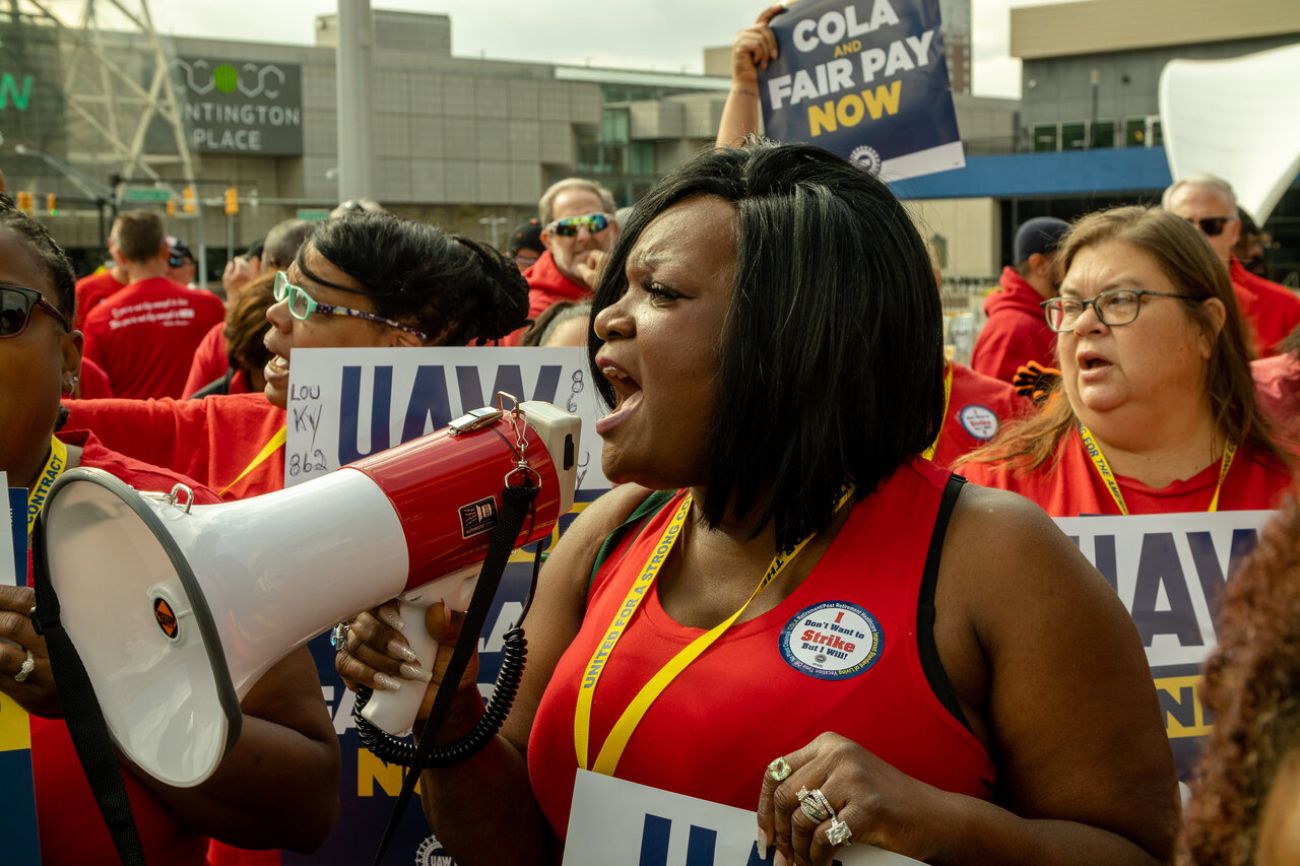
Late last Friday afternoon, Shawn Fain, president of the UAW, addressed workers at the Mercedes SUV plant in Vance, Alabama, after the union failed in a representation election (2,054 votes in favor, 2,642 against) many had expected them to win. He told them, “Justice isn’t about one vote or one campaign. It’s about getting a voice, getting your fair share.”
When Fain was sworn in as president on March 26, 2023—after winning the first direct election for the UAW presidency by just 477 votes—the challenges were monumental. He had national negotiations for the Big Three automakers coming up in less than six months and an organization plagued by decades of corruption. The union was burdened with staff used to taking the easy way out, allowing members’ contracts to worsen as its leadership indulged in fancy cigars, fine hotels, and gourmet food.
In the 14 months since his election, Fain has made remarkable headway. He launched a bold strategy in the Big Three negotiations—the stand-up strike—which resulted in significant gains. Next came the North Carolina Daimler truck negotiations for plants in North Carolina, Georgia, and Tennessee, and the decisive unionization win at the Volkswagen plant in Chattanooga. His intrepid leadership reaches far beyond the union and has uplifted the entire progressive movement.
Perhaps for that reason, the VW victory raised expectations that the UAW could win in Alabama. But Alabama isn’t Tennessee. Alabama’s top business, political, and community leadership are so hostile to unions that they implemented every nefarious tactic in the 1993 book by the notorious union buster Martin J. Levitt, Confessions of a Union Buster. In it, Levitt outlined a campaign just like the one headed by Alabama Governor Kay Ivey. “The enemy was the collective spirit,” Levitt writes. “I got a hold of that spirit and while it was a seedling; I poisoned it, choked it, bludgeoned it if I had to, anything to be sure it would never blossom into a united workforce.” He forthrightly admitted that anti-union consultants are “terrorists…. as the consultants go about the business of destroying unions, they invade people’s lives, demolish their friendships, crush their will, and shatter families.”
As is typical in what union organizers call an “A-Level boss fight” in its attempt to throttle a union vote, management offers all sorts of real material gains for workers who announce support for the union. As Fain explained in his Friday night talk, “Let’s be clear: Workers won serious gains in this campaign. They raised their wages, with the ‘UAW bump.’ They killed wage tiers. They got rid of a CEO who had no interest in improving conditions in the workplace. Mercedes is a better place to work thanks to this campaign, and thanks to these courageous workers.” Getting rid of wage tiers, which has been a key demand of autoworkers for years—made possible by the gutsy campaigns under Fain—wasn’t just a material gain but also a structural one. The problem is, at the moment it isn’t a gain backed by a union contract. So it can be stripped away at any time.
But since such tactics were only to be expected, what else went wrong in Alabama? What can autoworkers themselves, the UAW, and the progressive movement take from this defeat? Fain closed his speech by telling the crowd, “The workers here ultimately will win. Most of us have lost elections in our lives and I know I’ve always learned from it. What matters is what you do with that experience.”
The first big problem was the lack of a real community strategy strong enough to counter a Levitt-style battle waged outside the plant (although in Alabama, the governor, a prominent minister, and former Crimson Tide football coach Nick Saban were walking inside the plant). To the degree that most unions think about something they refer to as “the community campaign,” it generally comes too late. Union staff may complain—with considerable justification—that the boss’s community work is fake. But sadly, so is most of what passes for the labor movements efforts: In Alabama, a pastor from the Providence Missionary Baptist Church, in Marion, the Rev. Matthew Wilson, sent an anti-union text message to workers, made a potent pro-management video shared with workers, and took a walk through the plant. Saban, who delivered seven national college football championships to the state and whose hero status probably exceeds Trump’s, was joined by lesser-known figures such the Black female head of the Business Council of Alabama, Helena Duncan. She published a commentary on January 30, 2024, suggesting that the plant and all “good jobs” would flee the state if workers unionized.
The UAW functionally didn’t have a community campaign—certainly not one that could contend with the boss’s. If unions are truly committed to bottom-up organizing—which the new UAW leadership is—they need to realize that they are sitting on a gold mine of potential community power. The workers themselves have the capacity to build a bottom-up community strategy simply by first engaging all solid supporters in a one-on-one conversation that asks, “It’s great we are building majority support. But you know, with Mercedes, it’s going to take even more to win. Who are some of the local people you already know? Where do you and/or your family worship, or what leagues are your kids in doing sports, or what do you and/or your family volunteer for?” Workers must already be pro-union to have these conversations. But even with just 2,000 yes votes, the UAW had plenty of room to build bottom-up from the outside along with bottom-up inside. These connections can then be mobilized by the workers to build a powerful counternarrative that can defeat a boss’s campaign because there’s more workers with connections than a governor, a minister, and a famous football coach.
Mistake 2: Straying from Its 30-50-70 Model
Perhaps the most exciting recent announcement by the UAW was Fain’s commitment to pour $40 million into organizing the unorganized over the coming two years. The union’s national website listed a bevy of resources for workers, starting with the outline of a new model they call the 30-50-70 strategy. After 30 percent of workers sign cards that authorize an election, the campaign goes public. At 50 percent, workers then rally with President Shawn Fain and other leaders. At 70 percent, they demand recognition for the union from the employer. In the Mercedes plant, the union filed for an election on April 5 and held a rally and issued a press release claiming that it had a supermajority of support inside the plant. But in conversations with organizers over the past month who didn’t want to be identified, the concept of a supermajority seemed elusive.
For example, the union released what would normally be a “majority photo poster”—if not a “supermajority” photo poster—that had just 700 worker pictures on it. That means they were short of a 55 percent majority by 2,091 workers. When these posters are done—actually showing a supermajority—they can be a key tool in winning campaigns. Supermajority posters show, not tell, that most of the workers are united. But there was never any supermajority literature produced in the UAW campaign. Instead of following their supposed strategy, it seemed the senior staff fell prey to a belief in “Momentum”—the theory that a “whirlwind” created from the gains in the national Big Three negotiations, followed by the Daimler truck success, and the VW vote—would propel the UAW to victory.
Mistake 3: Having an In-Plant Organizing Committee with Activists, Not Leaders
At the time the UAW released the 700-picture poster, organizers said the union had people from outside the plant phoning the workers—a common, failed strategy. When asked why it relied on distant phone banking, the answer was that there were still too many unassessed workers, and they were trying to get a feel if those were breaking yes or no. This is evidence of the campaign’s failure to correctly identify and recruit the genuine organic or natural leaders to the in-plant worker organizing committee. Assessing the strength of the campaign among the plant’s workforce should be the job of a properly built worker-organizing committee—not outsiders.
Organizers also said that when they filed for the election, they had at least one worker committee member per department covering 90 percent of the facility. It’s great that the new leadership now understands the need for worker-to-worker committees in the plant. But that’s true of any private-sector fight: Union staff is forbidden from setting foot on the employer’s property—from parking lots to grass that might be a mile from the plant. Union staff can actually get arrested for this—which is a bad look and a gift to the boss’s campaign. Even if the union actually had 90 percent of the departments covered, it couldn’t have had the right workers on the committee. Pro-union activists, no matter how important to the campaign overall, can’t make up the organizing committee. The hard work of workers’ correctly identifying their most respected department and shift leaders, then recruiting them, is the only way to win against stiff union-busting campaigns.
One reason the activist-committee approach worked at the VW plant a month earlier is that the UAW had what’s called a “neutrality agreement” hammered out between IG Metall, the German autoworkers union, and VW. Such an agreement might have prevented the kind of egregious behavior Mercedes engaged in—but there was no such agreement with Mercedes. Instead, the union announced that it was engaging with the German government to pressure Mercedes under a new German law around companies’ behavior in the supply chain—a prime example of magical thinking. Having worked in Germany for years now, it’s clear to me that relying on the German government to fix the behavior of management in the US is like watching an underfunded and overwhelmed—yet well-intentioned—National Labor Relations Board try to tame Amazon, Starbucks, or Elon Musk.
It’s unfortunate that so much of the progressive movement’s hopes were riding on the Alabama UAW election. The highest price was paid by the Mercedes workers themselves—who endured Levitt-ish hell being rained down on them in a fight they deserved to win. Which makes it all the more important that we learn the lessons of this defeat. Next time the union needs to focus on leaders, not activists. It must develop a bottom-up, worker-led community strategy that kicks off when the union begins to talk with workers. There likely won’t be any more VW-like neutrality agreements with other foreign-owned US-based automakers, but the UAW can still win big. As Shawn Fain himself said last Friday, “What matters is what you do with that experience.” Everyone will continue to cheer this new UAW leadership on, as we should. Their task is not easy, and they are fighting for all of us. But simply put, there are no shortcuts.
Jane McAlevey has been a UAW member for a decade, including participating in the largest academic strike—against the UC system in 2022 (she’s also a member of the UAWD, a group within the UAW working to transform from corrupt to democratic). She’s been a columnist for The Nation and was the magazine’s strikes correspondent from 2019 to 2023. Her books include A Collective Bargain: Unions, Organizing, and the Fight for Democracy and Rules to Win By: Power and Participation in Union Negotiations, cowritten with Abby Lawlor (March 2023). She is currently a senior policy fellow at the University of California’s Institute for Research on Labor and Employment.
ZNetwork is funded solely through the generosity of its readers.
Donate