

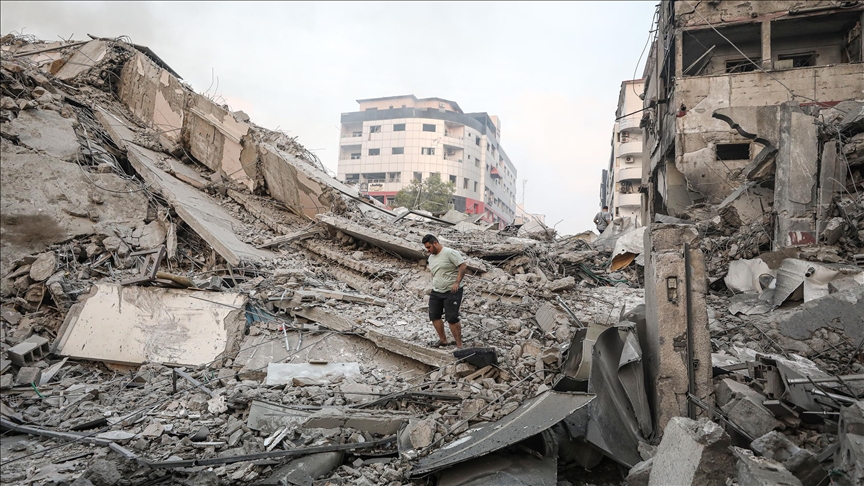
More than a decade ago, Israel started to understand that its occupation of Gaza through siege could be to its advantage. It began transforming the tiny coastal enclave from an albatross around its neck into a valuable portfolio in the trading game of international power politics.
The first benefit for Israel, and its Western allies, is more discussed than the second.
The tiny strip of land hugging the eastern Mediterranean coast was turned into a mix of testing ground and shop window.
Israel could use Gaza to develop all sorts of new technologies and strategies associated with the homeland security industries burgeoning across the West, as officials there grew increasingly worried about domestic unrest, sometimes referred to as populism.
The siege of Gaza’s 2.3 million Palestinians, imposed by Israel in 2007 following the election of Hamas to rule the enclave, allowed for all sorts of experiments.
How could the population best be contained? What restrictions could be placed on their diet and lifestyle? How were networks of informers and collaborators to be recruited from afar? What effect did the population’s entrapment and repeated bombardment have on social and political relations?
And ultimately how were Gaza’s inhabitants to be kept subjugated and an uprising prevented?
The answers to those questions were made available to Western allies through Israel’s shopping portal. Items available included interception rocket systems, electronic sensors, surveillance systems, drones, facial recognition, automated gun towers, and much more. All tested in real-life situations in Gaza.
Israel’s standing took a severe dent from the fact that Palestinians managed to bypass this infrastructure of confinement last weekend – at least for a few days – with a rusty bulldozer, some hang-gliders and a sense of nothing-to-lose.
Which is part of the reason why Israel now needs to go back into Gaza with ground troops to show it still has the means to keep the Palestinians crushed.
Collective punishment
Which brings us to the second purpose served by Gaza.
As Western states have grown increasingly unnerved by signs of popular unrest at home, they have started to think more carefully about how to sidestep the restrictions placed on them by international law.
The term refers to a body of laws that were formalised in the aftermath of the second world war, when both sides treated civilians on the other side of the battle lines as little more than pawns on a chessboard.
The aim of those drafting international law was to make it unconscionable for there to be a repeat of Nazi atrocities in Europe, as well as other crimes such as Britain’s fire bombing of German cities like Dresden or the United States’ dropping of atomic bombs on Hiroshima and Nagasaki.
One of the fundamentals of international law – at the heart of the Geneva Conventions – is a prohibition on collective punishment: that is, retaliating against the enemy’s civilian population, making them pay the price for the acts of their leaders and armies.
Very obviously, Gaza is about as flagrant a violation of this prohibition as can be found. Even in “quiet” times, its inhabitants – one million of them children – are denied the most basic freedoms, such as the right to movement; access to proper health care because medicines and equipment cannot be brought in; access to drinkable water; and the use of electricity for much of the day because Israel keeps bombing Gaza’s power station.
Israel has never made any bones of the fact that it is punishing the people of Gaza for being ruled by Hamas, which rejects Israel’s right to have dispossessed the Palestinians of their homeland in 1948 and imprisoned them in overcrowded ghettos like Gaza.
What Israel is doing to Gaza is the very definition of collective punishment. It is a war crime: 24 hours a day, 7 days a week, 52 weeks of every year, for 16 years.
And yet no one in the so-called international community seems to have noticed.
Rules of war rewritten
But the trickiest legal situation – for Israel and the West – is when Israel bombs Gaza, as it is doing now, or sends in soldiers, as it soon will do.
Israeli prime minister Benjamin Netanyahu highlighted the problem when he told the people of Gaza: “Leave now”. But, as he and Western leaders know, Gaza’s inhabitants have nowhere to go, nowhere to escape the bombs. So any Israeli attack is, by definition, on the civilian population too. It is the modern equivalent of the Dresden fire bombings.
Israel has been working on strategies to overcome this difficulty since its first major bombardment of Gaza in late 2008, after the siege was introduced.
A unit in its attorney general’s office was charged with finding ways to rewrite the rules of war in Israel’s favour.
At the time, the unit was concerned that Israel would be criticised for blowing up a police graduation ceremony in Gaza, killing many young cadets. Police are civilians in international law, not soldiers, and therefore not a legitimate target. Israeli lawyers were also worried that Israel had destroyed government offices, the infrastructure of Gaza’s civilian administration.
Israel’s concerns seem quaint now – a sign of how far it has already shifted the dial on international law. For some time, anyone connected with Hamas, however tangentially, is considered a legitimate target, not just by Israel but by every Western government.
Western officials have joined Israel in treating Hamas as simply a terrorist organisation, ignoring that it is also a government with people doing humdrum tasks like making sure bins are collected and schools kept open.
Or as Orna Ben-Naftali, a law faculty dean, told the Haaretz newspaper back in 2009: “A situation is created in which the majority of the adult men in Gaza and the majority of the buildings can be treated as legitimate targets. The law has actually been stood on its head.”
Back at that time, David Reisner, who had previously headed the unit, explained Israel’s philosophy to Haaretz: “What we are seeing now is a revision of international law. If you do something for long enough, the world will accept it.
“The whole of international law is now based on the notion that an act that is forbidden today becomes permissible if executed by enough countries.”
Israel’s meddling to change international law goes back many decades.
Referring to Israel’s attack on Iraq’s fledgling nuclear reactor in 1981, an act of war condemned by the UN Security Council, Reisner said: “The atmosphere was that Israel had committed a crime. Today everyone says it was preventive self-defence. International law progresses through violations.”
He added that his team had travelled to the US four times in 2001 to persuade US officials of Israel’s ever-more flexible interpretation of international law towards subjugating Palestinians.
“Had it not been for those four planes [journeys to the US], I am not sure we would have been able to develop the thesis of the war against terrorism on the present scale,” he said.
Those redefinitions of the rules of war proved invaluable when the US chose to invade and occupy Afghanistan and Iraq.
‘Human animals’
In recent years, Israel has continued to “evolve” international law. It has introduced the concept of “prior warning” – sometimes giving a few minutes’ notice of a building or neighbourhood’s destruction. Vulnerable civilians still in the area, like the elderly, children and the disabled, are then recast as legitimate targets for failing to leave in time.
And it is using the current assault on Gaza to change the rules still further.
The 2009 Haaretz article includes references by law officials to Yoav Gallant, who was then the military commander in charge of Gaza. He was described as a “wild man”, a “cowboy” with no time for legal niceties.
Gallant is now defence minister and the man responsible for instituting this week a “complete siege” of Gaza: “No electricity, no food, no water, no fuel – everything is closed.” In language that blurred any distinction between Hamas and Gaza’s civilians, he described Palestinians as “human animals”.
That takes collective punishment into a whole different realm. In terms of international law, it skirts into the territory of genocide, both rhetorically and substantively.
But the dial has shifted so completely that even centrist Western politicians are cheering Israel on – often not even calling for “restraint” or “proportionality”, the weasel terms they usually use to obscure their support for law breaking.
Britain has been leading the way in helping Israel to rewrite the rulebook on international law.
Listen to Keir Starmer, the leader of the Labour opposition and the man almost certain to be Britain’s next prime minister. This week he supported the “complete siege” of Gaza, a crime against humanity, refashioning it as Israel’s “right to defend itself”.
Starmer has not failed to grasp the legal implications of Israel’s actions, even if he seems personally immune to the moral implications. He is trained as a human rights lawyer.
His approach even appears to be taking aback journalists not known for being sympathetic to the Palestinian case. When asked by Kay Burley of Sky News if he had any sympathy for the civilians in Gaza being treated like “human animals”, Starmer could not find a single thing to say in support.
Instead, he deflected to an outright deception: blaming Hamas for sabotaging a “peace process” that Israel both practically and declaratively buried years ago.
Confirming that the Labour party now condones war crimes by Israel, his shadow attorney general, Emily Thornberry, has been sticking to the same script. On BBC’s Newsnight, she evaded questions about whether cutting off power and supplies to Gaza is in line with international law.
It is no coincidence that Starmer’s position contrasts so dramatically with that of his predecessor, Jeremy Corbyn. The latter was driven out of office by a sustained campaign of antisemitism smears fomented by Israel’s most fervent supporters in the UK.
Starmer does not dare to be seen on the wrong side of this issue. And that is exactly the outcome Israeli officials wanted and expected.
Israeli flag on No 10
Starmer is, of course, far from alone. Grant Shapps, Britain’s defence secretary, has also expressed trenchant support for Israel’s policy of starving two million Palestinians in Gaza.
Rishi Sunak, the UK prime minister, has emblazoned the Israeli flag on the front of his official residence, 10 Downing Street, apparently unconcerned at how he is giving visual form to what would normally be considered an antisemitic trope: that Israel controls the UK’s foreign policy.
Starmer, not wishing to be outdone, has called for Wembley stadium’s arch to be adorned with the colours of the Israeli flag.
However much this schoolboy cheerleading of Israel is sold as an act of solidarity following Hamas’ slaughter of Israeli civilians at the weekend, the subtext is unmistakeable: Britain has Israel’s back as it starts its retributive campaign of war crimes in Gaza.
That is also the purpose of home secretary Suella Braverman’s advice to the police to treat the waving of Palestinian flags and chants for Palestine’s liberation at protests in support of Gaza as criminal acts.
The media is playing its part, dependably as ever. A Channel 4 TV crew pursued Corbyn through London’s streets this week, demanding he “condemn” Hamas. They insinuated through the framing of those demands that anything less fulsome – such as Corbyn’s additional concerns for the welfare of Gaza’s civilians – was confirmation of the former Labour leader’s antisemitism.
The clear implication from politicians and the establishment media is that any support for Palestinian rights, any demurral from Israel’s “unquestionable right” to commit war crimes, equates to antisemitism.
Europe’s hypocrisy
This double approach, of cheering on genocidal Israeli policies towards Gaza while stifling any dissent, or characterising it as antisemitism, is not confined to the UK.
Across Europe, from the Brandenburg Gate in Berlin, to the Eiffel Tower in Paris and the Bulgarian parliament, official buildings have been lit up with the Israeli flag.
Europe’s top official, Ursula von der Leyen, president of the European Commission, celebrated the Israeli flag smothering the EU parliament this week.
She has repeatedly stated that “Europe stands with Israel”, even as Israeli war crimes start to mount.
The Israeli air force boasted on Thursday it had dropped some 6,000 bombs on Gaza. At the same time, human rights groups reported Israel was firing the incendiary chemical weapon white phosphorus into Gaza, a war crime when used in urban areas. And Defence for Children International noted that more than 500 Palestinian children had been killed so far by Israeli bombs.
It was left to Francesca Albanese, the UN’s special rapporteur on the occupied territories, to point out that Von Der Leyen was applying the principles of international law entirely inconsistently.
Almost exactly a year ago, the European Commission president denounced Russia’s strikes on civilian infrastructure in Ukraine as war crimes. “Cutting off men, women, children of water, electricity and heating with winter coming – these are acts of pure terror,” she wrote. “And we have to call it as such.”
Albanese noted Von der Leyen had said nothing equivalent about Israel’s even worse attacks on Palestinian infrastructure.
Sending in the heavies
Meanwhile, France has already started breaking up and banning demonstrations against the bombing of Gaza. Its justice minister has echoed Braverman in suggesting solidarity with Palestinians risks offending Jewish communities and should be treated as “hate speech”.
Naturally, Washington is unwavering in its support for whatever Israel decides to do to Gaza, as secretary of state Anthony Blinken made clear during his visit this week.
President Joe Biden has promised weapons and funding, and sent in the military equivalent of “the heavies” to make sure no one disturbs Israel as it carries out those war crimes. An aircraft carrier has been dispatched to the region to ensure quiet from Israel’s neighbours as the ground invasion is launched.
Even those officials whose chief role is to promote international law, such as Antonio Gutteres, secretary general of the UN, have started to move with the shifting ground.
Like most Western officials, he has emphasised Gaza’s “humanitarian needs” above the rules of war Israel is obliged to honour.
This is Israel’s success. The language of international law that should apply to Gaza – of rules and norms Israel must obey – has given way to, at best, the principles of humanitarianism: acts of international charity to patch up the suffering of those whose rights are being systematically trampled on, and those whose lives are being obliterated.
Western officials are more than happy with the direction of travel. Not just for Israel’s sake but for their own too. Because one day in the future, their own populations may be as much trouble to them as Palestinians in Gaza are to Israel right now.
Supporting Israel’s right to defend itself is their downpayment.
ZNetwork is funded solely through the generosity of its readers.
Donate