

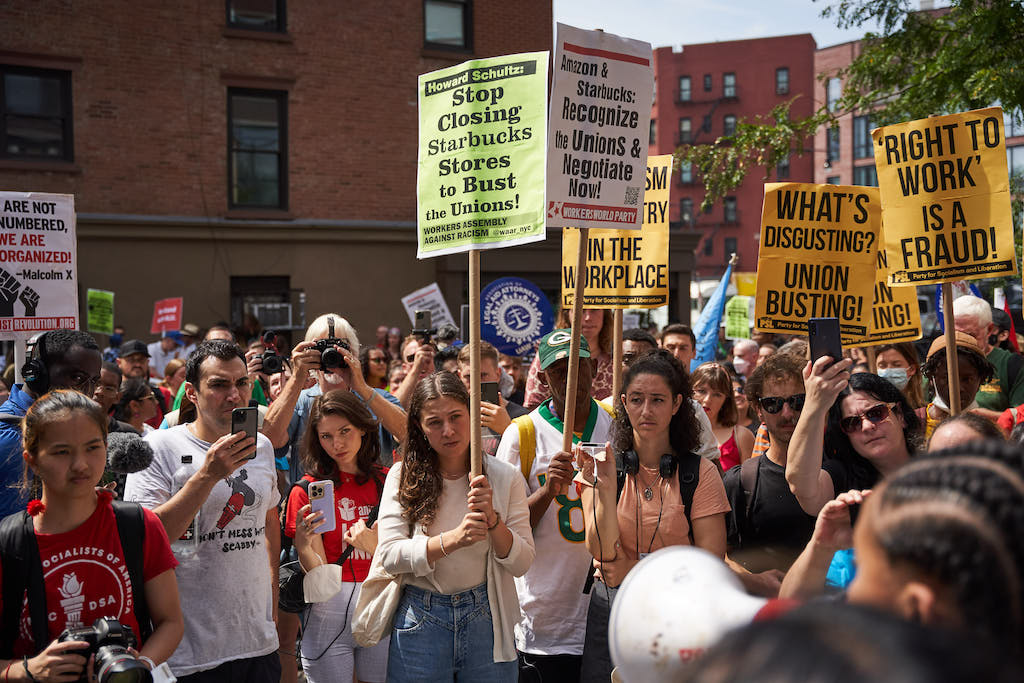
Oh, Labor Day, what a glorious day! In leftist circles, we sometimes hear conspiracy theories about how the September Labor Day was a “counterrevolutionary” move by the state to distract workers from the real labor day, May Day. The truth is a bit more nuanced.
The late 19th century was a vibrant period of labor militance and major worker strikes. To appease labor unions and the growing support for making Labor Day a holiday — and to undermine the radical association with May Day — the United States made Labor Day a national holiday in 1894.
The idea for a September labor celebration actually came from across the border. In 1872, Toronto printers struck for a nine-hour workday, and the annual labor celebrations that grew out of their fight became a fixture in Canada. When Peter J. McGuire (a key leader of the early American Federation of Labor) witnessed one such Canadian festival in 1882, he was inspired to bring the idea stateside. The first U.S. Labor Day was in fact celebrated September 5, 1882, in New York City — before May Day was immortalized in 1886.
May Day, on the other hand, was inspired by the sacrifice and fierce determination of Chicago workers in the 1886 Haymarket Affair. What began as a peaceful rally became violent as police attacked the rally and a bomb exploded killing demonstrators and police. Although there was no evidence linking leaders of this movement to the bombing, seven anarchists were sentenced to death; four were hanged and one committed suicide. Two had their sentences reduced. Workers’ demands for an eight-hour workday enraged bosses who enlisted the police to crack down on the labor movement with lethal force.
International Workers’ Day (May Day) is inspired by, and in memory of, the fight of those courageous Chicago workers. Beginning in 1926, May Day was commemorated worldwide with huge demonstrations and the closing of most workplaces. From Russia to France to Mexico, the massacre at the hands of the Chicago Police is honored by labor movements everywhere — with one notable exception, the United States.
The capacity for organized workers to win better wages, benefits, conditions, and the ability to make decisions over the workplace faces steep challenges. As a result of increasingly hostile federal and state governments, labor is weakened in both the private and public sector. Most people in the U.S. work for private companies. Only 6% of workers in the private sector are unionized, a steady decline since the mid-1950’s when more than a third of workers in the private sector were in a union. The few private unions that are still active are often unable to win even limited demands. Since the 1990s, when massive trade deregulation opened borders for large corporations, private sector unions have faced the challenge of capital flight — where employers pick up and move to a new location without organized labor.
Capital has the ability to transcend borders while the majority of workers do not. When capital can move freely but workers can’t, the scale is tipped in favor of the capitalist class. Beginning on May 1, 2006 and on every May 1st since , May Day in the U.S., although not an official holiday, is observed with demonstrations and rallies as International Workers Day with an emphasis on immigrant justice. Confronting globalized capitalism requires a globalized working-class struggle. May Day is explicitly international while nationalism splinters the working class — something the Industrial Workers of the World (IWW) has long recognized ands challenged.
Although the public sector employs only 15% of all workers, in the U.S., 33% of them are members of unions, more than five times the private sector rate. Half of all union members work in the public sector such as in local, state and national government. That turns public sector unions into a primary target for anti-democratic, free-market actors. Namely, major corporations and right-wing leaders. Conservatives attack the public sector precisely because it is where labor most often still wins. For example, the structural assaults against teachers and public education are designed to crush union membership and demonstrate the uphill battle facing labor advocates and social justice movements as a whole.
The growth of neoliberalism causes heightened individualism and lack of solidarity among workers. Revitalizing the labor movement counteracts the atomization of the working class. Organizing a union is about more than winning concessions. It is about restoring the dignity of workers, reversing the obscene expansion of wealth inequality, and resisting authoritarianism. It’s about transforming an economic system that reinforces the exploitation of the many for the benefit of the few.
There is growing support among the public for unionization is a prerequisite for reversing the decline we’ve seen over the last few decades. While society would benefit from increased union membership and unionized workshops, strengthened collective bargaining power alone cannot deliver economic justice. To make that a reality, what is needed is social movement unionism — a more radical, class-wide political struggle whose demands go beyond better wages and benefits.
Labor Day should stand for something more than a day off work and a chance to attend a picnic or rally. It should stand for workers having more power in the union, the workplace, and the right to more fulfilling work. It should stand for organizing all workers including the precariat and winning demands that benefit the whole working class.
One powerful narrative that keeps workers’ rights limited is the contemporary concept of “work-life balance.” This is a controversial position that many labor advocates champion. But the unfortunate and unintended result of this framing is that it ends up telling workers that your life at work is somehow not your life. In the “work/life balance” narrative we’re all made out to be either an employee or a civilian, as if there are two severed halves of our existence that aren’t intrinsically related, and what matters most is your time off work. Labor organizing taken seriously seeks to materially improve working conditions and life outside the workplace. Organizing should never be reduced to a workplace; it is a transformation of our relationship to power in all spheres of life.
Labor is more than unions and the workers in unions; it is also nonunion workers and the unemployed. Everyone does labor every day; some just get paid for it.
We need to build a labor movement that also organizes for causes off-the-clock that meets worker needs such as universal health and free childcare, that challenges militarism, authoritarianism and AI; that unites with other social movements for justice and liberation and acts in solidarity with workers across the globe.
Happy Labor Day


Peter Bohmer has been an activist in movements for radical social change since 1967, which have included anti-racist organizing and solidarity movements with the people of Vietnam, Southern Africa, Puerto Rico, Cuba, Palestine and Central America. For his activism and teaching, he was targeted by the FBI. He was a member of the faculty at the Evergreen State College in Olympia, WA from 1987 to 2021 where he taught political economy. He believes alternatives to capitalism are desirable and possible. Peter is the proud parent of a daughter and three sons.
ZNetwork is funded solely through the generosity of its readers.
Donate




