

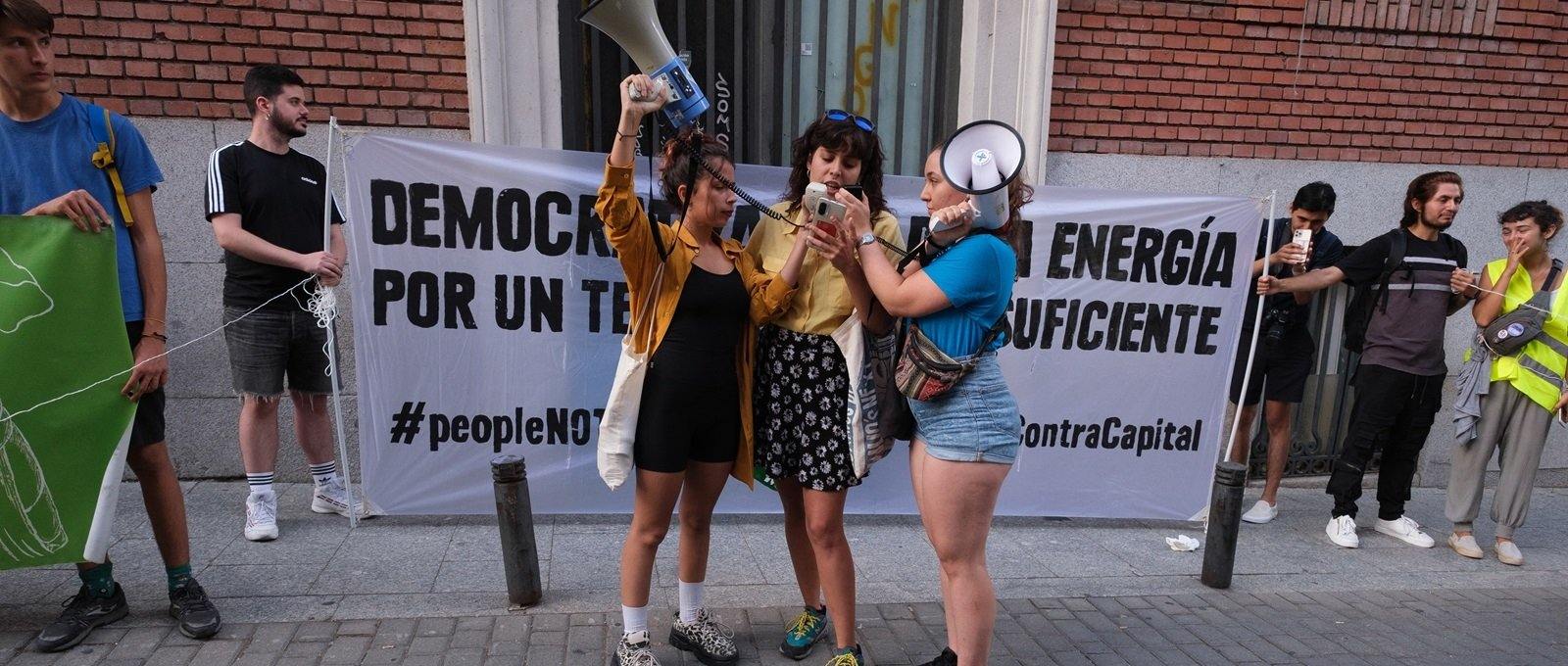
Far from apathetic, young people in countries such as Spain are strongly mobilised around very specific and urgent causes. The climate crisis is perhaps the most prominent: inspired by global movements such as Fridays for Future, thousands of young people have taken to the streets to demand action on global warming.
They are also passionate about defending human rights and gender equality – as shown by the mass marches on International Women’s Day (8 March) in recent years. They have first-hand experience of precarious work and the housing crisis: almost three quarters of young people in Spain cite housing as their main concern, followed by the lack of decent work (cited by 67 per cent). It should come as little surprise, given that more than one in four young people are living in poverty or social exclusion (27.4 per cent, around two million people aged between 16 and 30).
This precarious economic reality – temporary contracts, low wages, difficulty becoming independent – are entwined with other causes such as mental health (46 per cent mention the need for policies in this area) and the climate emergency (31 per cent).
Younger generations are not mobilising on a whim, but because they feel that their immediate future is at threat in areas as basic as having a habitable planet, a decent job and a home.
Unlike their elders, young people today have highly developed global awareness, thanks to the internet. They connect local issues such as housing prices with international trends (gentrification, ‘vulture’ investment funds). Similarly, global causes ranging from climate change to #BlackLivesMatter resonate with young people in Spain. They also embrace intersectional struggles: they understand that the climate crisis exacerbates social inequalities, that precarious employment affects young migrants more, and that the feminist struggle must be inclusive of all identities.
This broad awareness means that young people are speaking out about issues that used to take a back seat. In 2025, for example, youth collectives organised feminist student strikes against gender-based violence, putting intersectional feminism and anti-racism at the centre of public debate. To put it simply, the young people of today are far from indifferent. On the contrary. They feel that many of the biggest problems of our time fall on their shoulders, that urgent action is needed, and they do not intend to sit back with their arms folded.
Most young people do not feel represented by political parties, trade unions or traditional institutions. Voter turnout falls with each election, and many feel that voting has no impact on their day-to-day lives. Over 80 per cent say they do not feel that politicians listen to them, and almost 60 per cent do not feel represented by the current political system.
The lack of representation is also generational: there are very few people under 30 in Spain’s Congress or the governments of its autonomous communities. This reinforces the perception that institutional politics is turning its back on the younger generations. Although some are trying to reform from within, many others are building their own avenues for participation, far removed from party membership cards, hierarchical structures or committees.
New forms of action: digital, horizontal, urgent
Direct action, peaceful civil disobedience and social media are the main tools of youth activism. From flash mobs on Instagram to viral campaigns on TikTok or Change.org, digital activism allows for rapid, cross-cutting and often effective mobilisation.
Examples such as Extinction Rebellion or student groups promoting feminist and climate strikes demonstrate the rise of more horizontal organising, with decision-making in assemblies and no official spokespersons. Traditional forms are giving way to fluid movements, without hierarchies or formal structures, but with great capacity for action.
This new ecosystem also politicises other spaces: festivals, platforms such as Twitch and youth newsletters that analyse current affairs from perspectives ignored by traditional media. Creativity is a political language: memes, performance art and satirical or educational TikTok videos are all part of the youth repertoire.
The risks: burnout, precarity and repression
This approach also has its weaknesses. Burnout affects many activists who combine their commitment with precarious jobs or demanding studies. The lack of support structures or stable funding means that many initiatives fizzle out after the first few months.
Meanwhile, digital exposure carries the risk of cyberbullying, hate campaigns and police surveillance. Young women, racialised and LGBTIQ+ people suffer targeted attacks that often lead to self-censorship or temporary withdrawals from activism.
At institutional level, the repression is also real: from Spain’s Gag Law to fines for spontaneous gatherings and police ID checks. In response, young people have strengthened legal support networks, learned about cybersecurity and built spaces for mutual care.
The spark reviving democracy
Despite the challenges, this emerging youth activism is already making an impact and pointing to huge opportunities to revive civil society and democracy.
Several recent examples illustrate its potential for success. Climate strikes initiated by schoolchildren – unimaginable a decade ago – forced political leaders to address the climate crisis with a sense of urgency. In Spain, the government declared a climate emergency in 2020, a move welcomed by environmentalists that came largely in response to public pressure led by young people. Since then, environmental policies have taken centre stage in public debate.
Similarly, the feminist tide driven by young people achieved tangible changes: following the mass demonstrations on 8 March 2018 (supported by almost six million people who took part in work stoppages), Spain approved key measures in favour of equality, such as legislation to combat sexual violence and the extension of paternity leave.
These legal victories are underpinned by the perseverance of youth groups that kept the flame alive on the streets and on social media, year after year.
In the world of work, protests by young people, delivery riders, interns and digital culture workers have also led to reforms: the ‘Rider Law’, which recognised the labour rights of platform delivery riders, was partly the result of pressure exerted by young people affected by the issue, acting outside and alongside traditional trade unions.
The contribution of these movements is not only measured in terms of laws passed, but also in the renewal of the civic fabric.
Spanish civil society was considered demobilised after years of disillusionment, but young people are breathing new life into it. New platforms and associations are emerging, led by young people who connect different sectors. The Talento para el Futuro (Talent for the Future) platform, for instance, seeks to bring together young professionals and students to influence public policy, demonstrating that the emerging generation can organise itself formally without losing its essence.
Innovative campaigns such as Fridays For Future Spain (Youth for Climate) have professionalised their activism to an extent, by engaging in dialogue with local councils and presenting concrete proposals (more cycle lanes, renewable energy plans, etc.) without becoming conventional political parties. This constructive interaction is beginning to fill the gap between young people and institutions: it compels the authorities to listen to new ideas and gives activists experience in negotiating and making concrete demands.
Another key contribution made by young people is the renewal of a bottom-up approach to democratic practices. Initiatives such as participatory youth budgets in some cities (where young people are invited to decide how a portion of the municipal budget is spent) and youth councils are demonstrating that when young people are given a real voice, they respond with responsibility and creativity.
Youth activism has even made a formal space for itself at European level: in 2022, the EU organised the Conference on the Future of Europe, where many delegates were under 30, and recommendations on education and climate issues arising from youth forums were put forward.
These developments reinforce the idea that involving young people in decision-making improves the quality of democracy. It is time to banish the paternalistic view that infantilises young people: they are not just the future, they are the present, and their participation is essential to dynamic and robust democracy. Institutions are beginning to realise this, albeit slowly, and some parties have incorporated proposals from youth movements into their programmes (such as affordable housing measures and the fight against the climate emergency with more ambitious deadlines).
Looking ahead, the transformative energy that young people are injecting into civil society could be the antidote to democratic fatigue. Where older generations see stagnant institutions, young people see a blank canvas for innovation. Their insistence on climate justice, equality and economic dignity is charting the course for public debate, forcing governments and businesses to react. And while this youth activism is, for now, more fragmented and sometimes shorter-lived than in older organisations, it is also more horizontal, inclusive and capable of adapting quickly to new challenges.
Renew or perish
Twenty-first century democracy would do well to draw on these new forms of participation to renew itself. If young people’s energy can be channelled rather than stifled – by fostering genuine intergenerational dialogue, for example – we all stand to gain. We need a pact between generations whereby older people recognise and validate the concerns and aspirations of young people, and vice versa. Only then will the trust and social fabric we need to face shared challenges be rebuilt.
Far from being demobilised, young people are crying out for the chance to build a different world. And they are not doing so from a place of submission, but taking the initiative on the streets and online. Their message is clear: they will not wait their turn or ask for permission to lead the change.
This non-conformist attitude, if properly channelled, can breathe new life into democracy, making it more participatory, transparent and forward-looking. The task now falls to everyone – institutions, the media and older generations – to support, rather than hinder, this political and social awakening among young people. Ignoring their discontent – or worse, criminalising their activism – is not an option in a country that aspires to a vibrant democratic future.
Young people have already ignited the spark; whether that flame will fan into a profound renewal of civil society will depend on whether a hand is extended to these new actors. Democracy can only be protected through a collective effort. The younger generation is doing its bit. Will the rest of society do the same
ZNetwork is funded solely through the generosity of its readers.
Donate