
Following the wave of global recognitions of the State of Palestine from key Western and European nations, Israel has been stepping up its plans to render these gestures moot by implementing measures meant to cripple and delegitimize the Palestinian Authority (PA).
Earlier this month, Israel approved a massive settlement plan that would split the West Bank in two. Since October 7, 2023, it has plunged the PA into an economic crisis by withholding nearly 7 billion shekels (around $2 billion) in Palestinian customs money. And in recent months, the Israeli army has launched repeated invasions into the heart of Palestinian cities in the West Bank, ostensibly under PA control.
But Israel still hasn’t used its most important trump card in responding to the recent Western and global recognitions of a Palestinian state. It involves a piece of paper, and the person holding it is Israel’s hardline Finance Minister, Bezalel Smotrich.
Every year, the Finance Minister renews an indemnity letter allowing Israeli banks to accept money transfers from Palestinians in the West Bank, shielding Israeli banks from anti-terrorism laws they might be at risk of breaking by dealing with Palestinian banks. Smotrich has repeatedly threatened to revoke this letter in response to global sanctions against hardline Ministers like himself and Itamar Ben-Gvir, which could cause the collapse of the Palestinian banking sector — and possibly, the Palestinian Authority. Smotrich has recently been periodically renewing the letter in four-month stretches, using the intervals as pressure points to threaten the PA.
This is the spearhead of Israel’s campaign of economic warfare against Palestinians in the West Bank. Here’s why it could hasten the collapse of the PA and formally bring about a one-state apartheid reality.
Israel’s financial warfare against the Palestinian Authority
The Palestinian Authority’s stand-in for a central bank is the Palestinian Monetary Authority (PMA), which is prohibited from printing money or having its own currency under the economic agreements the PA signed with Israel during the Oslo Accords. This means that nearly every economic transaction Palestinians make has to go through Israel.
Mondoweiss reached out to an economic expert and former financial consultant for the PMA, who advised the body on the risk of Israel blocking transfers from Palestinian to Israeli banks, or what’s known as “corresponding banking relations.” The consultant spoke with Mondoweiss on the condition of anonymity to be able to comment freely on the matter. He believes that the PMA is poorly prepared to withstand the economic firestorm that might be coming.
If Israel goes ahead with severing banking relations, he says, it might even lead to the collapse of the PA as a political entity. Here’s his explanation.
The majority of Palestinian trade comes from or through Israel. That is where the banks come in: all payments to any merchant happen when a Palestinian bank sends money to its Israeli counterpart. “That transfer happens electronically, in Shekels,” the consultant says. “There are only two main methods of getting merchandise into Palestine: Israel, which is the predominant way, and Jordan. If you want to import essential goods like gasoline, you have to pay the Israeli supplier directly to their bank account.”
In essence, this means that if Smotrich prevents Israeli banks from receiving these payments, it would effectively heavily curtail the ability of Palestinian merchants to bring products into the West Bank through Israel, as they’d have no way of paying for them. The money they have would be useless.
Smotrich has already threatened to revoke this letter several times, most recently in June, when he announced that he would cancel the indemnity in response to sanctions placed on himself and fellow hardline minister Itamar Ben-Gvir by the UK, Australia, New Zealand, Canada, and Norway — even though the PA was not involved in the sanctions.
For weeks, Palestinians in the West Bank started feeling the impact. “Smotrich’s announcement meant two things,” the consultant says. “Israeli banks would stop accepting cash shipments from Palestinian banks, and they wouldn’t accept electronic transfers either.”
That last part is what threatened to unravel the Palestinian economy. Israeli banks were already being directed to refuse cash payments from Palestinian banks before Smotrich made his announcement, but were still able to receive electronic transfers. While merchants were able to pay their Israeli suppliers, the Israeli unwillingness to accept cash from Palestinians created its own kind of crisis.
The consultant says that, for one, it created a surplus of cash in the Palestinian market without allowing it to be used.
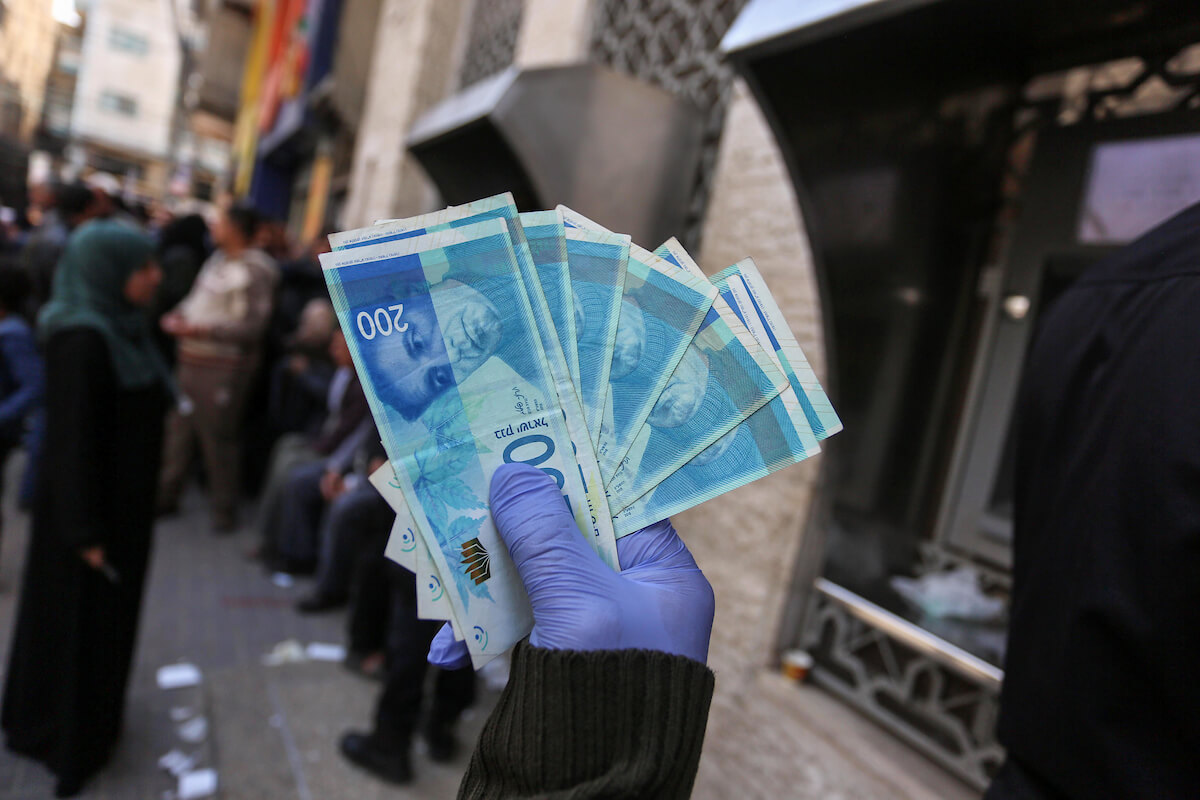
“There was a massive amount of cash built up in Palestinian banks, reaching as high as 14 billion Shekels [nearly $5 billion], and it wasn’t being converted into electronic money,” he says, explaining that the way the cash is converted into electronic money is by sending it to Israeli banks as a shipment, after which that amount would be added to the Palestinian bank’s books. Israeli banks weren’t accepting these shipments.
“This has already happened multiple times,” the consultant adds. “It was happening well before Smotrich threatened to cancel the waiver, which would have seen the cutoff of all banking relations, not just cash shipments.”
So what did the Palestinian banks do? They stopped letting people deposit more than a certain amount of cash into their own accounts, so that the banks didn’t accumulate even more surplus cash in their vaults. For some banks, it was a 20,000 Shekel ($5978) cap, for others as low as 10,000 Shekels ($2,989). “The PMA was unable to control the situation,” the consultant says.
This created a whole new host of problems for Palestinians whose accounts were slowly being depleted of money through scheduled online payments and postdated checks that started bouncing. This is especially true for the sizable portion of people who receive their livelihood in cash rather than direct deposits, who themselves must make regular deposits so that their payments go through.
But the biggest impact of the cap imposed by Palestinian banks was the inability of merchants to sell key resources like gasoline, because they couldn’t pay Israeli fuel suppliers anymore. “The problem with gas stations is that people overwhelmingly pay them in cash,” the economic consultant explains. “But the gas station owners need electronic money in their account so that they can pay their suppliers in Israel, yet the Palestinian banks won’t let them deposit the cash they have.”
In mid-June, as Israel’s war on Iran was reaching its peak, the sudden increase in demand for gasoline — people wanted to fill up their cars in case of later shortages — led to a shortage of fuel in the West Bank after gas stations were unable to pay their Israeli suppliers past a certain amount.
“Israel used to do this all the time as a negotiating tactic when it wanted something from the PA,” the consultant says. “But this time might be different. This is the worst the crisis has ever gotten.”
These measures have brought the Palestinian economy to its knees, the consultant says. “We’re talking about billions of Shekels sitting in Palestinian vaults.”
And this is only half of the problem. When asked what would happen if Smotrich went through with cutting off all banking relations, including electronic transactions, the financial consultant said that things would start getting worse fast. “You could have hyperinflation, because all the trade would have to go through Jordan,” he says. “Since the supply chains aren’t there, everything would become more expensive.”
Another possibility is that the banks might try to go through an intermediary, the consultant says. “An intermediary bank might help them get around the Anti-Money Laundering and Countering the Financing of Terrorism measures, which the Israeli banks claim as the reason they can’t transact with Palestinian banks,” he explains. “But that would also be expensive, as there would be extra fees for each transaction.”
Absent these avenues, the consultant says there would likely be a growth in the black market. “But that also incurs its own fees,” he added. “The Palestinian economy is already exhausted, and the strain is starting to show. The economy shrank by 30% in 2024, and likely further in 2025.”
The severing of corresponding banking relations would also impede Palestinians from importing vital goods like fuel, leading to extreme shortages. “How are you going to pay for all the merchandise and all the trade with Israel?” the consultant says. “You basically wouldn’t be able to trade with Israel. The Palestinian economy will be at a standstill.”
In late June, Smotrich eventually backed off on his threat of all-out financial siege, extending the bank waiver by four months in a deal with the Israeli cabinet. The cabinet had agreed to punish the PA for its efforts to take Israel to the Hague over its genocide in Gaza, and it also appeased Smotrich by approving five illegal Israeli outposts in the West Bank and committing to building thousands of new housing units for settlers.
But despite the signing of the indemnity, the problem of cash buildup has largely remained.
For a time, the Israeli banks loosened some restrictions over the summer on accepting cash shipments, but Palestinian banks started placing caps on how much people were allowed to deposit in their accounts — as a preemptive measure, since the banks weren’t sure how long their Israeli counterparts would continue to accept cash shipments. As it turned out, not very long — Israeli banks have continued to periodically tighten their restrictions since then, throwing the Palestinian economy into a state of chronic disarray.
‘The economy is getting broken’
Palestinian business owners first started to feel the impact of the cash buildup over the summer, which was compounded by the outbreak of the Israeli war on Iran.
Anton Ghanem, a family business owner in his thirties, runs a cardboard factory just north of Ramallah with a legacy going back to 1985. “We made the first cardboard boxes for most local products, including Palestinian food and medicine factories,” Ghanem said. “Today we provide for restaurants, trade companies, and basically any business that uses cardboard boxes.”
The way Ghanem’s company runs its business is that it imports raw cardboard sheets through an Israeli trade company. “We have always made our payments quite easily to the Israeli company’s bank account,” Ghanem explains. “Now it’s more complicated. I have many payments that I make in postdated checks, especially to Palestinian service providers, and I need to have enough money in the bank so the checks don’t bounce. But since the bank is not taking shekels, and since I am paid in shekels — all in cash — I have to convert them to dollars first, and then deposit those in my bank account, because the bank is accepting U.S. dollars.”
But the problem, Ghanem explains, is that the bank’s exchange rate is below the regular exchange rate. “I will always lose money to the bank this way,” he says.
That wasn’t all. Ghanem also had to make payments to Israeli providers through digital transfers, and for this, he needed to deposit even more shekels by converting them into dollars. “I’d lose even more money this way,” Ghanem noted. “This creates an extra cost.”
So far, Ghanem has been able to absorb the cost without raising the price of his products, but the only reason he’s able to shoulder the losses is that he’s waiting for the crisis to end. “If the crisis continues, it will be more difficult.”
Some prices have already increased for the average Palestinian, and for some products, they increased so much earlier in the summer that they became unavailable on the market.
Jeries Mashriqi, a grocery store owner in the east Ramallah villages region, told Mondoweiss that tobacco wholesalers raised prices so much in early June that he stopped selling them. “The prices were being jacked up for electronic payments specifically, because more and more retailers were trying to pay electronically to adapt to the new situation,” Mashriqi explained. “But I had to pay 10 Shekels more for each box of ten packs when I bought them electronically, yet the price for the customer remains the same.”
That’s because Mashriqi couldn’t raise the price of the packs he sold, since the wholesalers sold the packs, too, hence setting the market price. “So it wasn’t worth selling cigarettes anymore,” Mashriqi says. “I didn’t make any money from it.”
“Wholesalers of other products didn’t raise the prices for electronic payments, but they’ve started insisting more frequently on being paid electronically,” Mashriqi adds. “It pushed me as a retailer to ask customers to pay with their Visa cards instead of cash. This is just not sustainable in Palestine.”
For a global economy built on card payments and digital transactions, Mashriqi’s statement might seem odd. But daily transactions in the West Bank are overwhelmingly done with cash. Tradespeople, for instance, get most of their money in cash. According to the financial consultant who spoke to Mondoweiss, only about half of Palestinians in the West Bank have a bank account.
The financial consultant tells Mondoweiss that there were ways of getting around the issue of surplus cash, but now that the crisis has already started, there’s little that can be done. “They could have encouraged more electronic transactions and imposed extra fees on Shekel cash payments,” he says. “It’s something that should have been invested in to make us less vulnerable to Israeli banking whims.”
“The e-payments would still be subject to going through Israeli banks,” he clarifies. “But it would solve the issue of cash buildup.”
“The Palestinian Monetary Authority and the government did invest in the infrastructure side of it,” the consultant adds. “But they have always been very afraid to try to incentivize it.”
The consultant explains that one of the governors of the PMA tried to implement some incentives to switch over to electronic payments, “but he was blocked by the government because it would entail a significant cultural shift,” he says. “And the government just wasn’t willing to make it.”
“It’s just not in people’s culture,” Jiries Mashriqi agrees. “I own a large store on a main street, and my customers come from all over the East Ramallah villages. But there are many other small businesses that barely make 50 shekels a day. They depend entirely on local customers, and if everything goes electronic, they will simply go out of business.”
Even if the PA rushes to implement an electronic payment system to address the surplus cash crisis, the consultant says it is “too little, too late.”
“If this crisis gets resolved, then yes, we’ll have time and space to invest more into electronic payments,” he said. “We’d be able to solve the issue six months from now. But right now, the economy is getting broken.”
And now, following the global wave of recognition of a Palestinian state, Netanyahu has vowed that he would announce what Israel’s retaliation would be after he meets with U.S. President Trump on September 29. That’s just before Smotrich’s indemnity letter is set to expire, leaving the Palestinian Authority facing an uncertain future.
ZNetwork is funded solely through the generosity of its readers.
Donate