
“The […] United States working class is [in] very many important respects […] the most progressive working class of the world.”
Leon Trotsky wrote these words in 1944 not as flattery, but as a warning against fatalism. His essays on fascism were born from a conviction that catastrophe was not inevitable, that history turned on misdiagnosis as much as material force. The question he forced upon his readers was never simply whether fascism was possible, but whether political actors could recognise the moment before it consolidated.
Is Trotsky’s analysis relevant for what we are witnessing in 2026?
Leon Trotsky wrote Fascism: What It Is and How to Fight It because he believed millions of people had been led to war due to catastrophic political misdiagnosis. His essays on fascism were compiled into this 1944 pamphlet, and to his mind, it was written in the aftermath of one of the greatest failures in the history of the international left, namely the Nazi seizure of power in Germany in 1933 without serious resistance.
For Trotsky, this outcome was not inevitable. It was the product of analytical error, strategic paralysis, and sectarian blindness. Fascism triumphed, he argued, not because it was invincible, but because its opponents misunderstood what it was, when it became dangerous, and how it could still be stopped. This pamphlet is therefore ostensibly less a theory than an autopsy, an attempt to salvage lessons from defeat before they were buried under myth, hindsight, and moral consolation.
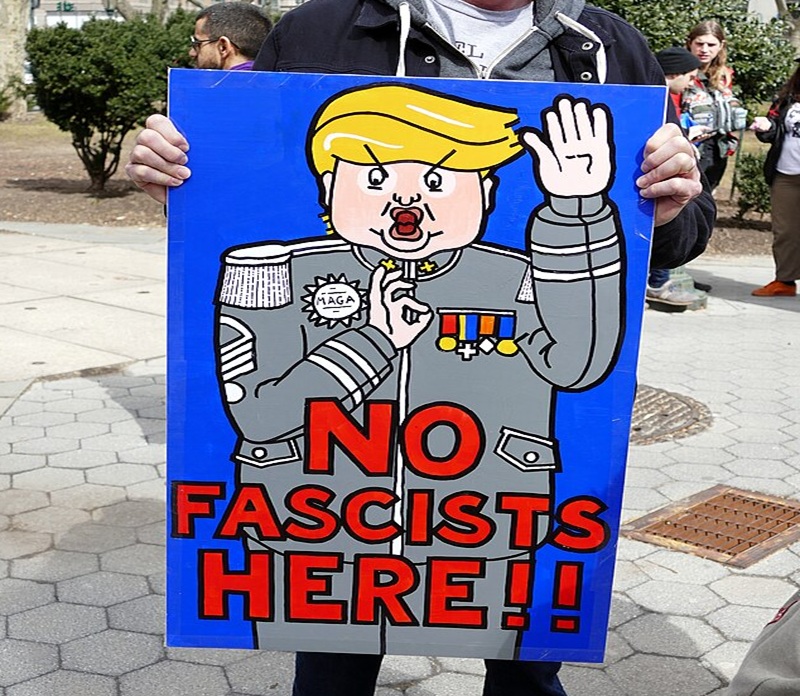
Understanding why Trotsky wrote about fascism is essential if we are to apply his framework today, particularly to the question that now dominates political debate in the United States and internationally, namely does Trumpism represent a form of fascism, or something else? Trotsky’s answer would not have been comforting, but it would have been precise.
The historical function of fascism according to Trotsky
Trotsky insisted that fascism must be defined by its function, not its rhetoric or style. Fascism, in his account, is not simply extreme nationalism, authoritarian leadership, or contempt for liberal norms and institutions. It is a specific response to a crisis, deployed when capitalism can no longer rule through democratic mediation or compromise through institutions of civil society.
For Trotsky, the defining features of fascism are structural. Fascism is a mass movement, not merely a coup from above. It mobilises primarily the petty bourgeoisie and declassed layers thrown into despair by economic and social dislocation. It directs their rage against the organised working class, minorities, and internal enemies, presenting these groups as the source of national decline. And once in power, fascism does not coexist with pluralism. Trade unions, workers’ parties, independent media, and autonomous civil society are not merely constrained but physically and organisationally destroyed.
Trotsky’s insistence on this definition was not pedantic. He believed that mislabelling a situation as fascist when it was not yet so could be as dangerous as failing to recognise fascism when it arrived. If everything is fascism, nothing is urgent. If fascism is treated as inevitable, resistance collapses into despair or symbolic protest. His pamphlet was written to prevent precisely this collapse of strategic judgement.
The social base of Trumpism
Measured against Trotsky’s framework, Trumpism reflects many of the conditions he identified as fertile ground for fascist movements. Its social base aligns closely with his analysis of so-called petty-bourgeois radicalisation. Trump’s most durable support comes from small business owners, self-employed workers, declining middle-class professionals, and communities experiencing long-term economic and cultural displacement. These groups perceive and/or have been manipulated to perceive downward mobility, loss of status, and a growing sense of being squeezed between global capital and an increasingly precarious labour market. In the United States, such anxieties are frequently articulated and mobilised through right-wing political and evangelical networks, which function less as an alternative explanation than as an ideological vehicle translating material and cultural dislocation into reactionary political mobilisation.
Trotsky was clear that the so-called petty bourgeoisie is politically volatile. Under conditions of hope and organisation, it can be drawn toward progressive and socialist politics. Under conditions of fear, fragmentation, and humiliation, it is easily mobilised by reaction. Trumpism channels this volatility through nationalism, racial grievance, conspiracism, and hostility to elites, while carefully avoiding any direct challenge to capital itself, and ability to spot the contradictions of such manipulation.
This dynamic is intensified by the collapse of mediating institutions. Trade unions have been weakened, local civic structures hollowed out, and political parties reduced to branding machines. Politics becomes personalised, moralised, and antagonistic. Trotsky believed this erosion of mediation was a prerequisite for reactionary mass mobilisation, and in this respect Trumpism fits his diagnosis with unsettling clarity.
Delegitimising democracy without yet destroying it
Trotsky emphasised that fascism advances through the systematic delegitimisation of democratic institutions before their formal abolition. Trump’s sustained attacks on electoral integrity, judicial independence, and the press follow this trajectory closely. Courts are portrayed as partisan obstacles, elections as fraudulent unless they deliver the “correct” outcome, and journalists as enemies of the people.
The events of January 6th, 2021 are particularly revealing from a Trotskyan perspective. They were neither a fully formed coup nor a meaningless outburst. Rather, they resembled a failed rehearsal, an attempt to apply extra-legal pressure in the name of a higher national legitimacy. Trotsky repeatedly warned that fascism tests the limits of legality before it consolidates power. Violence is normalised, justified, and selectively tolerated long before it becomes systemic.
Yet the failure of January 6th as an out-right coup d’etat matters as much as its occurrence. State institutions did not fracture decisively. The military did not intervene. Courts held. Electoral procedures resumed. Trotsky would not have described this as fascist consolidation, but as a warning signal of a deeper crisis that had not yet resolved itself.
The decisive divergence: labour, capital, and power
Where Trumpism diverges most sharply from Trotsky’s concept of fascism is at the level of class power. Fascism, for Trotsky, is capitalism’s last resort. It is deployed when the bourgeoisie concludes that parliamentary democracy, reformist parties, and constitutional repression are no longer sufficient to discipline labour and stabilise accumulation.
From this perspective, that threshold has not yet been crossed in the United States. Trade unions, though weakened, continue to operate legally and in some sectors are resurgent. Opposition parties function openly. Civil society organisations litigate, protest, and mobilise without being outlawed, and courts routinely block executive action. The owners of production and finance may still prefer the certainty and predictability associated with democracy and the rule of law. For Trotsky, a regime that tolerates such institutional pluralism, however strained, would not yet qualify as fascist. Furthermore, Trotsky also warned that analytical imprecision carried strategic risks. To declare fascism prematurely was not merely to misname a phenomenon, but to misjudge the terrain of struggle. Such misdiagnosis could encourage inappropriate tactics, alienate the undecided middle layers, and inadvertently reinforce authoritarian narratives of disorder and extremism, which reactionary forces could then exploit to justify repression.
Equally important is the position of capital itself. Contemporary American capitalism continues to function effectively within a hybrid system combining market liberalism with selective authoritarian governance. Major fractions of capital, particularly in technology, finance, and defence, have no interest in the destruction of democratic institutions so long as accumulation remains secure. Fascism, in Trotsky’s account, is not chosen lightly. It is chosen when alternatives have failed.
Trumpism therefore appears less as fascism proper than as a parasitic formation, namely hostile to institutions yet dependent on them, authoritarian in impulse yet constrained by unresolved class relations.
Bonapartism revisited
Trotsky’s concept of Bonapartism may offer a more accurate lens. Bonapartist regimes arise when class forces are deadlocked and the executive claims to stand above society, arbitrating between classes while concentrating power. Formal institutions remain, but their substance is hollowed out. Governance proceeds through emergency measures, decrees, and personal authority rather than stable consensus.
Trump’s leadership style, his reliance on executive action, and his portrayal of himself as the sole authentic representative of the nation align more closely with this model. Bonapartism is inherently unstable. It can slide back toward liberal democracy or forward into fascism, depending on how crises intensify and how opposition forces respond. Trotsky regarded it as a warning stage, not a final destination.
Does Trotsky’s analysis still matter?
Trotsky wrote with the conviction that fascism had a window of vulnerability. Before consolidation, fascist movements are chaotic, divided, and dependent on legality. After consolidation, resistance becomes extraordinarily difficult. He was seemingly haunted by the belief that the German left missed its last chance by misunderstanding the nature of the threat and mistiming its response.
This explains his insistence on analytical discipline. Calling everything fascism was not radical, it was reckless. It encouraged fatalism and sectarianism while obscuring moments when broad alliances and institutional defence could still matter. Trotsky’s motivation was not to downplay danger, but to identify it precisely enough to act.
Digital mobilisation and the limits of Trotsky’s analysis?
Trotsky was obviously of his time in that he assumed fascist mobilisation would be spatially concentrated, organisationally visible, and anchored in mass parties, street violence, and paramilitary formations, and arguably, digital capitalism has altered these mechanisms profoundly.
Today, reactionary mobilisation can occur without disciplined parties or formal membership. Online ecosystems produce leaderless massification, enabling harassment, intimidation, and coordination without clear chains of command. Political violence can be rehearsed rhetorically and symbolically long before it appears physically. Leaders benefit from plausible deniability while movements remain effective.
Repression itself has also changed form. Trotsky focused on overt physical coercion. Digital systems enable distributed coercion such as doxxing, reputational destruction, algorithmic amplification and silencing, economic exclusion, and sustained psychological pressure that veers towards manipulation and coercion. These mechanisms do not replace police terror, but they can weaken civil society and fragment opposition before formal repression becomes necessary.
Platform capitalism further complicates Trotsky’s assumption that the bourgeoisie consciously “chooses” fascism. Platforms monetise outrage regardless of ideology. Polarisation is amplified as a business model rather than a political strategy, producing authoritarian effects without a unified authoritarian project.
What emerges is a form of power that does not depend upon mass ideological conviction or overt coercion. Behaviour can be shaped without belief, conformity produced without terror, and political outcomes nudged without formal command. In this environment, the erosion of democratic capacity can proceed incrementally, through habituation and exhaustion, rather than rupture. Trotsky’s emphasis on visible repression and disciplined mobilisation remains essential, but it does not fully capture how authority now operates through prediction, modification, and control embedded within everyday digital systems.
Furthermore, one element not envisaged within Trotsky’s analysis, without necessarily overturning its substance, is the role of foreign state actors in amplifying domestic polarisation. Trotsky’s analysis assumes that the social crisis feeding fascist movements is principally national in origin, a consequence of internal class contradictions and the strategic choices of domestic elites. By contrast, contemporary US politics is now the target of systematic information operations conducted by rival states. US intelligence assessments of the 2020 election, summarised in the January 6th Committee’s report, concluded that Russian state organs, under Putin’s authorisation, conducted influence campaigns aimed at denigrating Biden, supporting Trump, undermining public confidence in the electoral process, and exacerbating existing social divisions. Subsequent threat assessments and European security analyses describe a similar pattern in 2024, Russian operations again appeared to favour Trump, while Russia, China, and Iran all sought to sow chaos, undermine electoral integrity, and deepen mistrust among US voters. From a Trotskyan perspective, these operations do not create the crisis of the petty bourgeoisie or the erosion of democratic legitimacy, but they act as external accelerants, foreign states strategically weaponising the very fractures that a Trumpist project depends upon. In this sense, the international context of Trumpism is doubly paradoxical, namely a nationalist, ‘America First’ movement whose ascent is actively abetted by the influence operations of a foreign power that sees advantage in a weaker, more divided American democracy.
Fascism as function before form
This creates a new danger Trotsky only partially anticipated. In the digital era, some of fascism’s functions can be achieved without full regime transformation. Labour organisations can be weakened through reputational warfare rather than bans. Journalists can be intimidated without censorship laws. Elections can be delegitimised without cancellation. Minorities can be targeted through networked harassment rather than state terror. Society can be polarized and subverted seemingly from within, creating the cognitive and social psychological conditions where forms of strategic resilience such as education and depolarisation are limited. Trotsky’s framework still holds, but it must be applied with greater sensitivity to indirect and outsourced forms of coercion. Fascism today may arrive functionally before it arrives formally.
“History repeats itself, first as tragedy, second as farce”?
One final comparison helps clarify both the relevance and the limits of Trotsky’s analysis. The Germany Trotsky analysed was a linguistically unified, territorially bounded society with a rapidly centralised media environment. Once fascists gained control of radio, newspapers, and public space, alternative sources of information collapsed quickly. The destruction of opposition was not only organisational but epistemic, dissent became difficult even to imagine.
The United States operates under very different conditions. It is embedded in a dense international information ecosystem that resists total enclosure and narrative monopolisation. Foreign media, transnational civil society, diasporic networks, encrypted communication platforms, and sustained global scrutiny all complicate efforts at comprehensive narrative control. Manipulation, disinformation, and intimidation are real and dangerous, but the cost of sealing the information environment is far higher than it was in interwar Europe.
International diplomatic and economic pressures, such as coordinated European resistance to coercive tariff threats and threats or use of force, can influence the strategic calculations of elite actors aligned with Trumpist projects. This demonstrates that external leverage may constrain certain forms of unilateral power projection, tempering some policy extremes and complicating simplistic narratives of inevitable authoritarian consolidation.
Institutional structure matters as well. Federalism, decentralised election administration, independent state courts, and staggered electoral cycles create friction against rapid consolidation of power. Midterm elections function not merely as rituals of liberal democracy, but as recurring stress tests that can interrupt authoritarian momentum. Trotsky never believed institutions were self-defending, but he understood that fragmentation can delay decisive rupture, sometimes long enough for counter-mobilisation to matter.
These differences do not invalidate Trotsky’s analysis. They qualify its application. Fascism, for Trotsky, was never inevitable. It emerged where crisis, misdiagnosis, and strategic failure converged. Digital capitalism and international information flows change the mechanisms through which authoritarian power is exercised, but they do not eliminate the underlying danger he identified. They may even allow some of fascism’s functions, intimidation, fragmentation, exhaustion, to be achieved without formal dictatorship.
The lesson Trotsky would insist upon remains uncomfortable but clear. The decisive question is not whether history repeats itself in familiar forms, but whether political actors recognise the moment before consolidation occurs. Misdiagnosis still kills movements. Precision still matters. And the existence of constraints is not a guarantee of safety, only a reminder that outcomes remain contingent, shaped, as ever, by political choice within this window of vulnerability, rather than historical fate.
One final complication deepens the distinction between tragedy and farce. As Shoshana Zuboff has argued, the twentieth century’s totalitarian regimes relied upon terror, ideological mobilisation, and the monopolisation of violence, a model of power that Trotsky knew well. By contrast, what Zuboff terms instrumentarian power seeks not the total possession of the individual, but the total certainty of outcomes. It operates through the extraction of behavioural data, the prediction of future action, and the subtle modification of conduct, exerting control from the outside-in rather than the inside-out. Where totalitarianism demanded belief, instrumentarianism demands only compliance through imposed choice architectures. Where fascism mobilised the mass, instrumentarian power manages populations through data-driven segmentation, behavioural targeting, and micro-targeted intervention.
If Trumpism has not yet crossed the classical fascist threshold according to Trotsky’s analysis, the more unsettling question is what forms of power may follow it. The danger may not lie solely in the consolidation of overt dictatorship, but in the fusion of state authority with platform-based systems of behavioural control. Instrumentarian power does not need an emperor, a Führer, a party, or even a coherent ideology. It requires only access to data, control over infrastructures of communication, and alignment between corporate and state interests. In such a configuration, democracy may persist formally while being substantively emptied, its rituals intact but its capacity for collective self-determination quietly eroded.
….and ‘How to Fight It?’
A modern gloss on Trotsky’s insistence that fascism must be fought before consolidation also helps clarify what resistance looks like under contemporary conditions. Trotsky did not imagine resistance as moral denunciation or symbolic protest, but as the deliberate extension of the window of vulnerability through organisation, clarity, and the prevention of fatalism. In the twenty-first-century international information environment, this logic no longer centres on seizing presses or confronting paramilitaries in the street, but on sustaining the credibility of elections, courts, labour organisations, independent media, and civil society networks long enough to deny authoritarian projects the moment of decisive rupture, and to provide the basis for forms of transitional justice when they fail.
Much of this work is already underway, continuing to fight ‘Trump Exhaustion Syndrome’ with trade unions rebuilding capacity, ‘Gen Z’ journalists/content creators/influencers like Adam Mockler and independent news media such as MeidasTouch documenting and calling out the daily abuses of arbitrary executive power in real time, States and civil society organisations litigating and monitoring elections, ‘legacy media’ journalists documenting abuses almost in real time, platforms under pressure to moderate amplification, transnational alternative media ecosystems providing information and analysis, and international actors signalling that constitutional breakdown and transgressions of international norms would carry diplomatic and economic costs, reinvigorating new and existing forms of rules-based multilateralism and bilateralism, rather than spelling their demise. From a Trotskyan perspective, these are not peripheral or merely defensive actions. They are precisely the kinds of counter-forces that matter before fascism consolidates, operating not to overthrow the state, but to prevent the conditions under which its destruction of pluralism, democracy, and the rule of law becomes irreversible, and widespread and systematic state criminality becomes inevitable.
“To learn to see all the crimes against humanity, all the indignities to which the human body and spirit are subjected, as the twisted outgrowths and expressions of the existing social system, in order to direct all our energies into a collective struggle against this system, that is the direction in which the burning desire for revenge can find its highest moral satisfaction.”
Leon Trotsky, Der Kampf, November 1911.
ZNetwork is funded solely through the generosity of its readers.
Donate