
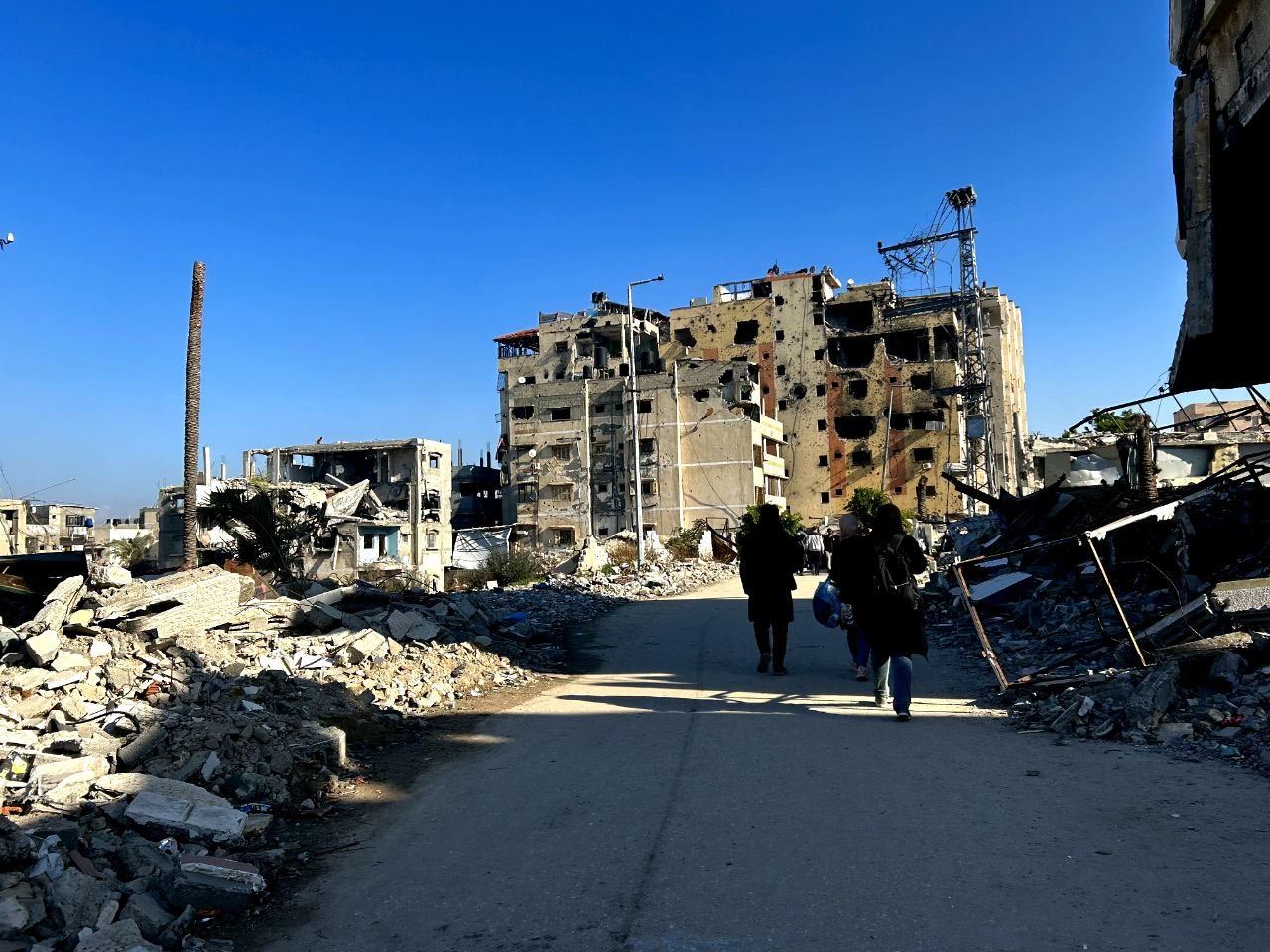
On Feb. 1, 2026, Indonesia condemned Israel’s latest airstrike on Gaza after at least 32 civilians were killed. The Ministry of Foreign Affairs warned that “unilateral violations of the ceasefire agreed in October 2025 not only exacerbate the suffering of Gaza civilians but also undermine trust and directly hinder efforts to achieve stability and a sustainable political settlement.”
The statement projected urgency and moral clarity. The facts support that tone. Since the ceasefire took effect on Oct. 10, 2025, Israel has launched at least 1,450 attacks on Gaza through airstrikes, artillery, and direct shootings. More than 500 civilians have died during what was supposed to be a halt in fighting.
But Indonesia’s condemnation collides with a very different message delivered days earlier.
At the World Economic Forum in Davos, President Prabowo Subianto signed the Board of Peace charter, an initiative launched by President Donald Trump, and declared that the situation in Gaza was improving. He reaffirmed Indonesia’s commitment to the two state solution as the ultimate political horizon.
Both claims cannot stand at the same time. A place that requires constant condemnation is not improving. A ceasefire violated more than a thousand times is not stabilizing.
This is not a minor inconsistency. It signals a foreign policy that struggles to describe reality, let alone shape it.
By joining the Board of Peace, Indonesia aligned itself with a framework built on reconstruction and diplomatic choreography, one that assumes the conflict can be managed while political negotiations inch forward. Yet Indonesia’s own foreign ministry continues to document civilian deaths and repeated violations. Jakarta is describing a crisis while endorsing a process that implies control over it.
Indonesia has long positioned itself as a principled defender of Palestinian rights. Massive demonstrations in Jakarta have demanded sovereignty for Palestinians and an end to occupation. The country’s public sentiment is neither ambiguous nor quiet.
What is ambiguous is the government’s strategy.
For years, Indonesia has treated the two state solution as the default answer to the conflict. The formula is familiar, widely accepted, and politically safe. It allows governments to sound committed to peace without redefining their approach.
But a framework must be judged by outcomes. The latest ceasefire unfolded under diplomacy anchored in the two state vision. Violence continued anyway. Civilians kept dying anyway. When a policy survives repeated failure without serious revision, it stops functioning as strategy and starts functioning as ritual.
Conditions on the ground expose the gap between language and reality. Barriers expand. Displacement persists. Security remains elusive. None of these trends suggest a conflict moving toward durable coexistence.
The Board of Peace sharpens the contradiction. Fewer than 20 countries reportedly joined the initiative, mostly from the Middle East, Asia, and South America, including Indonesia, Qatar, and Saudi Arabia. Western participation was limited, raising questions about the initiative’s reach.
Critics warn that rebuilding a devastated city through a structure designed by powerful external actors, while excluding the city’s own residents, risks sidelining established institutions such as the United Nations. Participation may offer visibility, but not necessarily influence.
The timing was stark. Prabowo signed the charter on the same day Israeli forces reportedly killed four more Palestinians. Diplomacy promised progress while events delivered the opposite.
Indonesia now speaks in two voices that cancel each other out. One voice condemns violations and invokes international law. The other treats the present trajectory as improvable through technical cooperation and long term negotiation.
The unresolved question is simple: What does Indonesia actually intend to do? Condemnation without policy is posture. Endorsing diplomatic frameworks that assume gradual improvement looks increasingly detached from the facts those same officials describe.
Indonesia has built a reputation as a country willing to defend humanitarian principles. That reputation carries weight, especially among developing nations searching for consistent leadership. But credibility erodes when rhetoric outruns strategy.
Foreign policy demands choice. Either Gaza is improving, or it is trapped in a cycle of violence that requires a different approach. Either the two state framework remains viable under present conditions, or it needs fundamental reassessment.
Indonesia cannot continue to declare progress while cataloging catastrophe. Moral language is not enough. Familiar formulas are not enough.
If Jakarta wants its solidarity with Palestinians to matter, it must replace contradiction with clarity and comfort with political courage. Until then, Indonesia risks sounding less like a principled actor and more like a government reciting the language of diplomacy while events move in the opposite direction.
ZNetwork is funded solely through the generosity of its readers.
Donate
1 Comment
Indonesia as a principled defender of Palestinian rights? Back in the days of Sukarno, perhaps. But then the government fell in with a bad crowd – white, capitalist, colonialist – for which profit over people was absolute principle – and that was the end of non-alignment and the PKI (communist party). East Timor fell next (Prabowo Subianto at the head of Kopassus counter-insurgents!) and West Papua. Nowadays all the Western governments together talk a bit Left-ish, gallop Right towards perdition, and people could do with a healthy dose of incredulity.