

Indonesia’s decision to join the Board of Peace (BoP) for Gaza is not a diplomatic adjustment. It is a moral collapse. It is a betrayal so grave that it places Indonesia on the side of domination rather than justice, control rather than liberation, power rather than principle.
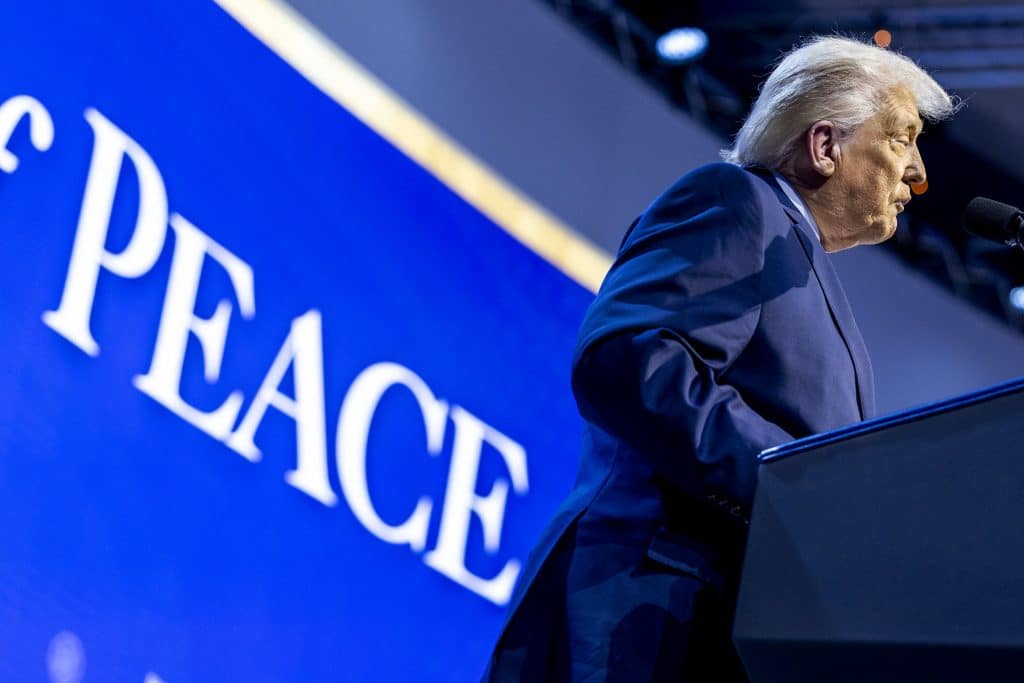
On Jan. 22, 2026, at the World Economic Forum in Davos, President Prabowo Subianto stood beside U.S. President Donald Trump and signed the charter of the BoP. Foreign Minister Sugiono celebrated this as international recognition of Indonesia’s diplomacy and its commitment to peace in Palestine. He claimed the board would manage Gaza’s administration, stabilize security, oversee reconstruction, supervise a transitional Palestinian authority, open the Rafah crossing for humanitarian aid and deploy an International Stabilization Force.
These are not commitments to justice. They are bureaucratic phrases designed to conceal the removal of Palestinian self-determination and the consolidation of foreign control over Gaza.
This initiative was conceived by Donald Trump — the political architect of Israeli impunity. His record is not one of peacemaking but of systematic dismantling of international law, endorsement of illegal Israeli expansion and enabling policies that reduced Gaza to rubble and mass graves. A political structure designed by such a figure does not exist to free Palestinians. It exists to contain them, discipline them and render their oppression manageable.
Indonesia’s leadership insists this move is a “strategic, constructive and concrete” step toward Palestinian independence. But no concrete guarantees of freedom, sovereignty or equality have been offered. There is no binding mechanism to end military domination, no assurance that Palestinians will exercise real political authority, and no safeguard against Gaza being ruled, rebuilt and reshaped by foreign powers hostile to Palestinian rights.
Instead, Gaza is being placed under an externally designed administrative regime that marginalizes Palestinian agency and empowers those who have spent decades denying it.
Even more damning are the unanswered questions. What actual power does Indonesia hold within this board? Are all members equal, or is decision-making monopolized by Washington? What protections exist to prevent Gaza’s reconstruction from becoming a massive profit-making venture for foreign governments, corporations and elites — turning devastation into investment opportunity and Palestinian suffering into capital? How will Indonesia prevent Gaza from being treated as a development project rather than a homeland restored to its people?
There is no clarity on how disputes among members will be resolved, nor on how states can avoid becoming extensions of Trump’s transactional, coercive diplomacy. If Israeli leaders sit at this table, where is Palestinian representation? Who speaks for Gaza? Who decides its future? And when ceasefires are violated — as history shows they inevitably are — what enforcement power does this board have beyond issuing statements while Palestinians die?
Perhaps the most obscene element of all is the reported requirement of a staggering financial contribution to secure permanent membership. If true, this transforms peace into a purchase, justice into a transaction and solidarity into a commodity. It implies that access to Gaza’s future can be bought — even while Palestinians themselves remain excluded from deciding that future.
This betrayal must be understood within the broader transformation of Indonesia’s foreign policy under President Prabowo. His administration has moved away from Indonesia’s traditional ASEAN-centered diplomacy toward a “post-ASEAN” strategy that prioritizes global stature and great-power alignment over moral consistency. He has sidelined regional forums, aggressively courted Washington, pursued deeper engagement with Moscow and Beijing, and sent Foreign Minister Sugiono to seek entry into BRICS — a move that succeeded in 2025, making Indonesia the first ASEAN nation to join the bloc.
At the same time, Prabowo has cultivated closer ties with Donald Trump and maintained discreet engagement with Israel even before assuming office, including security and agricultural cooperation. Indonesia’s embrace of the Board of Peace must therefore be understood not as humanitarian concern but as geopolitical repositioning — even if that repositioning comes at the expense of Palestinian liberation.
Let us speak plainly about what this board does not do. It does not dismantle apartheid. It does not end occupation. It does not restore stolen land. It does not guarantee political equality. It does not place Palestinians at the center of their own destiny. Instead, it institutionalizes external control, normalizes domination and rebrands subjugation as “stability.”
Peace imposed without freedom is not peace. Reconstruction without sovereignty is not justice. Administration without equality is not liberation. Any future that preserves structures of hierarchy, exclusion and domination — even under new bureaucratic arrangements — merely repackages oppression.
Indonesia once stood firmly on the side of the oppressed. It rejected colonialism, apartheid and occupation not as diplomatic conveniences, but as constitutional and moral obligations rooted in its own anti-colonial struggle. That legacy is now being dismantled.
This board does not exist to liberate Gaza. It exists to manage it. It does not exist to dismantle injustice. It exists to regulate it. It does not empower Palestinians. It sidelines them.
Indonesia’s participation does not soften this structure. It legitimizes it.
Peace cannot be built by those who enabled devastation. Reconstruction cannot be just when it is imposed by those who deny Palestinian humanity. Administration cannot be legitimate when it is designed by those who refuse Palestinians political existence.
By joining the Board of Peace, Indonesia has chosen access over accountability, power over principle, optics over justice and diplomacy over dignity. It has crossed from solidarity into submission, from resistance into accommodation, from moral leadership into moral collapse.
The Indonesian people deserve truth, not slogans. They deserve accountability, not abstraction. And the Palestinian people deserve liberation — not management, not supervision, not occupation by another name.
History will not remember who signed documents in Davos. It will remember who stood against injustice — and who chose instead to normalize it.
ZNetwork is funded solely through the generosity of its readers.
Donate
