

As the administration of President Donald Trump dismantles reforms enacted under Joe Biden, workers and management at a Fort Valley, Georgia, school bus plant are thriving because of the same policies.
On Trump’s first day in office, he signed an executive order that would freeze future spending under two Biden-era laws: The Inflation Reduction Act and the Infrastructure Investment and Jobs Act, which authorized funding of more than $2 trillion. Under Biden, those grants often went to companies that supported worker unions, according to the Center for American Progress.
Several workers at Blue Bird Corp., a school bus manufacturer with 1,500 union employees at its plant in Fort Valley, said that support transformed their workplace. They pointed to better job conditions under a union contract and said that the company has thrived under a grant and contracts worth hundreds of millions of dollars thanks to federal support for electric buses.
Observers, including former acting Secretary of Labor Julie Su, said that Trump’s actions could mean an abrupt end to successful government programs that have already improved the lives of workers across the country and added to companies’ bottom lines.
* * *
At first glance, Blue Bird’s story looks like it’s solely about the power of unions to improve a workplace.
Like many workers in the Deep South, workers at Blue Bird had tried to organize a union without success since the 1960s. In 2019, they began to gain traction. The majority-Black workforce was fed up with starting wages as low as $13 an hour, no official pay scale, and the resulting unpredictability — and rarity — of raises. The factory roof leaked, and some parts of the job, like working with hazardous pressure systems, felt unsafe, they said. What’s more, the policy for time off was opaque: The company would “give personal leave to who they want to, not when people might really need it,” said Dee Thomas, a 12-year veteran of Blue Bird who serves as USW Local 697’s executive vice president.
Blue Bird officials declined repeated requests by Capital & Main for comment.
Workers began talking among themselves about a union. One member knew someone who was in the United Steelworkers union, and soon employees were talking to union organizers, meeting in parks, local churches and public libraries.
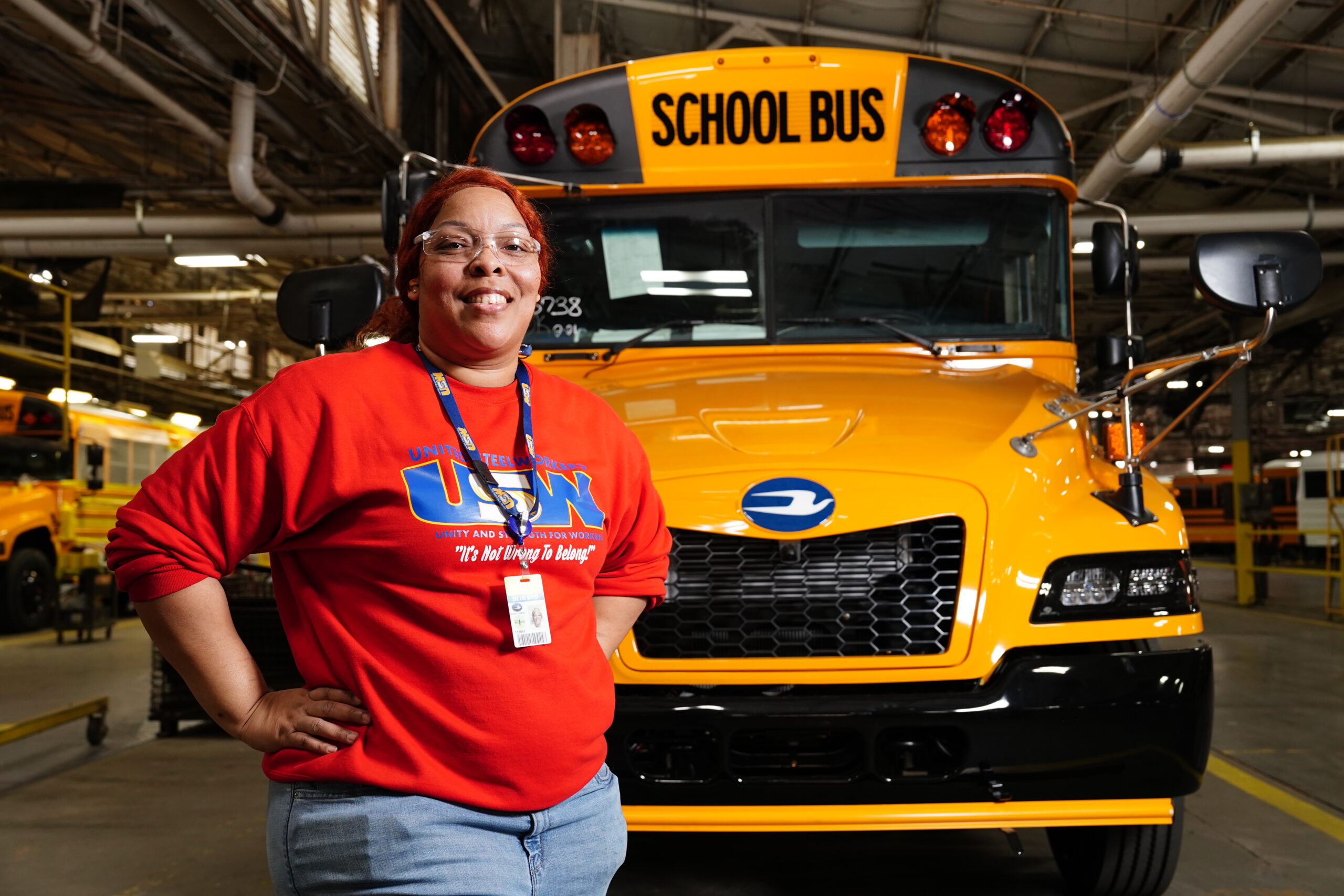
Blue Bird Corp. employee Dee Thomas. Photo courtesy United Steelworkers.
In 2022, workers heard that Blue Bird — one of the country’s only bus manufacturers with electric vehicle expertise — told investors they expected to bring in at least $1 billion in federal incentives encouraging public school districts to switch to electric school buses. They wanted a fair share of the proceeds they were helping the company make.
“We’re making them school buses,” Thomas said. “They’re making a lot of money.”
When the union campaign went public in early 2023, Blue Bird fought it, workers said. The United Steelworkers union filed unfair labor practice complaints with the National Labor Relations Board, alleging that managers threatened to close the plant if workers voted for a union, surveilled employees as they talked with union organizers, and urged workers to vote against the union in mandatory employee meetings. (After the union election, the charges were withdrawn.)
Guidelines under a grant from the Environmental Protection Agency helped the union organizing campaign, said Alex Perkins, a USW organizer and current staff representative for the Blue Bird union. The EPA’s Clean School Bus Program, funded by the Infrastructure Investment and Jobs Act, required union neutrality at companies, banning them from using government funding to support or oppose union organizing activity.
Activists said they reminded Blue Bird executives that the federal money they’d bragged to investors about might not be granted to “union busters.” In response, the company tempered its opposition, Perkins said.
In early May 2023, Blue Bird workers voted 697 to 435 to authorize the United Steelworkers union to represent them.
* * *
The victory was only a first step: The union needed to negotiate a contract with the company before workers’ jobs would actually improve. Some of Blue Bird’s potential customers, as well as federal grants, gave preference to companies that committed to good faith contract negotiations with workers. Su, who was acting secretary of labor at the time, had made quick contract agreements a priority for the Department of Labor.
Most employers, on the other hand, drag out initial contract talks, and most first contracts take more than 500 days — more than 16 months — to be ratified, according to a recent Bloomberg Law study. There is no penalty for employers who drag out negotiations or even fail to sign a contract. Nearly one-third of all unions that win an election do not have a contract within three years, with more than a quarter never getting a contract at all.
Workers weren’t sure how Blue Bird would respond to negotiations, so they resolved to show the company that treating workers well could help its bottom line.
In August 2023, with contract negotiations at Blue Bird in process, Melinda Newhouse, assistant to the United Steelworkers’ international president, called in to a Los Angeles Unified School District public school board meeting about its pending $80 million contract for 180 electric school buses. “When public investment is made, it should be done in a way that takes into account more than just the bottom line,” Newhouse told the meeting, referring to Blue Bird’s new union.
The district, bound by law to accept the lowest “responsible” bid, chose Blue Bird. The company’s then-CEO, Phil Horlock, called it “the largest single order ever of EV school buses.”
The same summer, the Biden administration threw some weight behind union workplaces. When the Department of Energy issued its call for proposals for Domestic Manufacturing Conversion Grants, funded by the Inflation Reduction Act, it said that automotive applicants had to describe how their project would benefit their community with high-quality jobs and support for collective bargaining agreements. If Blue Bird wanted to expand production, a union could help it get grants to do so.
As contract negotiations entered their 10th month, Su visited Blue Bird. A longtime labor activist before joining the government, Su had made it her mission to urge companies to adopt contracts within one year.
“Too often workers who choose a union face significant delays in getting a first contract,” Su told Capital & Main. “And that delay is not accidental.”
In Fort Valley, Su urged Blue Bird executives and workers alike to ratify a contract before the first anniversary of the successful union vote. “To their credit, Blue Bird took it on,” Su said. Management checked in with her regularly about the progress of bargaining, which Su saw as “a strong sign of their good faith” and collaboration, she added.
Workers came to feel that Blue Bird was collaborating with them, too. “We worked together,” the company and the union, said Perkins, who was also on the bargaining committee.
In May 2024, just shy of the one-year deadline, Blue Bird and the union agreed to a three-year contract that went into effect the following July. The agreement raised the lowest-paid workers’ wage to around $22 an hour, standardized the retirement plan, established a profit-sharing agreement and created a health and safety committee with trained staff. It also formalized the collaboration that had evolved between Blue Bird and workers over the course of negotiations and established regular meetings among worker representatives, management and the CEO to discuss concerns in the workplace and ideas for improvement.
“A union relationship is a partnership,” Horlock said at the official signing of the union agreement. “[Secretary Su] explained that to me, and I’m grateful we listened and we did it. We got it done.”
The same month the union contract went into effect, Blue Bird got a Domestic Manufacturing Conversion Grant worth nearly $80 million to expand electric bus production — and with it, union jobs. In the company’s grant application, Blue Bird highlighted its “efforts to work jointly” with the United Steelworkers and touted its commitment to “good faith negotiations” with the union. USW also sent a letter of support with the application outlining how the company and union would work together.
Today, workers say the union has made their jobs better with raises, improved safety and lower turnover. Public records suggested that the unionization effort has continued to pay off for Blue Bird, too. During the first quarter of 2025, Blue Bird reported “near record quarterly profits,” Horlock said in the company’s February earnings call. Horlock attributed the company’s performance to its investments to upgrade facilities, develop new products and “continu[ing] to enhance the plant working environment for employees.” Horlock stepped down as CEO in February but remains on the board of directors.
Blue Bird’s experience under Biden-era policies provides a prime example of how companies can actually benefit from unions — once they stop fighting them, said Arthur Wheaton, director of labor studies at Cornell University’s School of Industrial and Labor Relations.
“There are a lot of common interests between the union and the company,” he said. The union can benefit the company by giving management workers’ insights, gained from firsthand experience on how to solve problems, he added. And, as with the Steelworkers, many unions have connections with elected officials who can shape policy to create additional jobs and more stable employment. “It only helps the Steelworkers to have Blue Bird get more funding,” Wheaton said.
All of that reflects the Biden administration’s strategic and intentional support of unions, said Ian Elder, national director at Jobs to Move America, an advocacy organization that works to lift labor standards. The previous administration was “enacting a form of industrial policy [with] an intention to cultivate industries that create good, sustainable careers” while “addressing climate change, protecting the environment, and protecting communities from environmental harm,” Elder added.
* * *
Today, Blue Bird and its workers enjoy a kind of success that’s likely to become rare as the Trump administration ends the kinds of policies that made Blue Bird’s collaboration possible.
The contract at Blue Bird was “a seed of the kind of change that is possible,” Su said. “That is even more important than ever now, when we have an administration that speaks about being pro-worker, but does things that are horribly anti-worker.”
Indeed, Trump’s sweeping funding freeze hit the Clean School Bus Program — and its provisions rewarding good faith contract negotiations — leaving its remaining $2 million in funding unspent. The EPA has made no announcement of new funding, though existing awards are still being paid out.
Meanwhile, the Trump administration has issued orders to begin eliminating new emissions standards that favor electric vehicles, consumer subsidies for buying them and federal funding to support their development. In a similar vein, the Domestic Manufacturing Conversion Grants that paid off for Blue Bird have been spent, with no additional funding — or a program to replace it — in sight.
Su’s replacement as secretary of labor, Lori Chavez-DeRemer, was initially lauded as a pro-worker Republican, but she has yet to promote policies in support of unions. Although Chavez-DeRemer has posed for multiple photo ops with workers, she has also recanted her support for the PRO Act, the pro-union bill backed by the Biden administration, and declared her support for right-to-work legislation that is widely understood to be anti-union. She also endorsed a Trump agenda that includes effectively canceling project labor agreements with unions for federal construction work; eliminating diversity, equity and inclusion initiatives; and removing union input from registered apprenticeship programs.
The Environmental Protection Agency, Department of Energy and Department of Labor did not return requests for comment.
Meanwhile, the Blue Bird union’s officers remain optimistic that their collaboration with the company will survive Trump’s changes. There are nearly two years left on their current contract — enough time, they think, to prove to Blue Bird that companies and workers do better when they work together.
“The culture is changing at Blue Bird,” Thomas said, pointing to their ongoing advice to management and other contract wins. “Management will be changing as well. … They are going to get it right.”
ZNetwork is funded solely through the generosity of its readers.
Donate