
On June 18, 2023, Hardeep Singh Nijjar, a Sikh community leader in British Columbia, Canada, was murdered outside his Gurudwara (Sikh house of worship) in what was clearly a well-planned assassination. After months with no updates from law enforcement about the status of the investigation, Prime Minister Justin Trudeau made a startling announcement in parliament. The Canadian government had credible information that the government of India was behind the assassination. Nijjar was a Canadian citizen.
Here’s the short version of the possible motive behind the killing: Nijjar was an advocate for Sikh separatism, and the Indian government accuses Sikh separatists (including Nijjar) of terrorism.
Regardless of whether the Indian government’s terrorism accusations are true or not, killing a Canadian citizen on Canadian soil is a serious violation of Canadian sovereignty. Indian whataboutery is a poor defense. Yes, Western countries have carried out illegal attacks on other countries’ soil (such as U.S. drone attacks), but that doesn’t provide India the excuse to do the same, because two wrongs never make a right
If the government of India did have evidence against Nijjar that would stand up in court, why did it not pursue an extradition request in Canadian courts? If the assassination were indeed a covert operation by Indian intelligence, that’s almost a tacit admission that they did not have such convincing evidence.
Subsequent developments and revelations have made Trudeau’s accusations look even more credible. Far from categorically denying the link and cooperating with the Canadian investigation, the Indian government has engaged in a diplomatic row with Canada. And, it has come to light that the FBI has been aware of threats to the lives of several Sikh activists in the United States since June, immediately after the Nijjar assassination. Although the FBI did not disclose the source of the threats, the timing and the intended targets point to the same potential culprit as the Nijjar assassination.
But what else was happening in June 2023?
Biden Embraces a Tyrant
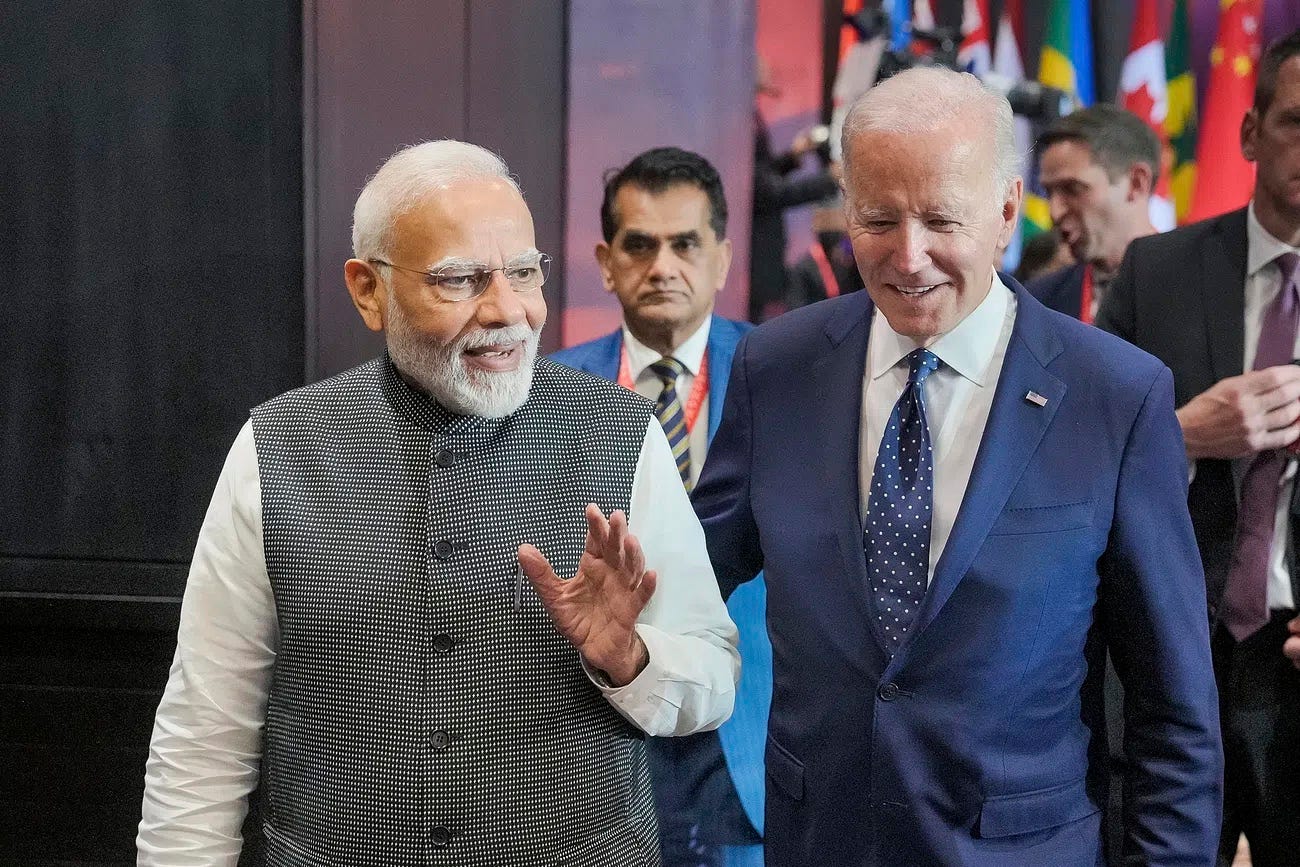
On June 22, barely days after the murder of Nijjar, President Joe Biden welcomed Indian Prime Minister Narendra Modi to the White House for a state visit, ignoring the growing alarm about the human rights situation under Modi’s rule, shared by Amnesty International, Human Rights Watch, Genocide Watch, and the U.S. government’s own Commission on International Religious Freedom.
This was a cowardly and unprincipled betrayal of hundreds of millions of Indians—Muslims, Christians, Sikhs, Dalits (lowest in the caste hierarchy), Adviasis (Indigenous peoples), LGBTQ+ (particularly transgendered) people, and others—who have been targets of vicious legal and extra-legal attacks on their rights by the Modi regime and its increasingly emboldened supporters.
I have elaborated earlier about why, in addition to being morally reprehensible, Biden’s welcome of Modi was contrary to the long-term interests of a United States that preserves democracy at home and is respected internationally. The Nijjar assassination, and threats against Sikh community members in the United States, underscore this point. As Biden welcomed Modi to the White House, his guest’s government was likely planning to murder U.S. citizens on U.S. soil.
But before we delve further into this point, it’s worth looking at a new outrage in India.
The Newsclick Raids
In early October, Indian law enforcement raided the office of Newsclick, a publication critical of the Modi government, and the homes of several of its staff as well as contributors and associates. They arrested several people, seized computers and phones, and sealed the office premises.
This story has received some traction in the United States because it has been connected to a New York Times story, and to the narrative of the emerging superpower rivalry between the United States and China. However, it’s important to put these raids in perspective as merely the latest example of a long string of attacks by the Modi government against critical media coverage.
Previous examples include government targeting of journalists who covered the historic Indian farmers’ protests of 2020-2021, and attacks on the BBC for airing a documentary critical of Modi. India ranks 161 out of 180 countries in Reporters Without Borders’ Press Freedom Index.
But the Indian government’s assault on press freedom, and particularly the recent Newsclick raids, isn’t just a domestic issue in India. It has an important bearing on the United States, including domestic politics.
The United States is also teetering on the edge of fascism, which numerous experts on fascism have been warning about. Likewise, the government and ruling political party in India have fascist roots.
There are few things authoritarians hate more than a robust free press. True to form, former President Donald Trump used dangerous rhetoric to demonize the media. The condition of press freedom in India is a warning to the United States of what will happen if this continuing slide into fascism isn’t stopped.
The Newsclick raid brings up its own particular set of concerns that are relevant in the United States. The Indian government claims that the media outlet receives illegal Chinese funds and is effectively an agent of China. The United States is in the midst of a dangerous “new Cold War” with China, as my IPS colleagues Phyllis Bennis and Lindsay Koshgarian describe it, If authoritarian tendencies and anti-China hysteria grow unchecked in this country, there could well be a rerun of the NewsClick story here.
Blowback
It’s reprehensible that the U.S. government is willing to endanger the future of democracy in the world’s most populous country, and the basic human rights of more than a billion people, for the sake of friendly relations with the Modi government. But how much domestic blowback in the United States will be tolerated as the price for this toxic friendship?
As noted earlier, the U.S. government has said nothing publicly about death threats against Sikh citizens of the United States that likely originate from the Indian state. Likewise, they are silent about the growing fascist stranglehold on India, even when the Indian fascist movement is closely aligned with homegrown fascists. U.S. fascist leader Steve Bannon has tried to help reelect Modi in India and mobilize Hindu nationalists within the Indian-American community to support far-right politics in the U.S.
This raises the possibility that BJP-ruled India will become a key source of foreign support for a fascist takeover of the U.S.
Geopolitics and Profits over People
One obvious motive for Biden to pursue friendly relations with the repressive Modi government is the U.S. desire to ensure India’s continued participation in a U.S.-led anti-China alliance, a key element of the “new Cold War” with China. But it’s not the only motive.
India is the world’s most populous country, with the fifth highest Gross Domestic Product. The United States is India’s largest trading partner and the third largest source country for foreign direct investment (FDI) in India. The State Department notes that U.S. companies “have invested billions of dollars in the India’s tech, defense, aerospace, and pharmaceutical sectors,” and that the leading U.S. tech companies—Google, Amazon, Microsoft, Apple, and Meta (parent corporation of Facebook and Instagram)—have their largest presence outside the United States in India.
Clearly, the U.S. government’s position on India is strongly influenced by the business interests of powerful U.S. corporations who want to conduct operations in India, source goods and services from India, or sell their products in India.
Understanding these motivations is important to challenge U.S. policy towards India. This isn’t an isolated instance of the U.S. foreign policy establishment picking the wrong people to support in a distant land. They appear willing to sacrifice not only the rights of billions of Indians but also the lives of US citizens who are involved in resisting the fascist Indian government. The establishment seems to be putting U.S. democracy at risk for the sake of geopolitical advantage over China and the profits of large corporations, particularly “Big Tech.”
ZNetwork is funded solely through the generosity of its readers.
Donate