
Israel and its allies moved heaven and Earth to prevent a legal debate over its military occupation of the West Bank, Gaza, and East Jerusalem from happening. This past week in The Hague, the debate finally took place.
On Monday, February 19, in response to a late December request from the UN General Assembly for an authoritative opinion, the UN’s supreme judicial body convened oral hearings on the “legal consequences” arising from Israeli “policies and practices” over the course of its 56-year belligerent occupation of the Palestinian territories, including East Jerusalem.
In other words, on the legality of Israel’s occupation and what UN member states must do to hold Israel accountable under international law.
The International Court of Justice (ICJ) hearings wrapped up late this afternoon, Netherlands-time.
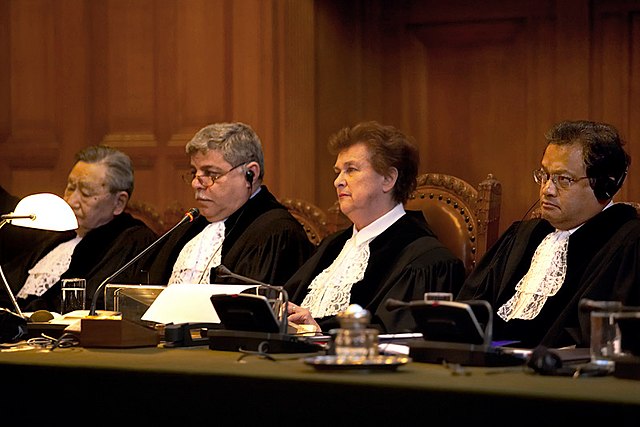
Enjoined by the court’s Lebanese President Nawaf Salam to limit their comments to thirty minutes, diplomats and attorneys from fifty nations and three organizations stood before the ICJ’s 15 judges, laying out facts and arguments.
Many got emotional.
“Exceptional moral principles for humanity” are at stake, Bangladeshi ambassador Riaz Hamidullah declared. “Palestinians are not an expendable people.”
The Palestinian people had a right to independence in 1948, like all other League of Nations Mandate territories, Belizean Ambassador Assad Shoman told the court in a sharp, incisively voiced statement.
“No state reserves to itself the right to systematically violate the rights of a people to self-determination … except Israel,” Shoman said. “No state seeks to justify the indefinite occupation of another’s territory … except Israel. No state commits annexation and apartheid with impunity, except it seems — Israel … Israel must be made to behave like all civilized nations, Stop violating international law and UN resolutions! Respect the right of the Palestinian people to self-determination. Palestine must be free!”
South Africa seconded that sentiment.
“We as South Africans sense, see, hear and feel to our core the inhumane, discriminatory policies and practices of the Israeli regime as an even more extreme form of the apartheid that was institutionalized against black people in my country,” Vusimuzi Madonsela, South African ambassador to the Netherlands, told the court.
“[No] country is above the law,” declared Indonesia’s Foreign Minister, Retno Marsudi. “Indonesia believes that this legal motion is also a motion of global conscience. It should not be another … call to go unheeded, ignored blatantly by Israel. Never again means never again.”
Describing Israel’s wrongful acts, Palestinian UN Ambassador Riyad Mansour and Kuwaiti Ali Ahmad Ebraheem Al-Dafri began crying. Al-Dafri struggled to regain composure, apologizing to the court.
Many turned to history: the 1917 Balfour Declaration; the ‘sacred trust obligations’ embodied in Article 22 of the 1919 Covenant of the League of Nations; decolonization; the start of the British Mandate in 1922; the 1947 partition agreement; the Nakba; the 1967 Six-Day War.
Pondering Israel’s assault on Gaza, Algerian law professor Ahmed Laraba channeled Roman statesman Cato the Elder — “obsessed by Carthage, whose leitmotif was the term ‘Carthago delenda est’, as we can say today that ‘Gaza destructum est’.”
With a few exceptions, Israel’s allies seem to have accepted the inevitability of an ICJ Advisory Opinion and are now in damage control.
U.S. State Department attorney Richard Visek urged the court to issue the narrowest opinion possible, focusing on the peace process, in deference to American efforts at the UN Security Council.
France, Norway, and Luxembourg called for stricter justice. So did Irish Foreign Minister Rossa Fanning, in a cogent, precisely phrased presentation that riveted the court’s justices — eyeglasses in hand, heads cocked, chins on palms.
“Neither the duration of the occupation nor the scale and extent of [Israel’s] settlement activity is, in Ireland’s view, justified or permitted by the law regulating the use of force in self-defense,” Fanning told the court, suggesting that Israel’s occupation is arguably illegal, and certainly counterproductive.
“[If] the security of one people can only be achieved by the occupation over so many decades of the territory of another people, one has to wonder whether there can be any military solution to the problem that it purports to address,” Fanning said.
Faithful to the Netherlands’ reputation as the cradle of modern international law, Dutch legal advisor René Lefeber spent his allotted half-hour expounding on the international legal canon, without uttering Israel or Palestine’s names once.
High Crimes
Israel’s breaches of international law are extensive and egregious, the UN top court was told, in six days of oral pleadings and 57 written statements filed by UN member states and three organizations — the League of Arab States, the Organization of Islamic Cooperation, and the African Union.
Topping the list of Israel’s allegedly “wrongful acts”: the acquisition of Palestinian territory by force; denial of the right of the Palestinian people to self-determination; imposition of alien subjugation and rule, racial discrimination and apartheid, and — the crime of crimes — genocide.
Hierarchically superior in the legal canon, the norms prohibiting these acts have been codified as ‘customary’ (universal and binding) by the UN-affiliated International Law Commission.
Many are ‘peremptory’ (jus cogens) norms, with no derogation. In lay parlance, obligatory.
Crucially, peremptory norms ‘give rise to obligations owed to the international community as a whole,’ erga omnes. All states have an interest in ensuring respect for them. States are obliged not to recognize situations arising from breaches of these norms, to withhold aid or assistance, and to cooperate to bring grave breaches to an end.
The most grievous of breaches attributed to Israel — genocide and apartheid — are classed as ‘crimes against humanity’ under the Rome Statute of the International Criminal Court.
British barrister Philippa Webb, a member of Belize’s legal team, focused on Israeli apartheid.
“[In] the West Bank, there is the separation wall, restrictive permit requirements, checkpoints, and segregated roads,” Webb told the court. “Gaza is under siege … Millions of Palestinians are confined to ever smaller strips of land, the longest and most complete siege of the greatest number in modern history. The whole of Gaza has become an impoverished, desperate ghetto.”
Laws of Occupation Breached
Lower on the hierarchy of wrongful Israeli acts presented to the ICJ in Advisory Opinion hearings that concluded today — numerous breaches of the laws of war and occupation, codified in the 1949 Fourth Geneva Convention. Several of these are considered “grave breaches” under Geneva IV’s Additional Protocol and war crimes under the Rome Statute.
These include collective punishment; confiscation and destruction of land; the appropriation of natural resources; movement restrictions; pillage; unlawful killing; targeting of hospitals, educational institutions, and journalists; forcible transfer, and imprisonment of Palestinians inside the Green Line.
The gravest of Israeli breaches of the laws of occupation, its settlement enterprise — clearly aimed at making an independent Palestinian state impossible, numerous states told the court this week.
“The defining feature of Israel’s occupation of Palestinian territory in the West Bank, including East Jerusalem, has been continuous settlement activity,” Irish Attorney General Rossa Fanning told the court.
“By transferring parts of its own civilian population into the OPT, Israel has violated Article 49(6) of the Fourth Geneva Convention,” Fanning said.
Israel’s settlement enterprise, accompanied by the application of domestic Israeli laws and administration in the occupied Palestinian territory, constitute a “disguised form of annexation,” Fanning told the judges.
Annexation amounts to the acquisition of territory by force — among the gravest of wrongful acts, Fanning said, thus rendering the occupation illegal.
Israel’s occupation of the West Bank and Gaza, “in the war it launched” against Egypt and Jordan (therefore an act of aggression), was illegal from the start, Ralph Wilde, legal counsellor for the League of Arab States told the court. Even if the war was a lawful act of self-defense, Wilde said, its justification “ended after six days.”
A half-century later, Israel’s occupation constitutes a continuing unlawful use of force, said Wilde.
Predictably, U.S. State Department attorney Richard Visek disagreed. Israel was defending itself in June 1967, Visek suggested. Furthermore, the laws of belligerent occupation say nothing about its duration. The legal status of occupation is based solely on how or why a country invades territory (jus ad bellum), rather than how it conducts that occupation (jus in belo), or how long occupation lasts, Visek said.
“On that approach,” another member of Belize’s legal team, Ben Juratowitch, riposted, “an occupying power that has lawfully established an occupation would be unrestrained by law as to how long that occupation lasts … That would of course mean that an occupation could lawfully become indefinite. And that must be incorrect.”
Legal Consequences
Having outlined wrongful Israeli policies, practices, and acts rendering its occupation illegal, lawyers told the court about the legal consequences Israel must face.
“Israel must dismantle the physical, legal and policy regime of discrimination and oppression … evacuate Israeli settlers from Palestinian territories, permit Palestinians to return to their country and property, and lift the siege and blockade of Gaza,” Belizean team member Philippa Webb told the court.
“These consequences, taken collectively, mean that Israel must immediately, unconditionally, and totally withdraw from the entire Palestinian territory,” Webb said.
Belize’s remedy was seconded by almost all of the presentations delivered to the court this past week.
Israel’s Allies Push Court to Not Render an Opinion
Having concluded oral sessions, the International Court of Justice can either accede to the General Assembly’s request for an Advisory Opinion or — exercising its discretionary power — it can decline to do so, something it has never done.
The U.S., Canada, UK, and a handful of other states — among these, Zambia, represented this morning by its lavishly wigged Solicitor General, and Fiji, clearly a friend of Israel, who referred to the General Assembly’s Advisory Opinion request as a “distinctly one-sided” “legal maneuver” to side-step the ‘Peace Process’, assigning legal consequences on just one of the parties to the ‘conflict’ — are hoping for a first.
The court has “compelling reasons” not to issue an Advisory Opinion, they argue. Israel has not consented to ICJ jurisdiction over what amounts to a ‘bilateral dispute,’ best resolved through negotiation between the two parties; international law would get in the way; ‘seized’ by the situation since 1967, the Security Council’s authority in these matters is superior to the General Assembly’s; an Advisory Opinion would complicate the Council’s pursuit of its ‘Land for Peace’ ‘framework,’ based on the Oslo Accords.
If the court does issue an opinion about Israel’s occupation, the U.S., Britain, Zambia, and Fiji argued, it should refrain from delving into the exceptionally complex root causes of the situation, going back a century, based on over 15,000 pages of documents provided to it by the General Assembly that the court hasn’t the capacity to assess.
Others dismissed these arguments as “fallacious” (Kuwait), “perverse” (Lebanon), “fiction” (Saudi Arabia), “myth” (Organization of Islamic Cooperation),” and an “affront to the rule of law” (League of Arab States).
“These [reasons] have been constantly discarded by the Court,” Algerian jurist Ahmed Laraba added, quoting directly from several of the court’s past Advisory Opinions.
An ICJ Advisory Opinion on Israel’s prolonged occupation would actually facilitate a negotiated agreement, some argued.
“A clear legal characterization of the nature of Israel’s regime over the Palestinian people can only assist in remedying the ongoing delay in achieving a just settlement,” South Africa’s ambassador to the Netherlands, Vusimuzi Madonsela, told the court.
Netherlands legal adviser René Lefeber told the court that the General Assembly’s Advisory Opinion request “should be regarded in a much broader frame of reference than a bilateral dispute.”
Self-determination, Lefeber reminded the judges, is a “permanent, continuing, universal and inalienable right with a peremptory character.” If that right is denied, he added — remarkably — people living under colonial domination, apartheid or foreign occupation have the right to liberate themselves “by all available means, including armed struggle … in accordance with international law.”
Consequences of a Powerful Advisory Opinion
Having failed to stave off ICJ hearings, Israel is now up against the wall. Unlike the court’s January 26 preliminary measures order in response to South Africa’s genocide application, Advisory Opinions are not binding.
Still, they carry enormous authority and are hard to ignore. Israel certainly will.
But, the fallout from a broadly-framed ICJ Advisory Opinion, sometime this summer, promises to be huge.
It will “help set the stage, politically, for what is regarded as legitimate in the international community, at the halls of the United Nations, in capitals of states around the world, when they’re dealing with the question of Palestine,” Canadian international law scholar and State of Palestine legal advisor Ardi Imseis told Mondoweiss, on the first day of hearings.
“Most particularly, because the occupation is unlawful and an internationally wrongful act, third states would not be allowed to continue to engage the State of Israel, the occupying power, in relation to the occupied Palestinian territory, in the same way that they have done over the past 56 years,” Imseis said.
“That means the end of all trade in arms; that means the end of all trade in settlement products.”
“[A] serious breach of a peremptory norm entitles states other than the injured state to take countermeasures against the responsible state as a legal consequence of that breach,” legal counsel for the Dutch Foreign Ministry, René Lefeber, confirmed to the ICJ last week. The Netherlands did this in late January, cutting off the provision of F-35 spare parts to Israel.
The U.S. government will also be under the gun. Recent U.S. sanctions against violent settlers, and Antony Blinken’s confirmation that Israeli settlements are “inconsistent” with international law, suggest increasing willingness to hold Israel accountable for its breaches of peremptory norms, as required under international law.
Strategic lawsuits promise to proliferate.
In response to the ICJ’s January 26 provisional measures order against Israel, U.S. District Court Judge Jeffrey White cited “undisputed evidence” that “the ongoing military siege on Gaza is intended to eradicate a whole people and therefore plausibly falls within the international prohibition against genocide.”
Judge White “implored” U.S. officials “to examine the results of their unflagging support” for Israel.
A decisive Advisory Opinion is certain to put wind in the BDS movement’s sails.
This past November, shortly after the start of Israel’s assault on Gaza, the Norwegian Pension Fund completed the withdrawal of its half-billion dollar investment in Israel Bonds.
Last week, four Norwegian universities reportedly terminated ties with Israeli counterparts.
And, as the ICJ drafts its Advisory Opinion on the legality of Israel’s occupation, it will also be building the factual basis for its genocide ruling two or three years down the road.
“I’m hopeful,” Giulia Pinzauti told Mondoweiss, in a café down the street from the Peace Palace.
“Everybody’s talking about genocide, as if that’s the only issue,” says Pinzauti. “Clearly, there’s a much bigger problem concerning the legality of the occupation and Israel’s discriminatory practices in the occupied territories. So that’s why I think this Advisory Opinion is extremely important … a good setup for hopefully the merits of the case concerning the Genocide Convention because it puts things in a much broader context.”
In the meantime, says Pinzauti — who teaches a course about the ICJ at Leiden University — the ICJ’s upcoming Advisory Opinion on the legal consequences of Israel’s prolonged occupation promises to transform the political landscape.
“It’s difficult for judicial decisions to change things on the ground, and that’s where impacts are really needed,” Pinzauti told Mondoweiss. “I’m hoping that judicial decisions or pronouncements or advisory opinions will help shape state policies in a way that can make effect on the ground where it’s really, really needed … I think it can provide the foundations for a just and lasting peace.”
ZNetwork is funded solely through the generosity of its readers.
Donate